http://www.marxist.com/greece-on-the-brink-of-revolutionary-situation.htm
 Greece on the brink of revolutionary
situation<http://www.marxist.com/greece-on-the-brink-of-revolutionary-situation.htm>
Written by Stamatis Karagiannopoulos Monday, 06 June 2011
[image:
Print]<http://www.marxist.com/greece-on-the-brink-of-revolutionary-situation/print.htm#>
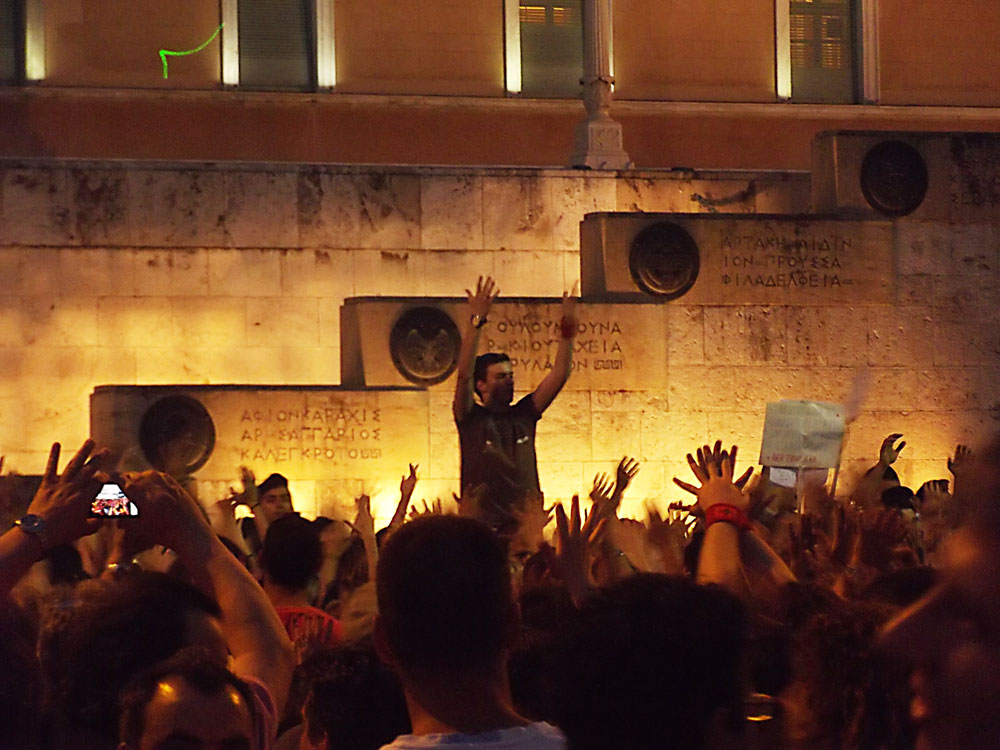
*Yesterday a milestone was passed in the social and political situation in Greece and throughout Europe. Impressive mobilizations rolled across the country: half a million in Athens and rallies of thousands of people gathered in Thessaloniki, Patras, Larissa, Volos, Heraklion, etc. This places Greece on the threshold of a revolutionary situation. It means that, for the first time in decades the developed capitalist countries of Europe are faced with the prospect of a revolution with continental dimensions.* Half a million protesters in Athens - Uprising across the country [image: June 2, Syntagma Square. Photo: Rania H.] <http://www.marxist.com/images/stories/greece/Jun_2_Syntagma_Square-Rania_H.jpg>Yesterday's gathering in Athens, apart from its impressive size, had many new elements. The awkwardness and blind rage that characterized the first days of the movement have given way to enthusiasm. The masses have acquired a sense of confidence through the collective show of strength. While the early days were focused on the idea of a silent angry people, yesterday the mood had changed. The people shouted ingenious slogans against the government and the Troika, and everywhere groups of people were spontaneously formed in which everyone wanted to express an opinion on the movement and on the next steps to be taken. At the same time, in the most advanced part of the protesters, especially in the youth, an interest to seek a political solution for the "next day" was evident. This explains the enormous interest in participating in the People's Assembly of Syntagma Square, which was attended by 10,000 people, patiently waiting to participate, although very few were able to speak. >From 9.30 pm onwards, the density of the protest made it impossible even to approach the site of the assembly. The predominant element in the meeting was the spontaneous opinions voiced by ordinary workers, unemployed and young people expressing the need to continue the struggle. Many proposals were made: "to besiege the parliament on the day the austerity measures are put to the vote"; "to fight to set up popular meetings in every neighborhood"; "to put into practice the decision of the People's Assembly for an indefinite general political strike"; "to fight the media propaganda with an organized campaign in the neighborhoods and squares. On one point all were agreed: "next Sunday there will be a million people in the streets of Athens! The situation becomes revolutionary The masses are erupting onto the scene very dramatically and are consistently to the forefront. The climate in the neighborhoods this week highlights the potential for mass assemblies. The enthusiasm from the protests is being carried into every workplace, thereby putting tremendous pressure on the leadership of the unions to take action. Already the GSEE leadership has been forced to call a 24 hour strike of all those companies that are soon to be privatized on Thursday 9th June. For the first time these workers will be engaged in coordinated action, while another 24 hour general strike was announced for 15th June. It is certain that this general strike will be different to those we saw last year. Coming as part of the general escalation of the mass movement that has developed in the squares, it will have a much greater participation than before in the private sector. And it will be combined with the most widespread popular protests in decades. This strike will not mobilize only a part of the working class, but will tend to embrace the vast majority of the working class and trade unions. It will put the proletariat at the head of a struggle that is not a struggle for economic demands alone, but a political struggle of the masses in the streets. This strike therefore will have an inner tendency to become a lasting general strike, regardless of the intentions of the bureaucracy. What is revolutionary situation? In the writings of Lenin and Trotsky, we can find the definition of what is a revolutionary situation. In his book "The failure of the Second International" (1916) Lenin explained: What, generally speaking, are the symptoms of a revolutionary situation? We shall certainly not be mistaken if we indicate the following three major symptoms: (1) when it is impossible for the ruling classes to maintain their rule without any change; when there is a crisis, in one form or another, among the upper classes, a crisis in the policy of the ruling class, leading to a fissure through which the discontent and indignation of the oppressed classes burst forth. For a revolution to take place, it is usually insufficient for the lower classes not to want to live in the old way; it is also necessary that the upper classes should be unable to live in the old way; (2) when the suffering and want of the oppressed classes have grown more acute than usual; (3) when, as a consequence of the above causes, there is a considerable increase in the activity of the masses, who uncomplainingly allow themselves to be robbed in peace time, but, in turbulent times, are drawn both by all the circumstances of the crisis and by the upper classes themselves into independent historical action. .....The totality of all these objective changes is called a revolutionary situation. Such a situation existed in 1905 in Russia, and in all revolutionary periods in the West;... Trotsky in 1940, in the Emergency Manifesto explained the necessary conditions for the victory of the proletariat: The basic conditions for the victory of the proletarian revolution have been established by historical experience and clarified theoretically: (1) the bourgeois impasse and the resulting confusion of the ruling class; (2) the sharp dissatisfaction and the striving towards decisive changes in the ranks of the petty bourgeoisie, without whose support the big bourgeoisie cannot maintain itself; (3) the consciousness of the intolerable situation and readiness for revolutionary actions in the ranks of the proletariat; (4) a clear program and a firm leadership of the proletarian vanguardthese are the four conditions for the victory of the proletarian revolution. (Manifesto of the Fourth International on Imperialist War and the Imperialist War). All these elements have developed in Greece today. The ruling class begins to understand that they cannot govern as before; to lie and deceive the masses, i.e. with the old, gentle, "democratic" means. The suffering and indignation of the masses have been growing over a long period. The masses have already begun to move independently of the ruling class. The ruling class finds itself in a state of unprecedented confusion because of the impasse. They are absolutely unable to reach to a unified strategy. Some say: we must completely capitulate to the foreign lenders and see where we can go from there". Others suggest that Greece should "renegotiate with the troika, while still others say we must "get out of the euro now in order to strengthen the country's competitiveness." Some say: "lets form a national government", while others urge Papandreou to continue carrying out the dirty work until he gets the boot. Some, are even secretly studying the possibility of a coup, in an attempt to put the brake on the movement of the masses. This scenario was outlined in a leaked report by the CIA in the bourgeois press last week. The desertion of 16 PASOK MPs from the government over the issue of new cuts and taxes, shows that the pressure of the movement has destabilized the governments parliamentary group for good. New Democracy and LAOS, fearing that they will go down together with Papandreous sinking ship, are now keeping their distance from the government, trying to speculate on the result of a future election. The traditional mainstay of the bourgeoisie, the middle classes have been radicalized and are now in the streets. The proletariat again and again shows its readiness to act. All the basic elements for a revolutionary situation have matured. The only thing that is lacking is a clear programme and firm leadership of the proletarian vanguard. That is all that is needed quickly to convert the revolutionary situation into a victorious revolution which will expropriate the exploiters and eliminate capitalism, setting in motion a movement that can lead to the victory of socialism in Greece, the Mediterranean and throughout Europe. The leadership of the Left is acting criminally Ever since the beginning of mass movement on the streets, the Left leaders have adopted an unacceptable attitude. The leadership of the Communist Party sends ultimatums to the people located in squares, urging them to "finally make the right policy proposals!" (See main article in Rizospastis on 3 / 6). The task of a Communist Party leadership is not to ask the movement to make the right policy proposals, but to participate actively in the movement, to try to raise the of consciousness and help the masses to formulate the correct demands. Last Friday, the Stalinist leadership of the Communist Party made complete fools of themselves in front of the eyes of thousands gathered in the Syntagma Square. That afternoon a demonstration of PAME, the trade union faction of the Communist Party, ended up in the Square. There they delivered a 15-minute speech, during which the Communist Party called on the people assembled on the squares *ex cathedra* "not to trust anybody else except PAME". When the speech was over, in order to avoid mixing up the protesters in the square with the Communist workers, the organizers of the PAME demo immediately ordered members of the Communist Youth to form "chains" and immediately, the "Communist" left the square. In this way, the Stalinist leadership of the Communist Party has proved eloquently their organic inability to connect with the real mass movement. They have shown that they regard it simply as a means of strengthening the Partys position in the parliamentary elections. On the other hand, the leadership of SYRIZA refuses to enter the movement openly and boldly. It is a very serious mistake just to ask for elections, without making any proposal on how to further develop the movement, when people are on the streets, getting self-organized, ready to get rid of the government and the "troika" altogether. It is also an incorrect attitude of the CC of Synaspismos (decision 29 / 5) to ask Party members to participate in the movement, while pretending to be non-partisan";* " ... In this movement we participate as citizens, trying to listen and learn, we take part in uniting our voice with thousands of angry in each square of the country ....* ". The rank and file of the Left parties should respond to this damaging attitude. The position of comrade Alexis Tsipras (President of Synaspismos) and comrade Aleka Papariga (Secretary of the Communist Party) must not be confined to party offices and television panels. The place of the leaders of the Left in these moments is in Syntigma and the other squares. If the Left fails to participate openly and boldly in the movement, with appropriate ideas and suggestions that will help lead to victory and the final overthrow of the capitalist system of slavery, the core of the movement will be occupied by all sorts of petty-bourgeois and professional "patriots" who are trying to obscure the social content of the movement, replacing the class struggle with nationalist confusion. The working class must lead the struggle! The outbreak of this mass movement in the squares, found the labour movement in a state of fatigue and frustration, mainly because of the devastating role of the union bureaucracy, which up to now imagined they could defuse the militant mood of hundreds of thousands of workers with an occasional 24-hour general strike. So naturally, the initiative in the fight against the government and the Troika, passed from the unions to broader sections of people, who had not been involved in mobilizations in the last few years. Unemployed university graduates, skilled and unskilled unemployed, young people without work experience, middle class people devastated by taxes and robbing banks and the collapse of the market, workers without any union or political affiliation, students who are just beginning to be politicized, pensioners and housewives: people from all layers of the working society form the main basis of this mass movement in the squares. These layers have a fresh and combative mood. They dont have bureaucratic leaders above them to put the brake on the mobilization and so far, they have created a movement that has proved to be persistent and long lasting. On the other hand, as is perfectly natural, these layers together with explosive anger and militancy, display inexperience of mass protests and are desperately seeking appropriate political slogans, appropriate fighting methods and specific political demands. In these circumstances, therefore, the need for a distinct contribution of the working class and the labour movement in the struggle is decisive. The decisions of the People's Assembly of Syntagma Square calling for a general strike clearly recognize this need. Without paralyzing the economic centers of the system, there cannot be any fundamental change in society. But very little has been done until now to realize the general political strike demand. Most of the leading layer in the Popular Assembly in Syntagma Square are under the false impression that the general strike is a merely a militant auxiliary to the demonstrations in the squares. In reality, it represents a decisive escalation of struggle and reflects a new, higher stage of this struggle. We must understand that the general strike cannot be organized by shouting slogans outside the union offices and workplaces, but must flow from the demands of the workers themselves through the trade unions and workplaces. In working-class neighborhoods and workplaces, we must create action committees and elect strike committees to prepare for the strike. That is the only way to guarantee its success. Finally, it is vital to make clear that a general political strike will lead to the downfall of the government. It must not bring to power a government of bourgeois political careerists, but rather one of elected representatives of the people coming out of the movement itself. Therefore, the democratic organization of the movement is a crucial issue, not only for the growth but also for the solution of the question of power in order to serve the interests and aspirations of the indignant working people. The views put forward by different groups of intellectuals within the movement on "direct procedures and democracy through sms and e-mails, which are portrayed as "direct democracy, have nothing to do either with the immediate issues or democracy. What we need now What we need now is: - Popular Assemblies in every neighborhood, with assemblies in the workplaces to elect recallable action committees everywhere. - Popular Assemblies in the central squares of all major cities that are composed of elected and recallable representatives at neighborhood workplaces meetings and. - The create of a Pan-Hellenic Central Committee elected by the recallable representatives of the Popular Assemblies of the different cities. Finally, at the heart of the struggle should be the following two demands: - A complete write-off of the debt created by Greek and foreign exploiters and thieves! - To abolish forever the nightmare of debt, poverty and unemployment we need to place the control of the financial centers and the concentrated wealth of the country (banks, insurance companies, infrastructure, transport and big firms in every industry) under social ownership, through the democratic control of the working people, as a step forward the victory of the revolution throughout Europe and the world! *Athens, 6 June, 2011.* [Non-text portions of this message have been removed] ------------------------------------ --------------------------------------------------------------------------- LAAMN: Los Angeles Alternative Media Network --------------------------------------------------------------------------- Unsubscribe: <mailto:[email protected]> --------------------------------------------------------------------------- Subscribe: <mailto:[email protected]> --------------------------------------------------------------------------- Digest: <mailto:[email protected]> --------------------------------------------------------------------------- Help: <mailto:[email protected]?subject=laamn> --------------------------------------------------------------------------- Post: <mailto:[email protected]> --------------------------------------------------------------------------- Archive1: <http://www.egroups.com/messages/laamn> --------------------------------------------------------------------------- Archive2: <http://www.mail-archive.com/[email protected]> --------------------------------------------------------------------------- Yahoo! Groups Links <*> To visit your group on the web, go to: http://groups.yahoo.com/group/laamn/ <*> Your email settings: Individual Email | Traditional <*> To change settings online go to: http://groups.yahoo.com/group/laamn/join (Yahoo! ID required) <*> To change settings via email: [email protected] [email protected] <*> To unsubscribe from this group, send an email to: [email protected] <*> Your use of Yahoo! Groups is subject to: http://docs.yahoo.com/info/terms/