http://www.marxist.com/greece-papandreou-waiting-to-be-overthrown.htm
 Greece: Earth shattering strike and demonstration as Papandreou hangs on to
power waiting to be
overthrown<http://www.marxist.com/greece-papandreou-waiting-to-be-overthrown.htm>
Written by Editorial Board of Marxistiki Foni Thursday, 16 June 2011
[image:
Print]<http://www.marxist.com/greece-papandreou-waiting-to-be-overthrown/print.htm#>
*Yesterday hundreds of thousands of workers and youth participated in a
24-hour general strike called by the GSEE and ADEDY (private and public
sector trade union confederations), marching on demonstrations to the main
squares of seventy cities and towns across Greece. From the early morning
hours participation in a mass gathering to encircle the Houses of Parliament
was enormous.*

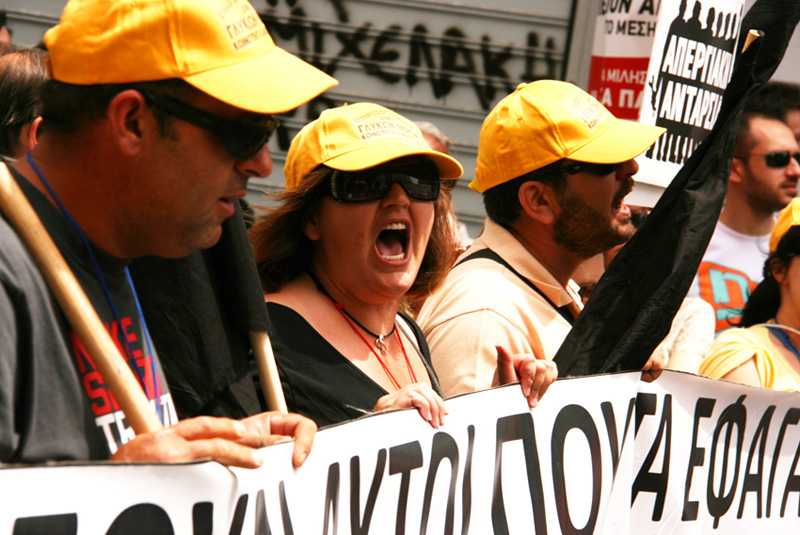
[image: General strike, May last year. Photo: Laoutaris]
<http://www.marxist.com/images/stories/greece/strike_050510_Laoutaris_3.jpg>According
to figures released by the GSEE, in many key sectors participation in the
strike was 100%. For example, we have the following figures: Refineries
100%, Ship yards 100%, Transport and shipping 100%, Ports 100%, Steel
Industry 80%, and Construction 90%. In the banking sector, DEI (public
electricity company), OTE (public telephone company), ELTA (Greek Post) and
the water companies participation reached 90%.

This level of participation confirms the fighting spirit that exists within
the Greek labour movement and its ability to lead in the right direction the
struggle of the masses that has been growing over the last three weeks
against the government and its new austerity measures that are aimed at
imposing the conditions demanded by the "troika".

Estimates are that there were 250,000 protesters in Athens, 35,000 in
Thessaloniki and 10,000 in Patras. As we wrote yesterday, no doubt, if the
demonstrations in Athens had been allowed to proceed peacefully, the numbers
that had already started to enter Syntagnma Square in the morning indicated
that by the afternoon the number of protesters would have exceeded the one
million mark.

However, as we explained, the forces of state repression used agents
provocateurs, with police officers in plain clothes as well as the usual
troublemakers mingling with the protesters, who were able to temporarily
halt the "wave" of the masses who were ready to paralyse the Houses of
Parliament and the Maximou building (the official office of the Prime
Minister). Thus, for a while the march of a mass of militant workers and
youth was interrupted by scenes of violent clashes with the police. The
latter tried to use tear gas, with methods reminiscent of the Israeli army
in occupied Palestine, to empty Syntagma Square of protesters. There are
many videos and photographs taken by eyewitnesses which were uploaded on the
internet, that show how in the early morning police in the National Garden
behind the parliament building were piling up sticks and iron bars to arm
the troublemakers. The same videos show masked "anarchists" moving forward
and concentrating under police protection.

However, even while the TV channels rushed to talk of the "funeral" of the
movement, in the afternoon slowly but surely, thousands of people began to
gather again in Syntagma Square. The masses consisted of workers and young
people, who during the violent events hid in nearby areas waiting for the
situation to calm down, of workers from the private sector who had not come
out on strike for fear of dismissal, but who hastened to the demonstration
in Syntagma Square after their shifts had ended and finally, of many others
who were not involved in the morning rallies, but who had been outraged by
the TV news reporting which had tried to smear the mass movement.

Immediately, the government and the bourgeois parties, gripped by panic and
fear, tried to hastily come up with a political solution in a desperate
attempt to cut across the movement of the masses which by the hour was
assuming revolutionary connotations.

Papandreou turned to the leader of New Democracy, Mr Antonis Samaras,
proposing that they form a new government of national unity with a
"technocrat" as prime minister. The leader of New Democracy, fearing he
would be identified with a government that has become totally isolated from
society, put forward the condition that such a government should renegotiate
the Memorandum and the new austerity measures called for by the Troika.
Samaras did this deliberately, as he knew that Papandreou could not accept
such a condition, and neither could the real boss, i.e. the "troika".

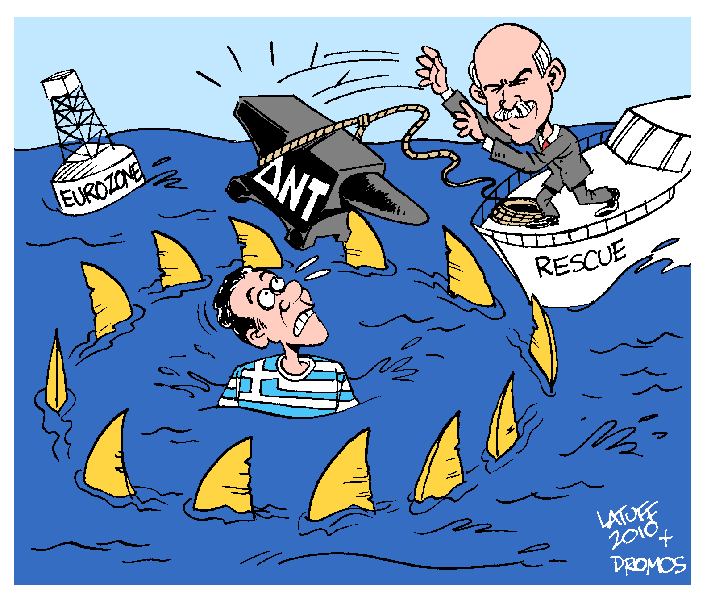
[image: Illustration: Latuff]
<http://www.marxist.com/images/stories/greece/Latuff_-_GreecePapandreouEurozoneImf.gif>In
essence, by putting this demand on Papandreou, Samaras was refusing to
participate in such a government which would have to legislate a new series
of draconian attacks against the workers. What Samaras fears is that by
entering such a government he would be jeopardising New Democracy's
electoral fortunes, and thus its ability to be a useful reserve force for
the Greek capitalists, just when the polls show that New Democracy for the
first time in two and a half years are now the first party with 31%, 4%
ahead of the PASOK. The same polls, however, reveal that that 40% of voters
say they would not vote for any party, so disgusted are they at all the main
parties.

All this explains why yesterday's attempt to patch together a coalition
government fell on deaf ears. This situation, in the final analysis, is due
the huge pressure of the mass movement from below that wants to see the fall
of this government. The masses, led by the working class, are now setting
the trend and pushing this hated "government of the Memorandum" to stampede
out of power.

Last night's announcement by Papandreou and yesterday's events are an
eloquent expression of the political stalemate the ruling class is faced
with. In the end all that Papandreou could do was announce a cabinet
reshuffle. By doing so, he pleased no one. He angered the workers and youth
who are in the squares, who want to see an end to this government. He also
angered the ruling class, who are concerned that his attempt to cling on to
power with small manoeuvres will only serve to push even more people out
onto the streets.

As a last resort, what the bourgeoisie is now promoting is early elections.
>From these they are hoping to get a new government with the New Democracy as
the sovereign power. They have reached this conclusion because the can see
that they are unable to form a government that has the authority to curb the
upward trend of the mass movement.

The opposing pressures of the mass movement on the one side and the
bourgeoisie on the other have already opened up a big rift within the PASOK
parliamentary group. One after another, PASOK Members of Parliament, have
openly expressed their disagreement with the government, either from the
"right" (complaining of timidity and mismanagement on the part of
government) or from the "left" (attacking the individual measures of the new
draconian austerity programme). Already another PASOK MP has declared
himself an "independent", leaving the PASOK parliamentary group with 155 of
the original 160 that were elected in the 2009elections, while two others
have resigned their positions as MPs so as not to have to vote for the
measures.

What is even worse for Papandreou is that he is finding it very difficult to
convince any of his MPs to accept ministerial posts, while a group of 25
PASOK MPs have requested an extraordinary parliamentary group meeting for
this afternoon to discuss what is going to eventually happen.

Workers and youth are now "clenching their teeth" and emboldened by a
feeling that the uprising will very soon lead this hated government of the
"troika" to fall, are preparing to give it the coup de grace, and are
continuing their demonstrations.

In the article we produced last night (in Greek) we stressed the following:

"Papandreou hasn't resigned yet but he has 'thrown down the gauntlet'! Let
us pick this up then! Since he doesn't want to resign, let's 'resign' him.
The great movement that we have created in these days and which is now
setting the political tone must pass to a new, higher and more effective
phase.

"The most effective way of achieving this is to intensify efforts in
working-class neighbourhoods, the workplaces and unions so we can implement
directly the decision of the People's Assembly of Syntagma Square which
correctly raises the need for an all-out political general strike.

"And since the ruling class is now facing a serious power problem, let us
strengthen the organs of our own power, which have emerged through our own
struggle, from the popular assemblies in towns, neighbourhoods and
workplaces. Let us proceed directly to the formation of a Central
Panhellenic Committee of Struggle elected by the popular assemblies which
will be able to replace the power of the "troika" and the banks and to serve
our needs, refusing to pay the extortionate debt and placing the
concentrated wealth of the country in the hands of society as a whole and
under the control of the workers.

"In these conditions the leaders of the KKE and SYRIZA must stop simply
calling for elections. They must contribute directly to the development and
to the spread of the mass movement with a political general strike and
prepare for the possibility of a sharp change in the polling stations,
joining their forces together based on a radical programme of socialist
transformation of society. Only in this way can early elections, which are
now being promoted by the ruling class as a last resort in order to halt and
divert the movement of the masses, produce a result that would strengthen
the mass movement with all its demands."

Whether the eventual outcome will be, either a new coalition government or
early elections, there are two key elements in the situation in Greece.

On the one hand, the mass movement feels emboldened and confident and will
continue to express its determination to influence key political
developments. The possible fall of Papandreou will whet the appetite of the
masses who are pushing to win back all that they have lost with this
government and they will stay mobilised to enforce a fundamental solution to
their problems.

On the other hand, political instability and the development of a
revolutionary situation in Greek society, brings ever closer the possibility
of a default, and any remaining "optimism" that the "international markets"
may still nurture that Greece will be able to repay its debts will very
quickly vanish. The only thing Greece can export now to its partners in the
EU is recession, economic instability and the "fashion" of popular
uprisings.

Source: *ÌáñîéóôéêÞ
ÖùíÞ<http://www.marxist.com/weblinks/europe/marxistiki-foni.htm>
* (Greece)


[Non-text portions of this message have been removed]


------------------------------------

---------------------------------------------------------------------------
LAAMN: Los Angeles Alternative Media Network
---------------------------------------------------------------------------
Unsubscribe: <mailto:[email protected]>
---------------------------------------------------------------------------
Subscribe: <mailto:[email protected]>
---------------------------------------------------------------------------
Digest: <mailto:[email protected]>
---------------------------------------------------------------------------
Help: <mailto:[email protected]?subject=laamn>
---------------------------------------------------------------------------
Post: <mailto:[email protected]>
---------------------------------------------------------------------------
Archive1: <http://www.egroups.com/messages/laamn>
---------------------------------------------------------------------------
Archive2: <http://www.mail-archive.com/[email protected]>
---------------------------------------------------------------------------
Yahoo! Groups Links

<*> To visit your group on the web, go to:
    http://groups.yahoo.com/group/laamn/

<*> Your email settings:
    Individual Email | Traditional

<*> To change settings online go to:
    http://groups.yahoo.com/group/laamn/join
    (Yahoo! ID required)

<*> To change settings via email:
    [email protected]
    [email protected]

<*> To unsubscribe from this group, send an email to:
    [email protected]

<*> Your use of Yahoo! Groups is subject to:
    http://docs.yahoo.com/info/terms/