http://www.marxist.com/greek-government-survives.htm
 Greek government survives but working class prepares for 48-hour general
strike <http://www.marxist.com/greek-government-survives.htm>
Written by Marxistiki Foni Editorial Board in Athens Thursday, 23 June 2011
[image: Print] <http://www.marxist.com/greek-government-survives/print.htm#>

*The powerful 24-hour general strike and the mass demonstrations of June 15
in Greece demonstrated how deep the anger of the Greek working masses runs.
It served to send the ruling class a warning: that this is no ordinary
protest movement, but one with revolutionary connotations. That is why they
hurriedly patched together a new government, in the hope of cutting across
the movement. But to no avail!*

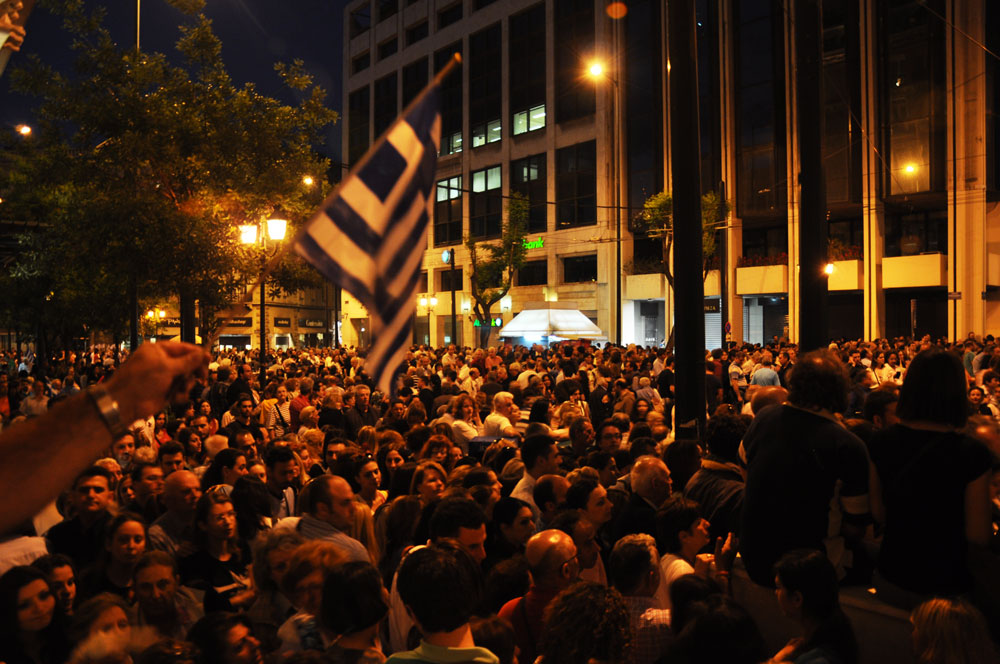
[image: May 31. Photo: Giorgos Tserkis]
<http://www.marxist.com/images/stories/greece/May_31_Athens-Giorgos_Tserkis.jpg>The
government and the opposition New Democracy party, in a state of confusion
and under the pressure - or rather orders - of the "troika", tried in the
afternoon of the day of the general strike to form a coalition government
which would have a stronger parliamentary majority to carry out the "dirty
work" that until now the PASOK leadership was doing on its own.

However, the immense movement of the masses, with the working class and
labour movement now in the lead, threw these efforts out of the window.
Especially the amazing return of thousands of people to Syntagma Square in
the afternoon of June 15, in spite of the ruling class's attempts to derail
the protest by using hooded agents-provocateurs, was a clear indication of
the working people's determination to resist the austerity measures and it
was this that made the New Democracy leaders more hesitant about
participating in government.

The leadership of New Democracy - although to all intents and purposes it
stands for an even more draconian policy than that of the present government
- feared that participation in a coalition government at a time when the
vast majority of the people were involved in or supported the movement could
lead to them discrediting themselves prematurely and thus no longer being a
useful political backup for sinking Greek capitalism. That explains why Mr
Samaras deliberately presented some conditions that could not be accepted at
this stage by either the government or the "troika". Thus he avoided having
to face the broad mass of the people who hate the Papandreou government.
The government reshuffle and its aims

Immediately after the breakdown of negotiations for the formation of a
coalition government with New Democracy, the government's efforts focused on
attempting to avoid having to call early elections which would have meant
delaying the vote in  parliament on the "Mid-Term" Plan. It did this by
using the old trick of a cabinet reshuffle.

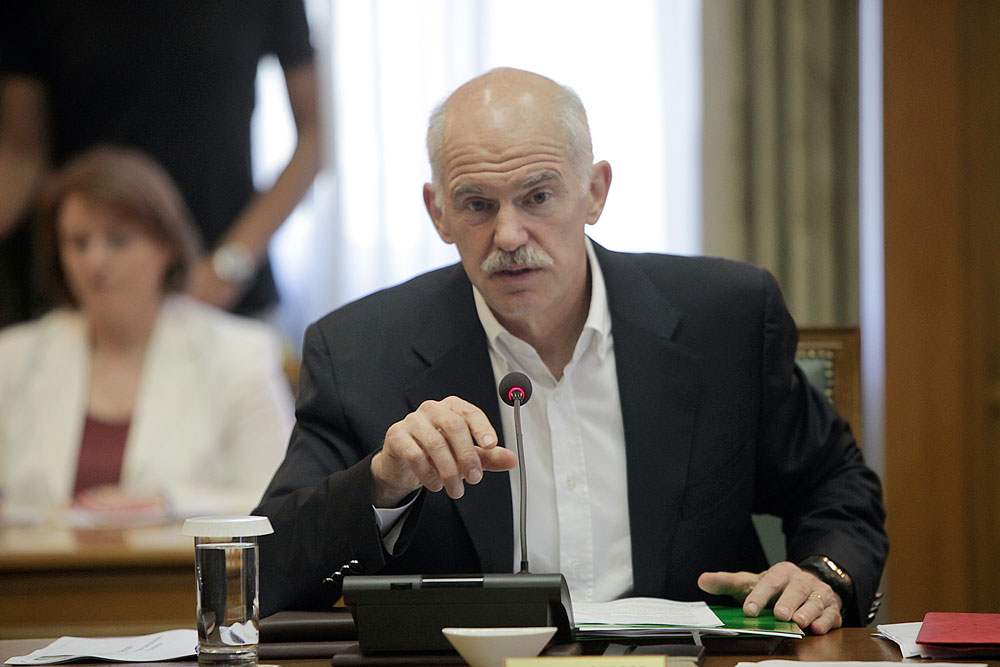
[image: Ppandreou durin cabinet meeting, 22 June. Photo: Prime Minister of
Greece]
<http://www.marxist.com/images/stories/greece/Jun_22_cabinet_meeting_Papandreou-Prime_Minister_of_Greece.jpg>The
government and the ruling class feared that postponing the vote on the
"Mid-Term" Plan in conditions of political and social instability would
strengthen those within the "troika" who are already saying that the option
of "helping" Greece with another loan, or even to provide the remaining
instalments of this current one is pointless.

There was another element that convinced them that a cabinet reshuffle was
the better option. They desperately needed to avoid a historical precedent
of a government being overturned by a mass movement, something that would
weaken any future government of capital in Greece.

The reshuffle aims to raise the profile of their preferred successor to the
hated George Papandreou, the favourite of the major media groups, Mr Vagelis
Venizelos. The objective is to keep PASOK united and under the control of
the ruling class. In spite of all this, the ruling class understands that
the reshuffle has not solved their problems. They have no illusions that the
people will easily abandon the squares. They look with terror at recent
polls that show that over two million people have been participating in the
movement (out of a population of about 11 million), and despite the official
lies of their own media, they can see that a PASOK-ND coalition would not
win the consent of the people. Only 8% indicated support for such an option
according to a poll by Kapa Research two months ago published in the
newspaper *To Vima*).

The Greek bourgeoisie and its international backers in the "troika" now have
no other option but to support with all their might this "reformed"
government, which yesterday won the vote of confidence in parliament. At the
same time they are counting on the fact that the leaderships of the Left
[KKE and SYRIZA] will continue with their present mistaken policies, such
that the elections that will inevitably be held in the near future do not
produce any unpleasant surprises for the elite.
We get the "mid-term" plan while they make super profits

On pages 69-72 of the 2011 Government Budget the following information is
provided:

   1. Spending on salaries and pensions does not exceed 19.8 billion Euros.
   2. Regular state revenues are estimated at 56 billion Euros.
   3. The sum dedicated to loan re-payments amounts to 62 billion Euros.

It is obvious from these figures that the loans provided by the "troika" are
not provided to pay salaries and pensions. Nor are the cuts and
privatisations for the same purpose. It is all for the sake of repaying loan
sharks - lenders, both domestic and foreign.

The "Mid-Term" Plan is the latest fruit of this policy. It includes
austerity measures, increased taxation and privatisations worth EURO 28.26
billion, or 12% of Greek GDP for the years 2011 to 2015.

Specifically, this includes:

   - Wage cuts of EURO 2.2 billion.
   - Pension and other social security cuts of EURO 5 billion.
   - Increased contributions from workers and pensioners on Social Security
   of EURO 3 billion.
   - Increases in taxes, cuts in social benefits and tax relief and
   increases in road tax, amounting to EURO 6 billion.
   - Massive privatisation - selling off of state assets amounting to EURO 50
   billion.

On the other hand, while the workers suffer so the usurers can be paid, the
Greek ruling class prospers, as the following points clearly indicate:

   - Greek ship owners continue to enjoy 44 different tax breaks from the
   Greek State. In the first five months of 2011 alone they emerged as
   champions in buying and selling boats worldwide, investing more than $1.9
   billion to buy 67 ships of all kinds, according to data from the brokerage
   house Allied Shipbroking.
   - From 2004 to 2009 the assets of the banks increased from 275 billion
   Euros to 579 billion Euros, reaching a level twice the GDP of the country!
   - Taxation of profits of the big corporations in recent years has fallen
   from 45% to 20%.
   - Total tax evasion of the middle classes is estimated by the government
   to be 50 billion Euros annually.
   - According to estimates of the Tax Office SDOE (*Ta Nea*, 05.11.2009),
   the number of "offshore" companies that belong to Greek capitalists is in
   excess of 10,000 and these have an annual turnover of about 500 billion!

48-hour general strike must be prelude to all-out general strike

The most important element in recent days has been the decisive entry of the
labour movement onto the scene. The labour movement is now counter-attacking
and is objectively at the head of the mass protests.

On June 6 we witnessed a united general strike in all public enterprises and
throughout the public sector, which paralysed the country. The following
day, the GENOP-DEI (the trade union in the public electricity company)
decided to launch repeated 48-hour strikes, which are already under way.

Last week, the POE-OTA (municipal workers' union) became the first mass
workers' union to support the call for an all out extended political general
strike. On June 15 we saw an escalation of the counterattack of the labour
movement, with the massive 24-hour general strike.

Now, as the workers face the determination of this new government (after the
cabinet reshuffle) to pass the "Mid-Term" Plan they are "clenching their
teeth" and preparing for another offensive. The fact that the leadership of
the GSEE has called a 48-hour general strike on the days of the
parliamentary debate and vote on the "Mid-Term" Plan, shows what enormous
pressure the trade union bureaucracy is under from the rank and file. It
shows the degree of willingness on the part of the workers to struggle and
make sacrifices in what they see as a decisive struggle.

Support for an all out political general strike has grown among the masses
and this slogan today is the only one that meets the needs of the moment and
it must be called. The 48-hour general strike called by the GSEE should be
in preparation for an all out extended political general strike. But how
should workers and youth organise such an unusual mass strike?

   - Mass meetings in the workplaces must elect strike committees that will
   organise the action locally and that will be coordinated with the action
   committees elected by the popular assemblies, forming at national level a
   Centralised National Action Committee.
   - The strike committees should conduct an organized campaign for mass
   participation in the strike in the workplaces where private sector unions do
   not exist. If any company dares to sack workers who participate in the
   strike these workplaces should be occupied.
   - In a joint effort, labour and popular assemblies have to discuss and
   organize the setting up of strike funds to support the strikers and organise
   soup kitchens for those working class families that would have difficulty in
   surviving.
   - Picket lines must be organised at each workplace. With the cooperation
   of the pickets and the People's Assembly of Syntagma Square, defence squads
   of the most decisive and strongest sections of the movement must be
   immediately set up, adequately equipped to protect the mass demonstrations
   and rallies against the violent actions of disguised police agents
   provocateurs.
   - The all out political general strike raises the question of power and
   the movement must therefore have a clear and unambiguous answer to this
   question. The Centralised National Action Committee, elected through the
   labour and popular assemblies, should be ready to replace the power of the
   "troika" and the banks and place the concentrated wealth of the country
   under the control of the masses.

The leadership of the Left is lagging behind what is really required

The leaders of the KKE (Communist Party) and SYRIZA instead of acting to
strengthen and lead the movement in the direction of demanding a
fundamental, revolutionary change in society, have simply been calling for
elections as soon as possible.

The political demands they are raising, in the eyes of the masses, seem to
align them with the bourgeois parties of New Democracy, LAOS and Democratic
Alliance, seeking elections as a last resort to halt the mass movement. With
this approach, the left leaders send out the message that they prefer the
prospect of winning a few more seats in the bourgeois parliament over the
interest of the mass movement which is beginning to challenge the clearly
undemocratic nature of the existing bourgeois regime.

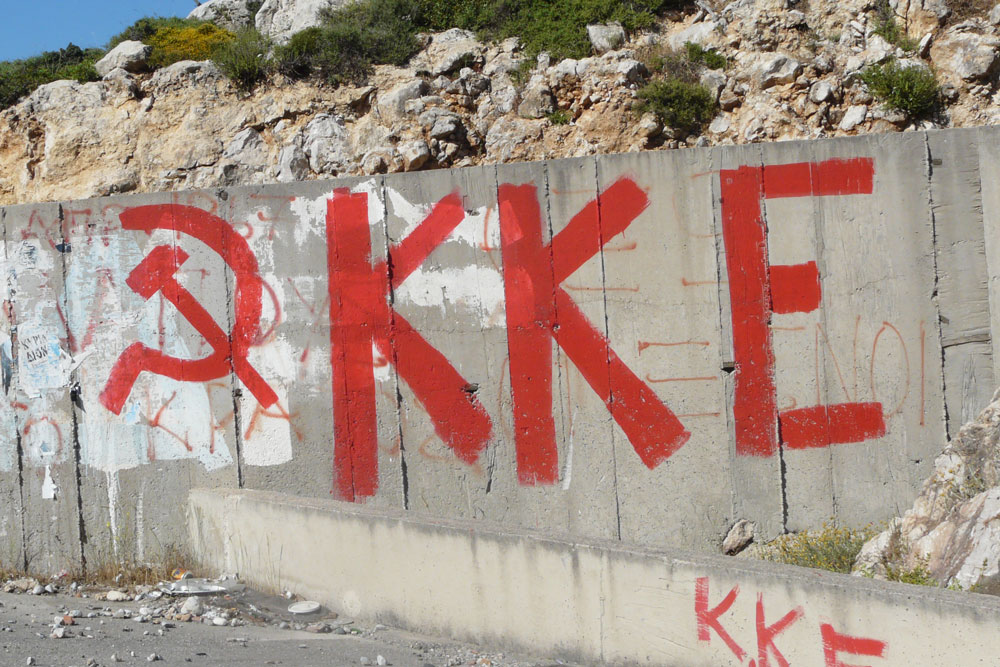
[image: Photo: Piotrus]
<http://www.marxist.com/images/stories/greece/KKE_Rhodes_graffiti-Piotrus.jpg>This
monotonous repetition of the call for early elections at a time when the
mass movement is shaping political developments and is ready to overthrow
the government, together with the fact that the very leaders of the Left
have not prepared the ground for a clear alternative government that could
emerge from such elections, and also clearly revealing with the positions
they have adopted that they do not want to take power, does a great
disservice both to the movement itself and to the Left.

It is true that the fact that the leaderships of both the KKE and SYRIZA are
calling for elections does not mean that they have the same approach towards
the movement. The approach of the leadership of the Communist Party to the
movement is openly and defiantly cold and hostile. The leadership of the
Communist Party has been concentrating its efforts on organising party
gatherings to insulate ordinary rank and file communists from the movement
and to undermine rather than support and develop it. The General Secretary
of the party refuses even to call it a "movement" and in derogatory terms
describes those who have been participating in it as "former allies of the
PASOK and New Democracy"!

The leadership of SYNASPISMOS (and SYRIZA), on the other hand, while
appealing for participation in the movement, do not openly state what
proposals they have to develop it further and to lead it to victory. They
adopt an attitude of passive support, as if all they are looking for is
future electoral gains from those involved.

So, what should the leaders of the Left (KKE and SYRIZA) do to intervene
constructively in a movement that is assuming more and more revolutionary
features as each day passes? It is worth quoting here a relevant excerpt
from the work of a great communist revolutionary:

"To utilize the favourable possibilities it is necessary to have a
revolutionary will, an iron determination to conquer, a bold and
perspicacious leadership...

"There is no need of inventing means of struggle. They are provided by the
whole history of the world working-class movement...

"A concentrated campaign in the working-class press pounding steadily on the
same key; real socialist speeches from the tribune of parliament, not by
tame deputies but by leaders of the people; the utilization of every
electoral campaign for revolutionary purposes; repeated meetings to which
the masses come not merely to hear the speakers but to get the slogans and
directives of the hour; the creation and strengthening of the workers'
militia; well organized demonstrations driving the reactionary bands from
the streets; protest strikes; an open campaign for the unification and
enlargement of the trade-union ranks under the banner of resolute class
struggle; stubborn, carefully calculated activity to win the army over to
the cause of the people; broader strikes; more powerful demonstrations; the
general strike of toilers of town and country; a general offensive... for
the workers' and peasants' power...

"There is still time to prepare for victory... From the depths of the masses
come vibrant echoes to every bold word, every truly revolutionary slogan.
The masses want the struggle.

"It is not the spirit of combination among parliamentarians and journalists,
but the legitimate and creative hatred of the oppressed for the oppressors
which is today the single most progressive factor in history. It is
necessary to turn to the masses, toward their deepest layers. It is
necessary to appeal to their passions and to their reason. It is necessary
to reject the false 'prudence' which is a synonym for cowardice and which,
at great historical turning points, amounts to treason..." (Leon
Trotsky, *Whither
France?* 1934)

Prospects

Everything now clearly indicates that in the immediate future there will be
two dominant elements in the Greek situation: the inexorable path to
bankruptcy of Greek capitalism and the strengthening of the movement of the
masses.

Political uncertainty and the developing revolutionary situation in Greek
society, together with impending economic collapse (according to ELSTAT
Greek GDP this year is expected to fall by around 5%) and mass unemployment,
with 820,000 registered unemployed, irrespective of the likely possibility
of an agreement on a new loan, bring closer the prospect of bankruptcy.

At present, the imperialists want to "save" Greece in order to protect the
major European banks and to avoid a domino effect of further bankruptcies
and a new recession. But the possibility of a new world recession does not
just depend on Greece alone, nor is Greece the only source of danger to the
European and world economy, since government debt has soared everywhere.

Already in the circles of international capital they are abandoning the idea
that the "sickness" of bankruptcy is limited to Greece - see the possible
downgrading of Italian credit worthiness, for example - or that it is only
Greece that cannot repay its debt. They are now beginning to understand that
Greece's "donors/partners" can also be infected by financial instability and
the growing "fashion" of popular uprisings.

Meanwhile, the movement of the masses is getting more confident and is
beginning to realise the power that it has in setting the tempo of political
developments. The mass movement in the Greek squares has now been going on
for one month. Ironically, the bourgeois media continue to refer to this
movement with its original name, the "indignant". The truth is that we are
no longer dealing with a few indignant people, but with the vast majority of
the masses of the country: workers, unemployed youth, pensioners, and
housewives, people whose lives have been destroyed or seriously damaged by
this crisis.

What we have is the popular masses, which in normal conditions are left on
the margins of political life, dramatically entering the stage and claiming
their right to shape future developments. The outbreak of this mass movement
was not a coincidence. It marks the beginning of a new era, which is
characterised by the historical impasse facing international capitalism and
its increasing inability to provide even the most minimal basic needs of the
working masses.

The entry of the Greek masses onto the scene of history was not something
unexpected and sudden. It was prepared and announced by the movements that
took place in Greek society during the past decade.

The first clear sign that something was changing was the successful strike
movement against the Social Security Reforms of the Simitis (PASOK)
government back in 2001, which led to political deadlock and which brought
down that government. Another indicator was the large antiwar movement, with
massive demonstrations, against the invasion of Iraq in 2003. Then there
seemed to be a brief pause, before we saw new mass movements which
radicalised the youth, i.e. the two mass student movements of 2006-2007
followed by the uprising of students against police violence in December
2008. And finally, we have had the record number of 24-hour general strikes
since 2008, which showed clearly that the working masses were close to
boiling point.

The "indignant" workers, unemployed and youth have become a "decisive" force
and now, in view of the attempt to enforce the "Mid-Term" Plan, are united
around the militant cry of "IT WILL NOT PASS!" However, any activist in this
movement must understand that the mass occupation of squares and a few
partial 24-hour general strikes are not enough to defeat a government that
has the backing of all the forces of the most powerful imperialist countries
on the planet. It will require a long and bitter struggle to stop their plan
to destroy of our living standards, something which they have invested
billions in worldwide.

The struggle must set itself the aim of bringing down this government and
replacing it with a new one that would implement a programme of cancelling
the predatory debt and taking over the banks and all large enterprises and
democratically planning the economy under workers' control for the benefit
of all working people. And because Greece is the weak link in the chain of
European capitalism, at the heart of the crisis of global capitalism, our
struggle must be international and we must view it as a step towards the
victory of socialism throughout the whole of Europe and worldwide.

Source: *ÌáñîéóôéêÞ
ÖùíÞ<http://www.marxist.com/weblinks/europe/marxistiki-foni.htm>
* (Greek)


[Non-text portions of this message have been removed]


------------------------------------

---------------------------------------------------------------------------
LAAMN: Los Angeles Alternative Media Network
---------------------------------------------------------------------------
Unsubscribe: <mailto:[email protected]>
---------------------------------------------------------------------------
Subscribe: <mailto:[email protected]>
---------------------------------------------------------------------------
Digest: <mailto:[email protected]>
---------------------------------------------------------------------------
Help: <mailto:[email protected]?subject=laamn>
---------------------------------------------------------------------------
Post: <mailto:[email protected]>
---------------------------------------------------------------------------
Archive1: <http://www.egroups.com/messages/laamn>
---------------------------------------------------------------------------
Archive2: <http://www.mail-archive.com/[email protected]>
---------------------------------------------------------------------------
Yahoo! Groups Links

<*> To visit your group on the web, go to:
    http://groups.yahoo.com/group/laamn/

<*> Your email settings:
    Individual Email | Traditional

<*> To change settings online go to:
    http://groups.yahoo.com/group/laamn/join
    (Yahoo! ID required)

<*> To change settings via email:
    [email protected]
    [email protected]

<*> To unsubscribe from this group, send an email to:
    [email protected]

<*> Your use of Yahoo! Groups is subject to:
    http://docs.yahoo.com/info/terms/