http://www.marxist.com/south-africa-support-march-for-economic-freedom.htm
 South Africa: Support the March for Economic
Freedom<http://www.marxist.com/south-africa-support-march-for-economic-freedom.htm>
Written by Ali Nooshini Wednesday, 26 October 2011
[image:
Print]<http://www.marxist.com/south-africa-support-march-for-economic-freedom/print.htm#>
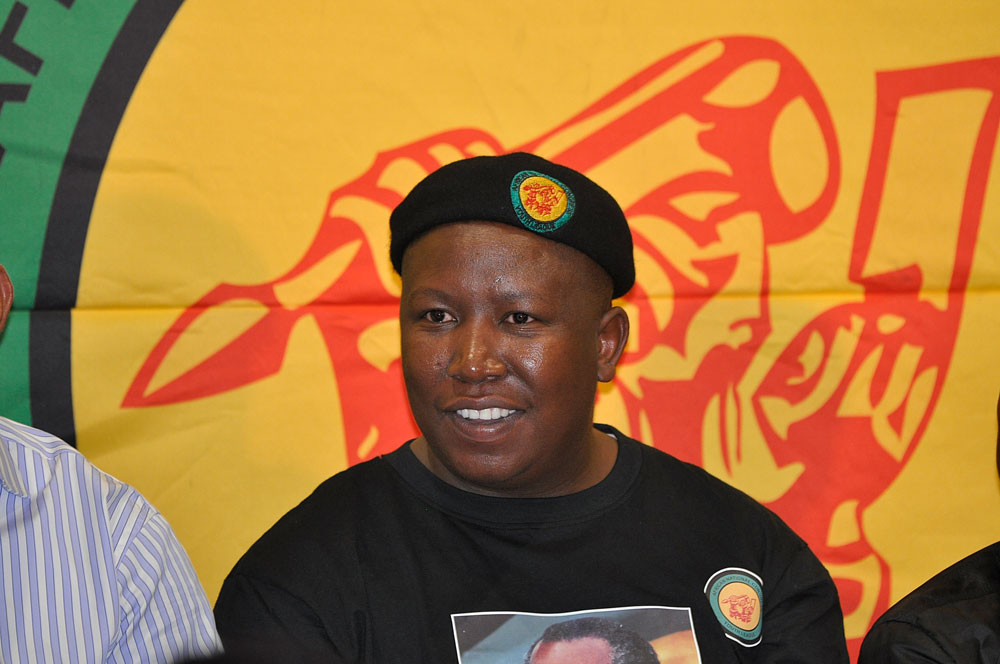
*On September 10th during the celebration of the ANC Youth League's 67th anniversary in Alexandra, ANCYL president Julius Malema declared economic war against the rich minority and made a call for a March for Economic Freedom to be held on Thursday and Friday, October 26-27th. "The day has come he said and on O.R. Tambo's birthday, we are going to march to the Johannesburg Stock Exchange and take the battle to the monopoly capital."* [image: Julius Malema, 14 September. Photo: Gary van der Merwe]<http://www.marxist.com/images/stories/south_africa/Julius_Malema_2011-09-14.jpg>Julius Malema, 14 September.The demonstration will march on the Chamber of Mines, Johannesburg Stock Exchange and on to the Union buildings in order to demand a series of radical demands from the government. Among the demands of the march are: Jobs, Free Quality Education, Proper Housing, Sanitation, Water and Electricity. These demands alone address the most pressing needs of the South African masses, but the most important demand is the call for the nationalisation of the land and the mines without compensation. The Youth League has called on all unemployed youth, underprivileged students, underemployed youth, squatter camp dwellers, all communities that are affected by service delivery protests, all landless people and people without electricity to join the march. Furthermore, the Youth League, in calling the march, state: ...to all economic freedom fighters that total liberation and emancipation of the oppressed and exploited people of South Africa will not only happen in boardrooms and conferences. The people should rise and demand what rightfully belongs to them. South Africa belongs to all who live in it - black and white, and the distribution of wealth should begin to reflect the reality that indeed South Africa belongs to all who live in it. It can never be correct that so many people continue to live in absolute poverty alongside wealth derived from our natural resources and political power to determine their equitable allocation. Pressure from below pushes leaders to the left The call for the March comes after several years of intensification of the class struggle in South Africa. The country has experienced steady and ever steeper rises in poverty and inequality. Although it is the biggest and most developed economy of Africa, according to the Gini coefficient, it is one of the most unequal countries in the world. The country, officially, has 24.5 percent unemployment and the same figure for township youth unemployment is 57%. Those living below the poverty line of $1.25 a day are 26.2% of the population and 60 percent of children are pushed out of the schooling system before they reach grade 12. These figures, as disturbing as they might be, do not give the full picture of the conditions faced by the South African masses. Poverty, misery, lack of proper education, lack of access to basic utilities and massive corruption are all factors that make every day a challenge for the vast majority of the 50 million South Africans. This situation has lead to a massive radicalisation within wide layers of the population in the last period. Besides the hundreds of thousands of industrial and municipal workers who every year go on massive strikes (especially in the so-called Strike Season between June and August), tens of thousands of workers and poor in townships around the country participate in massive spontaneous protests that violently flare up on an almost monthly basis. In 2011 alone more than 10 protesters have already been killed by the police and security forces while participating in these militant actions. The most important reflection of this radicalisation, however, has been the evolution of the ANCYL that, under the leadership of its president Julius Malema and Spokesperson Floyd Shivambu, has put forward an increasingly more progressive programme, particularly when calling for the nationalisation of the mining industry, an industry which makes South Africa the second largest producer of minerals in the world At the ANCYL congress in June the organisation passed a resolution that reads: (...) The ANC Youth League resolves to: 1. Amend section 25 of the Constitution of the Republic of South Africa to make provision for the expropriation without compensation of property, particularly land, for equitable redistribution in the public interest and for public purpose 2. Nationalization of strategic sectors and the commanding heights o f the economy to realise the Freedom Charters clarion call that the people shall share in the countrys wealth. As per the dictates of the Freedom Charter such strategic sectors must include the mineral wealth beneath the soil, the Banks and monopoly industry. The state must also have greater ownership and control of natural monopolies e .g. SASOL, Arcelor-Mittal , the Cement Industry etc. 3. Call for the establishment of a State construction company to reduce the overreliance on tenders and the use of consultants in the delivery of socio-economic infrastructure. 4. Demand the establishment of a State Bank 5. Greater state intervention, ownership and control of the Reserve Bank given its strategic role in our economy 6. Review the BEE policies to ensure that they are in line with the BBBEE Act to urgently address the challenges of unemployment, underdevelopment particularly amongst young people (...) This programme represents a direct challenge to the deal made by the leadership of the ANC and the capitalist class at the time of the end of the apartheid regime. The South African ruling class could see that attempting to maintain apartheid by brutal repression in the face of the revolutionary movement of the South African workers and youth could lead to their revolutionary overthrow. At the same time, they were afraid that democratic elections would mean a landslide victory for the ANC which would be put under enormous pressure to carry out the Freedom Charter and particularly the nationalisation of the economy. They demanded and the ANC leaders agreed the introduction of a so-called sunset clause in the constitution ruling out any nationalisations. Since 1994 no section of the movement had dared challenge this agreement openly. Now, the ANCYL is saying political freedom (i.e. bourgeois democracy) has not solved any of our social and economic problems in terms of housing, education, healthcare, access to water and electricity, land reform, etc., and what is needed now is *economic freedom*. This is extremely significant and goes to the heart of the matter. The bourgeois frightened In the conditions of South Africa, the ANCYLs call for economic freedom in our lifetime has connected with the feeling of anger of millions that is fuelled by the concrete conditions they live in. The call of the ANCYL, an organisation with hundreds of thousands of members and supporters, has raised concerns in the boardrooms of big business and in the newspaper columns of the strategists of Capital. In an article called *Zuma needs to boot his youth leader*, Alec Russell, a Financial Times editor writes that the ANC president Jacob Zuma, should draw inspiration from leaders of the larger emerging powers whose Brics club he has in their eyes joined. First, he should copy the authoritarian style of Beijing and expel Mr Malema from the party. Not suspend, expel. In an editorial called *The Malema Dilemma* the same Mr. Russell writes that The populist policies (...) including nationalisation of the mines and seizing white-owned land would be disastrous... Although the same author half-heartily admits that in ...the absence of well-articulated alternatives to address gaping inequalities, it is no surprise that the youth leagues ideas have been gaining traction. He warns that, Mr Malema is dangerous and that simply removing him will not be enough. Mr. Russell attempts to hide his message behind a thin veneer of liberal humane deception. The message, however, is quite clear: *The capitalist class cannot tolerate nationalisations of any kind and the ANC leadership must remove Malema completely from the scene of South African politics. *Unfortunately for them, it may be too late for that to have any effect since he has already started a movement he cannot stop himself. We are completely in agreement with Mr. Russell on one things: what has been started now by Julius Malema and the ANCYL leadership, can by no means be stopped by them again. Continuing on the same lines as Mr. Russell, Cynthia Carroll, chief executive of mining behemoth Anglo American PLC, threatened that mining companies simply will not invest if they cannot be assured that the assets they create will be secure. In ignoring this truth, the false prophets who argue for nationalization are advocating the road to ruin a path we must not follow. Malema himself did not seem very impressed by threats of a boycott of investments. These investors have never given us land, said Malema at a press conference in Johannesburg on Monday. "Our people are living like pigs so we mustn't talk about SA's reputation. Workers movement divided Although the programme that the ANCYL are putting forward is merely part of the Freedom Charter the 1955 ANC document which is considered as the statement of principles of the liberation movement it has stirred up opposition within the ruling circles of the ANC and its alliance partner, the SACP (South African Communist Party). The reason behind this is that 2012 is going to be a congress year for the ANC and the SACP. It is not probable that Malema himself will run for president of the ANC, but he will probably throw his weight behind contenders for the leadership of both the SACP and the ANC. This has alarmed President Jacob Zuma and above all SACP general secretary Blade Nzimande and they have been attacking Malema in public and behind the scenes. This has resulted in a series of disciplinary charges being taken up against Malema and the ANCYL leadership. There also seems to be a campaign within certain sectors of the state, which are loyal to Nzimande and Zuma, to sabotage the march. There have been reports of State institutions threatening people if they go on the march and some bus companies have had to pull out of the march because they were being told that their state contracts would be terminated if they transported protesters. On the other hand, COSATU, the trade union congress, SASCO , the student union and several of the largest unions, including the National Union of Metal Workers, NUMSA, have expressed their support for the march and the demands of the ANCYL. Zwelinzima Vavi, general secretary of Cosatu, who will probably contend for the leadership of the SACP at the next congress, said that communists should refuse to become prisoners to personal loyalties [to SACP president Blade Nzimande - AN] but [should] always [be] willing to become willing slaves of the only revolutionary class in our society -- the working class! He added that we see no reason why we should not support them when most of their demands are identical to ours. The Communist leaders The role of the leadership of the Communist Party in this affair has been unfortunate to say the least. Instead of putting the full weight of the party behind the campaign for nationalisation of the commanding heights of industry, the leadership has placed the Party in direct opposition to it. Especially SACP general secretary Blade Nzimande has been vocal in this regard accusing Malema of being corrupt and of undermining and sowing doubts about the intentions of the Youth League by saying that Hitler also nationalised the industry! Nzimande argued that this march is not a completely honest march on jobs and poverty as the youth league claims, and said that the party will be focusing on its own campaigns. Nzimandes main argument against the question of nationalisation is that the campaign might be hijacked by corrupt elements. As an alternative, the party, through its Red October campaign, is putting forward the idea of building workers cooperatives i.e. not touching the private property of the capitalists. To the attacks by Nzimande, ANCYL spokesperson Floyd Shivambu responded that it is indeed shocking for a general secretary of a communist party to defend the interests of white monopoly capital; such conduct is not only counter-revolutionary, but smacks of infiltration by representatives of the enemy of the NDR (national democratic revolution), white monopoly capital. One can indeed sympathise with the views of Shivambu. In opposing nationalisations, Nzimande is in effect placing himself in the camp of the capitalists. An even greater mistake is to counter expropriation of capital with the building of cooperatives. As Marxists we are not against cooperatives, but at the same time we understand that cooperatives cannot survive as islands of socialism within the framework of the capitalist market, and this is even more the case in South Africa, where capital is highly monopolised. Marx explained more than 100 years ago that cooperatives were not a viable alternative to the capitalist mode of production. Firstly the capitalists, still controlling the state and the majority of the economy would wage a campaign of sabotage, price-dumping, etc., in order to destroy the cooperatives. And to compete in the capitalist market, cooperatives would have to cut costs, ending up in a situation in which the workers in the cooperatives would be forced to exploit themselves further. Secondly, there is the problem that the whole idea of cooperatives, i.e. of individual groups of workers owning means of production, breeds a capitalist individualist mentality that at a certain stage lead to some workers wanting to own more shares or even the whole company. The question of workers cooperatives was also brought forward by the European Social-democracies in the early 1900s and especially in the 1930s. They tried to use the question in order to push the revolutionary movement of the workers into safe channels where it could do no harm to private property. The sad fact today, however, is that the majority of the cooperatives in Europe have gone bankrupt or are only cooperatives in name i.e. in effect they are owned and controlled by capitalists. It is true that nationalisation in and of itself will not solve all the problems. The question will remain as to who will audit them and, most importantly, who will control them. But at the same time we must underline the fact that the ANCYL programme and the demand for the nationalisation of the commanding heights of industry without compensation are very progressive demands at this stage in the South African class struggle. First of all they constitute a direct attack on private capitalist property, which should be sufficient for genuine socialists to support them, instead of the idea of cooperatives which leaves the private property of the means of production untouched. Secondly, and most importantly, the ANCYL programme unites all the oppressed and revolutionary layers of society through a series of transitional demands connecting the daily day struggles of the masses with the question of private property. What more could a communist ask for? We understand that the there may be some degree of distrust in Malema, as he has made large amounts of money as a businessman involved in getting state tenders, as well as having some very dubious political allies. These are legitimate concerns, but the way to deal with them is not to turn our back on the movement as a whole. First of all we must distinguish between the masses and the leaders. The movement that Malema has helped create is more than Malema himself. Once on the move, the movement develops its own laws and is no blind follower of its leaders. As the Financial Times pointed out, even if Malema were to leave the scene completely it is probably too late to stop the movement. Secondy, if comrade Nzimande has so many concerns about Malema and corruption, he should put forward demands of *full financial transparency within the tripartite alliance, the nationalised companies and the state *and he should also call for *workers leaders on a workers wage*. Instead of leaving the movement of nationalisation, that has gripped the minds of the South African youth, to people whom they do not trust, the SACP leadership should mobilise all its forces to implement the progressive proposals of the ANCYL and take them further. Unfortunately, that has not been the case. Instead, in an attempt to divide the movement, the Young Communist League, which is very loyal to Nzimande, has planned its Jobs for Youth Summit at the same time as the ANCYL demonstration. Reports, however, suggest that the vast majority of real YCL activists will be going to the march anyway. This divide between the organisation which should be the vanguard of the working class and the revolutionary youth can have tragic consequences in the future both for the Communist Party and for the working masses of South Africa. Support the March *Our view is that all truly revolutionary elements must see it as their duty to participate in the march on Thursday. But this march must not be seen as an end in itself. The march should be only the beginning of a campaign to mobilize the wider working class. Branches of the YCL, ANCYL, SASCO and COSATU should also organise delegations to the factories in order to bring as many young workers as possible to the march.* *We must make sure that the campaign does not stop with the march alone. After the march an energetic campaign must be waged to set up Nationalisation Committees in workplaces, factories and mines for the workers to discuss and decide on how to take the movement forward. These committees should also be connected on a regional and national level.* *The nationalisation of the commanding heights of the economy, as proposed in the Freedom Charter and in the ANCYL programme, would in effect mean the expropriation of the capitalist class, a class that is only capable at playing a parasitic role in society. It would allow the South African masses to move towards true liberation from the horrors of capitalism. Such a revolutionary development would also send shockwaves across Africa and around the world where the masses are searching for an alternative to the dead end of capitalism.* *Economic freedom in our lifetime means socialism!* [Non-text portions of this message have been removed] ------------------------------------ --------------------------------------------------------------------------- LAAMN: Los Angeles Alternative Media Network --------------------------------------------------------------------------- Unsubscribe: <mailto:[email protected]> --------------------------------------------------------------------------- Subscribe: <mailto:[email protected]> --------------------------------------------------------------------------- Digest: <mailto:[email protected]> --------------------------------------------------------------------------- Help: <mailto:[email protected]?subject=laamn> --------------------------------------------------------------------------- Post: <mailto:[email protected]> --------------------------------------------------------------------------- Archive1: <http://www.egroups.com/messages/laamn> --------------------------------------------------------------------------- Archive2: <http://www.mail-archive.com/[email protected]> --------------------------------------------------------------------------- Yahoo! Groups Links <*> To visit your group on the web, go to: http://groups.yahoo.com/group/laamn/ <*> Your email settings: Individual Email | Traditional <*> To change settings online go to: http://groups.yahoo.com/group/laamn/join (Yahoo! ID required) <*> To change settings via email: [email protected] [email protected] <*> To unsubscribe from this group, send an email to: [email protected] <*> Your use of Yahoo! Groups is subject to: http://docs.yahoo.com/info/terms/