From: Karen Pomer [mailto:[email protected]]
Sent: Wednesday, November 30, 2011 8:24 AM
Why nothing about Jeremy tonight?


The  <http://sass.caltech.edu/events/JeremyScahill_2011.shtml> Caltech Y
Social Activism Speaker Series present:

JEREMY SCAHILL

Independent Journalist and International Best-Selling Author Speaking on US
Foreign Policy, The Military-Industrial Complex, and National Security

WHEN: Wednesday, November 30th, 7:30 PM

WHERE: Caltech Ramo Auditorium, 332 S. Michigan Ave., Pasadena, CA, 91125
Venue Website <http://parking.caltech.edu/Parking_Zone_Map.pdf>  Ramo
Auditorium is located in the south side of the BAXTER building. See Venue
website for a Caltech Campus map.

FREE, no tickets required

** Reception with the speaker after the event **

MORE: Jeremy Scahill is recently back from Afghanistan and Somalia, which
Scahill says, "are two of the frontlines in the global US targeted killing
campaign." He represents the exceedingly rare US journalist who
independently conducts investigations abroad without being embedded with the
US military or foreign governments. He spent two weeks in Afghanistan in
October of 2010 in order to report the facts about the ongoing US war in
that region. He also spent ten days in Somalia at the beginning of July of
this year uncovering a secret CIA site built in Mogadishu. Jeremy Scahill
returns from his trips with important and fascinating stories derived from
first-hand observations, interviews, and videos about the status of the war
in Afghanistan, about the role of the US in secret prisons, renditions, and
torture in Somalia, and about the blowback that will come from such
detrimental actions in both regions of the world.

Jeremy Scahill is the author of Blackwater: The Rise of the World's Most
Powerful Mercenary Army, named by AlterNet as the best progressive book of
the year. He is a frequent contributor to The Nation magazine, where he
dispatches on wars, the military-industrial complex and national security,
and is a correspondent for the national radio and TV program Democracy Now!
He is currently a Puffin Foundation Writing Fellow at The Nation Institute.
Scahill has won numerous awards for his reporting, including the prestigious
George Polk Award, which he won twice.

While a correspondent for Democracy Now!, Scahill reported extensively from
Iraq through both the Clinton and Bush administrations. Traveling around the
hurricane zone in the wake of Katrina, Jeremy Scahill exposed the presence
of Blackwater forces in New Orleans and his reporting sparked a
Congressional inquiry and an internal Department of Homeland Security
investigation. He has appeared on ABC World News, CBS Evening News, NBC
Nightly News, CNN, MSNBC, The Daily Show, PBS's The News Hour, Bill Moyers
Journal and is a frequent guest on other radio and TV programs nationwide.
Scahill also served as an election correspondent for HBO's Real Time with
Bill Maher.

For more information please visit http://sass.caltech.edu/

Sponsored by the Moore-Hufstedler Fund, GSC, and the Caltech Y
###

<outbind://257/?ui=2&ik=5ea421167a&view=att&th=133f012d5e222848&attid=0.1&di
sp=inline&realattid=f_gvl3aoxx0&zw> Jeremy-Scahill.jpg   Jeremy-Scahill.jpg
60K View
<outbind://257/?ui=2&ik=5ea421167a&view=att&th=133f012d5e222848&attid=0.1&di
sp=inline&realattid=f_gvl3aoxx0&zw>  Download
<outbind://257/?ui=2&ik=5ea421167a&view=att&th=133f012d5e222848&attid=0.1&di
sp=safe&realattid=f_gvl3aoxx0&zw>

 * * *

 <http://ipsnews.net/news.asp?idnews=105969>
http://ipsnews.net/news.asp?idnews=105969

CHILE
Student Protests Spread Throughout Region
By Pamela Sepúlveda*


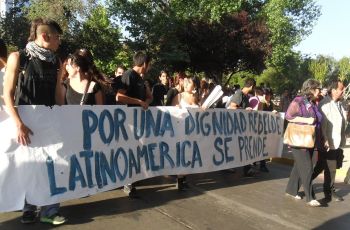
 Chile's student protests are catching on throughout the region. /
Credit:Pamela Sepúlveda/IPS <http://ipsnews.net/fotos/105969-20111125.jpg>
Chile's student protests are catching on throughout the region.

Credit:Pamela Sepúlveda/IPS
Buy this  <http://ipsnews.net/news.asp?idnews=105969#pictures> picture

SANTIAGO, Nov 25, 2011 (IPS) - In support of Chile's ongoing student
protests, and voicing their own demands, thousands of people took to the
streets in more than a dozen cities in Latin America Thursday demanding
quality public education.

The Latin American March for Education
<http://ipsnews.net/new_focus/education/index.asp>  was called by the
Chilean students' confederation, and demonstrations were held in Argentina,
Brazil, Chile, Colombia <http://ipsnews.net/news.asp?idnews=105811> , Costa
Rica, Ecuador, Guatemala, Honduras, Mexico, Paraguay, Peru, Uruguay and
Venezuela.

Some 10,000 protesters - according to the organisers - marched through the
streets of Santiago once again demanding reforms of the
<http://ipsnews.net/news.asp?idnews=56794> educational system. And again,
there was a crackdown by the anti-riot police, who arrested some 60 people.

The demonstrations in other cities in the region were peaceful, with the
exception of an incident in Bogotá, Colombia where the police fired tear
gas.

"Today is a very special day because we are marching throughout Latin
America," Esteban Miranda, president of the University of Chile law students
centre, told IPS.


          <http://ipsnews.net/new_images/transparente.gif>


Solidarity Colombia-style

"Today we are mobilising for all of Latin America because we are suffering
from governments that do not recognise education as a fundamental right,"
Gladys Ríos, a social science student at the University of Antioquia in
northwest Colombia, told IPS.

Under a steady drizzle, tens of thousands of young people poured onto the
streets in the main cities of Colombia in response to the region-wide call
to march for quality public education for all.

It was a smaller but no less enthusiastic demonstration than the one held on
Nov. 10, when around 200,000 students and teachers protested and managed to
press the rightwing government of Juan Manuel Santos to withdraw its
controversial bill to privatise education and to engage in a new round of
talks with students and teachers.

Although the government's announcement was welcome, it was met with
scepticism. "This is just pouring oil on troubled waters," said Ríos.

"Santos, like most of Latin America's political leaders, wants us to study
to just become semi-skilled workers, while we are fighting for education
that enables us to think critically and speak out about what affects us, to
improve things," she said.

Chilean activist Isabel Carcomo took part in the protest in Bogotá. "We are
demonstrating in favour of public, secular, non-sexist education," she
commented to IPS.

"The participants in the 12th Latin American and Caribbean feminist
conference are taking part in this demonstration because we want to
contribute to this movement that is demanding equality, justice and access
to education," said Carcomo, who was attending the women's meeting Nov. 23
to 26 in the Colombian capital.

"We will continue the struggle because the Piñera government is not willing
to give in, and continues to insist that education must be governed by the
market," said the Chilean activist. Ríos said "Santos is heading down the
same path that Chile took.

"Now he hopes things will calm down, everyone will forget, and then he'll
pull out his script again, just like he did with the free trade treaty with
the United States," she said.

"We will win this by sticking together and staying alert, without letting
our commitment wane," said Ríos, as the demonstrators marched towards
Bolívar square, after overcoming scuffles with the police, who tried to
disperse them with tear gas. Similar marches were held without incident in
the rest of the country.

He said the region-wide mobilisation was a demonstration of the similarity
of demands by students in the region, as well as of the support for the
movement in Chile.

"They are hanging in there with us, because we still have a long road
ahead," the student leader said.

José Barrera, a civil engineering student at the Catholic University, said
that what is happening in Chile "is an example of what education is like
when it's privatised, when it is no longer defended as a right of everyone."


An education law enacted by the 1973-1990 dictatorship of General Augusto
Pinochet set off a process of decentralisation and privatisation that gave
private schools free rein to pursue profit and use entrance exams to select
their students.

The Chilean system is not just divided into paid private education and
tuition-free public education, but is split into three: municipal schools
run by local governments, which are publicly funded and free,
state-subsidised private schools, and private schools that charge tuition.

Within the sphere of state-subsidised private education, students get free
tuition at some schools, while at others families pay monthly fees, an
arrangement known as "shared financing."

The protest movement is calling for an end to the freedom of private schools
receiving state subsidies to levy fees at will. Instead of the current
system, under which administrators of these institutions rack up profits,
the demonstrators want school fees to be invested in under-funded public
schools.

They also want public primary and secondary schools to be directly managed
by the Education Ministry, instead of by local governments, because the
decentralisation accentuated the inequality in
<http://ipsnews.net/news.asp?idnews=56336> education quality between rich
and poor districts.

"Countries that see the Chilean model as an example, and that are moving
towards privatisation, have to realise how harmful this kind of system can
be for education in general," he argued.

The march in downtown Santiago was supported by organisations of students
from secondary schools, technical, vocational and arts institutes, as well
as trade unions and teachers.

Luis Garrido, a representative of the Sindicato Único de Trabajadores de la
Educación (SUTE) teachers union, said the protest was against the rightwing
government of Sebastián Piñera's insistence on continuing to apply the logic
of the market to the educational system.

"Capitalism is profits, business, buying and selling, and that is not what
educators are about," said Garrido. He added that the movement in which
teachers and students have come together is demanding a "social
transformation."

The participants in Thursday's march say the student protests have become a
broader social movement that will continue to fight for structural changes
above and beyond the educational system, such as reforms to the free-market,
neoliberal economic system inherited from the dictatorship.

"We want to tell the Chilean government that even though this has dragged
on, we can continue, because we are still strong," Alfredo Vielma, spokesman
for the Asamblea Coordinadora de Estudiantes Secundarios assembly of
secondary school students, told IPS.

"We want to change the system, we want to change this life for a life that
is much more fair, and return to free education," he said.

Bogged-down negotiations

After six months of conflict, including more than 40 marches in Santiago and
other cities around Chile, there is no sign of an agreement with the Piñera
administration. The government says the debate should be left to Congress,
which is currently discussing the share of the national budget to be
assigned to education next year.

Presidential spokesman Andrés Chadwick said the demonstrations were
"absolutely unnecessary."

"If this really is about education, the march is completely gratuitous; it
is only causing problems for people," said the minister, who blamed Congress
for the failure to reach a solution.

But the students said the conflict is not limited to the debate on the
education budget, which is merely discussing whether to offer fewer or more
scholarships or student loans, without addressing the need for reforms.

"What they are doing in Congress is whitewashing the system by providing a
lot of scholarships. But they aren't responding to our demands," said
Miranda. "What we want is direct financing of the institutions; we want free
quality public education for all."

The university student leader said the debate on the budget may make some
progress, but the problems underlying the conflict cannot be solved by the
same politicians who have protected the system for decades.

"We don't agree that this can be resolved in parliament; we want it to be
resolved by consulting with the citizens, through a plebiscite or people's
assemblies," he said.

"The problem is Chile's institutions, and education is a symptom of that
larger problem," said Loreto Fernández, president of the social science
student centre at the University of Chile.

She told IPS "we need a more democratic country, where the voices of society
are really heard. It can't just be the same old political class reaching
decisions between four walls."

* With additional reporting by Helda Martínez in Bogotá.

(END)


[Non-text portions of this message have been removed]


------------------------------------

---------------------------------------------------------------------------
LAAMN: Los Angeles Alternative Media Network
---------------------------------------------------------------------------
Unsubscribe: <mailto:[email protected]>
---------------------------------------------------------------------------
Subscribe: <mailto:[email protected]>
---------------------------------------------------------------------------
Digest: <mailto:[email protected]>
---------------------------------------------------------------------------
Help: <mailto:[email protected]?subject=laamn>
---------------------------------------------------------------------------
Post: <mailto:[email protected]>
---------------------------------------------------------------------------
Archive1: <http://www.egroups.com/messages/laamn>
---------------------------------------------------------------------------
Archive2: <http://www.mail-archive.com/[email protected]>
---------------------------------------------------------------------------
Yahoo! Groups Links

<*> To visit your group on the web, go to:
    http://groups.yahoo.com/group/laamn/

<*> Your email settings:
    Individual Email | Traditional

<*> To change settings online go to:
    http://groups.yahoo.com/group/laamn/join
    (Yahoo! ID required)

<*> To change settings via email:
    [email protected]
    [email protected]

<*> To unsubscribe from this group, send an email to:
    [email protected]

<*> Your use of Yahoo! Groups is subject to:
    http://docs.yahoo.com/info/terms/