http://www.marxist.com/syria-assad-regime-beginning-to-crack.htm
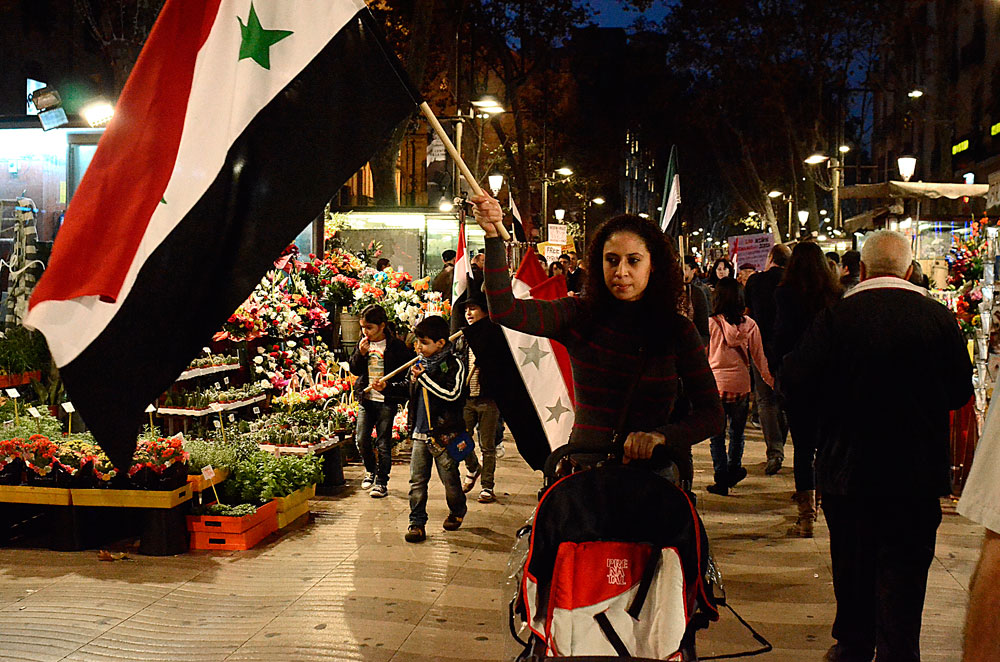
Syria: Assad regime beginning to crack as revolution moves to higher level<http://www.marxist.com/syria-assad-regime-beginning-to-crack.htm> Written by Mousa Ladqani Monday, 12 December 2011 [image: Print]<http://www.marxist.com/syria-assad-regime-beginning-to-crack/print.htm#> *Dramatic events have shaken the already stormy Syrian scene in the last month: strikes, demonstrations in downtown Damascus, attacks on intelligence headquarters, and condemnation by the Arab League. The Syrian regime looks weaker than ever and much exhausted, and a balance of forces favourable to the revolution seems to be the new reality. The arrival on the scene of a mass militia is an important shift in the situation which not only worries the regime, but also the bourgeois opposition and its imperialist allies*. Popular uprising continues [image: Protest in Barcelona, 12 November. Photo: Teresa Forn]<http://www.marxist.com/images/stories/syria/2011-11-12_Barcelona-Teresa_Forn.jpg>Protest in Barcelona, 12 November. Photo: Teresa FornWhat more than firing heavy guns directly at ordinary people's houses and bombing residential neighbourhoods with tanks can a military regime do to stop a popular uprising? How much more can it do than torturing activists and children to death, terrorizing families and the elderly in their homes, beating young women in public then kidnapping and raping them in centres of organized state crime (i.e. detention centres)? The barbaric oppression apparatus of the Assad regime has proven impotent in facing the incredible resilience and heroism of the people of Homs, Hama, Dar'aa, Duma, and all other Syrian cities, towns and villages. The regime seems to have lost all ability to connect with reality and to to understand the situation after 9 months of mobilisations by the masses. It still lives in the past when oppression equalled success and cannot understand why this simple and familiar equation is not holding true today; trying desperately to stick to it without much luck! Far from being "over", as the regime keeps claiming and repeating, the movement everywhere keeps mushrooming, sometimes in the most unexpected places. The last period witnessed a number of small demos in areas in the heart of Damascus and its Downtown, which many observers had ruled out in advance, such as Al-Mazeh near the Iranian Embassy, Al-Shi'lan Street, Al-Tilyani, Khalid Bin Al-Waleed Street, Al-Hijaz station, Al-Baramkeh near SANA (the official Syrian media agency), and other locations. Although not yet sizeable in numbers, the locations of these demos carry a lot of significance. The students have been no less militant and willing to fight. The four public universities, Damascus, Aleppo, Al-Ba'ath (Homs), and Tishreen (Latakia), have seen many protests both in the faculties and residences. Also, very significantly, students in private universities such as Al-Qalamun and the European (International) university, which come from well off families, have been on the move. Most importantly, the decay in the armed forces has reached a new level, as defecting soldiers have organized themselves as the Free Syrian Army and carried out shoulder-mounted rocket attacks at the very heart of the intelligence apparatus. These are only a few examples that indicate that the regime's favourite saying, "It is over", cannot be further from the truth. The movement is alive and growing. The revolutionaries joke that maybe it really is "over", but the regime is confused on the slight detail that it refers to its own struggle for survival! Meanwhile, the economic crisis deepens, setting a very bleak backdrop to the regimes efforts at self-preservation. The economy in free fall The continuous deployment of the armed forces, disturbances in production, slowing down of commercial activity to a minimum and complete seizing up of tourism have put immense strain on the Syrian economy. Despite the desperate attempts of the Central Bank to maintain financial stability, the Syrian Lira has lost 10% of its value compared to the dollar, and perhaps up to 20% in the black market. The orientation towards the "market economy" in the recent years has meant further dependence on trade and foreign investment which will cause the new economic sanctions to further undermine the stability of the economy. There is already a widespread fuel and electricity crisis, especially in the areas of high tension. Syrians are suffering many hours of electricity black-outs daily and have to wait in very long lines to get a mere container of natural gas for cooking or to fill their tanks with heating oil for their home furnaces. The Minister of Finance, Mouhammad Nidal Al-Sha'ar, has admitted that Syria is facing one of the worst economic crises in years, maybe the worst in its history, and what does Mr. Al-Sha'ar suggest as a solution? He suggests that "we should be more effective in regard to self-sufficiency, distribution of our resources, and managing our factories" and underlines "the necessity of paying attention to agriculture and food which have suffered neglect in the recent years, and reviving our factories, many of which have closed as a result of the free trade agreement with Turkey". Very well said Mr. Al-Sha'ar, but many industries have been sold off, and the monopoly of foreign trade was broken down to allow for private industry and the flood of foreign capital. Could it be that Mr. Al-Shaar is proposing reversing privatizations and reviving state planning of the most important parts of the economy as a solution to this crisis? Apparently not, the minister ruled out the possibility of going back to the practices of the period of the 1980s, where the majority of the economy was state owned and planned: "we have not taken any steps in that direction and we do not intend to do so" and "we will leave the private sector *which forms 73% of our economy* to work flexibly and manage its own affairs. Clearly, nothing remains of the old so-called socialist economy and what little industries remain in the hands of the state are there to support the 73% which manages its own affairs, despite the fact he has pointed to, i.e. that it manages them badly. Mr. Sha'ar points out that food and agriculture have been neglected since privatization and Ramiization (the practice of privatizing into the hands of Rami Makhlouf, the presidents cousin). But Syrias new capitalist class cannot be expected to undo their own birth, and so their hands are tied. Private ownership and the market reforms have made the economy far more fragile and sensitive to external economic pressures, but they are irreversible as far as the ruling class is concerned. And while these reforms have afforded some opportunities for regional bourgeois to invest and profit in Syria, Ramiization has siphoned off most of the profitable opportunities to the ruling clique and their families. This means the imperialists and these regional bourgeois see the coming fall of the Syrian regime as an opening to plunder even more s of the Syrian economy which was previously denied them by the regime. The Arab League moves against Assad In this context, the vultures have begun to circle. The decision of the Arab League to suspend the membership of Syria came as a surprise to the majority of observers. This decision came suddenly, but what is clear is that it could not have been made without the blessing of the imperialists. The king of Jordan, who is known to be a puppet of British imperialism, has called on Assad to resign, which confirms this without a doubt. Even a child in the Middle East knows that this monarch does not speak a word without being told what to say by his masters in London and Washington. This makes clear that imperialist and regional powers have made up their minds after much vacillation that it is only a matter of time before this regime falls: they must ensure that it falls in a controlled manner. The longer Assad holds on, the more unstable the situation will become and the less possible it will be to guarantee their interests in a post-Assad Syria or to contain the revolutionary tremors they are already beginning to feel below their feet. The decision was received by the Syrian regime with absolute hysteria. The Syrian representative at the Arab League had no other response but to publicly swear at the Qatari representative in his face. The mouthpieces of the regime went wild on all TV channels denouncing and cursing the Arab "traitors". Yet Walid Al-Mou'alem, the Syrian foreign affairs minister, came out on TV the next day and asked for restoration of dialogue with the Arab League! The contradictory response of Syrian diplomacy underlines the confusion and disorientation of the regime. Angry supporters of Assad attacked the Embassies of Qatar and UAE in Damascus. In Latakia, where the Assad family and their cronies come from, dozens of cars filled with regime supporters descended on the city from the surrounding villages. They attacked the Turkish and French consulates and burnt their flags. A relative of the president rushed the Arab (Maritime) university bringing down the flag of the Arab League, burning it and then trashing the building of the university. All this drama was followed by an armed demo of these supporters in Shehk Daher square in which they smashed stores and flung sectarian insults at citizens. Such are the manners of the graduates of the school of Assad's Ba'ath! This is the real worth of its slogan for Arab unity! The decision of the Arab League clearly opens the door for regional meddling and perhaps even direct intervention in Syrian affairs. For the moment, the regional powers seem content to intervene indirectly from the outside, and any direct military action by the main imperialist powers in Paris, London or Washington is ruled out after the costly Libyan campaign, particularly so long as Russia and China stand by their Damascus allies. If there is to be intervention, it will come from proxy powers. An Arab force would be convenient, and the Leagues decision gives a pretext. The Arab countries have gone further now imposing economic sanction on the regime, freezing all trade, investment and dealings with the Central Bank of Syria. Turkey, which has become more aggressive with the regime since the decision of the Arab League, has followed suit with economic sanctions. It has also been flirting with the idea of establishing a safe zone along its borders for civilians and defecting soldiers to hide in. Whatever happens to these plans, the regime is becoming more internationally isolated. This has a negative economic effect which further destabilizes the state, it has an effect on morale within the ruling cadres, and over the long term, even the support of Russia and China cannot be guaranteed should they decide the game is up for Assad. It has also made clear that the imperialists have stepped up their involvement in the future of the Syrian revolution. The Syrian National Council and the manoeuvres of imperialism Imperialism has been very busy in the last period. Beyond the actions taken by the Arab League, British Foreign Secretary William Hague arranged a meeting with the Syrian National Council in London and other powers have also been stepping up contact with it. It is formed of more than 200 representatives of the exile wings of the Syrian Muslim Brotherhood, the Damascus Declaration, some Kurdish organizations, and some people involved in other organizations. These are not democratically elected representatives of the movement, but simply a broad collection of spokespeople for some opposition parties. Its connection with the movement on the ground is non-existent, and though it claims to speak for the revolution, they have not earned the trust of the movement. Nevertheless, it is to this council that the imperialists look for a reliable leadership that can be trusted to carry out their dictates. It would be very convenient to impose this council on the revolution, much as the unelected National Transitional Council was imposed on the Libyan revolution. British Foreign Minister William Hague chose to meet with the council on the 21st of November, and not with the Free Syrian Army. The councils website carries a very short piece just after the meeting which is very interesting: The Syrian National Council states that the rumours of comments by Dr. Burhan Ghalioun during his meeting with British Foreign Secretary William Hague on Monday November 21st, requesting from the British side that they intervene with the Turkish authorities to stop the attacks of the Free Syrian Army are devoid of any connection with reality The statement goes on to praise the soldiers who have chosen to abandon the regime, but the vigorous denial only makes more clear that such a request was politically dangerous. Considering the councils insistence on non-violence, and its condemnation of the attacks on the intelligence services, it is clear that this request was made. Furthermore, such a request could not have been made had it not been clear that it coincided with the interests of the British side. What imperialism needs is a leadership of the revolution which is reliant on it, which needs its assistance, and has no existence independent of it. Such a leadership, weak, isolated, but propped up by the support of the imperialist and Arab powers, would be very receptive to negotiating favourable terms for foreign capitalists in a future Syria. The Syrian National Council fits the bill perfectly. The only problem is the beginnings of the development of an independent force which has arisen without any support from outside, despite the inaction of all the imperialist countries, with its own weapons and an authority in the movement earned from its bold guerilla actions against regime targets. This poses a danger to the imperialists ability to control events in Syria. Should the regime be brought down without their aid, it will be seen to have been the victory of the masses of defected soldiers, youth and workers in Syria, against the inaction of the so-called world community, i.e. western imperialism, which has cried crocodile tears for nine months and done absolutely nothing. A Syria born in this way would be a Syria with a revolutionary people made bold and confident by their own victories, unwilling to give an inch and demanding more and more for themselves. The hypocritical demand for a peaceful movement flows from this calculation. For the imperialists armed force cannot be allowed to fall under the control of the Syrian masses: it must be part of the plans of the bourgeoisie or not happen at all. The timing of the flurry of activity in recent weeks, meetings with the Council, sanctions, condemnation of the regime by the League, is very peculiar. After *nine** *months of toothless declarations, why move now? The key to the situation is the arrival on the scene of the revolutionary soldiers, who carried out bold attacks just before imperialism decided it had to take the initiative, or risk losing it to an independent force born from within the revolution itself. Revolutionary Soldiers Organize as the Free Syrian Army The steady defection of soldiers and officers from the Syrian army, and in some cases from the secret police and intelligence forces, has led to the formation of the Free Syrian Army. It has now reached over 15,000 soldiers according to statements by its spokesperson. Compared to the development of this armed wing of the revolution, the collection of doctors, lawyers and academics in exile that has styled itself the Syrian National Council and declared itself the leadership of the revolution seems but a joke. This soldiers' militia for a long time was not given much media attention but rather intentionally ignored in favour of propping up the Syrian National Council. However, such a growing force which has been putting its stamp on the ground could not be ignored for long. A turning point, or rather a reflection of the change in the balance of forces, came when a small unit of the Free Syrian Army attacked one of the most fortified security centres in the whole country, the headquarters of the Air Force Intelligence in Harasta, right by the Damascus-Homs highway at the Northern entrance of Damascus. They then melted away without casualties or arrests. The spokesperson of the Free Syrian Army commented following the attack that they had fighters all over the country including the capital Damascus and declared that operations of this type will continue and expand. This attack was preceded by a statement of the Free Army announcing the formation of its military council. They declared the Free Syrian Army the only legitimate armed body in the country and that the forces of the regime, having lost their legitimacy, will be a target of the free soldiers. The statement urged all individuals in the army, police, and intelligence forces to immediately desert their units and join the Free Army. The statement declared that the Free Syrian Army will take charge of the security of the country after the fall of the regime. It has prohibited its leadership from belonging to any political parties and promised to hand power over to a civilian government upon the first election. This declaration, carried out independently of the Syrian National Council, basically amounted to the pushing aside of the Council, which is fully in the hands of Turkey and the imperialists, as the supposed leader of the movement. The latest development surely produced panic, not only among the men of the regime, but also the men of the respectable opposition and their imperialist backers. Statements of concern over the "derailing of the revolution off its peaceful tracks" came in from all corners. Clinton, who a few days earlier had advised the defected soldiers not to submit their weapons to the authorities, a day after the Harasta attack, condemned the violence used by the opposition! Germany followed with condemnation a few days after. The hypocrisy of the imperialists has no limits! These are the same imperialists who, with indecent haste, moved to ensure their future interests in Libya through armed intervention on a scale far larger than the operations of the Free Army. To the imperialists, it is not the use of violence in and of itself which is immoral, but the use of violence by forces beyond their control and which may not align with their interests. The hypocritical pacifism of the bourgeois and petty-bourgeois is worthless to the revolutionary Syrian workers, soldiers and youth. Having realized the weight of the Free Syrian Army, the petty bourgeois politicians and their backers could not ignore it any longer; and so they now aim to contain it. A few days ago news leaked of talks in Turkey between Riad Al-As'ad, the head of the Free Syrian Army, and Bourhan Ghalyoun, the president of the Syrian National Council. This was confirmed on the page of the Free Syrian Army with a picture of Riad Al-As'ad and Bourhan Ghalyoun among others and a vague statement of co-operation and working together for the future of Syria. Also confirmed is the fact that the Council has asked the Free Army to restrict its actions to defensive operations and avoid taking the offensive. Officially, the leadership has agreed, indicating that there are forces within the Free Syrian Army which favour rapprochement with the Council and its imperialist backers. However, it is far from clear that these forces can deliver the Free Army into the hands of their new-found friends. Contradictions of the Free Army Questions abound about the nature of the Free Syrian Army, is it truly a body of genuine revolutionary soldiers, the armed militia of the revolution? Is it dominated by extreme Islamist elements, or could it be a mere tool in the hands of imperialist powers? Any serious observer of its development could not fail to realize that the Free Syrian Army is neither an Islamist militia nor an agent of foreign powers: the truth is that *its nature has not been decided yet.* The Free Syrian Army is a reflection of the deep crisis of the regime. Every time it has used the national army as a tool to deliver hammer blows to the revolution, it has chipped off more soldiers and reservists who have become determined to defend their brothers and sisters those the regime is demanding they massacre. This crisis has continued for nine months, with no end in sight. The regime has no victories to show for its efforts, or for the blood spilt. It can only claim stalemates as victories; it can only count its blessings that it has continued to survive. But no army can be inspired for long by the mantra our enemy multiplies, but we have not yet lost. This is the root of the defections. Every day, victory for the regime seems a more and more remote possibility to the rank-and-file of the armed forces, morale is clearly disintegrating, while the dedication and will to sacrifice of the revolutionaries becomes more and more clear. Viewed in this way, it is clear that the Free Syrian Army is not an organization with a preconceived programme or political vision, nor can it be. It is the collection of the mass of soldiers in revolt, who bring their own prejudices, limitations and ideas into the greater whole. They themselves are a reflection of the will of millions of Syrians aroused to the historic tasks of revolutionary struggle. The needs of the movement require an army to defend it against the regimes attacks, and this army has been born out of the objective development of the revolution. Some of those attracted to it have illusions in Islamism, much like some of the Syrian working masses. Others have illusions in imperialist intervention, which is again a reflection of the weaknesses present in the wider mass movement. This is natural and to be expected. For the moment, the essential point is that the ranks that are coming out of the national armed forces and filling out this army of the revolution are uncompromising and infected with the revolutionary fever of the masses. In nature as well in human society, necessity can express itself in a multitude of ways. The Syrian revolution is unfolding in particular conditions, without independent trade unions, and without a revolutionary party that can guide the revolution and carry out the tasks necessary to achieve victory. The pressures of revolution do not wait for the right outlet; they have broken out and expressed themselves through the Free Army. This is, at the moment, the only mass organization in the Syrian revolution. Through the lack of an alternative, it also becomes the leading organization in the revolution. This means, in the current conditions, all the questions of the revolution will express themselves in this organization. The Free Syrian Army has grown large enough to acquire a dynamic of its own; however, such a dynamic cannot be much different from those of the society it comes from. An army of a country is a miniature of its society. It holds its culture, suffers its ills and contradictions, enjoys its advantages and advancement, and reflects the beliefs and moods of its various classes and strata. This is particularly true in a revolutionary period, with a popular revolutionary militia. It is no surprise that a section of the Free Syrian Army holds religious beliefs and has illusions in political Islam as a big part of Syrian society holds these same beliefs and has similar illusions. Neither is it a surprise that a section of the Free Syrian Army has illusions in getting help from foreign powers to overthrow the regime, as such illusions are widespread among many ordinary Syrians who are searching for a way to victory. The political naivety of the masses facing such a historic task *without any political leadership*is thus reflected within the ranks of the Free Syrian Army. It is true that the leadership of this militia has no political perspective, has called a number of times for foreign help, and is now being swayed in the direction of imperialism but the fact remains that the ranks are another story although they may have their own confusions and illusions. Actually it is unclear how much control the leadership has over the units in these difficult conditions. We are daily bombarded with videos of soldiers declaring their defection, the formation of new fighting units, successful operations, soldier martyrs, etc. In these videos and statements there is often distrust of foreign (western and Arab) powers and anger at their betrayal of the Syrian people. There are videos where free soldiers appear among the masses talking and fraternizing with them, and in other videos free soldiers appear chanting revolutionary slogans or singing revolutionary songs. The leadership of the Free Army claims that it has received no military aid from foreign powers and its spokesperson has repeatedly complained of the lack of weapons and ammunition in the hands of the free soldiers. This seems to be confirmed by statements on successful operations in which the seizure of a small number of light weapons, for example 10 automatic guns, is highlighted as some important achievement. It would make sense that the imperialists are not willing to arm a revolutionary militia for their fear of the consequences. This suggests that the Free Syrian Army is still incubating within the mass movement, a fact that makes it difficult for the imperialists to trust it as a tool to carry out their plans for the revolution or better, their plans to derail the revolution. Despite the different currents from within and without that are pulling it in different directions, it is still too tied to the movement to be reliable for imperialism. After all, how are the free soldiers leading a guerilla life, managing to survive day-to-day, to eat, to drink, to hide and so on, without the active help of the revolutionary workers and youth in the towns and villages? These elements are clearly far less reliable, from the standpoint of imperialism, than academics living in Paris, well away from the infectious revolutionary mood of the masses. The development of the Free Syrian Army is a positive step forward for the movement, but the future of the revolution cannot be guaranteed so long as the political development of this organization is not in the hands of the revolutionaries themselves, but left to the unelected few to carry out in discussions behind closed doors with the Syrian National Council and the imperialists. The revolutionary army must belong to the people! Imperialism has taken note of the Syrian revolution, and it is racing to steal the fruits of the masses labour before the regime has even been overthrown. Only democratic control by the movement over its army and its representatives can prevent this. This army, having taken the leading role in the revolution, for the moment is the key to its future. The decisions it makes will lead either to victory or defeat. These are decisions that are far too important to not be debated and decided democratically. What is the opinion of the brave fighters who attacked the intelligence headquarters in Damascus on the declaration by their spokesperson that, in agreement with the National Council, there will no longer be offensive operations of this type? The Free Syrian Army prohibits its leadership from belonging to any party, but this is not the point. The point is that the bourgeoisie and the imperialists have their parties, in the National Council, and without free debate within the Free Army over the future of the insurrection and the revolution, the leadership can easily be forfeited into the hands of these cronies. The moves of the leadership of the Free Army towards the Council underline this danger. Soldiers should demand that the army be brought under the control of the movement. The Free Army can and should become a coordinating point for the insurrection, but the insurrection cannot be left solely to the insurgent soldiers. It must expand into the neighbourhoods, the factories, the schools. Committees of workers and youth should be organized to coordinate mass strike action and protests with the Free Army. This army must belong to the people, and its actions must be decided democratically by representatives elected from neighbourhood committees, workers committees, students committees and soldiers committees. Such a force would be a genuine expression of the revolutionary will of the Syrian people, and it is the only way to decide in an open democratic struggle of ideas allowing all parties of the opposition how to proceed. Not a ban on the participation of the leadership in the struggle amongst parties, but a demand that it happen openly under the watchful eye of the Syrian revolutionary masses, this is the guarantor that the Free Army will be the army of the Syrian people and no one elses. But amongst all of the parties of the opposition, the will to see this struggle through to the end is lacking. The Muslim Brotherhood and all its fellow parties on the National Council do not represent the revolutionary workers and youth, and have thrown their lot in with the imperialists plotting to steal Syria from its people. The Syrian people are a proud people, fiercely proud of their independence, and the revolutions they carried out against imperialism to win it. The regime, at the beginning of this revolt, maintained some support amongst the masses precisely because of their public and demagogic stances against imperialism. What the revolution needs now more than ever, is a revolutionary party independent of the manoeuvres of the imperialists that will put forward a programme to finish with the Ramis of Syria, without simply handing their wealth over to another set of crooks based in Riyadh, Beirut, Amman, Paris, London and New York. The wealth of the Rami Makhloufs was taken from the Syrian people, and it belongs to us and us alone. A revolutionary programme would demand that their wealth be nationalized, not under the control of a bureaucracy as in the past, but under the democratic control of the workers, soldiers and youth. Together, the revolutionary people shall decide how to use that wealth to end the crisis, and raise every man, woman and child out of the depths of poverty the Baathist capitalist class has thrown them into. The revolutionary Syrian masses have earned this better future with their blood. What is required is to build a Marxist tendency in Syria which can carry these ideas into the movement and offer a socialist perspective to the revolution. Otherwise, all kinds of accidental figures can come to the fore, who would come under the influence of imperialism. That is not what the Syrian masses are struggling for. [Non-text portions of this message have been removed] ------------------------------------ --------------------------------------------------------------------------- LAAMN: Los Angeles Alternative Media Network --------------------------------------------------------------------------- Unsubscribe: <mailto:[email protected]> --------------------------------------------------------------------------- Subscribe: <mailto:[email protected]> --------------------------------------------------------------------------- Digest: <mailto:[email protected]> --------------------------------------------------------------------------- Help: <mailto:[email protected]?subject=laamn> --------------------------------------------------------------------------- Post: <mailto:[email protected]> --------------------------------------------------------------------------- Archive1: <http://www.egroups.com/messages/laamn> --------------------------------------------------------------------------- Archive2: <http://www.mail-archive.com/[email protected]> --------------------------------------------------------------------------- Yahoo! Groups Links <*> To visit your group on the web, go to: http://groups.yahoo.com/group/laamn/ <*> Your email settings: Individual Email | Traditional <*> To change settings online go to: http://groups.yahoo.com/group/laamn/join (Yahoo! ID required) <*> To change settings via email: [email protected] [email protected] <*> To unsubscribe from this group, send an email to: [email protected] <*> Your use of Yahoo! Groups is subject to: http://docs.yahoo.com/info/terms/