http://www.marxist.com/iran-and-the-threat-of-war-what-should-our-attitude-be.htm
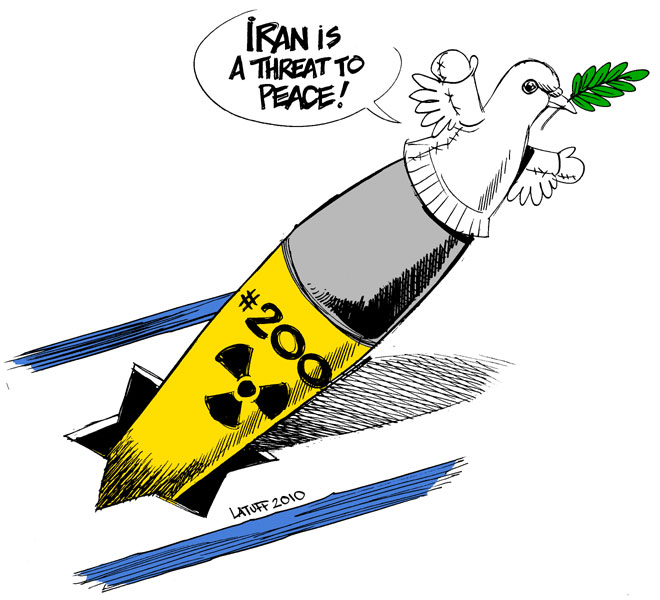
Iran and the threat of war: What should our attitude be?<http://www.marxist.com/iran-and-the-threat-of-war-what-should-our-attitude-be.htm> Written by Alan Woods and Hamid Alizadeh Wednesday, 22 February 2012 [image: Print]<http://www.marxist.com/iran-and-the-threat-of-war-what-should-our-attitude-be/print.htm>[image: E-mail]<http://www.marxist.com/component/option,com_mailto/link,153be54d7c26d10a41e3c88905c0af82e2046cd2/tmpl,component/> *Once again Israeli and American imperialism are sabre rattling in the Middle East. This time Iran is the target. Over the course of the last ten years one sanction after another has been placed on Iran in order to pressure it to abort its nuclear programme.* [image: Illustration: Carlos Latuff]<http://www.marxist.com/images/stories/israel/Iran_war.jpg>Illustration: Carlos LatuffIn the course of the last couple of years the imperialists have upped the stakes in the conflict over Irans nuclear programme. Israeli Prime Minister Benjamin Netanyahu has called Iran an existential threat to Israel and has said that the Israeli regime would do whatever it takes to stop the Iranian nuclear programme. Since last year four Iranian nuclear scientists have been assassinated, most likely through Mossad and CIA covert operations. At the same time the sanctions against Iran have been tightened, severely deepening the crisis in the Iranian economy. The latest major actions by the West have been the introduction of sanctions on Irans banking and oil sector. When the oil sanctions begin to bite, after being implemented at the beginning of February, the results will be catastrophic for the Iranian economy. Oil is the main source of income for Iran. Industry, services and agriculture are fully dependent on this sector. A collapse in income from oil could lead to major dislocation for Iran and especially for the Iranian people. The Israeli regime is not hiding the fact that it is contemplating an attack against Iran. This would not mean an occupation of Iran on the lines Iraq or Afghanistan. The Iranian army is not the same as the Iraqi army in 2003. It is far bigger, better equipped and has better trained soldiers. A land war with Iran on the part of Israel would mean that the invading army would have to go through two countries at least, posing huge logistical problems. Above all, faced with an American invasion of their country, the Iranian masses, with their strong anti-imperialist feelings, would put up a ferocious struggle. However, while a ground war is ruled out, an aerial attack is not. The Israelis have a history of such attacks. In 1981 they made a surprise air strike that destroyed an Iraqi nuclear reactor under construction in Osirak. In 2007 Israel conducted an airstrike on an allegedly secret nuclear installation in Syria. In the recent period Saudi Arabia and Jordan have both made it clear that they would allow Israel to use their airspace during such a campaign. This constitutes an open invitation for Israeli aggression against Iran. For the US and world capitalism the Middle East is crucial, especially for its oil supplies. They consider it their right to bully any nation into submission and into accepting their word as law.>Marxists utterly condemn all these acts of aggression on the part of the imperialist powers. Needless to say, that the main cost of such an attack would not be paid by the Iranian regime, but by the Iranian masses who are already suffering immensely under a despotic and reactionary regime. In such a situation it is necessary to cut across the thick fog of propaganda, and expose the real causes of this conflict and the interests that lie behind it. The nuclear question The imperialists accuse the Iranian regime of developing nuclear weapons. The Iranians on the other hand claim that the purpose of their nuclear programme is for peaceful forces, i.e. for energy. In a country that is floating on oil this seems somewhat improbable. However, it is easy to see why the Iranian regime wishes to develop nuclear weapons. They saw what happened to Iraq which possessed no weapons of mass destruction and was invaded and occupied. On the other hand, North Korea does have nuclear weapons and therefore the USA is trying to appease the regime and negotiate with it. The conclusion is hard to avoid: in order to resist imperialist bullying it is useful to have nuclear weapons. The complaints of US and Israeli imperialism on this question reek of hypocrisy. Israel is the only country in the Middle East with a nuclear arsenal and the USA has by far the largest nuclear arsenal in the world. The USA is the only country to have ever used nuclear weapons in war, as they did in Japan towards the end of the Second World War, killing and injuring hundreds of thousands of civilians. Who are they to decide who can and cannot develop nuclear weaponry? For decades the USA and especially Israel have grown accustomed to doing as they pleased in the Middle East. They have waged one war after another and bullied one country after another to suit their own purposes. But if Iran were to attain nuclear arms it would be a real threat to the dominant position of Israel, to the strategic interests of US imperialism and also to the US-backed Arab regimes in the Middle East. This is the real reason behind the hue and cry over Irans nuclear programme. It has nothing to do with bringing down a rogue regime or defending democracy. When the mass protest movement was fighting for democracy in Bahrain there was no move on the part of the imperialists to defend the masses on the streets. On the contrary, they conveniently turned a blind eye as the regime repressed the movement with the help of Saudi forces. The Saudi regime is itself not renowned for its respect for human rights, but where are the calls to curb the power of this regime? There are none because it is in the economic, political and military interests of both Israel and the United States not to touch these regimes. Changes in the Middle East The roots of this situation can be traced back to the US wars against Iraq in 1992 and in 2003-2011. Before 1992 Iran and Israel had cooperated together for decades of course always behind the scenes and not in public with the main aim of counter-balancing Iraq. But the collapse of the Iraqi army after the US invasion of 2003 changed the whole balance of forces in the Middle East, to the advantage of Iran.>The Arab revolution has further weakened the position of the USA in the Middle East, depriving it of key points of support, such as Mubarak. The same goes for Israel, which had a firm ally in Mubarak. The Saudi ruling clique, which was pushing the US to stand behind Mubarak till the bitter end, was thoroughly disappointed by Obamas wavering position. They see the US abandoning Mubarak as a betrayal and, more importantly, they see it as something that could happen to them. The Gulf States and Saudi Arabia have drawn the conclusion and have been pursuing their own interests in the region, especially during the Arab Revolution. The Qataris, through Al Jazeera, tried to intervene actively in other Arab countries in order to strengthen their own position in the region. If we add to this the fact that US influence in Turkey has also been weakened, it follows that the Americans, after their adventure in Iraq, and especially after the Arab revolution, have been left with very few solid points of support in the Middle East. Israel remains their sole sure ally, and that explains why Israel now has even more leverage in Washington than before. No US administration can afford to oppose Israel, which feels it can act with impunity. Certain things flow from this. A vacuum opened up after the collapse of the Iraqi army and it was the Iranians that filled it, not only inside Iraq, but throughout the region. Irans growing influence in the Middle East is of course seen as an opportunity by the Iranian regime, but the speed at which this development has been taking place is not necessarily to its advantage. It would have preferred more time to consolidate its position.>But why is it that the Iranian regime is risking everything by continually provoking the Americans and the Israelis to the point that these countries especially Israel are openly contemplating an attack? In part, this behaviour reflects the contradictions inside Iran. The regime is deeply split and in crisis. There is growing discontent among the masses. The value of the Rial has plummeted and inflation is threatening to spiral. This comes on top of a severe economic crisis that in the last two years has significantly weakened Iranian industry, with thousands of companies closing down and hundreds of thousands of workers losing their jobs and being thrown into poverty. In order to divert the attention of the masses away from their social and economic problems, the regime is whipping up national chauvinist sentiment and an atmosphere of pre-war mobilisation in order to rally large layers of the population behind itself against the foreign threat. The constant provocations of Ahmadinejad against the Israelis and the Americans are based precisely on this calculation. This process, however, has a logic of its own. Having made these threats, if they were then to backtrack and make concessions, all the contradictions would erupt on an even larger scale. It is probable that the regime, and especially the Ahmadinejad faction, would like to eventually come to some sort of an agreement with the US and Israel and reach an understanding in the Middle East, but they are forced by circumstances to step up the provocations and attacks. Israel The fact that Netanyahu has described Irans nuclear programme as an existential threat to Israel, means that the Israeli ruling clique, and especially the armed forces, cannot sit back and accept what they see as provocations from Iran without acting. They thus pose the question as if it were a matter of self-defence. What are the facts? Until now the Israeli ruling class has been able to do whatever they wanted, whenever they wanted, in the region unchallenged. Since1967, when it is believed that they first acquired nuclear arms, Israel has attacked Egypt, Syria, Jordan, Lebanon, Iraq and of course Palestine. And most of these countries have been attacked more than once.The rise of another nuclear power in close proximity would put serious obstacles in the way of continuing to hold this role in the region and the Israeli generals would go to unheard of lengths to defend this position. This is also what Netanyahu means when he talks of an existential threat to Israel. But this is not the most important factor in the equation. Far more decisive is the social situation within Israel itself. The Arab revolution had an important echo inside Israel. It showed the masses in Israel that, contrary to the propaganda of the regime, the Arab masses are not a hostile undemocratic force besieging Israel. In fact, the Israeli regime itself was thoroughly exposed in its clear opposition to the Arab masses demand for democracy and end to dictatorship. It is a known fact that the Israeli regime would have preferred Mubarak stayed in power! The Israeli ruling class has always tried to portray Israel as the victim of Arab terrorism, but the Arab revolution changed all that. It had an immense impact on the class struggle inside Israel itself. Contrary to a common belief on the Left, Israel is not immune to class struggle; the class divide is very sharp in Israel. According to the OECD, poverty in Israel is more widespread than in any other OECD country. Almost one in five people in Israel live in poverty i.e. in a household with income less than half of the national average. About 40% of people of working age have no jobs. 23% of all elderly are currently living below the poverty line and according to *Haaretz*, at the end of 2008, in Jerusalem, 48 percent of Jewish and 74 percent of non-Jewish children where defined as poor. Problems of jobs, housing and wages are becoming insurmountable for the Israeli masses. Last summer hundreds of thousands of Israelis took to the streets to protest their plight. At the height of the movement 500,000 people were on the streets in a country of 7 million inhabitants. Also the slogans of Fight like an Egyptian and Tahrir is here clearly showed that the movement was indeed, at least partially, inspired by the Arab revolution.These developments shook the Zionist state to its foundations. This is the main factor that is pushing the Israeli rulers towards a military adventure aimed at diverting the attention of the masses away from the problems at home. Saudi Arabia The Saudis are especially nervous and afraid. Before the Iraq war, Saddams Iraq acted as a buffer between Iran and Saudi Arabia, ensuring that the Iranians could not put too many demands on the Saudis. But with the Iraqi regime gone, and Iran gaining wide influence within Iraq, the Saudis and the Gulf States are feeling threatened by Iran, and even more so by the poor Shia workers who are a large and very oppressed part of society. This explains the swift and brutal intervention of the Saudi army in Bahrain. The Iranian regime has been acting in a very provocative manner in the Persian Gulf, especially towards patrolling US ships. As one Arab Gulf official told INEGMA Research in private: If Iran is behaving in such a bold manner and it is not yet a nuclear power, just imagine how it will behave when it actually possesses nuclear weapons. This explains why the Saudis have been pushing Obama to attack Iran. This was revealed in the diplomatic cables released by Wiki-leaks last year: The King, Foreign Minister, Prince Muqrin, and Prince Nayif all agreed that the Kingdom needs to cooperate with the US on resisting and rolling back Iranian influence and subversion in Iraq. The King was particularly adamant on this point, and it was echoed by the senior princes as well. Al-Jubeir recalled the King's frequent exhortations to the US to attack Iran and so put an end to its nuclear weapons program. He told you to cut off the head of the snake, he recalled to the Chargé, adding that working with the US to roll back Iranian influence in Iraq is a strategic priority for the King and his government. But the Saudis are not putting all their trust in the Americans. Last year they had an exercise of closing down parts of their aerial defence systems in order to simulate Israeli jets passing through in order to reach Iranian airspace. At the same time they and the Gulf states are buying arms like never before. Last year the Saudis made an arms deal with the Americans which alone was worth $60 billion the largest arms deal ever between the US and a foreign country. US limitations exposed The political atmosphere in the US has changed considerably since the days when George W Bush declared his war on terror. The Americans burned their fingers in Iraq and have been forced to withdraw. The situation in Afghanistan is even worse. It is estimated that the US will have spent more than $2.7 trillion on the wars in Iraq and Afghanistan by the time it withdraws from the latter. The US budget deficit, due largely to these wars and the bailout of the American financial system, has reached a staggering $14.2 trillion. Thousands of American soldiers have been killed in these two adventures. Opposition to war is today higher than ever. In fact one of the main reasons for Obamas election was his promise to end the wars.In such conditions, it would be difficult for the US to embark on an open war with Iran, and even more difficult for it to enlist the support of western countries for such an action. The 10-million strong anti-Iraq-war demonstrations would seem like childs play compared to the political furore that would ensue.This is why the Obama administration is doing everything possible to avoid a military clash with Iran. The Americans only took part in the bombing of Libya reluctantly. They had to be pushed by the French and the British into participating in the bombing campaign. But there was never any question of intervening in Libya with ground troops. The Obama administration actually wants to reach an agreement with the Iranians. In fact it has even been rumoured that Obama has offered Iran direct negotiations. Why then, all this talk about war?>The problem is that Washington does not control the actions of the Israeli ruling clique and its generals. They have their own interests, which do not necessarily coincide with those of the Americans. As the only reliable ally of the USA in the whole region, they feel they can pursue their own policies with virtual impunity. Moreover, Netanyahu regards Obama as a weak President and treats him with open contempt. In the last year American officials have been sent to Israel several times in order to get guarantees from Netanyahu that the Israelis will not attack Iran without informing the Americans in advance. But the Israelis have refused to give such assurances. The reason is obvious: they do not want to be tied by US imperialist interests on this question. If Israel attacks Iran which seems very likely the US will not have any choice but to give its backing. The Iranians have warned that in the case of an Israeli attack they would close the Strait of Hormuz through which 31 percent of the worlds seaborne crude passes on its way to the world markets. In response to this the Americans have made it clear that they would not hesitate to defend their interests in the Persian Gulf. In an undisclosed letter to Khamenei, Obama made it clear that the Strait of Hormuz is the red line that must not be crossed. This does not mean that the US would attack Iran with ground troops or try to occupy the country. They cannot afford to get bogged down in another unwinnable war. But that does not mean they cannot bomb Irans naval forces and defence infrastructure. But such an attack would have very serious consequences. Consequences of a clash The contradictions in the region are pushing towards some kind of an armed clash between Israel and Iran. The Israelis have to take a stance in regards to Iran and it is highly likely that they will choose to wage an aerial campaign mainly aimed at Irans nuclear programme facilities and its defence infrastructure. Such an attack might set back Irans nuclear programme for a couple of years, but it would not be able to halt it altogether. The Iranian regime would receive a bloody nose, but would not be defeated. Its military capability would be up and running again very soon. Such an armed clash would not lead to an all-out regional war. No Arab regime can stand up to the *Israelis, as we have seen many times before. *The rulers of the Arab world would either stay out of it, or else fall in line behind the needs of US and Israeli imperialism in one way or another. But matters are different when it comes to the Arab street. The masses in the region would correctly see it as yet another imperialist campaign to bully a Middle Eastern country into submission. The masses would once again come onto the streets and squares, confronting not just the Israeli and US aggressors but also their own governments. There would not be a US embassy left standing in the Middle East. It would exacerbate the class contradictions across the Middle East and would also lead to further destabilisation of the whole region. The Arab Revolution would receive a new lease of life and enter into a new stage. War and Class Struggle In 2009 the Iranian masses staged an impressive six month revolutionary struggle against the totalitarian regime of the Islamic Republic. The movement, lacking leadership, organisation and decisive working class intervention, was eventually defeated, but the Iranian masses have not yet said their last word. None of the contradictions have been solved and the regime has been thrown into a severe crisis. It is unlikely that it would be able to handle another blow in the same manner. The economic crisis that is ravaging the country has dragged down living standards to new lows. Unemployment is growing massively. In October 2012 the official inflation rate hit 19.1 percent. The real figures are of course much higher than this. The effects of the present sanctions and the subsequent collapse in the Rial are only going to exacerbate the situation further. In January the unofficial black market rate in Tehran was 18,200 rials to the dollar, compared to 11,000 to 12,000 the month before. These conditions are becoming even more unbearable for the masses and they will sooner or later result in a revival of the revolutionary movement. The imposition of sanctions and the threat of an attack from Israel are the main tools being used by the regime right now to keep the masses at bay. The regime blames the plight of the masses on imperialist sanctions. Thus, the Iranian and Israeli regimes are leaning on each other to divert the attention of their own masses away from the burning social issues. In fact, the regime has no interest in a war, which can end up by destabilizing it completely. Behind the scenes, they are probably looking for some kind of deal. But by making belligerent speeches and threats, they are playing with fire, especially where Israel is concerned. What effect would an armed clash have on the class struggle in Iran? Initially it would have the effect of temporarily cutting across the class struggle. In the first stages, war always has this effect. In 1914, the tsarist regime entered the First World War in order to head off the developing social revolution in Russia. Although the regime was widely hated, and the Bolshevik Party at that time had the support of two thirds of the organized workers, the revolutionary vanguard initially found itself isolated by a wave of patriotism. The advanced workers were swamped by the mobilization of the more backward and inert masses. Nevertheless, three years later, the masses entered the revolutionary road, overthrowing the tsarist regime. We would see something similar in Iran. For a time, it would relieve the pressure on the regime. It may be objected that this is impossible because the masses hate the regime. That is true. But however much the Iranian masses hate the regime, they hate the American and Israeli aggressors even more. When faced with imperialist aggression, they would rally to defend themselves and their country. We must be prepared for this. But later this would turn into its opposite. Wars always *begin* with a wave of patriotic sentiment but *end up* with revolutionary developments. After an initial period, all the contradictions within Iranian society would re-emerge on an even higher level than before. If Iran suffers military reverses, the process will accelerate. The people will draw the conclusion that all their suffering has been caused by the mullahs and react accordingly. Sooner or later, there will be a new and powerful revolutionary upsurge. The bourgeois reformers offer no solution The liberal Reformists of Iran criticize the conservatives for wanting to provoke a war with the imperialists. They moan that the Ahmadinejad clique is creating unnecessary enemies for Iran. In reality what they want is for Iran to *submit *to the demands of imperialism. That exposes the complete bankruptcy of the bourgeois reformists. If tomorrow the regime of the mullahs were replaced by a liberal (bourgeois) democracy, would that solve the problems of ordinary working people? The bourgeois reformers wish to open Iran to the world markets (i.e. to submit to US and Israeli imperialism). Thus, the people of Iran would only exchange one bad master for another. It would not solve any of the burning problems. Marxists are always ready to fight shoulder to shoulder with the masses in the struggle for democracy, but we do not have any illusions that in and of itself it will be able solve the main contradictions. The democracy that the Reformists are fighting for would place Iran under direct US imperialist domination. The exploitation of the working masses would continue unabated and once the masses of the country rose up against such conditions they would be met with just the same brute force by the stooges of imperialism. Neither the regime nor the bourgeois reformists can offer any solution to the basic problems of the people. They cannot provide jobs, houses and bread, because they all accept the unjust capitalist system: the rule of the rich over the poor, the exploiter over the exploited. All over the world the capitalist system is no longer capable of giving the most basic concessions to the masses. On the contrary, it is forced to attack living standards again and again. Our criticism of the regime is not that it stands up to imperialism. Our criticism is that it is incapable of waging a real struggle against imperialism. We do not tell the Iranian workers and peasants: we must not make enemies of the Americans and Israelis. We say: We must fight the imperialists. But do you really trust the Ahmadinejad clique to defend your interests? We warn you not to place your lives and destinies in the hands of this reactionary and corrupt regime, which will betray you in the decisive moment. Working people of Iran! Trust only in yourselves! Take the power into your own hands. Set up workers committees to run the war industries and clear out the corrupt officials and managers! Let the working people, unemployed and housewives control the price of bread and other basic necessities, and arrest speculators and crooks! Then a real war against the imperialists can be waged: a revolutionary war that would arouse the workers and peasants everywhere to follow their example and put themselves at the head of society! The masses have to, and will, struggle against imperialist aggression. But they also have to struggle against the Iranian regime and Iranian capitalism. If power was in the hands of the workers and they were threatened with an imperialist attack, they could make an appeal to the workers and youth of Israel to oppose a war and to struggle against it from within Israel. A socialist regime could thus turn an imperialist war into a revolutionary war for a socialist Middle East. Revolution the only way out We are entering into a new and turbulent period in the Middle East. The whole region is being transformed by the crisis of capitalism and the Arab revolution.The revolutionaries must be prepared for the stormy events that impend. *In Tunisia, Egypt and Libya the old dictatorships have been overthrown by the masses, but this does not mean that the revolution is over. In Syria the revolution is still going on and nobody can say how it will end. The movement in Israel has died down, but will come up again. Even Saudi Arabia is not immune from revolutionary developments. There is not a single stable regime in the Middle East and North Africa including Iran.* In order to achieve a lasting peace the workers and youth must uproot the system that is causing wars, poverty and misery and that divides society into oppressors and oppressed. Only when imperialism has been expelled from the region and its local bourgeois agencies have been overthrown will the workers of the region finally achieve a just society. The only reason why the workers have not yet succeeded in taking power is the lack of a revolutionary leadership. The defeat of the revolutionary movement in 2009 in Iran was the result of a lack of leadership. Without a clear revolutionary perspective and a correct programme the movement was incapable of drawing in the working class as an independent force and therefore the regime managed to weather the storm. By gathering the best elements of the youth and the workers; educating them in the ideas of Marxism, developing a programme for the revolution and turning them towards the workers, the ground can be laid for the future victory of the revolution. An alternative leadership of the revolution can and must be brought into being. That is the task of the day! Home <http://www.marxist.com/> » Middle East<http://www.marxist.com/middle-east/>» General <http://www.marxist.com/general/> [Non-text portions of this message have been removed] ------------------------------------ --------------------------------------------------------------------------- LAAMN: Los Angeles Alternative Media Network --------------------------------------------------------------------------- Unsubscribe: <mailto:[email protected]> --------------------------------------------------------------------------- Subscribe: <mailto:[email protected]> --------------------------------------------------------------------------- Digest: <mailto:[email protected]> --------------------------------------------------------------------------- Help: <mailto:[email protected]?subject=laamn> --------------------------------------------------------------------------- Post: <mailto:[email protected]> --------------------------------------------------------------------------- Archive1: <http://www.egroups.com/messages/laamn> --------------------------------------------------------------------------- Archive2: <http://www.mail-archive.com/[email protected]> --------------------------------------------------------------------------- Yahoo! Groups Links <*> To visit your group on the web, go to: http://groups.yahoo.com/group/laamn/ <*> Your email settings: Individual Email | Traditional <*> To change settings online go to: http://groups.yahoo.com/group/laamn/join (Yahoo! ID required) <*> To change settings via email: [email protected] [email protected] <*> To unsubscribe from this group, send an email to: [email protected] <*> Your use of Yahoo! Groups is subject to: http://docs.yahoo.com/info/terms/