http://www.marxist.com/in-defence-of-the-syrian-revolution-the-marxist-perspective.htm
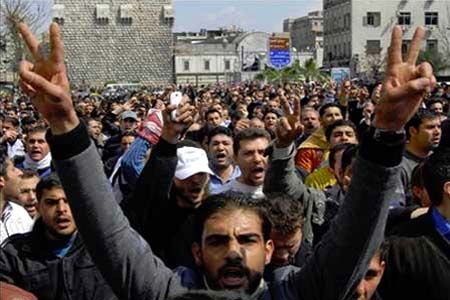
In Defence of the Syrian Revolution: The Marxist position on the revolution and Assads so-called anti-imperialism Part One<http://www.marxist.com/in-defence-of-the-syrian-revolution-the-marxist-perspective.htm> Written by Farshad Azadian and Basel Sulaiman Thursday, 15 March 2012 [image: Print]<http://www.marxist.com/in-defence-of-the-syrian-revolution-the-marxist-perspective/print.htm#> *It is a year since the Syrian masses rose up against the Assad regime. Since March 2011, the Syrian people have faced the open brutality of the state in wave after wave of mass demonstrations, strikes and civil disobedience. These movements arose in response to the stifling dictatorship, and against the massive inequality, unemployment and poverty in Syrian society.* [image: Demonstration]<http://www.marxist.com/images/stories/syria/Demonstration.jpg>Estimates put the total number of civilians killed by the regime at anything between 7,500 and 9,000, according to various sources, with the death toll increasing every day. In addition, there are reports that many soldiers refusing to carry out orders to kill civilians have been executed. Summary executions, torture and mass imprisonment have been the methods used by the Assad regime to curb the revolutionary movement in Syria. State brutality has only served to re-double the efforts of the revolutionaries. The Syrian revolution, once limited in its ability to reach into Damascus and Aleppo, has shifted over the past months. Aleppo, the industrial and commercial hub of Syria, saw a mass campaign of civil disobedience in response to a call for a general strike in December 2011. Most important has been the spread of the movement to Damascus, the countrys capital, which is seen as a regime stronghold. Over the past period massive funeral processions have been held in Damascus, which turned into demonstrations. This indicates a shift in the political situation in favour of the revolution among some layers. Thousands of soldiers and military officers have defected from the regime and have established the Syrian Free Army (FSA). This revolutionary army has been used to fight the old state apparatus and protect demonstrators. In the face of the massacres, many civilian protesters have decided to join this revolutionary army, with the ranks swelling to upwards of 10,000 to 20,000 according to some estimates. In certain areas, and for short periods, the old regime lost control and there has been the tendency to set up Peoples Councils that carry out all manner of activity, including security, healthcare, holding peoples tribunals, distributing food and protecting refugees fleeing repression. We had the short-lived example in the town of Zabadani, which is just 50km away from Damascus, where the old state apparatus was replaced by the *Free Local Council of Zabadani<http://www.marxist.com/declaratio-of-the-free-local-council-of-zabadani.htm> *, where every thousand residents elected a representative to the council. The council also had representatives from religious minorities and military defectors. The town was under popular administration for several weeks before, unfortunately, finally being crushed by the army. In this article, we outline what we believe should be the Marxist position in relation to the Syrian revolution, the imperialists and the tasks that lie ahead. It is the task of Marxists to support the revolutionary Syrian people in overthrowing the brutal Assad regime, and to patiently explain the way forward. We have to look at reality and understand that the Syrian revolution has many obstacles ahead of it, *not least of which is the role of the so-called leadership of the movement itself.* This leadership has a political programme that does not meet the real needs of the Syrian masses. The result has been limited working class action against the regime, in the form of industrial strikes, which could easily paralyze the regime. This is a key element in understanding why the revolution has not been able to go further than many activists had originally hoped. It explains also why the regime has managed to at least hold back a sufficient layer of the population from going over to the revolution, thus maintaining a base from which to repress the revolutionary movement. It has to be stated clearly that it is the failure of this leadership of the movement that has allowed Assad to do this. For the Syrian revolution to finally succeed it must win over a decisive layer of society, in particular the working class masses. Otherwise, the revolution could become prolonged, or even placed at risk altogether. In such a situation the vacuum that has been created is being filled by other forces, counter-revolutionary elements, who aim to hijack the legitimate movement of the masses and exploit the peoples desire for change to introduce their own reactionary agenda. We also write this article in light of the treacherous position some on the left have taken in supporting the Assad regime on the basis of his supposed anti-imperialism. This position ends up concretely as one of defending the counter-revolution that has the blood of thousands of revolutionary martyrs on its hands. These people incorrectly credit their position to the ideas of Marxism, whereas in fact they are a complete distortion of the ideas of Marx and Lenin. This is unforgivable, especially at a time where it is precisely the ideas of Marxism that are so relevant to the courageous struggle of our brothers and sisters in Syria. Some Leftists defend the counter-revolution It is an unfortunate fact that some organizations, which claim to be leftist, have adopted a position mirroring the propaganda of the Assad regime where the revolutionary movements are presented as an imperialist conspiracy or an Islamic take-over. Some groups have even described the Free Syrian Army (FSA) as being merely a band of thugs. Once one abandons a Marxist perspective in analysing the processes taking place in Syria, it is not surprising that such distorted analysis can take place. It must be bluntly said that those who take such a position are concretely taking the side of counter-revolution. The position taken by publications such as the *Peoples Voice*, which is associated with the Communist Party of Canada (CPC), exemplifies this absurd stance. In two articles published in the *Peoples Voice *(Vol. 19, Issue. 2), the magazine takes a vocal position in opposition to the Syrian revolution. It warns of the usurping of the popular revolt by imperialist-backed forces masquerading as revolutionaries, and then aims heated criticism at the Free Syrian Army, which it describes as paramilitary gangs. According to the *Peoples Voice*, this movement is trying to dislodge Syria from its nationalist, objectively anti-imperialist positions. The conclusion of the article is that the *Peoples Voice* calls on the Assad regime to concede reforms. It declares, serious concessions to the working class, including an empowerment of working people in a strong national front, could redress the course of events. These articles are a complete distortion of the Marxist position on Syria, and can only serve to disorient revolutionary-minded youth and workers in Canada and beyond. All this has also contributed to the significant suspicion among the Syrian masses and revolutionaries towards leftists in general. This suspicion is understandable given that thousands are being killed by a regime to which such communists are lending support. The Character of the Revolution The mass movement in Syria has, from the beginning, been directed through bodies called local co-ordination committees which are the grassroots and functional vehicles through which the anti-Assad movement has been organized. These existed before the formation of the Free Syrian Army. They have important political weight in the revolution, and control much of the situation on the ground. They have provided the movement with an important strength, and had until recently prevented the drift towards an ethnically based civil war. The Free Syrian Army (FSA) was formed through army defectors and civilians who decided to take up arms against the regime. It was built in direct response to the mass murder by the police and the army of protesters who lacked any means of self-defence. Furthermore, soldiers who refused to carry out orders to attack protesters were being executed as deserters. Far from the gangsters the *Peoples Voice* describes them to be, the mass movement overwhelmingly supports the FSA and droves of civilians have joined as volunteers. The FSA is a spontaneous creation of the revolution, and if it had the correct leadership has the potential to directly undermine the old state apparatus in favour of one directly controlled by the people. Of course, the FSA is a heterogeneous body, and is not without its own contradictions. Just as in the rest of the Arab revolutions, there is significant political confusion among the Syrian masses. The FSA leadership has insisted on the army having no political views under the guise of maintaining unity. But how can they demand that the defecting soldiers and volunteers should have no political views? They are clearly concerned that they may lose control of the fighting forces on the ground. The fact is that the pressing political questions must be debated within the mass movement and it is vital for a political and economic programme to be developed. Indeed, it is precisely this lack of political direction that has left the Free Syrian Army (FSA) open to attempts at hi-jacking by forces within the Syrian elite who are represented by the Syrian National Council (SNC). It is now becoming clear that the FSA leadership have very limited control over the fighting units that have been receiving almost no support from it and are increasingly flooded with civilian volunteers linked directly to the movement. In this vacuum of leadership the Gulf States have started funneling money to certain groups that meet their own reactionary agenda. However, the scale of this operation is still unclear. The SNC is the major organized opposition, and includes within its members the Muslim Brotherhood and bourgeois liberals. It is also clearly tied to the imperialists, who are using it is an instrument to push their own agenda within the country. However, it is also true that the SNC lacks a significant base on the ground in Syria and has little control over the revolutionary struggle in the streets. The reactionary nature of the SNC is testified by its repeated calls for foreign intervention in Syria, something which Assad can easily exploit, considering the strong anti-imperialist sentiments among the bulk of the Syrian people. The fact that the SNC refused to support the FSA for many months, is also indicative of the fact that their aim is not genuine revolution, with real power going to the working people, but merely a regime change according to the interests of imperialism, whereby power would shift from the present regime to a pro-western, pro-capitalist regime. Because of this, there is massive frustration and even anger developing against the SNC (and even the leadership of the FSA to an extent) for its complete inability to coordinate and direct the revolution. Even in purely humanitarian terms, the SNC is seen as being seriously at fault. It has been receiving millions of dollars in donations, but it has failed to even provide humanitarian support to the refugees in neighboring countries, to the families of victims inside the country, or to the fighters of the FSA on the ground. The popular mood is increasingly becoming one of condemnation of the complete failure of the SNC even in these smallest of tasks in providing aid. There has been a sharp realization in the recent period that we have to depend on ourselves and that we are being lied to. This indicates that among some layers at least there is a growing realization as to the real nature of the SNC. It is in fact this so-called opposition that has served to weaken the revolution. The fact that the SNC is prepared to call for imperialist military intervention, while opposing the masses taking up arms, exposes their real role and the interests it actually defends. It was in fact only under massive pressure that the SNC was forced to change its position towards the FSA. It did this for tactical reasons so as to maintain a degree of authority in the eyes of the Syrian people. This has led to a shift in its strategy, from opposition to the FSA, to an attempt to take control of the FSA. In this process they clearly aim to isolate the genuine revolutionaries and promote the more reactionary elements. In this Saudi Arabia and Qatar are spearheading the counter-revolution and promoting their own agents within the revolution to undermine it and move it in the direction of counter-revolution as they have done in the Arab world from Morocco to Bahrain. This has led to conflicts between the people fighting on the ground and the exile leaders. General Dempsey, Chairman of the Joint Chief-of-Staff of the USA, recently stated that he believed the armed opposition in Syria to be linked to Al Qaida. According to Dempsey therefore, the USA should not provide military aid to the revolutionaries. That the highest-ranking military officer in the USA can issue such a statement is indicative of the suspicions of the imperialists towards the Free Syrian Army. They do not know who they are dealing with and therefore they do not trust them. They want an armed force that can be trusted to establish a new regime based on the interests of imperialism. That they do not see in the FSA as it is now. Having said that, just as in Libya, it would be logical that Al Qaeda and other Islamic fundamentalist outfits would attempt to infiltrate its forces within the FSA, and exploit the lack of clear revolutionary leadership to push its own reactionary agenda. And it is precisely this that the regime is exploiting in its attempt to portray the whole opposition as rabid fundamentalist reactionaries. This independence of the FSA from direct control of bodies like the SNC is a major cause for concern for both the Syrian elite organized in the SNC and the imperialists. In fact, some sections of the US ruling class perceive Assad to be a more reliable partner in the region. They fear the Syrian revolution and are concerned that a post-Assad Syria may be less willing to co-operate with them. The Communist Party of Canada, in condemning the Free Syrian Army (FSA), is actually taking a very similar position to the imperialists, despite utilizing empty anti-imperialist rhetoric. As we have said, the SNC is actively trying to take control of the leadership of the FSA. Despite the supposed political neutrality of the FSA, some of its leaders ignoring their own calls for a non-political stance have publicly called for the establishment of no-fly zones. This reflects desperation at their military weakness faced with the far superior military clout of the Assad regime, but it is a completely incorrect position, and actually plays into the hands of Assad, who is attempting to portray the revolution as a plot hatched by the imperialists. It also reveals that where there is no clear political programme to which the Syrian people can keep their leaders accountable, reactionary proposals can come to the fore. To call for outside imperialist, military intervention is an outright betrayal of the revolution. Despite this weakness of the leadership, the development of an organization of the armed people is an important and progressive step forward. However, the fact that the Syrian regime, with its sophisticated army, has struggled to achieve an outright defeat of this revolutionary army is itself a testament to its popular support it indicates precisely the fact that it is *not* a paramilitary gang, as some would assert. Without mass support, the FSA would not have survived a week against the vastly superior army under Assads command. However, the revolution has suffered some serious setbacks, in particular in Homs and Idlib, which were strongholds of the revolution. Civil war, which initially was resisted, is now becoming more of a danger as the Assad regime exploits the weaknesses of the revolution and attempts to divert attention along ethnic and religious lines. The latest massacre of Karm Al-Zeitoun in Homs in which Aliwaite militiamen are reported to have raped and killed 50 Sunni women and children has provoked a massive sectarian backlash as the anger of the victims is directed against Alawites in general. This is clearly a conscious policy of the regime to solidify support among the Alawites, who in turn will feel threatened by the revolution! The likelihood of a sectarian bloodbath is therefore becoming more real by the day and it is a very real danger especially as the regimes militias are carrying out systematic killings in Homs. The regional reactionary regimes, such as Saudi Arabia, are also complicit in this fomenting of ethnic conflicts. Since they have not been able to control the situation they would rather things fall apart so that then they can come in and pick up the pieces and divide them among themselves. The imperialists scramble for Syria To understand the relationship of imperialism to Assad, it is vital to examine the history and development of the economy of Syria. Later we examine this in greater detail. Simply put, the Syrian economy at one point was largely planned and nationalized. However, after the collapse of the Soviet Union the Assads adopted the Chinese Model of the restoration of capitalism, which resulted in a massive expansion of private property, greater foreign investment, and the growing inequalities in Syria. This was a significant factor leading to the current revolution. The labels of anti-imperialism and progressive, that some place over the regime, are therefore totally false. At best, Assad at certain moments in recent years has had conflicting interests with certain sections of the world imperialists, while leaning on other sections. Assads relationship with Putins Russia that has come to the aid of the regime and has supported his counter-revolutionary violence is a case in point. Russia has major economic interests in Syria, both in terms of investments and in terms of arms trading. It has also important strategic interests in Syria, which allows the Russian navy and armed forces the usage of its territory. It is these cynical and narrow imperialist interests of the Russian capitalist class that have led it to continuously come to its aid. It is undoubtedly true that the various imperialist countries are intervening in the movement in Syria. This is not at all surprising, given the economic importance of the Middle East, and the vital strategic position of Syria. The various imperialist powers are jockeying to assert their own interests in Syria. The Russian, Chinese and Iranians have openly sided with the Assad regime, and are lending military assistance to it. On the other side, the United States, Canada, Israel, the Arab Gulf States and various NATO powers are divided over how to deal with Syria. These very same imperialist powers in the past were happy to do business with Assad, and responded very positively to his liberalization programmes and his assistance in creating stability in the region. Now they sense that Assads days are numbered. This is the source of the contradictory position of these imperialist powers. They fear a post-Assad Syria, but are also trying to assert their influence within the movement that seems likely to eventually overthrow Assad in order to protect their interests in the country. This is a serious danger to the Syrian revolution. The Western imperialists, and their allies in the Gulf States, are attempting to hijack and derail the revolutionary movement. Their intervention in Syria, which includes their links to the Syrian National Council (SNC), has served to create confusion and has weakened the revolution. It has also strengthened the Assad regime by helping him justify the repression of the movement. It is the duty of Marxists to expose the influence of the imperialists within the Syrian revolution. After Assad falls, the Syrian elite and the imperialists will be concerned about re-asserting their interests and effectively maintaining the old order, and carve up the wealth of the country. They are concerned that an armed and revolutionary people would be a major obstacle to this goal. Abandoning a revolutionary perspective The position taken by the Communist Party of Canada (CPC), like so many so-called Communists around the world, in the midst of the current revolution is that the Assad regime is objectively anti-imperialist, that should, however, enact certain pro-worker reforms. This is an absurd position, which is abstract at best. Assad is clearly carrying out a brutal counter-revolution, and the CPC is asking the counter-revolution to carry out pro-worker reforms. It is precisely the Assad regime that has carried out the anti-working class reforms and liberalization process, and reversed many of the historic gains won by the toiling masses in Syria. To create illusions that Assad would carry out such reforms is at best to confuse the people. To make such a demand for Assad to carry out reforms in the current context means precisely siding with the counter-revolution. Hundreds of Syrians are being killed every day in the midst of this revolutionary struggle. For Assad to carry out the reforms asked by the CPC, it must first crush the mass movement. No matter how much this position is prettified, Assad is carrying out counter-revolutionary mass murder, and the CPC is supporting him. This is a betrayal of internationalism and reflects the abandonment of Marxist theory. The position of the CPC in reference to calling for the Assad regime to make reforms and build a *strong national front* is particularly pernicious given the role of its sister organization, the Syrian Communist Party, in being a loyal partner of the Assad regime in its *Progressive National Front*. The Syrian Communist Party (SCP) has for decades been backing the regime while it carried out the most severe repression (including against the SCP itself!), with the complete destruction of independent workers organizations, the institution of a one-party system and carried out a programme of liberalization, i.e. privatisations, in the country. While occasionally raising token criticism (as the articles in the *Peoples Voice* have done), the Stalinists have played a treacherous role in Syria. This has made the work of genuine revolutionaries even more difficult, for it sends out a message that the left internationally supports the Assad regime! The criminal position taken by these so-called communists, which is rooted in their Stalinist ideology, is particularly serious as it damages the very name communist among the masses just when genuine Marxist ideas are most relevant to the Syrian people today. The duty of genuine Marxists is to expose the attempt by the imperialists to hijack the revolution. Furthermore, the Syrian revolution requires Marxist ideas if it is to succeed in bringing genuine democracy, and solving the pressing economic and social needs of the people. Only a socialist Syria, based on workers democratic control of a nationalized economy, can solve the contradictions within Syrian society that led to the revolution in the first place. The Communist Party of Canada (CPC) is not the only left-wing tendency that has put forward this, or a similar, position in relation to Syria. We have focused on the CPC because of its vocal position in this regard, and because of the positions adopted by its sister organization in Syria, the Syrian Communist Party, which has played a very negative role in the revolutionary events in that country. Having said this, it is also necessary to distinguish between the leadership of an organisation like the Syrian Communist Party and the ordinary rank and file left and Communist youth that has been actively participating in the movement widely. It is to their credit that they have sided with the revolution, and it is among this layer that we will find some of the best worker and youth activists who can play a key role in spreading the ideas of genuine Marxism. It is outside the scope of this article, but worth noting also, that a similar logic that is applied by some leftists to Syria is also extended to the situation in Iran today and Libya under Gaddafi, where they also perceived anti-imperialist regimes. Our aim is to clarify the genuine traditions of Marxism and Leninism, as relevant to the situation in Syria, and to clear away any confusion that may exist among genuine revolutionaries on this important issue. Therefore, in Part Two of this article, we elaborate on the historical and social factors that have contributed to the Syrian revolution, and the political programme with which the revolutionaries in Syria must arm themselves in order to ensure the swift defeat of Assad. *[To be continued...]* [Non-text portions of this message have been removed] ------------------------------------ --------------------------------------------------------------------------- LAAMN: Los Angeles Alternative Media Network --------------------------------------------------------------------------- Unsubscribe: <mailto:[email protected]> --------------------------------------------------------------------------- Subscribe: <mailto:[email protected]> --------------------------------------------------------------------------- Digest: <mailto:[email protected]> --------------------------------------------------------------------------- Help: <mailto:[email protected]?subject=laamn> --------------------------------------------------------------------------- Post: <mailto:[email protected]> --------------------------------------------------------------------------- Archive1: <http://www.egroups.com/messages/laamn> --------------------------------------------------------------------------- Archive2: <http://www.mail-archive.com/[email protected]> --------------------------------------------------------------------------- Yahoo! Groups Links <*> To visit your group on the web, go to: http://groups.yahoo.com/group/laamn/ <*> Your email settings: Individual Email | Traditional <*> To change settings online go to: http://groups.yahoo.com/group/laamn/join (Yahoo! ID required) <*> To change settings via email: [email protected] [email protected] <*> To unsubscribe from this group, send an email to: [email protected] <*> Your use of Yahoo! Groups is subject to: http://docs.yahoo.com/info/terms/