http://www.marxist.com/egypt-how-do-we-fight-the-counterrevolution.htm
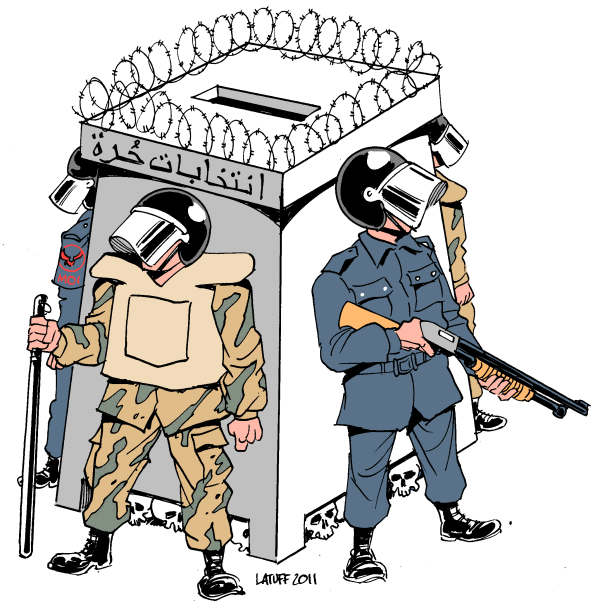
Egypt: How do we fight the counterrevolution?<http://www.marxist.com/egypt-how-do-we-fight-the-counterrevolution.htm> Written by Alan Woods Thursday, 21 June 2012 *The Egyptian revolution has taken a new turn in the last few days. The ruling Military Council (SCAF) has launched a number of very serious attacks on the revolution. The military police can now arrest civilians at will and parliament has been dissolved. The generals have also announced additions to the Constitutional Declaration of March 2011 which give them virtually unlimited powers. What was supposed to have been the first democratic presidential elections in the history of the country has ended in a farce and a power struggle between two rival factions of the Egyptian bourgeoisie: The Muslim Brotherhood and the Armed Forces.* [image: Egypt elections Latuff]<http://www.marxist.com/images/stories/egypt/Egypt_elections_Latuff.gif>It is true that Mursi and Shafiq are not the same. The Muslim Brotherhood is not the main counter-revolutionary current, at this moment, but it is certainly not a revolutionary force, and never has been. It represents that wing of the Egyptian bourgeoisie that was excluded from state power for decades and is demanding its share of power, together with the wealth and privileges that go with it. It initially did not support the movement against Mubarak, but it saw the fall of Mubarak as an opportunity to work with SCAF so the Muslim Brotherhood could take a role in government. It therefore jumped on the bandwagon when it was already rolling, but at every step it has striven for a deal with the generals and the old regime. It seeks, not to overthrow the regime but to reach a compromise with it. That is why for most of the last year the Brotherhood has worked closely with Scaf, but, to its dismay, instead of being rewarded for its services, it has been kicked in the teeth. The last round of the presidential election pitted Mohamed Mursi of the Brotherhood against the generals candidate, Ahmad Shafiq. The official results have not yet been published, but it is clear that Mursi won. Yet Shafiq is claiming victory. This is a ceremony of confusion on a grand scale. It is designed to confuse and disorient the masses, in order to prepare the way for a counterrevolutionary offensive. This has already begun. On Friday 15th of June the Supreme court The court's overturned a law passed by the Islamist-led parliament that barred senior officials from the Mubarak government from holding office, clearing the way for Ahmad Shafiq to compete in a presidential run-off election on Saturday and Sunday. But what was to have even more consequences was when the Mubarak appointed justices - citing legal problems with the last round of parliamentary elections - called for the Islamist-led parliament to be dissolved. As if this were not enough, the hated emergency laws, which were lifted only weeks ago, were replaced with similar laws which give the army the right to arrest civilians and try them, even for minor crimes. On Sunday night, few hours after the conclusion of voting, the SCAF took further steps to consolidate its position. It issued amendments to the Constitutional Declaration that will limit the powers of the coming president and expand the military's role, notably giving it a heavy influence over the writing of the country's next constitution. The amended Article 60 gives the SCAF the power to potentially appoint a Constituent Assembly to write the next constitution if the current assembly fails to complete its mandate. The current assembly was elected by a Parliament that was dissolved last week by court order. The Constituent Assembly is required to complete its work within three months and then put its draft to a popular referendum. All these measures, when taken together, amount in effect to a coup détat. They would signify a de facto annulment of all the gains of the Revolution and its juridical liquidation. Because the Revolution was not carried through to the end, and the old state apparatus remained intact, such a development was inevitable. The military coup has been in the making for a long time. What happened during the last week was the culmination of a process that had been going on for months. The problem became visible with the reaction to the sentencing of former dictator Hosni Mubarak on 2 June. There were protests, but they were much smaller than before. They have consistently been testing the ground for an offensive over the last year and in a specifically intensified manner over the last few months. The fact that there has been a certain falling-off in the response of the masses to the provocations has played a decisive role. The June 2 demonstrations were the clearest expression of this fact. This gave the SCAF confidence that it could act without facing a strong reaction. The generals growing confidence led them to think they could take on the Muslim Brotherhood. The end of illusions The initial stage of the Revolution was characterised by the lack of a clear programme and a certain naivety, especially with regard to the role of the Egyptian army. Now the revolutionaries are learning to abandon their naive illusions on the basis of harsh and bitter experience. The Egyptian army is not a homogeneous organism. It reflects the class contradictions in society. While the rank and file of the army, and big sections of the lower officers, sympathised with the Revolution and refused to fire on the people, the upper ranks consisted of hardened supporters of the old regime. Corrupt to the marrow, the generals owed their privileged life style to the plundering of the state and control over profitable parts of the economy. They will never relinquish these privileges without a fight. Their actions were perfectly predictable. A Jadalliya article (6 June, 2012) puts the question very clearly: The junta wants to leave, head back to the barracks, with legal, political, and constitutional assurances that their position, privileges, control over the economy, and decision making, remain unchanged. In short, they dream of the old Turkish model. However, the Revolution itself showed that the generals are not all-powerful. On the contrary, there are definite limits to their power. As in mechanics, so in politics, every action produces an equal and opposite reaction. In attempting to hijack the Revolution by stealth, the generals will provoke a reaction on the part of the masses, who are beginning to understand that in order to secure their goals, it is necessary to go further. On Friday (the day the parliament was dissolved) Jack Shenker the Guardians correspondent in Cairo wrote: There is a huge amount of anger and frustration, but people are struggling to find an outlet for it. People are beginning to see Tahrir Square as a trap - a kind of sanitized space in which forces behind the status quo allow dissent to be aired. A place where people can let off steam but ultimately a kind of contained urban space in which nothing changes. After the Mubarak verdict people flocked to Tahrir square in quite large numbers. There was an element of festivity, an element of anger. The security forces kept their distance and after a couple of days everyone went home and life went on the counter revolution went on. People fear that the military generals have found a way to co-opt Tahrir into their own authority, where mobilization doesn't really threaten the course of institutional politics. This has led to a lot of disillusionment. People are not sure where to take their protests and where to take their energy. We will see people in the square but whether that reaches critical mass remains quite doubtful at least for now. But that may change after the election especially if Shafiq is triumphant. In the last period the SCAF have orchestrated a massive campaign in all the media in order to instil fear of chaos into the minds of the people. The police have not been upholding law in the streets, allowing the criminal element to carry on their crimes undisturbed, in order to create a general feeling of insecurity. The aim is to push parts of the middle classes and the lumpenproletariat towards counter-revolution and Shafiq. If we add to this an inevitable element of tiredness after months of upheavals, it is easy to see how the counter-revolution has recovered its nerve and is becoming more consolidated, confident and strong. Nevertheless, the reactionaries are still very weak compared with the revolutionary potential of the masses and especially the working class. That potential is still very strong, but it lacks an organized outlet and a clear political expression. *That is the central problem of the Egyptian Revolution. * The role of the Muslim Brotherhood The leaders of the Muslim Brotherhood have been acting in the worst possible way, even from the point of view of consistent bourgeois democracy. In the most cowardly fashion they have accepted all the impositions, intrigues and manoeuvres of the generals. Simply by participating in the second round of the elections they provided a respectable cover for the counterrevolutionaries. Now, having collaborated with the generals for months, they are screaming that they have been cheated. Of course! This is not a game of chess where the rules are established in a handbook. The generals are fighting to save their power and privileges, and that means a fight in which no blows are prohibited. Yesterday the Muslim Brothers called a protest demonstration, which, to judge by the pictures, was big. From a distance it is impossible to get an accurate idea of the mass character of the demonstration. It is possible that it was mainly the activists, campaigners etc. There are some dangers in this. In such moments the advanced elements can run too far ahead of the masses, who may be tired and confused. This may lead to defeats. The masses need time to absorb the lessons and draw conclusions. It was clear that a lot of the revolutionary organisations (Such as the April 6 youth movement) also supported the protest yesterday. Was this correct, or not? Of course, it was correct to come out onto the streets to protest against the activities of the counterrevolutionaries. To demonstrate on the streets together with members of the Muslim Brotherhood was quite correct and necessary. *But to protest against the counterrevolutionaries is one thing; to support the MB, to call for votes for it and to advocate the entry of the Left parties into a coalition government with them: that is another thing altogether*. Role of the Stalinists Some parts of the revolutionary movement, such as the April6 youth movement have consistently called for non-politics i.e. they have turned their backs on politics and taken no political positions. But by aiming at the lowest common denominator, they have played a particular harmful role because they help to perpetuate the bad political line of the existing parties and hold back the development of a genuinely revolutionary political consciousness of the youth. On the other side, the role of the Stalinists has been particularly harmful. Probably the biggest party on the Left is the Tagammu Party, which is led by ex-Stalinists. On 30 June Egypt Independent reported the chairman of the Tagammu Party Refaat al-Saeed as saying that revolutions in the Arab world "are not coincidence, but have foreign parties that seek to spread chaos and change the systems of governance behind them. This is exactly the same language used by the counterrevolutionaries who seek to discredit the Revolution by attributing it to foreign forces. In exactly the same way, the Russian counterrevolutionaries accused Lenin of being a German agent in 1917. We would like to ask the leaders of Tagammu: which foreign forces were behind the overthrow of Hosni Mubarak? You cannot say that the Americans or Israelis were responsible, because both had excellent relations with Mubarak and his regime and had no interest in overthrowing it. Maybe it was Russia or China? We do not think so. Perhaps Tahrir Square was organized by men from the plant Mars? In a meeting Thursday with members of al-Rowad Club in 10th of Ramadan City, Saeed also called the idea of forming a presidential council unacceptable. He said the council, which would bring together former presidential candidates Hamdeen Sabbahi and Abdel Moneim Abouel Fotouh, and possibly Mohamed ElBaradei, to form a civilian government, would be a late step even if it gained the consensus of the [people] in the street. Such a council and its composition would prove highly divisive, he said. Here the art of sophistry reaches heights never seen before. Opposition to the military that is to say, to the old regime, is presented as divisive! The leaders of Tagammu have apparently not noticed that Egyptian society was divided long before the occupation of Tahrir Square divided into rich and poor, workers and bosses, oppressors and oppressed. Instead of reading us pompous homilies on the evils of division, they should make it clear on which side of the social divide they stand and whose interests they represent. "Do Tahrir demonstrators represent all the segments of the society? he asked. If so, then where is the right of other squares all over Egypt to choose the presidential council?" Comrade Saeed evidently suffers from serious memory lapse. Has he already forgotten that just a few months ago, the squares and streets all over Egypt were packed with people demanding the overthrow of Mubarak and his corrupt regime? It was the squares all over Egypt that overthrew the hated regime of Mubarak. And they did this without any assistance from foreign sources. The problem is that they did not carry their Revolution forward to destroy the entire rotten edifice of state power on which Mubarak rested; they did not expropriate the bankers and capitalists; they did not purge the old army generals, police chiefs, judges and bureaucrats. That is the reason why the Revolution now finds itself in danger. The report concludes: The greatest danger of the presidential council, he said, is that it could bring into question a transfer to civilian power. He also urged the Egyptian people not to boycott the runoff elections. Citizens should respect the results of the election, he said, because rejecting them would worsen the situation and lead to grave consequences. In his speech, Saeed also worried that disputes and divisions in Egyptian society could lead to the collapse of the state. Isnt this incredible? According to this leftist, the way to establish a civilian government is to hand over power to the candidate of the military! He urges the Egyptian people not to boycott the runoff elections, that is to say, to accept the rules of the game invented by the generals to perpetuate their rule. He warns the citizens that not to accept the result of rigged elections, not to accept the victory of the candidate of the counterrevolution, would lead to grave consequences, that is, disputes and divisions in Egyptian society could lead to the collapse of the state. What state are we talking about here? A journalist of Democracy Now explains: But what is clear is that the military council has really taken control of the basic aspects of what we were supposed to have been building in a post-Mubarak state these last 16 months. I mean, we spent three months going to parliamentary elections, and thats just been voided. Theres been no reform in the security apparatus. Theres been no reform of the media. Theres been no reform of the judiciary. So, really, the Mubarak regime is still very much in place. And to top it all off, its last prime minister is now in a runoff against the Muslim Brotherhood, which is really the same political landscape that Egypt has had for many decades now. On top of this the hated emergency laws which were lifted only weeks ago were replaced with similar laws which give the army the right to arrest civilians and try them. On Monday they added to this by revising the constitution to give the SCAF veto powers in all major questions regarding the constitution and foreign policy. >From these lines it is very clear that, far from fearing the collapse of *this *state, it is the duty of all genuine revolutionaries to work to bring about the collapse of the old bureaucratic-military state the state of the oppressors of the Egyptian people and to create a new and genuinely democratic state based on the rule of the majority the workers and peasants. It is precisely because the Revolution stopped short of this objective that the forces of the old regime are attempting to make a comeback. They are trying to turn the clock back, to liquidate the Egyptian Revolution and to place a heavy army jackboot on the neck of the people. Faced with such a prospect, every communist and socialist, every class-conscious worker and progressive intellectual, every consistent revolutionary democrat must fight to defeat the counterrevolutionaries. To their eternal shame the leaders of Tagammu stand on the wrong side of the barricades: against the revolutionary people, with the counterrevolution. A question of leadership As time passes the need for a revolutionary party and leadership becomes more and more obvious. But this does not exist, or it exists only in an embryonic form. The Revolutionary Socialists had a chance to raise themselves to that level. They have a base among the youth, they have some influence within some workers and thanks to their tireless work they have authority within Tahrir. But all these achievements will count for nothing without a correct revolutionary line. We have already commented on the position these comrades have taken towards the Muslim Brotherhood. Not only did they call for a vote for the MB in the second round of the elections; they actually call for the formation of a collation government of the MB and the Left to save the Revolution. This is a fundamental mistake. To make matters worse, while adopting a highly conciliatory attitude towards the bourgeois MB, they have displayed a sectarian approach towards the workers movement. This is precisely the opposite of what we expect from Marxists, and it has isolated them. After the coup the RS made a statement that is quite good in its content, but it displays a lot of pessimism and disorientation in its conclusions. This pessimistic appraisal, which reflects a complete lack of faith in the masses and the working class, leads them to completely false political conclusions. On the one hand, the RS say that since 11 February 2011 the Brotherhood has been a conservative organisation. On the other hand they say that it is * part of the revolutionary movement*. Thus, instead of correcting their mistake, they are repeating it and deepening it. They say: We are calling on revolutionary forces to build a mass movement against the coup and the changes to the Constitutional Declaration. *These revolutionary forces include the Muslim Brotherhood.* This is entirely false. The Muslim Brotherhood has never been a revolutionary force. The leaders of the Revolutionary Socialists have made a mistake that is the inverted mirror image of the mistake of the leaders of Tagammu. The latter oppose the Muslim Brotherhood but have taken an even worse position, supporting the openly counterrevolutionary wing of the Egyptian bourgeoisie. Insofar as the Muslim Brotherhood that is, the oppositional Islamist wing of the bourgeoisie, is compelled to oppose the counterrevolutionary wing (the SCAF) in deeds, not just words, we will participate in any action that tends to mobilize the greatest number of people against the regime. But we will do so under our own banner, with our own revolutionary slogans, which aim to unmask and discredit the Muslim Brotherhood, not spread illusions in their revolutionary credentials. We must understand that the bourgeois leaders of the MB are not at all revolutionary, that they will call for actions against the regime only with the greatest reluctance, that they will do everything in their power to limit and hamper the masses from taking real revolutionary action, that they only lean on the masses in order to extract concessions for themselves, and that they will detach themselves from the mass movement the moment they extract even minor concessions. The task of the Revolutionary Socialists is not to pant the bourgeois Muslim Brotherhood as part of the revolutionary movement, to call on the workers to vote for them and to demand a coalition government including the MB. It is to utilise each and every opportunity to expose the MB in the eyes of the masses and to tear away the masses from the pernicious influence of the Brotherhood. What is our attitude? I have written about the first round of the election, which was the most interesting part of the election, although the second round also showed some interesting developments. Probably we will ever know what the real result was, but it is clear that there was heavy rigging. All credible sources indicated that 15-20% of electorate had voted, but the official figures (which have been leaked) point to above 45% (the same or more than the first round). This is a joke. There were clearly a huge number of abstentions, reflecting disgust and disillusionment with the rigging of the first round. Many people favoured a boycott, which under these circumstances was the only correct tactic. As Omar Kamel, an Egyptian activist put it: Given a choice between eating shit or eating shit, most Egyptians have decided theyre not hungry, At the same time, there is massive anger towards the SCAF because of the dissolution of the parliament and similar measures. Somebody on Al Jazeera said some something on these lines: We know that the corrupt bastards in parliament were no good, but the SCAF had no right to dissolve the parliament. This accurately sums up the position. The clash between the army and the Muslim Brotherhood has led to open war between the two antagonistic camps of the Egyptian bourgeoisie. The working class does not support either of these wings of the bourgeoisie. But we are not at all indifferent to this struggle, which now dominates the political life of Egyptian society. What attitude should the Egyptian Marxists take in relation to the dissolution of parliament? On the one hand, we have no illusions in parliament in general, and even less in this particular parliament, which stands in the same relation to a normal bourgeois parliament as a castrated tom-cat to a lion. It is a miserable caricature. Yes, of course! *But at the same time, we must fight against any attempt of the old regime to disband it, because this would mark a step back for the Revolution and a victory for the counterrevolution*. No doubt the generals are now puffed up with a feeling of superiority and exaggerated confidence that may prove to be a serious mistake. The open agents of the counterrevolution gathered round Shafiq are proclaiming themselves as winners. This is a blatant provocation, which is provoking a storm of indignation in the population. It is possible that this provocation will lead to a further radicalization of the Revolution. That is why the American imperialists are so cautious in their public declarations. There can be little doubt that despite their democratic phrase mongering, Clinton and her fellow gangsters would not be too upset if the generals were once again in the saddle. But they fear that a premature move in that direction might lead to new and uncontrollable explosions. For this reason, Washington is carefully establishing contacts with the leaders of the Muslim Brotherhood. Key role of the working class The revolution is not a triumphal march. It will last for several years, with inevitable ebbs and flows. The counterrevolution is on the offensive, as it was in July and August in the Russian Revolution of 1917. But that was followed by a further, even more powerful movement in the direction of revolution, culminating in the Bolshevik Revolution. The Russian Revolution was achieved in the space of just a few months because of the presence of the Bolshevik Party under the leadership of Lenin and Trotsky. If such a party existed in Egypt, the working class would already be in power. It is the absence of such a leadership that has so far prevented the Egyptian Revolution from achieving its goals. The revolutionary masses have repeatedly displayed their fighting potential in a whole series of street protests, occupations, and strikes. It is the strength of the mass movement, and not any combinations at the top, which will force the junta to retreat. Deals with the Muslim Brotherhood will have precisely the opposite effect. They weaken the class consciousness of the masses and encouraging them to accept the role of passive spectators in the parliamentary game and looking to the politicians to solve their problems, instead of trusting their own strength. . Not electoral combinations and deals but strikes and demonstrations are the only hope for toppling the regime. What is required is an all-Egypt general strike, linked to the demand for the overthrow of the old regime. That can only be prepared through an intensification of the street protests and strikes, which should combine demands for bread, work and houses with consistent democratic slogans, especially the slogan of a revolutionary constituent assembly. The main motor force of the Egyptian Revolution is the working class. The strike wave has entered its sixth continuous year, with no end in sight. No presidential candidate, no mullah and no army general can stop it, because none of them can offer any solution to the real and pressing problems of the workers and their families. These strikes have brought the workers repeatedly into direct confrontations with the army. The workers are learning through experience that as long as the military junta remains in power, no solution is possible. The workers struggle is, of necessity, a political struggle. The workers struggle has also brought them into conflict with the Muslim Brotherhood, who represents the bosses. The advanced workers are under no illusion concerning the class nature of this organization and the interests it defends. As time goes on, the Brotherhood will be increasingly exposed. The process of disillusionment among sections of the poor and the youth in will accelerate, leading to crises and splits. This process will be greatly facilitated if the Revolutionary Socialists break completely with the Muslim Brotherhood and adopt a clear independent class position. We call upon the ranks of the Revolutionary Socialists to correct the leaderships false positions. The prior condition for your success and for the victory of the Egyptian Revolution, is that the working class places itself at the head of the Egyptian Nation. But this can only be achieved on the basis of a ruthless struggle against every faction of the bourgeoisie, especially the Muslim Brotherhood. *No trust in the Muslim Brotherhood!* *The workers of Egypt must trust only in their own strength and organizations!* *Step up the strikes and demonstrations in preparation for a general strike! * *Down with the Junta! For a revolutionary constituent assembly!* London, 21 June 2012. [Non-text portions of this message have been removed] ------------------------------------ --------------------------------------------------------------------------- LAAMN: Los Angeles Alternative Media Network --------------------------------------------------------------------------- Unsubscribe: <mailto:[email protected]> --------------------------------------------------------------------------- Subscribe: <mailto:[email protected]> --------------------------------------------------------------------------- Digest: <mailto:[email protected]> --------------------------------------------------------------------------- Help: <mailto:[email protected]?subject=laamn> --------------------------------------------------------------------------- Post: <mailto:[email protected]> --------------------------------------------------------------------------- Archive1: <http://www.egroups.com/messages/laamn> --------------------------------------------------------------------------- Archive2: <http://www.mail-archive.com/[email protected]> --------------------------------------------------------------------------- Yahoo! Groups Links <*> To visit your group on the web, go to: http://groups.yahoo.com/group/laamn/ <*> Your email settings: Individual Email | Traditional <*> To change settings online go to: http://groups.yahoo.com/group/laamn/join (Yahoo! ID required) <*> To change settings via email: [email protected] [email protected] <*> To unsubscribe from this group, send an email to: [email protected] <*> Your use of Yahoo! Groups is subject to: http://docs.yahoo.com/info/terms/