http://upsidedownworld.org/main/news-briefs-archives-68/3751-bolivia-tipnis-marchers-return-home-pledge-to-resist-government-consulta
  *Bolivia: TIPNIS Marchers Return Home, Pledge to Resist Government
Consulta* [image:
PDF]<http://upsidedownworld.org/main/news-briefs-archives-68/3751-bolivia-tipnis-marchers-return-home-pledge-to-resist-government-consulta?format=pdf>
[image:
Print]<http://upsidedownworld.org/main/news-briefs-archives-68/3751-bolivia-tipnis-marchers-return-home-pledge-to-resist-government-consulta?tmpl=component&print=1&page=>
[image:
E-mail]<http://upsidedownworld.org/main/component/mailto/?tmpl=component&link=aHR0cDovL3Vwc2lkZWRvd253b3JsZC5vcmcvbWFpbi9uZXdzLWJyaWVmcy1hcmNoaXZlcy02OC8zNzUxLWJvbGl2aWEtdGlwbmlzLW1hcmNoZXJzLXJldHVybi1ob21lLXBsZWRnZS10by1yZXNpc3QtZ292ZXJubWVudC1jb25zdWx0YQ%3D%3D>
  Written
by Emily Achtenberg, Rebel Currents     Friday, 13 July 2012 08:22

Source: NACLA <http://www.nacla.org/>

Following a two-week vigil in La Paz, frustrated lowland indigenous
marchers have decided to return to their native communities. Some 1,500
marchers arrived in the nation’s capital on June 27, after a 62-day,
360-mile cross-country trek to protest the Bolivian government’s plan to
build a highway through the Isiboro-Sécure Indigenous Territory and
National Park (TIPNIS). The marchers are also protesting the government’s
proposed *consulta*, or consultation process on the road, which they regard
as illegitimate.

The protesters were welcomed warmly by the citizens of La Paz but treated
with a combination of hostility and indifference by the government of
indigenous president Evo Morales. The government refused to dialogue
directly with the march leadership, which it has consistently sought to
discredit, and barred the protesters from the Plaza Murillo (seat of
government) where they were tear-gassed and sprayed with water cannons on
two occasions. Government officials did meet and pact with several *dissident
march
contingents*<http://www.la-razon.com/nacional/Gobierno-pacta-bloque-marcha-indigena_0_1642635734.html>,
who agreed to abandon the protest in exchange for promised community
benefits.

Plagued from the start by poor logistics and inadequate provisions, the
march was further debilitated by La Paz’ harsh winter climate that took a
special toll on women and some *300
children*<http://www.la-razon.com/nacional/indigenas-permanecen-Paz-junto-padres_0_1643235711.html>who
participated in the La Paz mobilization. On July 3, the Morales
government signed an
*agreement*<http://www.la-razon.com/nacional/Gobierno-acuerda-consulta-corregidores-TIPNIS_0_1644435601.html>with
45 (out of 63) indigenous TIPNIS authorities in support of the
*consulta*, which appeared to thoroughly marginalize the protesters. Then,
on July 10, the leadership of CIDOB, the lowlands indigenous federation
that sponsored the TIPNIS march—including its president Adolfo Chávez—was *
replaced*<http://www.la-razon.com/nacional/mujer-preside-Cidob-Chavez-desconocen_0_1648635171.html>at
a hastily-organized general assembly by a pro-
*consulta* slate, an act that appeared to seal the fate of the TIPNIS
protest.

For Interior Minister Carlos Romero, who described the march as a “*failed
mobilization*<http://www.paginasiete.bo/2012-07-12/Nacional/Destacados/03Nal01120712.aspx>from
the start,” the marchers’ return provides an opportunity for the
government to begin a “*real
dialogue*<http://www.la-razon.com/nacional/Gobierno-marchistas-TIPNIS-verdadero-consulta_0_1648035274.html>”
with the 63 indigenous TIPNIS communities through the *consulta* that is
scheduled to begin July 29. But TIPNIS leaders have vowed to resist the *
consulta* through a variety of tactics, including barring access by
government teams to the rivers that traverse the territory.

“The struggle isn’t over,” says TIPNIS leader*Fernando
Vargas,*<http://www.la-razon.com/nacional/IX-tratara-impedir-consulta-TIPNIS_0_1648635175.html>“we’re
just taking it back to our communities.”  A judicial complaint under
a provision of Bolivia’s constitution that safeguards environmental and
patrimonial rights (*acción popular*) is also being considered.

The marchers’ opposition to the *consulta*, a fundamental right of
indigenous people (under the Bolivian constitution and international law)
to “free, prior, and informed consultation,” is problematic even for many
who sympathize with their objectives. *Julieta
Paredes*<http://www.la-razon.com/opinion/columnistas/instrumento-consulta_0_1645635435.html>,
an Aymara activist and founder of the feminist organization*Mujeres Creando*,
movingly describes how the TIPNIS marchers have challenged her long-held
assumptions about progress, autonomy, property, and land. Still, she
writes, “the Ninth March gave me pain and anguish. How can we march against
the *consulta*? The *consulta* is an instrument for our people, whether
it’s before or after; time isn’t linear.”

Originally, the marchers objected to the*consulta *primarily because it
would take place after fundamental decisions affecting the road had already
been made. This concern has been substantially tempered by the government’s
rescission of Brazilian firm OAS’ construction contract, and the
corresponding loss of Brazil’s construction financing. In any case,
Bolivia’s Plurinational Constitutional Tribunal has recently upheld the “ex
post facto” nature of the *consulta, *on the grounds that even projects
already underway should be subject to challenge and potential
reconsideration.

But the Tribunal has conditioned the constitutionality of the *consulta* on
the government's ability to carry out a planning and implementation process
in good faith, with the confidence of all parties, to achieve consensus.
According to anthropologist *Xavier
Albó*<http://www.la-razon.com/opinion/columnistas/Consulta-cooptacion-TIPNIS_0_1646235444.html>,
“we are far from complying with the conditions that would make the *consulta
previa*constitutional.”

Rather than demonstrating community consensus, Albó argues, the
*consulta*protocol has only achieved a sign-off by indigenous leaders,
some more
legitimate than others. According to *Fernando
Vargas*,<http://www.la-razon.com/opinion/columnistas/Consulta-cooptacion-TIPNIS_0_1646235444.html>only
18-20 of the 45 signatories are authentic community representatives.

Of the 63 communities that are required to be consulted, says Albó, 13 are
located inside “Polygon 7,” an area of the park dominated by pro-road coca
growers which is outside the indigenous territory. While originally settled
by lowland indigenous groups who are the intended subjects of the *consulta*,
these communities have relinquished their collective land title, shed their
native customs, and do not satisfy the “double category”  standard of
belonging to both the national park and the indigenous territory, as
required by the *consulta* law.

n Albó’s view, the Morales government’s coincidental distribution of
handouts to TIPNIS communities at a time when it is seeking their support
for the *consulta*, its determined campaign to discredit lowland indigenous
leaders, and its maneuvers to replace legitimate community authorities
constitute egregious acts of bad faith which have exacerbated, rather than
ameliorated, the TIPNIS conflict. TIPNIS leaders hold the Morales
government directly responsible for creating (and subsequently recognizing)
a “*parallel
CIDOB*<http://www.paginasiete.bo/2012-07-12/Nacional/Destacados/02Nal02120712.aspx>,”
which they claim has the legitimate support of only 5 of 13 regional
affiliates.

What lies ahead for the TIPNIS conflict is anyone’s guess. A recent *poll*
<http://www.paginasiete.bo/2012-07-11/Nacional/Destacados/4900000101.aspx>in
the four largest cities shows that 43% favor the *consulta*, while 38%
support the marchers’ demands against both the TIPNIS highway and the *
consulta*.
Bolivia’s*Ombudsman*<http://www.paginasiete.bo/2012-07-12/Nacional/NoticiaPrincipal/02Nal01120712.aspx>has
called for a postponement of the
*consulta*, to avoid the risk of serious confrontations, comply with the
Constitutional Tribunal’s mandate, and establish a process that is both
legitimate and legal.

To the extent that the Morales government has "defeated" the TIPNIS
marchers, argues columnist *Ilya
Fortún*<http://www.paginasiete.bo/2012-07-05/Opinion/Destacados/17Opi00105-07-12-P720120705JUE.aspx>in
a grim assessment, it is only a “pyrrhic victory.”

“Although [the government] may succeed in crushing them [the TIPNIS
marchers]," he writes, "these events will be recorded in the collective
memory as a despicable episode, a symbol of the deceptiveness,
decomposition, and decadence of the Morales regime. What seems today to be
a victory over these few contestants will be the stigma that, sooner or
later, marks the exhaustion of this government and its exit out the back
door.”

*Emily Achtenberg is an urban planner and the author of NACLA’s weekly blog
Rebel Currents, covering Latin American social movements and progressive
governments (nacla.org/blog/rebel-currents).*

------------------
Timeline of Bolivian Mining Conflict in Mallku Khota
Written by the Andean Information Network
July 12, 2012

The several violent, reoccurring conflicts in northern Potosí over the
presence of a Canadian mining company have finally been at least
temporarily resolved by an agreement by the Morales government to rescind
South American Silver’s mining concession.  After multiple violent clashes
between community members, various demonstrations, a march to La Paz, three
different hostage situations, and the shooting death of one community
member during police intervention, the situation was finally resolved on
July 10th with the signing of an agreement between community members and
the government.  Among other things, the agreement reversed the Canadian
company’s mining concession, promised compensation for injured community
members, and guaranteed that the government would not take legal action
against protesters, including those involved in the hostage situations.  An
in-depth analysis of the events will follow this update.

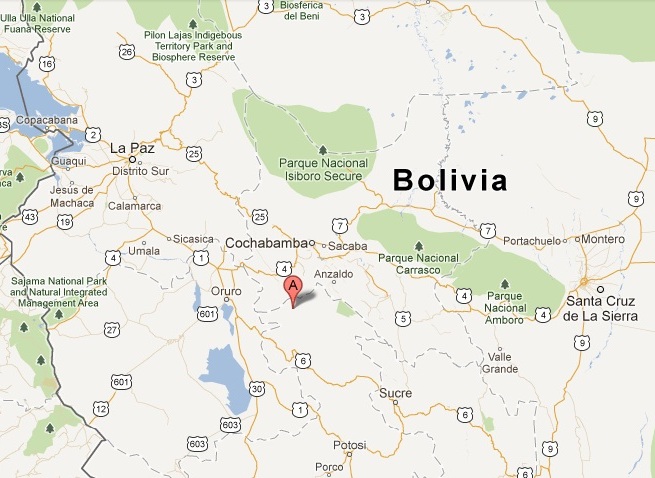
<http://ain-bolivia.org/wp-content/uploads/Mallku-Khota-Map21.jpg>


*Timeline of Incidents in Mallku Khota*

April

   - April 1st: A group of community members opposed to the Canadian mining
   company, South American Silver (SAS), briefly took a community relations
   representative from the company hostage, but the incident did not receive
   much attention nationally.[1]

May

   - May 5th: Community members took a police officer hostage.
      - Police entered the community with arrest warrants for some
      community authorities.  The charges were initiated by SAS and presumably
      related to the kidnapping in April but the press did not specify.[2]
      - Community leader Cancio Rojas explained that the community was
      opposed to SAS because the community was not consulted before the
      concession was given and it feared that SAS would contaminate
water sources
      in the area once exploitation of the minerals began.[3]
   - May 7th: Community members took a second police officer hostage.
   - May 9th: Protesters release police hostages after Potosí governor made
   vague promises of a community consultation. [4]
   - May 18th: A community meeting to discuss the fate of SAS turned into a
   violent confrontation that left dozens wounded.  Some 200 community members
   who are hostile to SAS arrived to the meeting unexpectedly, wielding
   dynamite and shouting accusations at meeting attendees.[5]
   - May 28th: Thousands of people Mallku Khota residents marched from
   their communities in northern Potosí to La Paz to demand the eviction of
   SAS.
   - May 31st: The Bolivian government reaffirmed that it would respect the
   Canadian company´s mining concession.[6]

June

   - June 7th: Protesters demanding the reversal of SAS’s mining concession
   arrive in La Paz.
   - June 8th: Police tear-gassed protesters, including children, in the
   Plaza Murillo.[7]  Protesters wounded some police officers.[8]
   - June 10th: Representatives from five Mallku Khota ayllus asked the
   government to send security forces to the area to avoid conflicts between
   local communities.  These ayllus claimed marchers represent Mallku Khota.
   [9]
   - June 12th: A group of approximately 700 anti-SAS community members
   attacked three pro-SAS communities.[10]  According to reports, the
   attackers included cooperative miners who supposedly illegally exploit gold
   in the area.
   - June 12th: Some 6,000 community members opposed to SAS took over a
   mining camp in the area.  Using dynamite and trenches they had dug, they
   impeded access to the entrance.[11]
   - June 13th: The government dispatched 230 police officers to the area.
   - June 28th: The government released Cancio Rojas from prison and put
   him under house arrest in Potosí.  The community authority was accused of
   damaging the SAS’s equipment and kidnapping police officers in May.
   - June 28th: Community members took  two engineers from SAS hostage,
   accusing them of spying.[12]  The engineers admitted to dressing up in
   traditional clothes from the area, considered a serious offense for an
   outsider, and taking pictures during a community meeting.[13]

July

   - July 2nd: Anit-SAS community members took three more SAS employees
   hostage, presumably  when they raided and burned a mining site in Sacani.
   [14][15]
   - July 3rd: The Cochabamba police commander sent 150 officers to the
   area.[16]
   - July 5th:  Three SAS hostages escaped.[17]  By this date, there were
   380 police officers stationed in the area.
   - July 5th: Four community members sustained gunshot wounds, and one
   died during a conflict with police.[18]  Protesters took one police
   hostage.
      - The Morales administration staunchly denied that any confrontation
      with police, and insisted that the fatally wounded protester, José Mamani
      Mamani, died because he drunkenly mishandled dynamite.[19]
      - Medical examiners, however, confirmed he died from a bullet
      entering the nape of his neck.[20]
      - A joint inspection by local authorities found 24 used tear gas
      cans, 30 bullet casings, four loaded bullets shells, 13 rounds of used 9
      millimeter casings, and other police paraphernalia at the site of Mamani
      Mamani’s death.[21]
   - July 7th: State entered dialogue with community members.[22]
   - June 8th: Community members and government reached a preliminary
   agreement and liberated remaining hostages.[23]
   - July 10th: Community members and the government signed an official
   agreement.[24]  The agreement included: [25]
   -
      - Reversion of mining concession
      - Compensation for the family of José Mamani Mamani
      - A job for a relative of Mamani Mamani
      - That the government pays for all the medical expenses for the four
      community members who were shot by police
      - A guarantee that no legal action will be taken by the government
      against any of the community members
      - An investigation looking into the police officers and corresponding
      legal action if merited
      - Compliance with community justice sentence for engineers
         - In a local trial, community authorities mandated that the
         engineers must build 1,000 adobe houses in 30 days after they
recover for
         injuries sustained in their captivity.[26]
      - Legal support for community authority Cancio Rojas, who has been
      charged with several crimes related to the conflict.


 ------------------------------

[1]
http://www.la-razon.com/economia/Mallku-Khota-SA-denuncia-rehenes_0_1641435885.html
[2]
http://www.lostiempos.com/diario/actualidad/nacional/20120510/liberan-a-los-dos-policias-rehenes-en-mallku-khota_170951_359311.html
[3]
http://www.lostiempos.com/diario/actualidad/nacional/20120510/liberan-a-los-dos-policias-rehenes-en-mallku-khota_170951_359311.html
[4]
http://www.lostiempos.com/diario/actualidad/nacional/20120510/liberan-a-los-dos-policias-rehenes-en-mallku-khota_170951_359311.html
[5]
http://www.la-razon.com/ciudades/Pelea-Mallku-Khota-heridos-desaparecidos_0_1616838339.html
http://www.lostiempos.com/diario/actualidad/politica/20120519/violencia-entre-ayllus-del-norte-de-potosi_171996_361733.html
[6]
http://www.paginasiete.bo/2012-06-01/Nacional/Destacados/29Cul00101-06-12-P720120601VIE.aspx
[7]
http://www.opinion.com.bo/opinion/articulos/2012/0608/noticias.php?id=59375
[8]
http://www.opinion.com.bo/opinion/articulos/2012/0608/noticias.php?id=59364
[9]
http://www.eldiario.net/noticias/2012/2012_06/nt120611/politica.php?n=33&-pobladores-de-mallku-khota-exigen-seguridad-ante-los-avasallamientos
[10]
http://www.lostiempos.com/diario/actualidad/economia/20120613/cooperativistas-atacan-tres-comunidades-en-mallku_174878_368477.html
[11]
http://www.la-razon.com/economia/comunarios-Mallku-Khota-presencia-autoridades_0_1631836901.html
[12]
http://www.la-razon.com/economia/Comunarios-condicionan-libertad-ingenieros-Presidente_0_1641435905.html
[13]
http://www.opinion.com.bo/opinion/articulos/2012/0710/noticias.php?id=63236
[14]
http://www.la-razon.com/economia/Comunarios-secuestran-tecnicos-Mallku-Khota_0_1643835662.html
[15]
http://www.eldiario.net/noticias/2012/2012_07/nt120703/sociedad.php?n=71&-campamento-de-empresa-minera-es-saqueada-y-quemada-por-comunarios
[16]
http://www.lostiempos.com/diario/actualidad/economia/20120704/secuestran-a-otras-3-personas-en-mina_177274_374204.html
[17]
http://www.la-razon.com/economia/Evo-concesion-compania-Mallku-Khota_0_1648635155.html
[18]
http://www.lostiempos.com/diario/actualidad/economia/20120706/mallku-khota-cuatro-heridos-de-bala-son-atendidos-en_177578_374958.html
[19]
http://www.lostiempos.com/diario/actualidad/economia/20120706/gobierno-muerte-en-mallku-khota-no-fue-por_177567_374938.html
[20] http://erbol.com.bo/noticia.php?identificador=2147483960926
[21] http://erbol.com.bo/noticia.php?identificador=2147483960978
[22]
http://www.la-razon.com/economia/comunarios-Mallku-Khota-liberan-rehenes_0_1647435266.html
[23]
http://www.lostiempos.com/diario/actualidad/economia/20120709/gobierno-logra-acuerdo-y-liberan-a-tres-rehenes_177841_375577.html
[24]
http://www.la-razon.com/economia/Evo-concesion-compania-Mallku-Khota_0_1648635155.html
[25]
http://www.la-razon.com/economia/comunarios-Mallku-Khota-liberan-rehenes_0_1647435266.html
[26]
http://www.eldiario.net/noticias/2012/2012_07/nt120709/sociedad.php?n=39&-tres-ultimos-rehenes-son-liberados-tras-diez-dias

---------------

Nationalization without WORKERS CONTROL...or socialism!
Bidding awards made by YPFB will be investigated for evidence of corruption
Posted by Bolivian Thoughts
<http://bolivianthoughts.com/author/xxxyyy34/> ⋅July 13, 2012
⋅ Leave a
Comment<http://bolivianthoughts.com/2012/07/13/bidding-awards-made-by-ypfb-will-be-investigated-for-evidence-of-corruption/#respond>
*Filed Under*  hydrocarbons <http://bolivianthoughts.com/tag/hydrocarbons/>,
natural gas <http://bolivianthoughts.com/tag/natural-gas/>,
YPFB<http://bolivianthoughts.com/tag/ypfb/>

Another sign of corruption or at least bad management or lack thereof, this
time in the top state-owned hydrocarbon company: YPFB (the pride of current
government’s nationalization policy).

El Diario reports:

<http://bolivianthoughts.files.wordpress.com/2012/07/2012-07-11-04-28-27-pm.jpg>It
is in doubt the transparency of the procurement process to build the
separator plants of liquids of Rio Grande and Gran Chaco, after it was
discovered that two senior executives of Yacimientos Petrolíferos Fiscales
Bolivianos (YPFB), now in prison, are charged with abuse of public goods,
illicit enrichment and laundering of illicit profits and other crimes.

According to Santa Cruz newspaper El Día, the public prosecutor will review
allocations for more than $770 million dollars. Taking into account that
the Gran Chaco plant has a cost of $608 million and the Rio Grande plant
$163 million dollars.

It’s about Gerson Rojas Teran, former national liquids separation plant
manager, who according to his own testimony had the confidence of the
President of the Company [YPFB], Carlos Villegas; and Agustín Ugarte
Méndez, Member of the qualifying [bidding] Commission. The first is in
Palmasola and the second in a cell of the special forces of fight against
crime (Felcc).

According to ANF, with data from the El Deber newspaper, the
anti-corruption Commission of prosecutors included about twenty people who
are members of the separation of liquids plants projects qualifying
Commission.

In the vehicle and in offices of Gerson Rojas, former National Manager of
liquids separation plant, prosecutors and the police found documents that
reveal him as the holder of the Banco Mercantil Santa Cruz safety deposit
boxes, which were shared with Agustín Javier Ugarte Méndez, Gran Chaco
project director. In one of them found $90,000, the other was empty, but
the Prosecutor’s Office found manuscripts by amounts approximately to
$400,000.

This Committee formed by Carlos Candia and Anuncio Pierola, under the
direction and supervision of the national anti-corruption Coordinator,
Norma Olmos Gonzales, also extended investigations to representatives of
the companies that participated in the bidding, including Pentechs, EASA
and a German company. The citations for the investigated persons to declare
were already prepared for delivery.

Candia said that Gerson Richard Rojas Teran, former National Manager of
separation plant liquids, and Agustín Javier Ugarte Méndez, great Chaco
project director and senior member of the rating Committee, already with
warrant of arrest at the Palmasola prison. The first due to improper use of
property of the State and the other for illicit enrichment, abuse of
benefits by reason of the position and other influences.

Prosecutors expressed that both YPFB executives maintained a close
relationship of friendship and according to findings, they have increased
the amounts on the bidding points in order to favor themselves with
thousands of dollars. “Nothing else means that they have safe deposit boxes
in banks where every day, it was growing at an alarming rate, their
heritage with money from the State,” said Candia.

RELATIONSHIP WITH VILLEGAS

The deposed Manager of plants of separation of liquids of Yacimientos
Petroliferos Fiscales Bolivianos (YPFB), Gerson Rojas, syndicated by misuse
of property of the State and illicit enrichment, said in his informative
statement that day that he hit a State car, he was in official function
because he managed the purchase of land, task coordinated with the
President of the State oil company, Carlos Villegas.

El Deber had access to the Act of disclosure statement of Rojas, stating
verbatim in two parts: “that day (June 17) was at a Commission in Bulo Bulo
[chapare town], on the purchase of the land to put tubes for ammonia and
urea plant”. “My person coordinates all purchase of land directly with Lic.
Villegas and himself with the President of the Nation. “The previous
Saturday, i.e. before June 17, 2012, in a similar Commission was an act of
commitment with a villager on the purchase of 90 hectares to a Federation
of coca growers unions, along these lines was this task”.

Later, Rojas emphasizes that since he started his functions, had direct
dealings with Villegas, even above the National Vice President of
operations, Mario Salazar. The statement is signed by Gerson Richard Rojas
Teran, lawyer Lider Guzman Cabrera, Sergeant Gustavo Osinaga and Attorney
Jaime David Canedo Encinas.

President Evo Morales complained, June 14 from Chimore, by the rise in the
price of a hectare of land in the tropics of Cochabamba of $2,500 to $4,500
dollars, which would be damaging the installation of industries, such as
the case of the ammonia plant and urea that plans to build in the town of
Bulo Bulo, and which would generate 2,000 sources of employment in the
future.

THE ORIGIN

The research has its origins on June 17, when Gerson Richard Rojas starred
in a triple road accident at kilometer 94 of the road near Yapacani. The
Prosecutor’s Office on the basis of reports established that Rojas was
drunk in command of the station wagon model Toyota 2012, plate 2841-KKL
valued at us $80,000, which was shattered [official vehicle].

After the accident, the man fleeds the scene and left abandoned the
motorized, but this fact gives rise to a thorough investigation. In the
vehicle and his office, prosecutors and police found documents that give
away him as a holder of the Banco Mercantil Santa Cruz safety deposit boxes.

BANK BOXES

Richard Rojas bank’s boxes were shared with Ugarte. In one of them found
$90,000, the other was empty but the Bank data provided to the Prosecutor’s
Office say that money they withdrew before the raid. In the case the
Prosecutor’s Office found manuscripts amounts approximately to $400,000.

http://www.eldiario.net/noticias/2012/2012_07/nt120711/economia.php?n=15&-adjudicaciones-hechas-por-ypfb-seran-investigadas-por-indicios-de-cor

<http://bolivianthoughts.files.wordpress.com/2012/07/ypfb-el-diario-11-jul-12.jpg>This
cartoon is also from El Diario, July 11, 2012:

You can see the head of YPFB and next door, the people in charge of the
bidding processesses…

Early in this government, one Santos Ramirez, who was at the top, maybe
only second to current President, is now purging time on a similar fraud… I
just hope Bolivia gets rid of corruption and we start recuperating our
exporting potential capacity, some seven years ago, we were ranked second
in the gas export business in South America, and now we even have to buy
diesel and gasoline…


[Non-text portions of this message have been removed]


------------------------------------

---------------------------------------------------------------------------
LAAMN: Los Angeles Alternative Media Network
---------------------------------------------------------------------------
Unsubscribe: <mailto:[email protected]>
---------------------------------------------------------------------------
Subscribe: <mailto:[email protected]>
---------------------------------------------------------------------------
Digest: <mailto:[email protected]>
---------------------------------------------------------------------------
Help: <mailto:[email protected]?subject=laamn>
---------------------------------------------------------------------------
Post: <mailto:[email protected]>
---------------------------------------------------------------------------
Archive1: <http://www.egroups.com/messages/laamn>
---------------------------------------------------------------------------
Archive2: <http://www.mail-archive.com/[email protected]>
---------------------------------------------------------------------------
Yahoo! Groups Links

<*> To visit your group on the web, go to:
    http://groups.yahoo.com/group/laamn/

<*> Your email settings:
    Individual Email | Traditional

<*> To change settings online go to:
    http://groups.yahoo.com/group/laamn/join
    (Yahoo! ID required)

<*> To change settings via email:
    [email protected]
    [email protected]

<*> To unsubscribe from this group, send an email to:
    [email protected]

<*> Your use of Yahoo! Groups is subject to:
    http://docs.yahoo.com/info/terms/