The Chinese Communist Party 1927-37 – The development of Maoism - Part
1<http://www.marxist.com/chinese-comminist-party-1927-37-part-1.htm>
http://www.marxist.com/chinese-comminist-party-1927-37-part-1.htm
http://www.marxist.com/anti-japan-protest-reveal-social-malaise-in-china.htm


China: Protests against Japan reveal much deeper social
malaise<http://www.marxist.com/anti-japan-protest-reveal-social-malaise-in-china.htm>
Written by Niklas Zenius JespersenTuesday, 13 November 2012
[image:
Print]<http://www.marxist.com/anti-japan-protest-reveal-social-malaise-in-china/print.htm#>

In August and September Japan’s manoeuvres of the disputed islands of
Diaoyu provoked some of the largest demonstrations in China since the
uprising of Tiananmen Square in 1989. The dispute over the islands is
predominantly an imperialist conflict over control of trade routes and oil
resources. However, the protests in China went beyond the level of
expressing anti-Japanese sentiment. In fact, although the government did
attempt to limit them to this, the protests were as much against the regime
in Beijing as against Japan’s aggressive manoeuvres.

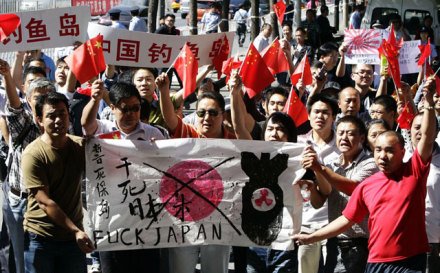
[image:
2012-anti-japan-protests]<http://www.marxist.com/images/stories/china/2012-anti-japan-protests.jpg>In
the world media the demonstrations against Japan have in general been
portrayed as government sponsored and in support of the Chinese government
against Japan. But this only gives part of the picture. While the
government did undoubtedly try to use the protests for their own purposes
and allowed the protests to go further than it would normally do, this was
only for a period and only to a certain degree.

Reports suggest that the original organisers of the first protests were not
the regime but came mainly from the so-called “New Left” of China. The New
Left of China is a common term used for Marxist, neo-Maoist and other
revolutionary and radical left groups in China critical of the restoration
of capitalism and the liberalisation policy of former president Deng
Xiaoping and his followers.

For example, members of the group Wuyouzhixiang were reported to have been
involved in the organising of the first protests in Beijing. Wuyouzhixiang
is a neo-Maoist group who until recently ran a debate website for part of
the New Left in China. The group was recently banned as part of the
campaign against the left-wing supporters of former Communist Party leader
Bo Xilai, who many saw as a leftist renewer of policies from the Mao era
(although that is clearly not what Bo stands for, far from it!).

Wuyouzhixiang is clearly not a group backed by the regime or a group who
could be described as regime supporters. Of course, this example alone does
not prove in itself that the protests were not regime friendly. But the
conduct of the demonstrators is proof enough. In several cities they came
to minor or major confrontations with the riot police. In Shenzhen in
southern China the protests were especially intensive and had an attitude
clearly critical of the regime. As such, a demonstration on the 16th September
came to violent clashes between the riot police and 2000 protesters, when
protesters attacked first a local office of the Communist Party and later a
Japanese
mall[i]<http://www.marxist.com/anti-japan-protest-reveal-social-malaise-in-china/print.htm#_edn1>
.
Attacks on the Communist Party for its “lack of patriotism”

The attack on the Communist Party office came after demonstrators saw a
Japanese car in the parking lot in front of the office. Already many
protesters were angry at the police for defending Japanese companies and
arresting nationalist activists. The protesters began accusing police and
government representatives for not being patriotic enough, preferring to
defend Japanese economic interests rather than Chinese national
sovereignty. While such outcries may appear as nothing more than extreme
chauvinism we must understand the deeper political motivations behind them.

Officially the Chinese government and Communist Party make a big effort to
present themselves as patriotic and to show that they are defending the
national interests of China. The national struggle of China has been one of
the major political forces for more than a century, beginning with the
struggle against imperialist and colonial aggression against China in the
opium wars. The Chinese revolutions of 1925-7 and 1949 were to a large
degree struggles for national liberation. Especially the latter part of the
revolutionary movement was to a large degree directed against Japanese and
western occupation of eastern China.

The enormous crimes imperialist Japan committed against the people of China
during the second Sino-Japanese war from 1937-1945 were monstrous, costing
possibly as much as 22 million civilian lives. These crimes have not been
forgotten, especially since Japan has continuously refused to give any real
apology for the crimes, or provide compensation to the victims or to take a
clear stand against this part of its history. For example, the former
Japanese Prime Minister and current opposition leader Shinzō Abe has
visited the Yasukuni Shrine, which pays homage to convicted Japanese war
criminals on several occasions, the last one this.

Abe has stated that he wants to water down a 1995 statement by the Prime
Minister, Tomiichi Murayama, apologising for Japan's wartime aggression,
and to withdraw a 1993 apology for the use of Korean women as sex slaves
before and during the war. That Japan was also used as a tool for
imperialist aggression against “communist” China during the Cold War
doesn’t make matters any better; nor does the military involvement of the
USA on the side of Japan in the conflict, which further strengthened the
opinion that China is once again under attack from its old imperialist
slave masters.

In this light it’s not hard to understand why many Chinese feel a hatred
for Japanese aggression. They expect their so-called patriotic government
to defend what they feel is part of their country and to demand respect
from China’s old slave masters. But what do they find? A government keen to
cooperate with Japanese businesses when it suits their own private economic
interests, while preaching patriotism to the people. While officially
huffing and puffing against Japan, the same leaders buy Japanese luxury
goods in private. This attitude reeks of hypocrisy to many ordinary Chinese
and doesn’t do any good for the authority of the regime in the eyes of the
people.
Social protests brewing

It is important to understand that class struggle and political radicalism
isn’t always expressed in the same way. In countries where there is no
strong independent labour movement, and China is such a country today, and
no focus for channelling dissatisfaction, this will often find other
channels through which to express itself. This is exactly what has happened
in China recently. The inability of the Chinese government to defend
territory to which it claims sovereignty was unacceptable to many ordinary
Chinese, who in this conflict saw a reminiscence of the humiliation of
China by its imperialist competitors, especially Japan, in
pre-revolutionary times.

The obvious lack of patriotism expressed by members of the Chinese
government was just one provocation too many. Social unrest is brewing in
China after decades of high economic growth which, however, has not reduced
the gap between the rich and the poor; on the contrary, in the last twenty
years polarisation of wealth has massively increased. In many provinces –
and in the cities – corruption has been growing out of control and
government bureaucrats have been selling off local community land and
properties, further deteriorating the living conditions of the population.
Pollution is becoming a problem which is getting out of control as the
government does little to limit the expansion of toxic industrial plants.

This has led to several outbreaks of radical class struggle and social
unrest in the last couple of years. In Wukan the local population defeated
the police in open combat and threw them out as they protested against the
illegal selling of their land by local government bureaucrats. And in
Ningbo week long protests against dangerous pollution forced the local
government to retreat. In both places social uprisings won major victories
against the regime and the new Chinese capitalist class.

This general feeling of the situation not being right was a strong
motivation behind the protests against Japan, as people saw the failure of
the regime to produce real results. As this lack of results and lack of
patriotism became more and more obvious the protests turned more critical.
The mass show of Chinese flags and pictures of Chairman Mao has been seen
as an example of government support by many observers, but this reveals a
lack of understanding of what it really means. The flag of China is not
just the flag of the nation, it’s also the flag of the Chinese revolution
and Mao was the leader of that revolution and not just a symbol of the
regime – a revolution which seems to have less and less to do with the
China of today.
Anti-imperialism

Red Chinese flags have been appearing in large numbers in many social
protests, for example in Ningbo, and pictures of Mao are often carried in
strikes against the government and private capitalists. This has also been
the case in the protests against Japan. As previously mentioned, the Maoist
revolution was also a war of liberation against Japan. As such, Maoism is
seen by many as the only policy that can truly defend China against foreign
aggression in opposition to the current pro-capitalist policies of the
regime. In Shanghai, during a demonstration on the 16th September, a young
demonstrator with a picture of Mao shouted: “It is unforgivable that the
Chinese government is so weak-kneed. Only Mao Zedong's ideology can topple
Japan's imperialism." This is clearly a criticism of the current capitalist
regime of China and an example of the true nature of these protests.

The significance of the display of Maoist propaganda was clearly explained
in an article by *The Asahi Shimbun* in which they wrote: “One factor
behind the recent revival of Mao is the dissatisfaction with the economic
reform and open-door policy that was started by Deng Xiaoping after Mao's
death in 1976, and has been continued by the current leadership.” In the
same article they pointed out that, “Moreover, there was little reference
to Mao during similar anti-Japanese protests in 2005 and 2010.” This points
to the different character of the recent
protests[ii]<http://www.marxist.com/anti-japan-protest-reveal-social-malaise-in-china/print.htm#_edn2>
.

While we may understand that there is basically no *fundamental *difference
between Japanese imperialism and Chinese imperialism, this doesn’t mean
that ordinary Chinese people see it that way. The movement in Japan in
connection to the disputed islands has been utterly and completely
right-wing chauvinist and pro-imperialist, but this was not the case in
China. On the contrary many Chinese saw this as a fight against
imperialism. This can be seen not only by the above examples in this
article but in many more cases.

In Shenzhen for example, the main slogan of the 19th August demonstrations
was "Smash Japanese Imperialism" and many protesters made comparisons to
the crimes of Japan during the occupation of eastern China. It is no
coincidence that the demonstrations reached their peak with protests in
more than 180 cities around China on 18th September, the anniversary of the
Japanese invasion of Manchuria in 1931.
A dangerous situation for the regime in Beijing

Originally the Chinese regime saw some potential in the protests and in
creating a nationalist mood around the disputed islands. As such it was the
Chinese navy who allowed boats from Hong Kong to arrive at the islands and
dispute Japanese claims over them, even though the Chinese regime knew that
this would further escalate the situation. But not only this, the Hong Kong
campaign was to a certain degree financed by leaders of the Democratic
Alliance for the Betterment and Progress of Hong Kong (DAB), the governing
party of Hong Kong and a close ally of the regime in Beijing.

However, they could not control the situation. Not only did new left groups
take over the organisation of many of the protests from a very early point,
but many other regime critical groups began to join the protests. Left-wing
supporters of Bo Xilai became a common sight at many protests, as did
banners against corruption, inequality and in favour of food security. In
some areas the protests even escalated into open class conflicts, as with
the case of four strikes in Japanese factories in Guangdong and Shenzhen.

As said earlier, in a situation without a strong independent workers’
movement to channel dissatisfaction, this will find other channels. When
the regime allowed people to take to the streets to protest against
Japanese imperialist aggression, people began using this to organise a more
general protest against everything that is wrong with China today – a
situation that became increasingly difficult to control and increasingly
dangerous for the regime. In the end it could no longer be tolerated, and
the government was forced to use all its powers against the protesters.

Already on the 17th September the police in Xi’an had banned large protests
and forbidden the use of phone and online messages to organise protests. In
Shanghai paramilitary troops provided round-the-clock protection to the
Japanese consulate for the duration of the week, stripping demonstrators of
projectiles, warning them through megaphones against violence and limiting
protests in front of the consulate to a few minutes. In Guangdong local
governments warned citizens against assembling in large crowds[iii].

On the 19th September the limit had been overstepped. National authorities
sent in riot police to suppress existing protests and prevent the
recurrence of new ones and arrested many organisers of the protests. In
Beijing the local authorities closed down all train stations close to
protest sites; roads were reopened to traffic in order to make marches
impossible and Beijing-wide text messages warned citizens against further
demonstrations. Police stations across the country vowed retribution
against rioters and China's Commerce Ministry urged foreign companies to
report damage to the authorities. This showed clearly that the regime
didn't want the protests to continue, and with good reason.
A sign of what is to come

The regime in Beijing is finding that it is sitting on a powder keg that
could explode at any moment. The security around the recent party
conference is the tightest ever. The selling of toy planes has been
restricted. Taxis have been ordered to remove handles for rolling down the
windows in order to prevent the distribution of leaflets through them;
pigeon owners have been ordered to keep their pigeons indoors during the
conference and the selling of kitchen knives and pencil sharpeners have
been temporarily forbidden. For the first time in modern Chinese history,
the state is using more resources on internal security than on external.
The regime is afraid, very afraid. They saw what happened in the Middle
East and feared it would spread to Eastern Asia. They see social unrest
spreading over the country, an intense growth in labour strikes,
anti-pollution movements and peasant uprisings, not to mention the national
conflicts in Tibet and in the regions of the Uigur minority as well as the
pro-democracy protests in Hong Kong. Also in Hong Kong the September
election revealed a large turn to the left as well as considerable gains
for the left-wing parties and workers’ organisations.

What is missing is a focal point for these protests, a generalisation into
a broader struggle against the restoration of capitalism in China and
against the bureaucratic dictatorship. In a way, the protests against
Japanese imperialism provided such a focal point, although in a distorted
fashion. The regime understood this and stopped the movement from
developing further, preferring to be humiliated by Japanese imperialism
rather than facing anti-imperialist and social movements at home. The
protests show us what lies ahead in the future in China. Things can’t
continue in this way forever.

At some point, something will break, some episode – this could be an
otherwise insignificant event or a major issue – will provide a focal point
and direct a general movement against the regime. This was what happened in
the Middle East. The self-immolation of Mohamed Bouazizi in Tunisia was not
an extraordinary event and not the first of its kind. Yet it was the last
drop that made the cup run over and revolution broke out in an entire
region. When such an event will happen cannot be predicted in advance, but
the recent movement reveals that it could come much earlier than expected.
One thing we can be sure of, however. When the masses of China once again
rise in revolution, no power on earth will be able to hold them down.


------------------------------


[i]<http://www.marxist.com/anti-japan-protest-reveal-social-malaise-in-china/print.htm#_ednref1>
The
Asahi Shimbun: Police had hands full controlling protesters in Shenzhen (
http://ajw.asahi.com/article/asia/china/AJ201209170067)

[ii]<http://www.marxist.com/anti-japan-protest-reveal-social-malaise-in-china/print.htm#_ednref2>
The
Asahi Shimbun: INSIGHT: Mao references in anti-Japan protests a concern for
Chinese authorities (http://ajw.asahi.com/article/asia/china/AJ201209180053)

[iii]<http://www.marxist.com/anti-japan-protest-reveal-social-malaise-in-china/print.htm#_ednref3>
South
China Morning Post: Beijing threatens to clamp down on anti-Japan protests (
http://www.scmp.com/news/china/article/1039384/beijing-threatens-clamp-down-anti-japan-protests
)
All internet sources last tjecked the 5th November 2012.


[Non-text portions of this message have been removed]


------------------------------------

---------------------------------------------------------------------------
LAAMN: Los Angeles Alternative Media Network
---------------------------------------------------------------------------
Unsubscribe: <mailto:[email protected]>
---------------------------------------------------------------------------
Subscribe: <mailto:[email protected]>
---------------------------------------------------------------------------
Digest: <mailto:[email protected]>
---------------------------------------------------------------------------
Help: <mailto:[email protected]?subject=laamn>
---------------------------------------------------------------------------
Post: <mailto:[email protected]>
---------------------------------------------------------------------------
Archive1: <http://www.egroups.com/messages/laamn>
---------------------------------------------------------------------------
Archive2: <http://www.mail-archive.com/[email protected]>
---------------------------------------------------------------------------
Yahoo! Groups Links

<*> To visit your group on the web, go to:
    http://groups.yahoo.com/group/laamn/

<*> Your email settings:
    Individual Email | Traditional

<*> To change settings online go to:
    http://groups.yahoo.com/group/laamn/join
    (Yahoo! ID required)

<*> To change settings via email:
    [email protected]
    [email protected]

<*> To unsubscribe from this group, send an email to:
    [email protected]

<*> Your use of Yahoo! Groups is subject to:
    http://docs.yahoo.com/info/terms/