http://www.marxist.com/gaza-what-does-it-mean-nov-2012.htm
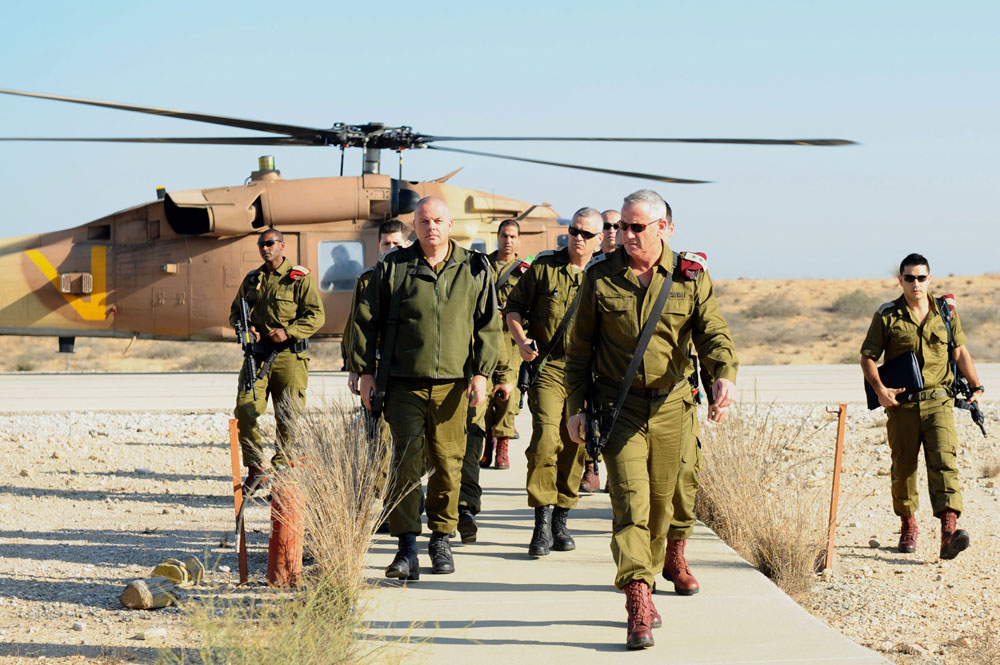
Gaza: What does it mean?<http://www.marxist.com/gaza-what-does-it-mean-nov-2012.htm> Written by Alan WoodsTuesday, 20 November 2012 [image: Print]<http://www.marxist.com/gaza-what-does-it-mean-nov-2012/print.htm#> On the morning of November 15, Israel carried out the extrajudicial killing of Hamas military leader Ahmed al-Jabari. This act sparked off a new and deadly conflict between Israel and Gaza. This whole affair has all the hallmarks of a premeditated provocation. *When the leaders speak of peace the common people know that war is coming. (Berthold Brecht)* [image: IDF chief of staff visits southern Israel-Israel Defense Forces]<http://www.marxist.com/images/stories/israel/IDF_chief_of_staff_visits_southern_Israel-Israel_Defense_Forces.jpg>IDF chief of staff visits southern Israel Photo: Israel Defense ForcesIsraeli Prime Minister Benjamin Netanyahu clearly wanted to provoke Hamas into an armed conflict. He has succeeded. Hamas responded with rocket attacks on Israeli towns that border the Gaza strip. The Israelis have used these attacks as an excuse for pulverising Gaza. Throughout the night of Nov. 16-17, the Israeli Air Force bombed targets across the Gaza Strip including key Hamas ministries, police stations and tunnels near the border crossing with Egypt. They also carried out strikes in Rafah's al-Sulan and al-Zahour neighbourhoods, as well as east of the al-Maghazi refugee camp. Later attacks included the bombing of a building that was known to be occupied by international journalists. The Israeli propaganda machine has gone into overdrive. They try to present their military onslaught as a justified response to terrorist attacks. Obediently falling into line, the mass media in the western world show their impartiality by presenting the conflict as a war between equals: Israeli bombs against Hamas rockets. But this conflict is absurdly unequal. Gaza is an open-air prison in which 1.7 people live in just 140 square miles. It is entirely at the mercy of its powerful neighbour, Israel. The latter possesses the most formidable military machine in the entire region. Its stockpile of arms, which includes nuclear weapons, is funded by Washington to the tune of US$3 billion a year. By contrast, Gaza is a tiny besieged enclave composed mainly of impoverished refugees. The primitive, homemade rockets fired from Gaza are no match for the sophisticated weaponry of the Israeli army and air force. Israeli jet fighters and drones are bombarding Gaza by day and by night. The Israelis claim that they are aimed to kill only terrorists and Hamas officials. But the television cameras of the world give the lie to this propaganda. Despite the claims of the Israelis that these attacks were carefully targeted, most of the victims were, as usual, civilians, including many women and children. The harrowing scenes of diminutive corpses being carried by grieving relatives to the cemeteries have shocked the public opinion of the world. The population of Gaza is angry and desperate, but increasingly traumatised by the unrelenting bombardment, against which they have no defences. Despite talk of a ceasefire, Israel continues its airstrikes on Gaza, and Gaza continues its long-range rocket attacks on major Israeli population centres. The sight of rockets flying in the direction of Israel may or may not boost morale, but in fact their effectiveness as weapons of war is minimal. As of last night (Monday) at least one hundred people have been killed in Gaza, while the Israeli death toll has reached the grand total of three. This is not a case of an eye for an eye, and a tooth for a tooth. The death toll of Palestinians exceeds that of Israelis by thirty three times. The Israelis claim that their Iron Dome defence system has intercepted most of the rockets. To judge by the very low Israeli casualty figures, this may be partly true. However, the claims of the IDF (Israel Defence Forces) that its Iron Dome interceptors have successfully intercepted 90 percent of the rockets are clearly exaggerated. Israel appears to be positioning itself in preparation for a ground operation. The Israeli Cabinet on Nov. 16 approved Defence Minister Ehud Barak's request to call up 75,000 reservists, even more than in the 2008-2009 invasion of Gaza. The main roads leading to Gaza and running parallel to Sinai have been declared closed military zones. Tanks, armoured personnel carriers, self-propelled artillery and troops have been massing on the border in recent days. Whether this is an act of intimidation or a preparation for something more serious remains to be seen. What was the purpose of all this? What interest can Israel have in taking on Gaza this time? The timing cannot have been an accident. It follows the same pattern we saw exactly four years ago. On Nov. 4, 2008, while Americans were going to the polls to elect a new president, the Israeli army entered the Gaza Strip with infantry, tanks and bulldozers Its alleged aim was to dismantle the extensive tunnel network used by Hamas to smuggle in weapons. Hamas responded with a barrage of mortar and rocket fire. On Dec. 27, 2008, Operation Cast Lead was launched. The military campaign began with a seven day aerial bombardment was followed by a 15-day ground incursion. By the end of the campaign, many people were killed and the infrastructure of Gaza was devastated. According to figures from the Israel Defence Forces figures, only ten Israeli soldiers died (four from friendly fire). The hundreds of rockets fired by Hamas killed three Israeli civilians. But 1,166 Palestinians were killed, of which 709 were said to be combatants. It is no secret that Netanyahu wants to bomb Iran, allegedly to sabotage its nuclear programme. It is also no secret that Netanyahu was hoping for the victory of Mitt Romney in the US elections. The Republicans are well known to be active advocates of an attack on Iran. Obama is a more cautious representative of US Big Business and is worried about the effect of an Israeli air strike against Iran. By flexing his muscles only a few days after the US elections, Netanyahu is ending a message to Washington, which says more or less: Obama can say whatever he likes, but we are the ones who decide what happens in this part of the world. It has been said that certain forces in Gaza may be manufacturing long-range rockets locally. Even more significantly, it is said that the rockets that have been fired into Israel have been imported from Iran. The latter accusation would give a sinister twist to the present conflict, providing it with a regional dimension that is highly convenient to Netanyahu, who is looking for any excuse to launch an air attack on Iran. Part of his calculations may have been an attempt to shoring up his rear prior to such an attack. At the same time, he may also be sending a message to the new Egyptian government. The Moslim Brotherhood is supposed to be hostile to Israel. It is also supposed to be friendly towards Hamas. But this attack has shown the Morsi regime to be weak and pusillanimous. Cairo makes noises about the humanitarian disaster in Gaza but does not lift a finger to go to its defence. Prospects for Negotiations The present conflict has once more glaringly exposed the impotence of the so-called United Nations. U.N. Secretary-General Ban Ki Moon has said he will go to Gaza, but he will not be able to do anything. All kinds of contradictory rumours regarding the outcome of cease-fire negotiations between Hamas and Israel have been circulating in Cairo. A Hamas spokesman told Al Jazeera that Israel and Hamas have agreed to 90 percent of the terms of a new cease-fire. But he did not say what the remaining ten percent consisted of. And while Israeli officials have told news outlets that the government is in talks with Cairo on a cease-fire, Israeli officials are now denying reports that an Israeli envoy is in Cairo at all. On the face of it, there seems to be some basis for a deal. Hamas would like to enjoy the prestige of a symbolic victory from its long-range rocket attacks against Tel Aviv and Jerusalem but does not want to pay the price of seeing its leadership and infrastructure pulverised in an Israeli ground invasion. For its part, Israel would like to remove or neutralize the threat posed by Hamas' long-range rockets but does not want to go through the experience of a ground invasion, drawing Israeli forces into urban warfare with the threat of suicide bombings that could prove costly. It would appear that Hamas is pressing for a temporary truce in return for Egypt opening the border blockade on Gaza and Israel halting targeted killings of its leaders and military commanders. Whether the Israelis will accept this is open to doubt. Who will guarantee such a deal? Unless Egypt agrees to assume responsibility for Hamas' rocket arsenal to satisfy Israel's security concerns, it will be difficult for Israel to take these talks seriously. But that would place Egypt itself right in the firing line of future conflicts. It would also fatally undermine the Morsi government. Both sides want a negotiated end - but on terms that would leave the other side in a weaker position. Both sides are well aware of the other sides game. In order to reach a deal, Hamas would have to recognize Israel's right to exist and Israel would have to accept something resembling a Palestinian state led by Hamas in Gaza, which would gradually take over the West Bank. Both these assumptions seem wildly improbable. It is hard to see how this contradiction can be resolved peacefully. Hamas does not want to give up its rockets. Israel cannot allow Hamas to possess weapons that threatens its heartland. The long-range Fajr-5 rockets can reach Tel Aviv and Jerusalem. The possession of these rockets improves Hamas' strategic position and also serves to undermine the Palestinian National Authority (In the West Bank) vis-a-vis Hamas. They will therefore resist any deal that deprives them of the rockets. But Israel will not accept the Fajr-5 in the hands of Hamas. Netanyahu announced to his Cabinet Nov. 18 that targeted killings would not only continue, but would increase. It is possible that all this merely means that both Israel and Hamas are trying to strengthen their negotiating positions by continuing their attacks before a cease-fire deal is struck. Be that as it may, while the leaders talk of peace, the war is already under way. And although a direct ground attack on Gaza by the Israelis has been temporarily stalled, the Israelis have already mobilized their forces and are ready to attack whenever they choose. Although probably the Israelis would prefer not to attack because of the consequences, both in terms of human casualties and in political reverberations, they are poised to attack. And one must not assume that this is just a bluff. Netanyahu has given notice that if a truce is not agreed soon, a ground war may be launched even before the end of this week. Gaza and the Arab Revolution The Europeans are putting heavy pressure on Jerusalem to desist from an actual invasion of Gaza. Western capitals fear that any serious conflict in the region can spiral out of control. Though they always speak of humanitarianism, their real motives are quite different. Paris, London and Berlin fear the effects on the price of oil and the anaemic economic recovery. Above all, they fear a new eruption of the Arab Street, always highly sensitive to the Palestinian cause. It is this that inspires their insistent calls for peace and restraint. But the Europeans are far too concerned in trying to halt the disintegration of the European Union to get involved with what is happening. The same fears exist at the highest levels of the United States government. That is why Hillary Clinton is on a plane heading for Cairo. But, having burnt their fingers in Iraq, the gentlemen in Washington do not wish to be dragged into another conflagration in the Middle East. In theory the United States can pressure Egypt by threatening to withhold financial and military aid. But in practice no US administration can oppose what Israel does because, after the Egyptian Revolution, it is now its only reliable ally in the whole region. Therefore, despite his weasel words, Obama has effectively endorsed the Israeli position. On the broader scale, however, Israel has never been so isolated. Back in 2008, Mubaraks Egypt could be relied upon to adopt a position of benevolent neutrality, which was, in practice, support for Israel. Now Mubarak has gone, and the present Egyptian government can no longer be relied upon. In 2008 Turkey was a close ally of both the USA and Israel. But Israels relations with Turkey have been strained to breaking point by the attack on a Turkish ship bringing aid to Gaza in May 2010, during which several Turkish citizens were killed by Israeli troops. The Turkish Prime Minister, Erdogan, has recently denounced Israel as a terrorist state. Under Assad Syria was an adversary, but at least it was a predictable one. With the chaos in Syria spreading to the Lebanon, Israel can no longer rely on Damascus to keep Hezbollah in check. Moreover, Iran has increased its influence in the region, bringing it closer to Israel and intensifying the tension over Iranian nuclear facilities. Closer to home, the growing crisis in Gaza threatens to provoke renewed instability in the West Bank and arouse the Palestinians in Jordan. Across the Jordan River valley, to Israel's east, the Hashemite kingdom is hanging by a thread. But the country most directly affected is Egypt. The Egyptian government, terrified of the repercussions of a new war on the streets of Cairo, has been the most active in trying to secure a cease-fire: Cairo is hosting talks on a ceasefire, involving senior Hamas and Islamic Jihad members. It is said that Israeli officials are also present in Cairo. The Egyptian government has a vested interest in preventing an Israeli ground invasion of Gaza because of the explosive effects inside Egypt. The Moslem Brotherhood is supposed to be aligned with Hamas. But in reality, its support is confined to hypocritical speeches about the plight of the people of Gaza. Morsi will have to promise the Israelis that he will do everything in his power to prevent weapons smuggling via Gaza. He will stand exposed before the masses. The leaders of Hamas have the ambition of donning the mantle of resistance that was earlier worn by Hezbollah. They hope that the present crisis will enable them to win a symbolic victory over Israel. But that is an idle dream, which can end up in the complete devastation of Gaza. The people of Gaza are increasingly desperate. They have no control over events that are destroying their lives. They hate the Israeli oppressors, but also resent the dictatorial rule of the men with beards, which has brought them nothing but death and suffering. Neither Hamas nor the so-called Palestinian Authority can offer any solution. Only a genuine revolutionary leadership can show the way out for the Palestinian people. For its part, the Israeli ruling clique pretends that their aggressive actions are intended to eliminate Hamas' arsenal of rockets and thus guarantee the safety of Israel. But with every new war, Israel becomes a less secure place. It is increasingly isolated both in the region and internationally. These brutal attacks on Gaza have added yet another twist to the bloody imbroglio of the Palestinian question. The spectacle of death and destruction will have filled yet another generation of Palestinian youth with feelings of rage and hatred, adding fresh fuel to the fire. In what way this can be presented as making Israel safe for future generations is s mystery. Every Palestinian child that dies in an air raid deepens the mood of bitterness and feeds the thirst for revenge. Every victory merely sows the seeds of new wars, new terrorist acts, new murders and atrocities. On this path lies nothing but death and destruction for all the peoples of this unhappy region. In this struggle, the IMT stands firmly on the side of the oppressed and against the oppressors. The question of who fires the first shot and all the rest of the diplomatic sophistry is of no interest. We stand shoulder to shoulder with the people of Gaza against the barbarous onslaught of the Israeli aggressors. We will be to the forefront of every anti-war movement, protest and demonstration. We will endeavour to bring out the class content of the struggle, its anti-imperialist character. We will mercilessly expose the hypocrisy of western governments and their false humanitarian rhetoric. We must build links with the most revolutionary sections of the youth in Gaza, who are fighting against imperialism and the Israeli state and also against the reactionary leadership of Hamas and the bourgeois collaborationist wing of the Palestinian leadership. Above all, we must maintain a broader perspective. The present conflict is just part of a far wider picture that encompasses the entre Middle East and cannot be understood outside this context. The Gaza crisis is only the prelude to a far greater crisis. It is inseparably linked to Netanyahus plans for an air attack against Iran, which will set the entire Middle East ablaze. It will have incalculable consequences, economic, political and military. It will provoke a new wave of upheavals in the Arab world and beyond. Regimes will fall. People will take to the streets. The price of oil will go through the ceiling, and the world economy will take a nose dive, as it did in 1973 for similar reasons. The Gaza crisis can be the match that reignites all the combustible material that has accumulated in the Middle East. It will mark a new stage in the ongoing Arab Revolution. The stage is set for dramatic events on a world scale. 20th November, 2012. [Non-text portions of this message have been removed] ------------------------------------ --------------------------------------------------------------------------- LAAMN: Los Angeles Alternative Media Network --------------------------------------------------------------------------- Unsubscribe: <mailto:[email protected]> --------------------------------------------------------------------------- Subscribe: <mailto:[email protected]> --------------------------------------------------------------------------- Digest: <mailto:[email protected]> --------------------------------------------------------------------------- Help: <mailto:[email protected]?subject=laamn> --------------------------------------------------------------------------- Post: <mailto:[email protected]> --------------------------------------------------------------------------- Archive1: <http://www.egroups.com/messages/laamn> --------------------------------------------------------------------------- Archive2: <http://www.mail-archive.com/[email protected]> --------------------------------------------------------------------------- Yahoo! Groups Links <*> To visit your group on the web, go to: http://groups.yahoo.com/group/laamn/ <*> Your email settings: Individual Email | Traditional <*> To change settings online go to: http://groups.yahoo.com/group/laamn/join (Yahoo! ID required) <*> To change settings via email: [email protected] [email protected] <*> To unsubscribe from this group, send an email to: [email protected] <*> Your use of Yahoo! Groups is subject to: http://docs.yahoo.com/info/terms/