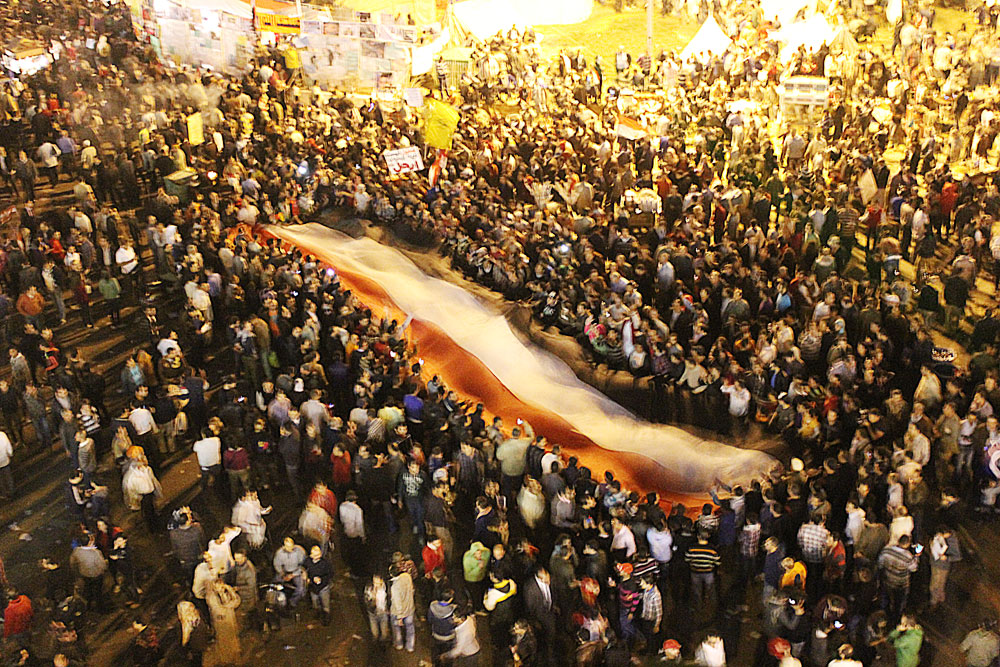
PHOTO GALLERY: Clashes enter tenth day around Tahrir
Square<http://english.ahram.org.eg/NewsContentMulti/59364/Multimedia.aspx>
http://english.ahram.org.eg/NewsContentMulti/59364/Multimedia.aspx ------------------------------------------------------- http://www.marxist.com/egypt-morsi-humiliated-as-revolution-raises-head.htm Egypt: Morsi Humiliated as Revolution raises its head once again<http://www.marxist.com/egypt-morsi-humiliated-as-revolution-raises-head.htm> Written by Hamid AlizadehWednesday, 28 November 2012 [image: Print]<http://www.marxist.com/egypt-morsi-humiliated-as-revolution-raises-head/print.htm#> Anger was simmering on Tahrir Square yesterday as hundreds of thousands poured in to the square to protest against Egypt's President Mohammed Morsi and his ruling Muslim Brotherhood (MB). Across the square large banners were inscribed with slogans such as The Muslim Brotherhood has stolen the revolution and The Muslim Brotherhood are liars. Throughout the day a seemingly never-ending stream of marches reached the square from all over the ancient city. In size and radicalism yesterdays protest was equalled only by those that overthrew the hated dictator Hosni Mubarak in January 2011. [image: Tahrir Square yesterday. Photo: Gigi Ibrahim]<http://www.marxist.com/images/stories/egypt/2012-11-27-tent_city_Tahrir-Gigi_Ibrahim.jpg>Tahrir Square last night. Photo: Gigi Ibrahim<http://www.flickr.com/photos/gigiibrahim/>This marked the 6th day of protests that initially started by opposing a decree by the President which would concentrate all state power in his hands. The decree, besides letting him rule with immunity from the judiciary, would also allow him to take any measures necessary to defend the revolution. In reality this is a pretext to do the very opposite! Initially the reaction to the decree was confined to relatively small layers of mainly youth. But as the repression of the protests turned more and more heavy handed the main reasons behind the decree became clearer for the wider population. Sensing that the revolution might be in danger, the masses returned to the streets. The chants of The people want to bring down the regime, Leave, leave! and Down with the regime! once again resounded all over Tahrir Square. Reflecting the mood on the streets one participant, Mohammed Magdi, told AP, We want to change this whole setting. The Brotherhood hijacked the revolution. People woke up to his [Morsi's] mistakes, and in any new elections they will get no votes. Magdi was among a massive crowd of around 10,000 marching from the working class district of Shubra. The riot police showed no mercy to the crowd which it attacked several times during the day. The tear gas they used, and which covered large parts of the square throughout the day, was of a particularly dangerous type and ended up costing the life of a 54-year-old man. Prime Minister Hesham Qandil had warned earlier on the day that, The government would sternly confront any destructive and violent actions that deviate from peaceful protests. But confronted with the revolutionary wave the forces of the state proved to be powerless. In spite of the harsh conditions, people kept pouring into the symbolic square. As the day went the crowds swelled beyond what any of the organizers had anticipated. The Muslim Brotherhood itself put the figure at 2-300,000. Many say that this was one of the largest protests ever in Egypt. One activist wrote on Twitter in the late afternoon: The other amazing thing is that there is no space in Tahrir and the marches haven't even reached it yet! The protesters werent only the youth, but from all walks of life, from striking workers and trade unionists to students and housewives, men and women, young and old, all there to show their anger and indignation. Another activist wrote on Twitter, This time, whole families went down. All the independents came down this time, some of our parents for the first time as well. Also beyond Cairo people were taking to the streets on a massive scale. There were large demonstrations in all major towns and cities across the country from Alexandria, Suez, Port Said and Luxor to Sohag, Assyut, Damietta, Mahalla, Tanta and many more. Although the swelling numbers in the square filled the masses with confidence and revolutionary optimism the mood was very serious and militant, far from the euphoric jubilant moods immediately after the revolution. This was in line with the mood we have witnessed in the demonstrations over the last week. In Alexandria where tens of thousands had participated in the protests, the Muslim Brotherhood ordered its members to abandon their offices which were under attack. In Mansoura the offices of the Muslim Brotherhood were burned down. In the proletarian bastion of Mahalla, protesters attacked the offices of the Muslim Brotherhood with stones and Molotov cocktails. The Islamists Stand Naked The Muslim Brotherhood, along with its political partner the Salafist *Nour Party*, had initially called for a counter-demonstration to take place in Tahrir Square as well. But seeing the mood that was developing they had to cancel their main rally in Cairo, hoping that at least in the other towns they would be able to muster sizeable turnouts. But despite this, and despite a well organised network and access to the state as well as its funds, the pro-Morsi demonstrations did not materialise. Only in the town of Assiut, far away from the industrial towns of the Nile delta, did the Brotherhood manage to gather 5000 people for a pro-Morsi demonstration. The protesters though, were mainly students of the Al-Azhar University, the chief centre of Islamic learning in the world, which is led by the reactionary Muhammad Sayyid Tantawy an old supporter of Mubarak. In Alexandria, which was known to be a stronghold of the Muslim Brotherhood and their Salafist friends, the Islamists only managed to stage episodic gatherings which were dispersed by anti-Brotherhood crowds. In the end the MB had to evacuate their headquarters which the angry crowd then tried to set on fire. The Islamists are under heavy pressure now. In a pathetic move, the ever so arrogant leader of the Nour Party and advisor to Morsi, Emad Abdel-Ghaffour, told Reuters that he had not been consulted before the announcement of the decree by Morsi last week. The Muslim Brotherhood, after barely five months in office, have now entered into crisis. Only a few days ago bourgeois commentators around the world were hailing Mohammed Morsi as the new leader of the Arab world, some even going as far as proclaiming him to be the new Nasser. But today all the previous glory he was basking in has been destroyed by the Egyptian masses who thoroughly humiliated him with this massive show of force. Last night Morsi was only standing due to the mercy of the masses. If he had dared to call for a counter-demonstration in Tahrir, it would have been thoroughly defeated and his presidency would not have lasted until the morning. Morsi is not and will never be a new Nasser, because Nasser, despite his shortcomings, based himself on the mass of workers and poor in Egypt to strike blows against capitalism. Morsi (just like the rest of his Islamist allies) on the other hand, more than anything else is the man of capital, the man of the old order standing as an obstacle to the birth of a new one. Felools manoeuvre Leaders open door for them On Monday, in an attempt to diffuse the movement that was building up, representatives of the President met with the Judiciary in order to strike a deal. Although a full retreat would have been too humiliating, Morsi publicly assured the Judges that his immunity would be limited to sovereign matters. At first the judges seemed to accept the deal, but seeing the anger on the streets they calculated that they could gain more concessions if they dug their heels in for a bit longer. Therefore they publicly denounced the deal claiming that there had never been one. [image: Tahrir Square last night. Photo: Gigi Ibrahim]<http://www.marxist.com/images/stories/egypt/2012-11-27-Egyptian_flag-Gigi_Ibrahim.jpg> Photo: Gigi Ibrahim <http://www.flickr.com/photos/gigiibrahim/>It is clear that while the MB in general has no problems working with the *Felool* name adopted by Egyptians for remnants of the old regime it is not all layers that are equally happy about sharing power with the group. Some of these layers see the present crisis as an opportunity to strike back in order to regain their lost positions. The hysterical shrieks of these gentlemen, we should add, are not fooling any Egyptian who can remember how the same judiciary both under Mubarak and since then has been a pillar of support for reaction. However, while trying to ride the wave of revolution in order to strike blows against the MB, they mobilised for todays protest and some of them attended Tahrir square. But throughout the day it was clear that the square resisted this trick and the Felools clearly stood out as an isolated minority in the protests. Unfortunately though, those who were supposed to lead the masses did not see through this trick. Last Thursday, the Liberal, Mohammed ElBaradei, and the Nasserist, Hamdeen Sabahi who are generally seen by the masses as parts of the camp of revolution announced a new National Rescue Front along with Amr Moussa, who was foreign minister under Mubarak. With the old excuse of the more the better these gentlemen are not only inviting Amr Moussa in but also his Felool friends in the judiciary and other places. The point is that the revolution has nothing in common with these people who just a few months ago were ready to drag the country through a sea of blood rather than have the people take power. Let us not forget that it was the judiciary who manoeuvred to cancel the parliamentary elections and to meddle in the constituent assembly. It was also the Judiciary who showed extreme leniency on Mubaraks butchers when they appeared in court. To give any opening to these people is equal to inviting the counter-revolution deep into the camp of revolution and this could have devastating consequences. Instead of clearing marking out the fault lines within society, and raising the political understanding of the masses, this tactic can only serve to disorientate and weaken the revolution. The first concrete results of this alliance have already revealed themselves. Firstly, the Brotherhood has been able to publicly accuse the anti-Brotherhood demonstrations of being in alliance with the Felool, a fact which would naturally dissuade many from joining the movement. Secondly, in order to satisfy the Felool, the programme of the front has been watered down to such a degree that it cannot attract anyone. Its main demands are the revoking of the presidential decree and in defence of the judiciary. To the extent that it defends the judiciary it is repelling the most honest and farsighted revolutionary forces and to the extent that it demands a withdrawal of the decree, it is actually tail-ending the movement whose demands in the Square were down with the regime i.e. *for a new revolution.* Thus we can see that the formula of the more the better actually turns into its opposite of limiting the scope of the revolutionary movement in order not to step on the toes of the old rulers. The only way to guarantee victory is by stating what is and putting forward a bold revolutionary programme and a plan of action aimed at sweeping away the whole regime and the economic and social system that stands behind it. Sabahi won more than five million votes in the first rounds of the presidential elections; he would probably have won the elections outright had there not been massive vote rigging. All of this happened because from the very beginning he made it clear that he was the candidate of Tahrir, and that he would support neither Shafik (candidate of the old regime) nor Morsi in a possible second round. But by cosying up with the Felool now he is risking losing all that support. If, yesterday, Sabahi had called for an escalation of the struggle into a general strike and a march on the presidential palace to overthrow Morsi, nothing could have stopped the movement. But instead the NRF is merely calling for more demonstrations and protests. The Revolutionary Socialists, as we explained in June, made a similar mistake. During the presidential elections, instead of exposing bourgeois class base and the counter-revolutionary character of the Muslim Brotherhood, they recommended a vote for Morsi as the lesser evil. Morsis campaign even thanked them in their victory statement. That criminal mistake for which the leadership of this organization is fully responsible weakened the organization and its links with the genuine revolutionary forces that are clearly not with the Brotherhood. In the last few days they issued a statement distancing themselves from the Brotherhood, but this is somewhat too late. If they had had the strength and understanding that it was necessary to state the real nature of the MB from day one of the revolution they would have had much to gain now as the living experience of the masses has shown them the true nature of the Brotherhood. Thus, because of this mistake and others like it, the organization and its many talented and dedicated members only form a small and relatively isolated part of the movement. Protracted and Unstable Process To all the sceptics who were moaning about the end of the Egyptian revolution after the coming to power of the MB, yesterdays demonstration should have served to teach them an important lesson. Whatever the degree of religious belief or nationalist feelings there may be at any given moment in time, this cannot stop the class contradictions that exist in capitalist society from eventually coming to the surface. This is what we wrote one year ago: It would be a mistake to ascribe supernatural powers to the Islamists and other counterrevolutionary forces, which somehow allegedly allow them to stand above society and the class struggle. The main point to understand is that these forces are all different shades of bourgeois parties who all defend the rule of capital. But as long as they defend the rule of capital, they must accept the logic of capitalism. They must therefore defend the crisis of capitalism, which at present does not allow for even the smallest and most basic concessions to the masses. If all this had happened ten years ago, they might have been able to consolidate some form of bourgeois democratic regimes. The boom in world capitalism would have given them some margin for manoeuvring. But now there is a profound crisis on a world scale. This is both the reason for the revolutionary ferment and the reason why it cannot easily be brought to an end. (One Year Since Bouazizis Death One Year of Arab Revolution<http://www.marxist.com/arab-revolution-first-anniversary.htm>, Hamid Alizadeh, 16 December 2011) Yesterdays show of force fully confirms what we said. The revolution has chased away the thugs of the Islamists and has left all the forces of reaction in a state of shock and paralysis. Unable to do anything, they could only watch and hope that the masses would show them mercy. Had there been a revolutionary leadership of the movement, yesterdays protest could have been turned into a new revolution sweeping away all the remnants of the old society. But the lack of such a force meant that the regime, though weak and unstable, is still standing. The masses want democracy, and we support them in this demand, but we also explain that the present state of things is the best that bourgeois democracy can offer in Egypt. The Marxists had foreseen the events that are now unfolding, but because of the weakness of the numerical weakness of the Marxist Tendency we are not able to bring these ideas to the movement as a whole. Therefore the masses will have to learn these lessons themselves through painful experience. Contrary to what bourgeois experts and sceptics on the left would have us believe, the Arab masses are not inherently prone to supporting reactionary Islamic fundamentalism. In fact the real traditions of the workers in Egypt and the rest of the region are Socialist and leftist. And as the tide of the revolution goes back and forth these old traditions will once again be rediscovered on a mass scale and this is because within the confines of the capitalist system not even the most basic needs of the masses can be met. Only the ideas of scientific socialism, i.e. Marxism, can show a way forward. Thus, the task of the day is to build a force within the Egyptian labour movement based on these ideas. By studying the experiences of the past and patiently explaining them to the workers and the youth our ideas will gain an echo within the revolution. Once this is achieved the road will be open to a genuine socialist revolution that will put an end to the capitalist system, which Morsi loyally serves. [Non-text portions of this message have been removed] ------------------------------------ --------------------------------------------------------------------------- LAAMN: Los Angeles Alternative Media Network --------------------------------------------------------------------------- Unsubscribe: <mailto:[email protected]> --------------------------------------------------------------------------- Subscribe: <mailto:[email protected]> --------------------------------------------------------------------------- Digest: <mailto:[email protected]> --------------------------------------------------------------------------- Help: <mailto:[email protected]?subject=laamn> --------------------------------------------------------------------------- Post: <mailto:[email protected]> --------------------------------------------------------------------------- Archive1: <http://www.egroups.com/messages/laamn> --------------------------------------------------------------------------- Archive2: <http://www.mail-archive.com/[email protected]> --------------------------------------------------------------------------- Yahoo! Groups Links <*> To visit your group on the web, go to: http://groups.yahoo.com/group/laamn/ <*> Your email settings: Individual Email | Traditional <*> To change settings online go to: http://groups.yahoo.com/group/laamn/join (Yahoo! ID required) <*> To change settings via email: [email protected] [email protected] <*> To unsubscribe from this group, send an email to: [email protected] <*> Your use of Yahoo! Groups is subject to: http://docs.yahoo.com/info/terms/