http://www.marxist.com/venezuela-capitalists-want-to-use-chavez-ill-health.htm
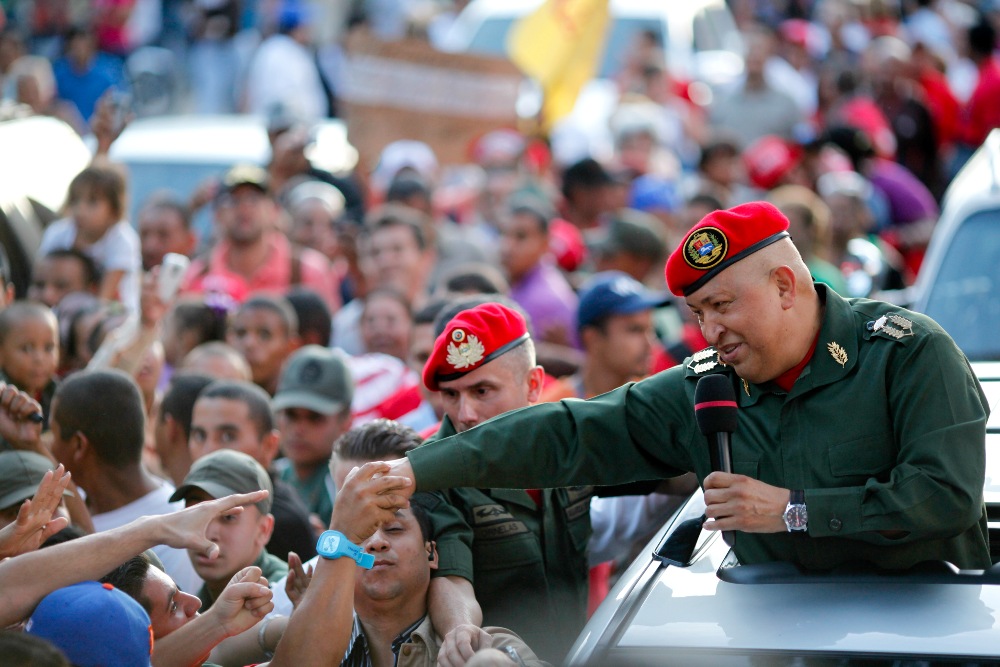
Venezuela: capitalists want to use Chávezs health problems to strangle the revolution<http://www.marxist.com/venezuela-capitalists-want-to-use-chavez-ill-health.htm> Written by Jorge MartínWednesday, 12 December 2012 [image: Print]<http://www.marxist.com/venezuela-capitalists-want-to-use-chavez-ill-health/print.htm>[image: E-mail]<http://www.marxist.com/component/option,com_mailto/link,f557829f9d21318b86cf0e0911a9db3a3fe0bf68/tmpl,component/> On Saturday, December 8, Venezuelan president Chávez announced that he would have to undergo another surgical intervention in Cuba. Adding that there are always risks in processes like this he explained that if anything happens to me that hinders me [from performing as president], vice president Maduro is his preference to replace him. [image: Chavez leaving hospital in 2011]<http://www.marxist.com/images/stories/venezuela/Chavez_leaving_hospital.jpg>Chavez leaving hospital in 2011The announcement came as a shock to the Bolivarian masses. This was the first time that Chávez spoke about his choice of replacement in the leadership of the revolution and this indicates that he is worried something might go wrong with his treatment. Tens of thousands of Venezuelans came out on Sunday, filling the Bolivar squares in every town and city to show their support for the president. The Venezuelan oligarchy and imperialism immediately jumped on this announcement in an indecent haste to get rid of Chávez. They argued that according to the article 234 constitution in the event of a temporary absence of the president, the vice president Maduro should assume the presidency. As a matter of fact, Chávez has used the provision in article 235 of the constitution to ask permission from the National Assembly to be absent from the country for over 5 days. This was granted on Sunday, December 9. Behind these legalistic arguments there is the clear aim of the opposition to remove Chávez from office in the hope that he will not be able to come back. Let us not forget that ever since he was elected in 1998, the oligarchy, the owners of banks, the land, the media and big businesses, and imperialism have waged a relentless campaign to defeat the revolution and overthrow Chávez using all means at their disposal, legal and illegal. This included the coup in April 2002, the criminal lock out and sabotage of the oil industry in 2002-2003, the *guarimba* riots of 2004 (at which time 100 Colombian paramilitaries were arrested in a ranch near the capital), the recall referendum of 2004, a constant investment strike, sabotage of the food distribution chain (including hoarding, racketeering and smuggling), etc. Now, by insisting on the removal of Chávez as a president, they want to achieve what they could not get in the October 7 elections. There is a good reason why they are so fixated in the figure of Chávez: he plays a key role in the Bolivarian revolution. There is an almost symbiotic relationship between the president and the Bolivarian masses which are the motor force of the revolution. Chávez has always shown himself to be sensitive to the pressures from below and the masses consider him as one of their own. This is in stark contrast with many of the other top figures in the Bolivarian movement, ministers, governors, local mayors, etc. None of them has even a fraction of the moral standing and political authority Chávez commands amongst the working class and the poor which are the basis of support for the revolution. Many are seen as corrupt careerists out to make a personal gain from their allegiance to the Bolivarian movement. While the revolutionary people, the workers, the peasants and the poor came out on the streets against the coup in April 2002, many of the Bolivarian regional governors swore loyalty to the new illegitimate coup-government of Carmona, only to quickly switch sides again as the masses defeated the coup. In important states like Aragua, Lara, Monagas and others, we have seen Bolivarian governors jump ship (*saltar la talanquera*) and join the reactionary opposition. Others remain on the Bolivarian side of the fence, but act as bourgeois IV Republic type politicians, dishing out jobs and positions to cronies and family members, getting involved in all sorts of corruption. The bureaucracy in the state institutions in many instances acts as a block to the revolutionary initiative of the masses. In many occasions the workers and the poor have reached directly to Chávez over the heads of Ministers and governors to get things done. Just to give an example the heroic struggle of the workers of SIDOR, against the regional governor Rangel who sent the National Guard against them and against the then Minister of Labour Ramon Rivero, which finally got Chávez to decree the expulsion of the multinational and the re-nationalisation of this key steel plant in Guayana. Rivero also lost his job as a result. Then, the workers in the basic industries demanded that workers control should be introduced, again, in opposition to the stated position of managers, directors and ministers. Finally Chávez called a meeting to establish the Socialist Guayana Plan and agreed to the workers demands, nominating a series of worker-directors in the key state owned factories. There are many other examples like this which have solidified the relationship between the president and the revolutionary masses and at the same time strengthened a deep rooted current of suspicion and distrust towards the bureaucrats and reformists at the top of the movement. The ruling class and imperialism are calculating that while Chávez is unpredictable (meaning he is quite capable of taking bold decisions and of striking blows against their interests), anyone who replaces him will be easier to defeat in elections and at the same time more amenable to the pressure of bourgeois public opinion towards conciliation and concessions. * Chavismo*without Chávez, they think, would lose its revolutionary edge, becoming much safer for the interests of private property. [image: Portada de El Nuevo País]Immediately after Chávez made his announcement, opposition supporters used the twitter hash tag #RIPChavez, revealing the disgusting lack of any morality on the part of more crazy elements of this democratic opposition. In the same vein the most extreme opposition commentators declared the end of the revolution (*El Nuevo Pais* published a frontpage headline declaring "The Revolution is Over"). The most intelligent representatives of the ruling class however, took a different line. Attempting to disguise their jubilation at the news of Chávezs ill health, they stressed the need for national unity across the political divide, for reconciliation and dialogue, etc. The business organisation Fedecamaras (which played a crucial role in the April 2002 coup), issued a statement along the same lines. In a press conference on Monday, December 10, they asked for an urgent meeting with vice president Nicolás Maduro to agree urgent macro-economic adjustments which they think Venezuela requires. They are basically asking for concessions from the government regarding exchange controls (a possible devaluation), liberalisation of prices of regulated food products, etc. Fedecamaras president Jorge Botti did not mince his words: Lets not wait until January. Decisions need to be taken now; we ask directly the acting president of the Republic, Nicolás Maduro, to jointly take together with his economic area ministers the necessary decisions as soon as possible. (Patronal pide reunión a Maduro y dice Venezuela está virtualmente paralizada<http://noticias.latam.msn.com/ve/venezuela/articulo_efe.aspx?cp-documentid=255085520> ) Notice the arrogance of this people. They were soundly defeated in the presidential elections just over two months ago and they now want to rule the country and take the most important economic decisions. The financial press and investment analysts have insisted in describing Maduro as a man of dialogue, someone we can talk to. Stratfor described him as pragmatic, while Barclays Capital said earlier this year that if Maduro was to lead the government we could expect a more moderate approach from him. Whether this is just wishful thinking on the part of the capitalists remains to be seen. What they wish for is clear: for Chávez to be out of the picture and for a new government to make all sorts of concessions to big business and multinationals and abandon any idea of moving towards a nationalised planned economy. There is another field in which the oligarchy is testing the terrain: the so-called political prisoners and exiles. Immediate after their election defeat on October 7th they started a campaign around this question. They say that all those who have been imprisoned for political reasons and those who have had to flee the country because of political persecution should be amnestied. First of all let us be clear about this question, we are not talking here about people who are persecuted because of their political views, but about politicians who broke the law and are either in jail or (the majority of them) have fled the country to escape justice. These are the people who carried out the coup in April 2002 (including brief coup-president Pedro Carmona in exile in Colombia), the people who organised the sabotage of the oil industry 10 years ago now, Manuel Rosales who was charged with corruption and left for Perú, others who are wanted in relation to the assassination of state prosecutor Danilo Anderson (who was investigating the April 2002 coup when he was killed), etc. These people should be tried and made to pay for their crimes, for which they have not even apologised or shown any remorse. The fact that it was suggested by opposition deputy Edgar Zambrano, who is travelling around the world to get a full list of these exiles (in Miami, Madrid, Bogotá, etc), that the government through Nicolás Maduro has expressed political will to solve this issue, is scandalous and created an uproar amongst Bolivarian activists. No government spokesperson has refuted this statement so far. What we can see is a situation in which the capitalists are exerting pressure on the leadership of the Bolivarian movement towards conciliation and concessions. On the other hand the Bolivarian masses want to push forward, towards the completion of the revolution, but they find themselves without a clear leadership and without any democratic revolutionary structure through which they can decide over the course of the revolution. It is worth remembering that for the last 14 years the masses have responded in their millions any time they have had a chance to get organised. In the Bolivarian Circles at the very beginning, in the Electoral Battle Units during the recall referendum, the launching of the Frente Francisco Miranda, the creation of the UNT trade union, the founding of the PSUV, the founding of its youth organisation JPSUV, and many others. Within these organisations, the masses have also instinctively rallied to the different leaders which appeared to be more radical, more consistent in maintaining their links to the rank and file and waging the most decided battle against the oligarchy. Every single time, after a brief period of enthusiasm, democratic discussion and revolutionary fervour from the rank and file and activists, the bureaucracy has managed to close down these spaces and organisations. *The PSUV Youth had its founding congress in 2008 at which the attempts to introduce an undemocratic constitution were defeated, and has not had another congress since then. The PSUV itself had a very democratic and left leaning founding congress and then an ideological one in 2010, but its structures had been reduced mostly to an electoral machine. The members did not even have a say in the selection of the candidates for the forthcoming regional elections on December 16.* *The Bolivarian revolution is clearly at a crossroads, in which different political lines are being proposed as to what is the way forward.* *The bureaucracy for instance has destroyed the Plan Guayana Socialista which we described before, removing all of the worker-directors in the basic industries. *This was done through a concerted campaign of open sabotage, discrediting, slanders and physical violence, orchestrated by all those who, for their own different reasons, are against workers control. The FBT trade union faction has played a key role in this campaign and so was the regional governor Rangel Gómez. The discontent is so great amongst the worker activists in the region that there is growing support for the other Bolivarian candidate Arciniega, standing on a Communist Party ticket. *Sections of the Bolivarian leadership advocate a sort of mixed economy in which the socialist elements would progressively spread and finally, sometime in the future, overcome the capitalist ones. In this way, allegedly, we would get to a socialist society without upsetting the ruling class too much too early. In our opinion this is a suicidal course, because it means that the normal functioning of the capitalist market economy is being disrupted without it being replaced by a democratic plan of production based on nationalisation of the means of production. This situation leads to scarcity, sabotage, inflation and general disorganisation of the economy which hits mainly the poorest sections which are the natural base of support for the revolution.* In his speech on Saturday about the situation of his health, Chávez made an appeal for unity of the movement. We are the first ones to be in favour of a united revolutionary movement. But the differences exist and are real. The only way to achieve unity is if the revolutionary movement as a whole can discuss them and make an informed decision. It is precisely when the bureaucracy curtails the democracy of the movement that division ensues. Once again, the masses, on October 7th delivered yet another electoral victory to the Bolivarian revolution by voting for president Chávez. He stood on a program which talks about a socialist economy and doing away with the old state apparatus. Now it is not the time for conciliation or for talks with the capitalists. It is time to put this program into practice. In our opinion this can only be done through the expropriation of the means of production, the banks and the big landed estates under democratic workers' control. The illness of president Chávez brings out clearly the fact that one single man cannot carry out a socialist revolution. It is the time for the working class and the poor to take the initiative into their own hands. A national revolutionary congress should be convened with delegates elected in each factory, workplace, working class neighbourhood and peasant community so that it can take the necessary decisions about what should be the next step. *No conciliation forward to socialism!* Home <http://www.marxist.com/> » The Americas<http://www.marxist.com/americas/> » Venezuela <http://www.marxist.com/venezuela/> [Non-text portions of this message have been removed] ------------------------------------ --------------------------------------------------------------------------- LAAMN: Los Angeles Alternative Media Network --------------------------------------------------------------------------- Unsubscribe: <mailto:[email protected]> --------------------------------------------------------------------------- Subscribe: <mailto:[email protected]> --------------------------------------------------------------------------- Digest: <mailto:[email protected]> --------------------------------------------------------------------------- Help: <mailto:[email protected]?subject=laamn> --------------------------------------------------------------------------- Post: <mailto:[email protected]> --------------------------------------------------------------------------- Archive1: <http://www.egroups.com/messages/laamn> --------------------------------------------------------------------------- Archive2: <http://www.mail-archive.com/[email protected]> --------------------------------------------------------------------------- Yahoo! Groups Links <*> To visit your group on the web, go to: http://groups.yahoo.com/group/laamn/ <*> Your email settings: Individual Email | Traditional <*> To change settings online go to: http://groups.yahoo.com/group/laamn/join (Yahoo! ID required) <*> To change settings via email: [email protected] [email protected] <*> To unsubscribe from this group, send an email to: [email protected] <*> Your use of Yahoo! Groups is subject to: http://docs.yahoo.com/info/terms/