http://www.marxist.com/drc-m23-imperialist-looting.htm
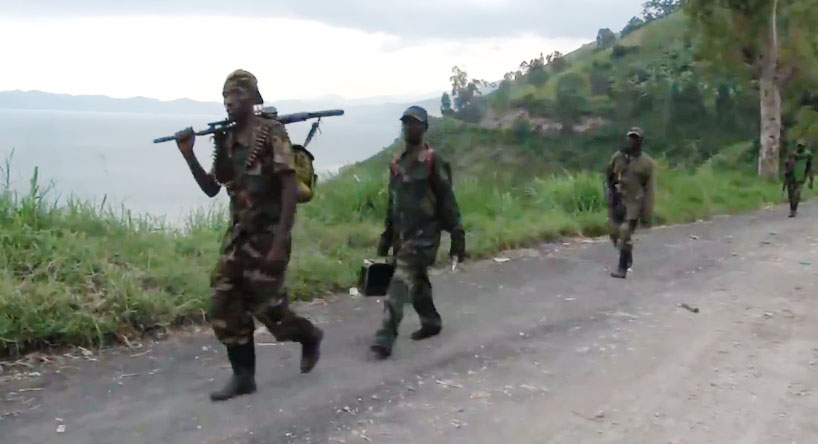
Democratic Republic of Congo: M23, imperialist looting and barbarism Part One <http://www.marxist.com/drc-m23-imperialist-looting.htm> Written by Gavin JacksonMonday, 21 January 2013 [image: Print]<http://www.marxist.com/drc-m23-imperialist-looting/print.htm>[image: E-mail]<http://www.marxist.com/component/option,com_mailto/link,ad7731a449d30cd3ab04ea0fc02086baf56190f6/tmpl,component/> Once again the Democratic Republic of Congo has been through months of turmoil, soldiers defecting en masse from the Congolese Army (FARDC) followed by fighting between government forces and militia in the Kivu regions. But why is all this happening and what interests lie behind these events? Gavin Jackson looks at the different forces on the ground and outlines the looting on the part of the various imperialist powers that is the real reason behind the barbarism. [image: M23 outside Goma. Photo: Voice of America/Wikimedia Commons.]<http://www.marxist.com/images/stories/Congo/M23_withdrawl_from_Goma-Gabe_Joselow.jpg>M23 outside Goma. Photo: Voice of America/Wikimedia Commons<http://commons.wikimedia.org/wiki/File:M23_withdrawl_from_Goma.PNG> .The M23 movement succeeded in taking hold of Goma, the provincial capital of North Kivu, after government forces evaporated on contact and MONUSCO soldiers offered meagre resistance. Many hundreds of thousands of Congolese have abandoned their homes and land to escape the brutal attacks of both militia and government soldiers. Rumours and partial reports of some of the most vile abuses associated with the Kivu regions and its militias have followed both M23 and FARDC soldiers on the Goma campaign. The question why M23 has taken up arms and who they are is rarely answered in full, it is only said that the extraction of rare earth metals is fuelling an existing conflict what that conflict is, is left unsaid. A new truce appears to be settling in place in and around Goma, for the moment. However, this is cold comfort for those who have witnessed truces come and go like the seasons in the Kivus. An eight month campaign has brought the soldiers of the M23 militia onto the alleys and boulevards of Goma and back again. On the surface it appears they have withdrawn to the hills in the region surrounding the key mining hub, but not without cleaning out the banks and government offices in the city on their way. In the process the Congolese Army has imploded under the weight of the complete demoralisation of the rank and file soldiers, and the inveterate corruption of the Congolese officer caste. Compare this to the early days of the mutiny in April and May where the FARDC came close to crushing M23 entirely. Despite the advantageous opportunity to shatter M23, Kinshasa was unable to end the rebellion. Meanwhile other militias began rampaging in the Eastern region, taking advantage of the redeployment of FARDC forces in a scramble for control of the mines and trade routes the bloodiest events taking place in the region where the *Raia Mutomboki *are active near the South Kivu-Burundi border while *Mai-Mai *have seized the important mining town of Walikale. More so, rumours of outright treason on the part of the former commander of FARDC forces in the east have emerged. Reuters reported on December 10th that Major-General Gabriel Amisi removed from his command after the fall of Goma betrayed the soldiers in his command to M23: *One senior FARDC officer who fought the M23 uprising said he believed Goma was lost because of what he called sabotage of the army's fighting capability. "All of our intelligence was given to M23," the officer alleged, saying that throughout the fighting "there was intense communications with them" from within the government ranks.*1 (Reuters<http://www.reuters.com/article/2012/12/10/us-congo-democratic-army-idUSBRE8B90AQ20121210>, 10.12.12) As if to underline the calamitous situation thousands of UN troops could do little more than carry out helicopter gunship sorties against the militiamen as they advanced toward Goma and nearby towns. Badly equipped, completely demoralised and all too aware of the profiteering of the officers, many FARDC soldiers some given nothing more than a faded second hand uniform and flip-flops to wear into battle were seen to be steaming drunk on the streets of Goma the night before the city fell. It is clear no defence of the city was possible with this human material the FARDC began demobilising itself, chaotically, through nearby towns in tatters. Both M23 and FARDC soldiers began according to UN reports looting and raping in some areas as one advanced and the other routed. As part of the withdrawal agreement 100 soldiers from each of the M23, FARDC and the UN remain at the key installation in the city, Goma International Airport. UN reconnaissance flights have confirmed the rebels are positioned only three kilometres outside of the city . For all intents and purposes M23 have conducted a retreat for public relations, while partially digging in at the main military objective which allows their reinforcements across the Rwandan border while presenting the possibility of cutting UN/FARDC forces off from the possibility of receiving *their *reinforcements, without safe access to the airstrip, from outside the immediate region for days. FARDC soldiers were seen handing their automatic rifles and handguns to young men and boys as M23 advanced on Goma. The night before the city fell (November 19th) over one thousand inmates of a Goma prison staged a breakout, AFP reports. And who can blame them? *The entire Muzenze prison was initially designed to accommodate a maximum of 150 inmates but up to 200 could be crammed into a single cell, [a now jobless warden] added. They were only given food every other day.* (AFP<http://www.google.com/hostednews/afp/article/ALeqM5imzuiv8pXgy10VWdCwYgNM68sEtg?docId=CNG.d51ff78acded8ce142e56fdc1bf3c97d.801>, 11.12.12) Abandoned by Kinshasa to the mercies of a disintegrating state infrastructure and a band of brutal mutineers the residents of the million strong city of Goma took justice into their own hands. At least six escapees have been lynched so far, including five accused of armed robbery who were burned alive. Over 500,000 people have fled their homes in the region in the last eight months escaping the areas under M23 control for those under the minimal oversight of Kinshasa. Without additional funding or resources the UN and aid agencies lack the means to reach many of the displaced. In desperation they return to their homes in search of food - M23 soldiers garrisoned to these villages murder them on sight for crossing into government territory. Human Rights Watch (HRW) has reported on the vile acts of M23: Since June, M23 fighters have deliberately killed at least 15 civilians in areas under their control, some because they were perceived to be against the rebels, Human Rights Watch said. The fighters also raped at least 46 women and girls. The youngest rape victim was eight years old. M23 fighters shot dead a 25-year-old woman who was three months pregnant because she resisted being raped. Two other women died from the wounds inflicted on them when they were raped by M23 fighters. Much of what is reported by HRW is horrific. While it lays bare the limitless barbarism to which capitalism has reduced this part of the globe, it is of such a character we feel it best to leave it to the readers of *In Defence of Marxism *to choose whether to read the reports for themselves. As if this were not enough, the soldiers of the FARDC are responsible for more acts of brutality torture, rape and murder than all of the militias *combined. *The proposed solutions of the NGOs, aid agencies and diplomats in response the sanctions, the criminal courts for men they can't catch, men who have the support of regional and international states and corporations they all stand in farcical contrast to the utter barbarism of it all; so much so the question must be asked at times *"are you out of your mind?"* Regime disintegrating News of the fall of Goma sparked militant demonstrations reminiscent of those which took place during last years rigged elections. Thousands of protesters are reported3 to have came out on the streets of Kinshasa, Kisangani, Bunia, Kindu and Bukavu for days burning cars and buildings and directing their rage at not only M23 but also Kabila and the UN peacekeepers who sat on their hands yet again. (Congo Planet<http://www.congoplanet.com/2012/11/21/news/2011/thousands-protest-m23-capture-of-goma-turnagainst-government-un-mission-monusco.jsp>, 21.11.12) The New York Times reported: Our president is a thief, a thief! exclaimed Jean-Claude Dumbo, an unemployed man in Goma. He doesnt pay the army. He steals it all for himself. In Kisangani the Congolese state forces found the courage to kill three protesters and injured seven others. This did not stop the enraged demonstrators ransacking the church of Bishop Runiga an M23 spokesperson burning the MONUSCO headquarters in the city, the local headquarters of the ruling PPRD party, the headquarters of the *Mouvement social pour le renouveau *and of the electoral commission (CENI) which helped to rig the 2011 elections. In Bunia six protesters were shot dead while another church of Runigas was ransacked, along with homes of UN staffers live ammunition was reportedly used to drive protestors away from the local MONUSCO office (romandie.com<http://www.romandie.com/news/n/_RDC__les_forces_des_Nations_unies_en_RDC_prises_a_partie_par_la_population34211120121723.asp>, 21.11.12). UN peacekeepers sent on a deployment to protect civilians do nothing to fight an extremely violent militia, yet are quite robust in defending themselves against Congolese demonstrators. FARDC soldiers were brought on to the streets of Bunia to crush the protests. In Walikale another MONUSCO office was showered with rocks; while in Bukavu, at the opposite shore of Lake Kivu to Goma, protesters fought police on the streets before burning the local headquarters of the*Majorité au présidentielle *(MP), a front set up to support Kabila. As government soldiers and police returned to Goma some protests also took place in the city, Businessweek reported: "We denounce the failure of the ministers of interior, defense and the army chief of staff. We ask for their resignation. A team that does not work must be changed," said one of the demonstrators, Luc Nkulula....Demonstrators on Thursday burned tires and policemen armed with rifles arrived on the scene. Security forces appeared ready to use disproportionate force to repel a group of youths, who were protesting against the forces' lack of resolve in the face of a rebel army. "We were here alone. The rebels have raped us, looted us. They have scared us. Why today, when we are expressing our anger, you are coming to stop us?" said Nkulula to a policeman. Without a movement to remove the Kabila clique from power the regime stumbles on from crisis to calamity through sheer inertia. This latest episode in over two decades of bloodshed has laid bare the deep scars left by the imperialist exploitation of the African continent. The well practised response of the bourgeois media 'conflict minerals', corruption, tin-pot dictators, brutal ethnic warfare, inexplicable violence, Africans slaughtering Africans - does nothing to advance our understanding of what is taking place and why. These are not episodic explosions of violence, but simply the most visible peaks in a struggle to control the colossal mineral wealth and trade of the region. Hard as it may be to believe in the advanced capitalist countries but these militia are a feature of everyday life for the workers and small peasants of the Eastern DRC. While this is the general trend there are outstanding examples. The work of Jason Stearns through both the Rift Valley Institute (RVI) and Congosiasa reveal a great deal of what is not covered, and, in spite of differences in method of analysis Stearns remains one of the better for accurate material on the region and we rely on much of this for the present article. Crisis In understanding the present outbreak of fighting we must do so against the background of the global crisis of capitalism. Capital has flowed into safe havens for investment often this has meant it has flowed into places or commodities the capitalists consider safe to store their wealth to see out the crisis for better days. One of these is gold, the market price of which has seen a steady boom. More important a factor than this has been the collapse in production in the industrialised regions of the earth. The manufacture of electronics, high technology items, automobiles and other manufactured goods has slowed down dramatically. As many of the minerals and metals extracted in the DR Congo are smuggled into Rwanda and Uganda it is difficult to get any real idea of fluctuation in prices and the impact on profits though this doesnt stop them showing up in the trade figures of both Uganda and Rwanda. Figures for production in China can give us an approximate idea of what is happening in the Rare Earth Elements (REE) market. As an example of how drastic the shift has been, the price of Lanthanum Oxide extracted in China has fallen 56%, dysprosium oxide 69%. China Minmetals (Ganzhou) Rare Earths profits were 368 million Yuan for the first six months of 2012, less than half of the profits of 885 million yuan made in all of 2011. Rising Nonferrous Metals Share Co. reported profits of 9.41 million Yuan for the first half of 2012, compared to a total of 173 million for all of 2011 a serious collapse in profits.(proedgewire.com<http://proedgewire.com/rare-earth-intel/china-to-stockpile-heavy-rare-earths-again/>, 17.10.12) The fate of each metal, however, paints a more complex picture. Gold is 15% up on the Tokyo Exchange from 31st December 2011, 44.7% on the Hong Kong Exchange. Overall the price of gold has increased from $1215 per ounce in December 2009, to $1432.57 in March 2011 and reaching $1913.50 in August 2011. The British *Telegraph *(13.12.12 *telegraph.co.uk*) reported that capital flow into European gold trading funds grew more than 15% in 2012, with $6.8 billion flowing in. (The Telegraph<http://www.telegraph.co.uk/finance/personalfinance/investing/gold/9742142/Gold-demand-increases-15pc.html>, 13.12.12) Amongst the other metals and REEs the picture is complex. Tantalum prices has boomed over 200% in the past year, Cobalt has fallen back by between 24-27%, Managanese has dropped 18.6% along with Molybdenum falling 17.2% (all as of 14.12.12 prices,mineralprices.com<http://mineralprices.com/default.aspx%23> ). These shifts in the world market have rippled out to every corner of the globe as a result the importance of the gold mines of the eastern DRC has grown immensely. The *Enough Project *has compiled information on the mines under FARDC control8, many of which are concentrated in the Kivus and Ituri. (enoughproject.org<http://www.enoughproject.org/files/publications/Goma%20Field%20Dispatch%20Appendix.pdf>, pdf) Using the Bisie mine as an example of common practice, amongst those levying a tax on miners allowed to work, aside from the army, are the Mining Police, the owner of the mine and the traditional Chief in the area who take 1 kilo of every twelve each (1 kilo of coltan has a market price between US$100-400). The Congolese secret service (ANR) and military intelligence (T2) each take 200 francs from every miner going into or out of mining sites. Add to this taxes levied on the *negociants, *South African, Pakistani, Indian, Lebanese and other traders who set up trading houses in the towns and cities of the Kivus, buying extracted material from the mineworkers (often using money loaned by representatives of the multinationals Glencor , FQM etc). Control of legal and illegal taxes on the *negociants *trafficking through Goma is worth over $16,200.00 per month. Not only has the importance of the mines simply increased but every sector of the Congolese state - from immigration control to the army and secret police have a stake in the mines, sucking the very sweat and blood from the huge mass of miners extracting the material, many of them children, using pick, shovel and bare hands in near dark, surrounded by explosions, toxic water, radioactive material and carcinogenic smoke. Alongside and in conflict with the FARDC, the Rwandan and Ugandan elite have extensive interests in the DRC. The gold mines of the north-eastern Ituri province have periodically fallen under the direct control of the Ugandan Defence Forces, while the smuggling of gold continues unabated. In 2007 the total of 10,700 tonnes of official exports of cassiterite from Goma to Rwanda was worth roughly $50-75 million. These official exports account for only around a third of what crosses the border, the rest is funnelled through the CNDP-M23 smuggling networks which is to say over 20,000 tonnes of cassiterite alone was smuggled across the border with a value of $100-150 million (Stearns, *Nkunda and the CNDP*). Citing a study by the *Enough Project*Reuters reported that while Rwandas total domestic mineral extraction for 2010 to 2011 increased 22%, exports of minerals increased 62%. Control of fuel in Goma was worth hundreds of thousands of dollars during war time, especially in the wars at the turn of the century. The total charcoal trade important as fuel in a region with little or no electrification and for mining operations is controlled by militias in the Virunga national park area (CNDP, FDLR, Mai-Mai) and was estimated to be worth $30 million dollars a year. (University of Antwerpen<http://www.ua.ac.be/objs/00210767.pdf>, pdf) While it may seem a joke in the industrialised world, along with the metals, minerals, gold, charcoal, ivory and tax rackets a major interest for Rwanda and M23 is.....cattle. While land ownership has changed hands a number of times since it began to be enclosed in the beginning of 20th century, the biggest landowners were from a Tutsi background 90% of the ranches in the Masisi and Rutshuru regions were given over to Tutsi businessmen by Mobutu in exchange for supporting his regime. Subsequent wars have seen land across the Kivus expropriated and re-expropriated by various factions to different degrees, however, the interests remain so much so that it has lead to what Stearns informs us is facetiously referred to as *vaches sans frontieres * Cows without Borders. Both Rwandan military and political elites have invested heavily in cattle which apart from carrying particular cultural significance in Rwanda are also extremely valuable in their own right. Not a few soldiers who have been integrated into the FARDC from Laurent Nkundas militia were in fact cattle herders brought over from Rwanda to work on the huge ranches owned by both Tutsi businessmen and CNDP officers. More so, there is evidence Rwanda has made use of the peace agreement to send 50,000 or more Rwandans across the border, with cattle, to seize Hunde land in Masisi and Rutshuru for ranches (hence the at times virulent anti-Tutsi sentiment). A 2008 UN report which Stearns helped to produce stated that *CNDP officers own over 1,500 cows in a small area of their territory, worth between $450,000 and $750,000, and probably own far more than that in other areas they occupy. According to ranchers, there could be as many as 180,000 cows in North Kivu, many of them in territory under CNDP control. *Stearns reports that around 7,200 head of cattle (worth $2.2-3.6 million) in Masisi, Ntagandas stronghold, belonged to high-ranking Rwandan officials. The total value of these herds together in North Kivu worth $54-90,000,000, all under the stewardship of M23 and Ntaganda. These herds alone are a huge material interest for both the Tutsi businessmen both sides of the border who support the successive RCD-CNDP-M23 militias. To underline the importance of the question of land and access to it formerly decided in many areas by the traditional chief, in other words in primitive communist relations Stearns (riftvalley.net<http://riftvalley.net/resources/file/RVI%20Usalama%20Project%202%20North%20Kivu.pdf>, pdf - p25-26) provides figures on changes to demographics and social relations, particularly in the Masisi and Rutshuru highlands. In 1928 the Belgian administration established the National Committee of the Kivus, a private company to which the Belgians granted right to dispose of land in the Kivus. Millions were made selling land for ranches and plantations to European settlers, displacing local communities. Gold was discovered by Australian adventurers in Ituri, along with other minerals, the Belgians began encouraging the migration of hundreds of thousands of Tutsi from Rwanda seized from the German Empire with up to 300,000 arriving in the colonial period to work the mines and plantations. As new ranches and plantations were fenced off the population was pushed on to smaller tracts of land to survive from, many were completely driven off the land into the mines. Between 1930 and 1990 the population of Masisi and Rutshuru rose almost tenfold, density in Masisi rising from 12 per square kilometre in 1940 to 111 per square kilometre in 1983. The 1966 Bakajika Law and 1973 Land Law crowned the changes in relations taking place on the ground, nationalising the land (Mobutu used this to turn ranches and plantations over to his allies) the 1973 law making the state the only authority capable of granting land titles and ending the customary titles granted by local chiefs. Between the first outpost of capitalism being established in 1908 and the 1970s centuries of development of property and class relations were compressed into the space occupied by decades. Moreover, capitalist property relations were implanted in the region at the point of its degeneration as a social form in the epoch of Imperialism. The impact on Congolese society has been catastrophic in everything from the lakes of blood spilt to the very cultural level of the region. We recall here the methods of the militias - of terrorising the small farmers, using as has been detailed murder, torture and rape to absolutely shatter families and wider communities, driving many hundreds of thousands of small farmers from their land. The militias and the businessmen backing them have a direct material interest in doing so, as part of a campaign to enclose more communal and small farmers land in order to expand their multi-million dollar agricultural industry taking in cattle, timber, tea and coffee (Starbucks is a particularly big investor in Rwanda) a conclusion supported by the findings of MONUC inquiries to fighting in the region. (Congo Siasa<http://congosiasa.blogspot.co.uk/2009/11/monuc-internal-report-about-ex-cndp.html> ) It is not only national but also international capital that is completely intertwined and reliant on these militias. In 2005 a Human Rights Watch report *The Curse of Gold * detailed the operations of AngloGold Ashanti, part of British multinational AngloAmerican, in working with, funding, supplying and providing logistical support to the *Nationalist and Integrationist Front (FNI)*in the Ituri province of North Eastern DRC, in order to access the rich gold fields around Mongbwalu. The FNI distinguished themselves from the other mass-murderers and rapists by hunting down women in the villages of the region around Mongbwalu in order to burn them as witches. Here also, we have the last word on the capacity of capitalism to truly advance human civilisation. Admittedly, Anglo-Ashanti have moved on. These days they operate out of a heavily fortified compound protected by cement walls, G4S security guards and barbed wire. Alongside Anglo-Ashanti, Glencore dominate the industrial mines of Katanga and the trade conducted by local *negociants*. Across North and South Kivu, the Canadian Banro and Loncor Resources as well as the Congolese Samika SARL hold concessions in the gold, wolframite, manganese and coltan mines which carpet the entire region, monopolising the industry (ipisresearch.be<http://www.ipisresearch.be/maps/MiMiKi/Concessions/WEB/INDEX.HTML>). Banro and Loncor Resources are two faces for the same set of capitalist interests, with Simon Village (formerly of HSBC), Arnold T Konradt (founder of Banro and head of a Canadian hedge fund) and Peter Colley (formerly of Ashanti) and lawyer Richard Lachcik serve as heads of both companies. In its turn Sakima SARL is a subsidiary of Banro. Add to these Tullow and Heritage Oil the board of which includes ex-Executive Outcomes and SAS soldier Anthony Buckingham, a former US special forces Colonel and a retired British General. Heritage and Tullow are in dispute with Kinshasha over contracts for exploration and drilling rights in the Albertine Graben which runs from the Virunga national park (north of Goma) north to Ituri. Tullow held concessions on the Ugandan side of Lake Albert, and worked closely with Museveni and his brother to develop the oil fields there UPDF soldiers engaging FARDC on occasion on the request of Tullow representatives. As part of the contract with Kinshasha Heritage provided millions of dollars worth of military equipment to the FARDC, including jeeps and speed boats to patrol the oil concessions precisely in those areas offering opportunity to develop contacts with Rwandan proxies and M23. Among the other interests of Heritage politely described as frontiersmen are the oil fields of Iraqi Kurdistan, Pakistan and Libya, they also had a stake in the Taoudeni Basin in Mali-Mauritania. Kinshasha tore up a massively profitable contract in 2010, handing it over to companies in the British Virgin Islands in other words notorious Israeli bourgeois Dan Gertler, deal maker for the seizure of First Quantums $1.1 billion investments. If they are not already involved in the present conflict, they have means, motive and the right connections with the British, American and Rwandan state machinery to be so. *[To be continued...]* Home <http://www.marxist.com/> » Africa <http://www.marxist.com/africa/> » Congo <http://www.marxist.com/congo/> [Non-text portions of this message have been removed] ------------------------------------ --------------------------------------------------------------------------- LAAMN: Los Angeles Alternative Media Network --------------------------------------------------------------------------- Unsubscribe: <mailto:[email protected]> --------------------------------------------------------------------------- Subscribe: <mailto:[email protected]> --------------------------------------------------------------------------- Digest: <mailto:[email protected]> --------------------------------------------------------------------------- Help: <mailto:[email protected]?subject=laamn> --------------------------------------------------------------------------- Post: <mailto:[email protected]> --------------------------------------------------------------------------- Archive1: <http://www.egroups.com/messages/laamn> --------------------------------------------------------------------------- Archive2: <http://www.mail-archive.com/[email protected]> --------------------------------------------------------------------------- Yahoo! Groups Links <*> To visit your group on the web, go to: http://groups.yahoo.com/group/laamn/ <*> Your email settings: Individual Email | Traditional <*> To change settings online go to: http://groups.yahoo.com/group/laamn/join (Yahoo! ID required) <*> To change settings via email: [email protected] [email protected] <*> To unsubscribe from this group, send an email to: [email protected] <*> Your use of Yahoo! Groups is subject to: http://docs.yahoo.com/info/terms/