http://www.marxist.com/perspectives-for-revolution-in-the-middle-east-part-1.htm
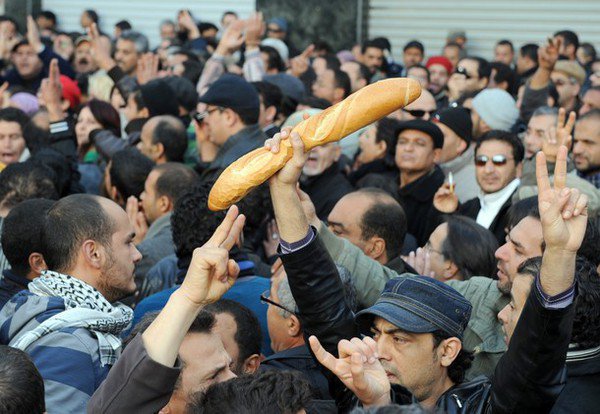
Perspectives for Revolution in the Middle East Part One<http://www.marxist.com/perspectives-for-revolution-in-the-middle-east-part-1.htm> Written by International Marxist TendencyMonday, 18 February 2013 [image: Print]<http://www.marxist.com/perspectives-for-revolution-in-the-middle-east-part-1/print.htm>[image: E-mail]<http://www.marxist.com/component/option,com_mailto/link,7ccbaa74e5988ae342d99ad3513d17b52d84e3b1/tmpl,component/> Two years since the Egyptian revolution and we have seen many killed on the streets of Cairo in clashes between the revolutionary youth and workers and the Islamists of the regime. This is an indication of the situation as it stands today in the Arab world. The revolution brought down the Mubarak and Ben Ali regimes, but did not solve any of the underlying social problems that were the fundamental cause of the revolution. [A statement based on a discussion by the International Executive Committee of the IMT at its recent January meeting]. [image: uprising tunisia]<http://www.marxist.com/images/stories/tunisia/uprising_tunisia.jpg>What we said in the past The Arab revolution came as no surprise to the Marxists. We had been following developments there for some time. For example, we published an article on the Arab Revolution in 2007: "*Class Struggle Brewing in the Middle East*"<http://www.marxist.com/class-struggle-brewing-middle-east010307.htm> and other articles. This was at a time when capitalism in Europe and North America was still experiencing a boom and Latin America was at the forefront. We emphasised the role of Venezuela and Latin America as a whole, as the centre of revolutionary developments on a world scale. While we were highlighting the revolutionary potential of the Latin American situation, explaining that it was an anticipation of what would soon emerge on a global scale, many on the left were sceptical. These people are always playing down the revolutionary potential of the masses. At the time they were claiming that the Middle East was the opposite of what pertained in Latin America. They claimed that what dominated in the Middle East was black reaction, and even some Marxists were of the opinion that the IMT leadership was too optimistic about world revolution. The fact, however, is that we base our optimistic perspectives not on subjective wishful thinking, but on the reality of the objective situation, on the economic, social, and political conditions and the real possibilities for social revolution that flow from these conditions. Ours is not an empty, abstract optimism. Back in 2007 we explained that in Israel, with the defeat in the war in Lebanon, the class contradictions would come to the fore. These perspectives were soon confirmed by a series of strikes by dockworkers and other sectors. In Iran we highlighted the splits that were emerging at the top of the regime and the growing social discontent. Two years later we saw the magnificent revolutionary movement that shook the regime to its foundations, and only failed to overthrow it due to lack of a firm revolutionary leadership. On Palestine we explained how Fatah and Hamas were both exposing themselves in the eyes of the masses, as they administered the Palestinian territories in the service of imperialism. Concerning the situation in Egypt, we wrote articles about the coming storm, despite the boom the country was experiencing at the time. If one had a superficial and undialectical approach to the siltation, looking only at the surface, everything would have looked fine, but we could see the huge social polarization that was taking place. We understood that the growing economy would lead to a strengthening of the working class; we also highlighted the role of women and the revolutionary role they would play. The strikes of the Malhalla textile workers, where women, wearing the veil led the way in pushing the men to also come out on strike, were an indication of what was about to erupt. We also highlighted the role of a highly educated but unemployed youth, with no outlet. It was a powder keg, just waiting for a spark. The Tunisian spark to the revolution That spark came at the end of 2010 in Tunisia, when one young, desperate poor man, set himself ablaze in protest at the way he had been treated by the police. This has an immediate resonance among the wider masses who identified with his condition, and the Tunisian revolution began. In turn, the Tunisian revolution was the bigger spark that then spread to Egypt, and then to the entire Arab world ad beyond. Our analysis on the Egyptian revolution was second to none, a daily analysis at the height of the struggle against Mubarak. We analysed each and every turn in the situation, anticipating the next step of the revolutionary masses. And we have followed the main stages since then. The main feature of the Arab Revolution is that there was no revolutionary leadership of the working class. Unless we understand this, we cannot explain subsequent events. Events don't stand still waiting for the subjective factor, the revolutionary party to be created. In such a situation a vacuum appears and it must be filled. In Tunisia and Egypt, that vacuum was filled by the Islamists. This has been also the case in Libya, Syria, etc. When such rapid changes take place, with swings from revolution to counter-revolution, many on the left start moaning once again, returning to their previous mantra about "Islamic fundamentalism!", almost as if this were some kind of invisible unstoppable force. This is utterly false. The rise of such forces is the consequence of a lack of revolutionary leadership. Revolution is a process and not one single act. Revolution and counter-revolution march together and at different moments in the process one or the other can dominate. The point is that life teaches. The Islamists took office in Egypt and Tunisia, filling the void, but now that they are in government they are being exposed as a reactionary force. Their task is to cut across the revolution, divert the masses down the road of Islamic fundamentalism, put up the pretence of being "anti-imperialists" while secretly doing business with "the Great Satan," and to apply the policies capitalism requires: austerity, cuts in subsidies, etc. parallel to the policies everywhere else. They demagogically say they are defending the revolution, while they in fact undermine it. The point is that now the masses are seeing through this and that explains the latest turn of events in these countries. New wave of revolution being prepared The revolution is not over. Far from it! A new wave of revolution is now developing. There will be many waves, precisely due to 1) the lack of the subjective factor, 2) the relative weakness of the ruling class, and 3) the enormous strength of the working class. This means that the ruling class is too weak to move immediately to a reactionary clampdown and therefore has to constantly manoeuvre and count on the weakness of the leadership of the working class. In 2011 all eyes were on the revolution in the Arab World, but within a very short amount of time it shifted to Europe. This is an important development, as we have always explained that the key to the world revolution is to be found in the advanced capitalist countries. In the past, the colonial revolution raged (in the 1960s and 1970s), while for the most part, in the advanced capitalist countries, there was a prolonged boom. The conditions in the former colonial countries were ripe for revolution, but revolution in the advanced capitalist countries was delayed. This explained the peculiar developments in these countries. The masses in these countries could not wait for the revolution in the advanced countries and proceeded towards revolution, but in the given circumstances, and with the mainly Stalinist leadership of these revolutions, the best that could be achieved was some form of Stalinism. This explains the phenomenon of proletarian Bonapartism that emerged from guerrilla wars, military coups and so on. Now the situation is very different. We have revolutionary and pre-revolutionary convulsions worldwide, involving both the former colonial countries and the advanced capitalist countries. The Arab masses now see their revolution as part of a regional and worldwide movement. They look to Spain, Greece, etc. for inspiration, and vice versa the masses in Europe are inspired by the revolutions in the Middle East. We see this also in the United States. See, for example, the struggle against Scott Walker in Wisconsin at the same time as the fall of Mubarak. An important element is that the Arab masses see also the diminishing power of U.S. and Israeli imperialism and their ability to crush revolutions, etc. and this gives the masses greater confidence. Egypt Initially in Egypt a section of the people had illusions in the Muslim Brotherhood (MB). But in a very short period of time people have started to see through them. Now the president, Morsi, is trying to move towards some form of Bonapartism, by assuming greater powers. But the masses reacted in hundreds of thousands, coming out onto the streets attacking MB headquarters, calling for the fall of the regime. The response of the regime to all this has been brutal. Through such experiences the masses see that nothing has changed. Now the MB is losing support rapidly. This is because the masses carried the revolution, not only to overthrow Mubarak but to solve the burning social and economic problems they were facing. And now that Mubarak has been removed nothing fundamental has changed for the masses. On the contrary, things have actually worsened for them. GDP in Egypt has gone from over 6% growth before the revolution to 1.8% now. There has been a sharp slowdown in the economy. Unemployment has risen and foreign investment has gone done to just 10% of what it was previously. In these conditions the youth and workers are drawing conclusions. The Islamists have been exposed, and there is a shift in the politics. This explains the emergence of the National Salvation Front (NSF), made up of various forces, including Nasserites like Sabbahi, who also declares himself a socialist (in reality more of a social-democrat). This is an interesting development, for Nasser was moving in the direction of proletarian Bonapartism and carried out many nationalizations and welfare reforms, opposing imperialism, and so on. Nasser is remembered positively in the memory of the Egyptian working class). However, the NSF also includes bourgeois liberals like El Baradei, and Moussa from the old Mubarak regime. This is a kind of popular front of forces that are rooted within the working masses and forces that represent the same ruling class that stood behind Mubarak. This Front has gathered much support among the masses, especially the youth in the recent period, and is an indication a of a further radicalisation taking place. The next period will see the present Egyptian government come under remorseless pressure. For the bourgeois and the imperialist its task is to carry out severe austerity measures. At this stage, in reality, Morsi has only just begun to implement the policies of the IMF and World Bank. He was forced to back off temporarily in face of the mass protests. The problem is that he has so far not lived up to the tasks the bourgeois and imperialists have been demanding of him. Thus the MB will have to press forward with the attacks and this will only expose them further in the eyes of the masses. Islamic fundamentalism a reactionary phenomenon The Muslim Brotherhood is and always has been a reactionary force. We took a principled stand on the Muslim Brotherhood when they tried to present themselves as being part of the revolution. We explained who they were and what they would do. Unfortunately, others on the left, like the Revolutionary Socialists, the Egyptian group affiliated to the British SWP, supported the MB, with the excuse that it was part of the revolution, albeit its right wing! This was a scandalous position to adopt for a group claiming to be socialists. What they forgot was that the role of Marxists is not to tail-end the masses. It is to tell the workers and the youth the truth. Sometimes telling the truth can make you temporarily unpopular. Sometimes it can be difficult to maintain one bearings in such a situation, and if one is not anchored to the fundamental ideas of Marxism one can make very serious mistakes. The IMT told the truth, and explained the real nature of the Muslim Brotherhood. Now we have the authority to enter into dialogue with the healthier elements on the left in Egypt, while the authority of those who sowed illusions in it has now been seriously reduced. This is a clear example of how a theoretical discussion and understanding of a phenomenon, and the position we take, determines whether you can build or not. With a wrong position you cannot build, even if you temporarily gather support. Sooner or later, the truth comes out. We see a similar situation in Tunisia, where now big protests and strike waves have continued. Towards the end of last year there were a series of strikes and regional strikes, with a general strike called for mid-December. But this was called off at the last minute by the UGTT union leadership. The decision to call off the strike was only passed with a very small margin on the National Executive of the union. There is in fact a strong left wing in the union. Had it not been for this decision there would have been a mass general strike that could have brought down the Islamist government. [Since then we have seen the mass movement, including a general strike, after the assassination of the opposition leader, Chokri Belaïd. Thousands took to the streets, attacking the offices of the ruling Islamist Ennahda party, which they considered responsible for the assassination]. In both Tunisia and Egypt, the Islamic government have already revealed their true colours, and the masses are being further radicalized as a result. Who can doubt that if there were a genuine socialist force, that it would be growing rapidly in these conditions? Rather than the black reaction of Islamism dominating the scene, we have the masses learning from experience and moving to a higher level. This is clearly the case in both Egypt and Tunisia. Libya The Egyptian and Tunisian revolutions sparked off a wider process that went well beyond the borders of these two countries. We see how in Libya the masses followed the lead of their neighbours and moved onto the road of revolution. But Libya is very different from its neighbours. It had a different history, a different regime, a far weaker working class, etc. Thus, it proved to be a much more distorted process, not as clear as in the Egypt and Tunisia. The so-called liberation achieved with the aid of imperialist bombs has led de facto to the fragmentation of the country. Different militias and local warlords have emerged, and the bourgeois internationally are deeply concerned at how things have turned out. Instead of a nice friendly, stable, pro-Western regime, they have a mess on their hands, with a split between Tripoli and Benghazi and many different local warlords controlling different parts of the country. Gadhafi was genuinely surprised when he was attacked by the west. "I'm your friend! he repeated many times. He expressed shock at being attacked by imperialist countries he had been doing good business with until very recently. He had collaborated with the west in its war on terrorism; he was policing the North African coast holding back the wave of desperate people trying to illegally emigrate to Europe. But the imperialists, especially the French, saw in Libya the opportunity of intervening in the Arab Revolution, cutting across the whole process and pushing it in a reactionary direction. Now they are facing an extremely unstable situation, which has spread into Mali, and threatens to go further. It is true that Al Qaeda has found a niche for itself and has been intervening.Nonetheless, it would be an exaggeration to focus all attention on the Al Qaeda elements they are there, of course, but that is not the whole story. Gadhafi had built up a complex network of tribal alliances, buying off the so-called tribal leaders, balancing one against the other, etc. Now, however, without the centralizing power of Gadhafi, this is falling apart, and the country risks actual break up. However, in Libya also, like in neighbouring Egypt and Tunisia, there is a strong anti-Islamic current. For example, after the killing of the U.S. ambassador in Benghazi, thousands of Libyans attacked the headquarters of the Salafite militias and burned them down, killing several of them, demanding they be disbanded, disarmed, etc. Conflict in Mali What the imperialists achieved with the bombing of the country has been the destabilization of Libya which has allowed Islamic groups to operate there, and this has connected with the internal conflict in Mali, which is a leftover of the colonial period. The borders of Mali are artificial; they cut though living communities and fuse together peoples that speak different languages and have different religions. This has created a complex National Question, which the Islamists have attempted to exploit. The situation is getting out of control for the imperialists as they stumble from one blunder to another. The French were the most enthusiastic in calling for a military intervention in Libya. They did not calculate the effects this would have in Mali and now they have been forced to intervene there as well. Mali has in fact been ravaged by civil war for more than a year. The Tuareg people have a history of national liberation movements. For decades the MNLA have been fighting for decades against Bamako's central authority. At the end of 2011, an alliance was formed by three fundamentalist groups: Al Qaeda in the Islamic Maghreb (AQIM); Ansar el Din; and the Movement for Oneness and Jihad in West Africa (MOJWA). In April this alliance occupied the north of Mali and the major cities Kidal, Gao, Timbuktu and Niafunke. A temporary agreement between the Tuareg militias and the central government created a temporary breathing space, but the "men in blue" were soon overwhelmed by the jihadists of Al Qaeda. The threat of four thousand Jihadist fighters, well armed and much more determined and aggressive than the Malian army, made the situation too precarious and unsustainable for French interests. Mali is a key country in the middle of West Africa, and is an important route to Niger, the main supplier of uranium for French nuclear power plants. So, far from the official pretext of the 'rise of Islamic Fundamentalism', there are important strategic and economic interests at stake. The French claim that military intervention is to "defend democracy". But there is no democracy in Mali, not even of the limited bourgeois type. In March 2012 there was a coup that removed the previous government and installed a military dictatorship under the control of Captain Amadou Haya Sanogo, who suspended the constitution and the main democratic rights, and who appoints and removes the presidents at will. Sanogo was trained in the US, and was therefore granted a degree of confidence in controlling Mali. But he has not been able to deliver; that is, to stop the advance of the rebels. This is where the "disinterested" democratic France comes into the picture. The fact is that there is no easy solution to the situation, either in Libya or Mali. The only real solution would be for the workers in Egypt and Tunisia to take power. The situation in Libya would then be rapidly clarified. One cannot discuss perspectives within the narrow borders of this or that country, especially when we are dealing with quite undeveloped countries such as Mali. Events in the advanced capitalist countries, in the long run, will develop what happens in the less developed countries. In this sense the European revolution is also key to understanding how things will develop in this situation. In fact, the whole world is interconnected. The Arab Revolution inspired the European masses and now the European masses offer inspiration and hope to the Arab masses. *[To be continued...]* Home <http://www.marxist.com/> » Middle East<http://www.marxist.com/middle-east/> » General <http://www.marxist.com/general/> [Non-text portions of this message have been removed] ------------------------------------ --------------------------------------------------------------------------- LAAMN: Los Angeles Alternative Media Network --------------------------------------------------------------------------- Unsubscribe: <mailto:[email protected]> --------------------------------------------------------------------------- Subscribe: <mailto:[email protected]> --------------------------------------------------------------------------- Digest: <mailto:[email protected]> --------------------------------------------------------------------------- Help: <mailto:[email protected]?subject=laamn> --------------------------------------------------------------------------- Post: <mailto:[email protected]> --------------------------------------------------------------------------- Archive1: <http://www.egroups.com/messages/laamn> --------------------------------------------------------------------------- Archive2: <http://www.mail-archive.com/[email protected]> --------------------------------------------------------------------------- Yahoo! Groups Links <*> To visit your group on the web, go to: http://groups.yahoo.com/group/laamn/ <*> Your email settings: Individual Email | Traditional <*> To change settings online go to: http://groups.yahoo.com/group/laamn/join (Yahoo! ID required) <*> To change settings via email: [email protected] [email protected] <*> To unsubscribe from this group, send an email to: [email protected] <*> Your use of Yahoo! Groups is subject to: http://docs.yahoo.com/info/terms/