http://www.marxist.com/pakistan-economic-salvation-privatisation-or-expropriation.htm
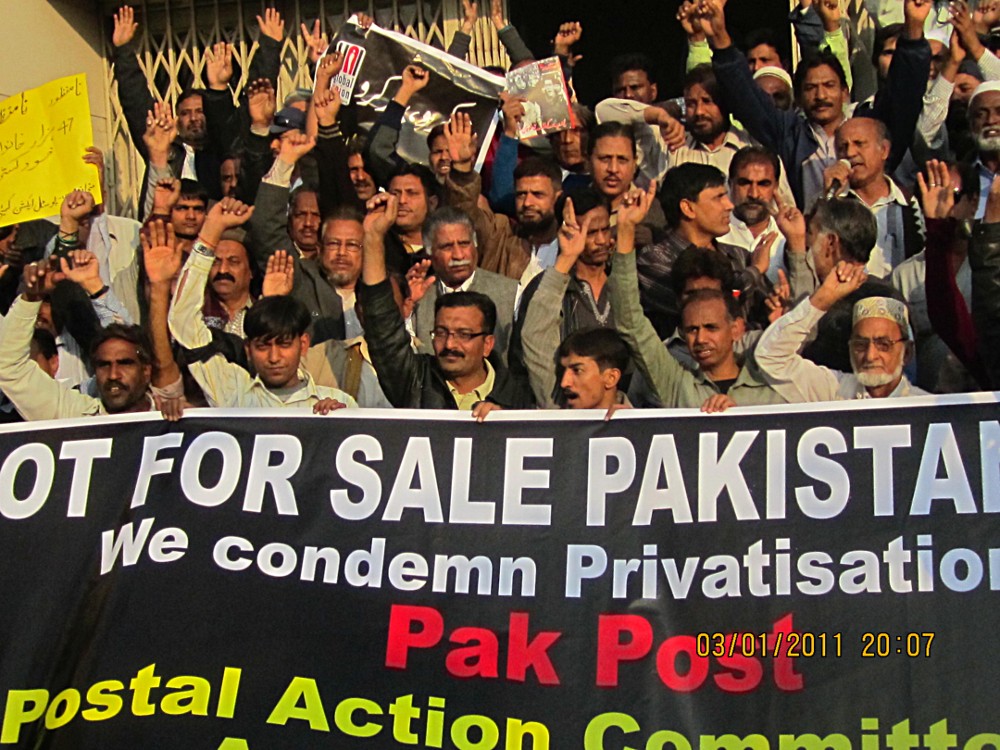
Pakistan: Economic Salvation - Privatisation or Expropriation<http://www.marxist.com/pakistan-economic-salvation-privatisation-or-expropriation.htm> Written by Lal KhanThursday, 21 February 2013 [image: Print]<http://www.marxist.com/pakistan-economic-salvation-privatisation-or-expropriation/print.htm>[image: E-mail]<http://www.marxist.com/component/option,com_mailto/link,9230127de09fda2a10f8d90a2a69aefa768389ce/tmpl,component/> There has been an aggressive campaign in the media that the recipe for growth and the solution to the economic crisis is privatisation and not the nationalisation of industry, agriculture, finance capital and the economy. Nationalisation has been dubbed as a failure and an economic disaster. The burgeoning losses and corruption in the PIA, WAPDA, Railways, Steel Mills and other state institutions have been diagnosed as the products of nationalisation and public ownership. For most analysts and politicians dominating society, the solution of these economic woes is simply the privatisation of these enterprises. Such brusque and absurd statements only lay bare the obtuseness and mediocrity of the experts of the elite who slavishly ape the western bourgeois economists who have plunged the economies of advanced capitalist countries into the deepest slump in memory. [image: postal workers protest 4 january]<http://www.marxist.com/images/stories/pakistan/postal_workers_protest_4_january.jpg>The reality is that the economic development in Europe, the USA, Japan and other advanced capitalist economies in the post war period was possible through the domination of state sectors in the economy that gave them a certain social advance and stability. The economic history of Pakistan also contradicts this approach of monetarist economics. In the 1960s under the Ayub regime there was a substantial expansion of industry and infrastructure and the main emphasis of the economic policy was not the present doctrine of trickle down and free market economics. On the contrary it was Keynesian economics that was pushing the growth rate and expanding the economy. Although it was the by-product of the spin off effects of the boom in western capitalism in that period, it was mainly through the intervention of the state that the economy surged forward. The state set up industries and dams and other infrastructure projects under the state institutions like the Pakistan Industrial Development Corporation (PIDC). Similarly, land reforms were introduced and the state invoked policies to expand and stimulate demand. But this model failed to carry out an equivalent social development which sharpened contradictions in society that exploded in the revolutionary upheaval of 1968-69. Despite defeat in a war, dismemberment of the country and massive destruction, the PPP government, under the influence of the mass upsurge, carried out some of the most radical reforms in the countrys history. Large chunks of the mainly domestic capital and industry were nationalised and massive land reforms were instituted. However, the capitalist state and the system were not overthrown under the utopian doctrine of a mixed economy. The reforms were sabotaged by a bureaucracy that was in cahoots with the landlords, capitalists and the imperialist monopolies. The failure of these reforms to deliver laid bare the incapacity of carrying out of reforms within a capitalist setup. These nationalisations were in fact bureaucratisation of the industries and did not introduce workers management, control and collective ownership. It was a regime of state capitalism that tried to attack some sections of the ruling class without eliminating their system in its totality. As soon as they recovered from the initial blows, this elite hyped inflation and sabotaged the economy resulting in severe social and political instability. In connivance with the imperialists and the military generals they toppled the PPP government and assassinated Bhutto through the gallows in a venomous vengeance for the bruises they got from these expropriations. In the 1980s, when Keynesian economics started to collapse internationally after the oil shock and the first major post war slump of the mid seventies, the new mantra was trickledown economics under the synonyms of Reaganomics and Thatcherism. In reality, it was the same old monetarist capitalism of the 1860s. The collapse of a bureaucratic caricature of socialism in the Soviet Union and the capitalist degeneration of the Chinese bureaucracy further gave impetus to this aggressive neoliberal economics. However, these policies in the ex-colonial countries from Chile to Pakistan were a catastrophe for the teeming millions. The brutal but cowardly Zia dictatorship was afraid and cautious of implementing large scale privatisations as they were terrified of a massive workers backlash that could have overthrown the despotic regime. But with the advent of the democratic regimes of Benazir Bhutto and Nawaz Sharif the privatisation process was accelerated. Thatcherism became the role model. With the lull in the movement and the ideological betrayals of the left political and trade union leaders, who capitulated to Fukuyamas theory of the end of history, the interests of the rulers were served. The disastrous impact on the workers and the impoverished masses was cynically ignored. Today, almost all of the mainstream political leaders in Pakistan subscribe to this doctrine of trickledown economics. Even in the present situation there are numerous examples which demonstrate the progressive impacts of expropriations for the oppressed masses. In its issue of 19th January this year the most ardent advocate of privatisation, The Economist, had this to write about the situation in Bolivia. Since becoming Bolivias president in 2006, Evo Morales has brought ever more of the countrys economy into the hands of the state. In his first year in office he renationalised the oil industry. Telecoms, much of electricity generation and then zinc and tin mining followed. On December 29th Mr. Morales announced the expropriation of two electricity-distribution companies owned by Iberdrola, a Spanish company...Bolivia has overtaken its wealthier neighbour Peru in access to clean water, the World Bank reckons... average incomes have more than doubled in dollar terms...The government may now be able to expand electricity provision, as it has with water...But to sustain this alleviation of poverty and the access of the basic amenities Evo Morales will have to go the whole hog and expropriate the commanding heights of the economy. Capitalism has to be overthrown and the socialist revolution completed for the emancipation of the masses in Bolivia. With the present catastrophic condition of Pakistans economy, privatisations only end up in worsening the plight of the toiling masses. What we can learn from the economic history of capitalism is that class interests are irreconcilable. For the ruling classes and their imperialist bosses these policies of privatisation and the intensification of exploitation are necessary to sustain their rates of profits. For the working masses it means exclusion from health, education, water, electricity and the other basic needs of life. But half hearted nationalisations within the constraints of capitalism are futile and end up in a disastrous economic crisis. The politics of the peoples emancipation need the expropriation of the banks, industry and agriculture. This can be only brought about by the creation and establishment of a democratically planned economy where all production, wealth and resources are not for the sake of profits but for fulfilment of human need and for putting an end to deprivation. Home <http://www.marxist.com/> » Asia <http://www.marxist.com/asia/> » Pakistan <http://www.marxist.com/pakistan/> [Non-text portions of this message have been removed] ------------------------------------ --------------------------------------------------------------------------- LAAMN: Los Angeles Alternative Media Network --------------------------------------------------------------------------- Unsubscribe: <mailto:[email protected]> --------------------------------------------------------------------------- Subscribe: <mailto:[email protected]> --------------------------------------------------------------------------- Digest: <mailto:[email protected]> --------------------------------------------------------------------------- Help: <mailto:[email protected]?subject=laamn> --------------------------------------------------------------------------- Post: <mailto:[email protected]> --------------------------------------------------------------------------- Archive1: <http://www.egroups.com/messages/laamn> --------------------------------------------------------------------------- Archive2: <http://www.mail-archive.com/[email protected]> --------------------------------------------------------------------------- Yahoo! Groups Links <*> To visit your group on the web, go to: http://groups.yahoo.com/group/laamn/ <*> Your email settings: Individual Email | Traditional <*> To change settings online go to: http://groups.yahoo.com/group/laamn/join (Yahoo! ID required) <*> To change settings via email: [email protected] [email protected] <*> To unsubscribe from this group, send an email to: [email protected] <*> Your use of Yahoo! Groups is subject to: http://docs.yahoo.com/info/terms/