http://www.marxist.com/what-the-assad-regime-was-and-what-it-has-become-1.htm
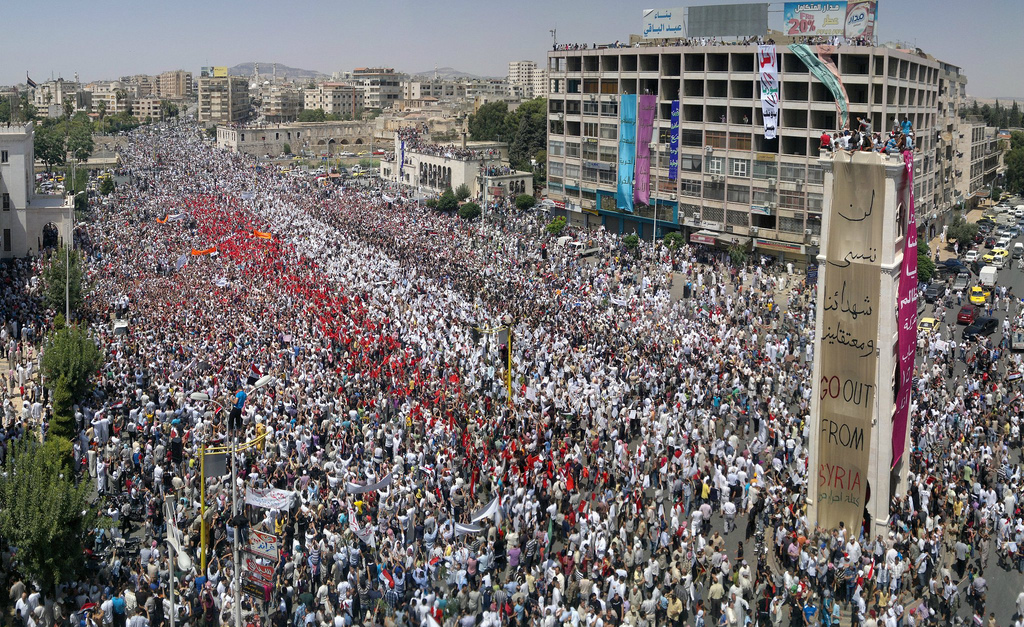
What the Assad regime was and what it has become Part One<http://www.marxist.com/what-the-assad-regime-was-and-what-it-has-become-1.htm> Written by Fred WestonFriday, 01 March 2013 [image: Print]<http://www.marxist.com/what-the-assad-regime-was-and-what-it-has-become-1/print.htm#> The Syrian revolution that broke out in March 2011 was part of the wider wave of revolution that spread across the whole of the Arab world. The International Marxist Tendency supported the revolution without reservations in spite of its shortcomings. Since then, however, due to the lack of a revolutionary leadership, what was a genuine expression of the masses, has now been hijacked by reactionary elements that have a very different agenda. [image: 22 July, 2011. Photo: syriana2011]<http://www.marxist.com/images/stories/syria/jul_22-syriana2011.jpg>Hama, 22 July, 2011. Photo: syriana2011<http://www.flickr.com/photos/syriana2011/>Although clearly prompted by events outside the country, the seeds of the Syrian revolution were to be found in the social and economic conditions that existed in Syria itself. For example, between 1980 and 2000 average incomes actually fell by around 10%. Unemployment was officially at 9%, but the real figure was closer to 20%. What allowed the Syrian regime to maintain itself in spite of the growing economic difficulties was the fact that it had sizeable oil reserves. In 2002 oil represented two thirds of exports and one half of state revenues. The economy was, however, still relatively underdeveloped as can be seen by the weight of agriculture, which still accounted for 27% of GDP and employed around 30% of the workforce. The private sector which previously had played only a secondary role was growing and was particularly strong in textiles, agro/food industry, chemicals, pharmacy and engineering. And after 1990 the public sector employed around one quarter of the active population, and was creating 20,000 jobs per year, while the private sector was creating between 40,000 and 60,000 jobs per year. However, 250,000 young people were entering the labour market every year. This explains the growing youth unemployment an important factor in the revolution! These conditions were a consequence of the economic policies adopted by the Assad regime over recent years, policies that have involved a gradual breaking down of the old state owned, centrally planned economy and the promotion of greater and greater private involvement in the running of economic affairs with a transfer of state assets mainly to cronies of the regime. All this led to a growing social polarisation, which is at the very heart of the revolutionary upheavals. It has to be said that there is much confusion on the left as to the nature of the Assad regime. Some still see in it the old regime that was based on a state owned, centrally planned economy. This led some to oppose the revolution from the very beginning when it was still a genuine expression of the mass movement from below. They see everything in terms of reactionary manoeuvres of imperialism, and in particular of reactionary regimes such as Saudi Arabia or Qatar. While it is true that these regimes have been supplying aid and arming a section of the insurgents, promoting those forces that fit their reactionary agenda and that foreign mercenaries are involved in the fighting it would be simplistic and false to see everything in these terms. Initially there was a genuine revolution that was evident in the early days of the uprising against Assad. And it was the duty of genuine Marxists to support that movement. However, once the revolutionary content of that movement ebbed and the initiative passed to various reactionary elements it was also the duty of Marxists to state clearly what had happened. The truth is that due to the impasse in the situation, the genuine revolutionary elements have been overwhelmed by all kinds of opportunist and counter-revolutionary elements that have come to the fore and been promoted by various foreign powers seeking to promote their own reactionary interests. This is a tragedy which has come about because of the lack of a revolutionary leadership with roots among the masses. Initially, especially the youth who took part in the mass protests, the movement was not ethnic or religious based. One of the slogans that could be heard on the rallies was we are all Syrians, a clear message to those who wanted to divide Syrian society along ethnic/religious lines. Those on the left who have come out in support of the Assad regime, see in it some progressive and anti-imperialist elements. The truth, however, is very concrete: there isnt an ounce of anti-imperialism in the Assad regime. There is nothing progressive about it that could in any way justify socialists giving the regime even the most critical of critical support. In order not to confuse revolution and counter-revolution, a thorough analysis of what the regime was in the past and what it has become over the years is essential. (We provide our analysis of this later in this article). Divide and rule As we have seen, faced with the initial revolutionary upsurge last year, attempts were made to divide the population along ethnic and religious lines. The Assad regime has fomented such divisions (as have also the reactionary regimes in the region, such as Saudi Arabia and other Gulf states). Having lost support in some key areas of the country, the means by which the Assad regime saw of holding on to some kind of mass base, at least in some areas, was to cut across the genuine revolution that had begun and provoke conflict between the different groups that make up Syrian society. This was done in the classic manner of pinpointing particular groups and carrying out brutal indiscriminate attacks against them. As a large part of the crack security forces carrying out such attacks are predominantly made up of Alawites, it was one small step to provoking a counter-reaction among the ethnic/religious groups under attack. Alawites as a whole began to be seen as the enemy. On the other side of the divide, reactionary fundamentalist groups saw in the ethnic/religious divisions a means of promoting their own agenda. And that is what has led to the present impasse. In this process the voice of the genuine revolutionaries has been drowned out by the forces of reaction. As we have seen, the revolution was rooted in the real economic and social conditions that had come into being under the Assad regime over a period of decades. In the recent period Syrian society had become more and polarised, with a small elite at the top enriching itself, while at the other end of the social spectrum we have had growing poverty and a general worsening of living conditions. Within this process of polarisation some layers had come out far worse off, but it is also true that, especially in cities like Damascus and Aleppo, a petit bourgeois layer was also reaping some benefit from the recent economic changes. This factor explains also the resilience of the regime. Had the revolution offered a programme that could have won over these layers, the Assad regime would have fallen long ago. Unfortunately, the revolution failed to develop such a programme and this is what opened up space for the reactionary elements. The main message the revolution expressed was for the downfall of the regime and democracy. But democracy in and of itself is not always sufficient to mobilise all of the population. It must be combined with an answer to the economic and social problems, such as wages, jobs, housing and so on. The demand for democracy, as in Egypt and Tunisia, reflects a desire for social change among the bulk of working people, for an end to the misery they are living in. If democracy is perceived as bringing instability, ethnic/religious conflicts and economic dislocation, then it will fail to get the full backing of all the working people. Added to this is the fact that very dubious and reactionary fundamentalist elements have entered the movement, attempting to divert it down a different road, giving the regime precisely what it required, the fundamentalist scarecrow with which to terrorise the urban petit bourgeoisie. The idea the regime has built up among these layers is that the opposition is merely made up of terrorists who want to drag Syrian society backwards and not forward; that it is made up of elements who would destroy the lay and modern nature of Syrian society; in a word it would mean barbarism. This has undoubtedly had an effect in at least neutralising some layers of the population, who cling on to the regime, not because they support the Assad regime, but for fear that something worse could take its place. There is another factor that explains the stalling and derailing of the Syrian revolution. The Egyptian and Tunisian revolutions also because of the lack of a revolutionary leadership were side-tracked and Islamic parties came to the fore in the initial stages. There too, although the revolution saw the mass participation of workers and youth and a very rapid overthrow of the hated old dictators, once the regimes fell, unfortunately, the masses had no mass revolutionary party to rally to. A vacuum appeared and it was filled with what was available, varying forms of religious based parties. (In Egypt now things are moving on, with a significant layer of the population turning against the new regime of Morsi, but still no clear perspective of how the Egyptian revolution can be completed is being offered). The situation in Libya has further added to the confusion. The regime eventually collapsed, but what has replaced it cannot be very attractive to many ordinary Syrians who are wondering what is going to replace the Assad regime once it falls. The prospect of the country breaking up into different fiefdoms, of different local power groups and militias, combined with dislocation of the economy is not a very attractive option. And, again, this explains why the regime, in spite of its brutality, has been able to hold on for so long. Having said all this, it is clear that Assad will sooner or later fall. A regime that has to rule by the sword alone is doomed to eventual collapse. Even the most brutal of dictators must provide the masses with something other than brutal force. If it cannot provide enough jobs, wages, services, food, etc., eventually its downfall will come. If there existed a revolutionary tendency, rooted within the masses, basing itself on the fundamental idea that a solution to the problems of the Syrian workers and youth can only be found in a radical transformation of society which can only mean the socialist transformation of Syria such a tendency would be in a position to win the ear of the masses and lead them in a class struggle. The tragedy is that such a tendency does not exist in Syria. The role of the Soviet Union And here we are faced with a key point in any discussion about Syria. Even the most militant and revolutionary workers and youth in Syria will wonder what we mean by socialist transformation of Syrian society. After all wasnt the Assad regime socialist? Wasnt the economy a socialist economy based on state ownership and planning? Wasnt Syria part of the sphere of influence of the socialist USSR, which eventually collapsed? Marxists must answer all this; otherwise they will never get an echo among the most advanced revolutionary youth of Syria, precisely those who have been sidelined by the different reactionary forces vying for control of the opposition, from the open stooge elements of western imperialism to the extreme reactionary fundamentalist groups. When a Marxist poses the need for a socialist transformation of Syria as the only way out, inevitably he or she will come up against a barrage of protests: but Syria *was* socialist and it didnt work. Genuine Marxists, i.e. the followers not only of the ideas of Marx, Engels and Lenin, but also of Trotsky, can explain why the Soviet Union collapsed. It is all in Trotskys classic, *The Revolution Betrayed *(written back in 1936!), where he explains how the Soviet Union degenerated into the Stalinist dictatorship which represented the interests of the bureaucracy and not of the workers and peasants. There were concrete material factors that led to that process of degeneration and which produced a phenomenon such as Stalin. Lenin never envisaged the possibility of socialism in one country. He understood the need for international revolution; otherwise the country could even have reverted back to capitalism. That is why he dedicated so much energy to building the Communist International. The theory of socialism in one country, however, became the dominant school of thought within the Soviet Union after Lenins death, where the bureaucracy had risen above the working class and had assumed material interests of its own. This idea was then imposed on the whole international communist movement, which in turn prepared terrible defeats in one revolution after another, further isolating the Soviet Union and in turn further strengthening the bureaucracys grip on power. It is not the purpose of this article to give a detailed account of why and how the October 1917 Russian revolution ended as it did. For a detailed explanation we refer our readers to Trotskys *The Revolution Betrayed <http://www.marxists.org/archive/trotsky/1936/revbet/index.htm> *and Ted Grants *Russia: From Revolution to Counter-revolution<http://www.marxist.com/russia-book/> *. However, we would stress that a correct Marxist appraisal of what happened in the Soviet Union, of what it was and what it became, is essential if one wishes to understand what the Assad regime was and the various changes and transformations that it has undergone over the years. Without such an understanding one can end up making some very elementary mistakes as some on the left, particularly of a Stalinist or ex-Stalinist extraction, have made in the recent period. The fact that parties claiming to be Communist have continued to support the Assad regime has done serious damage to the cause of the Syrian revolution. It is precisely because of this that an article such as the present is required to state clearly what a Marxist position on the events in Syria should be. Marxists stood clearly *with* the masses as they rose up *against* the Assad regime. However, to state that is not enough. As we have pointed out, there are extremely reactionary forces that are operating inside and outside Syria for the overthrow of the regime, but whom genuine Marxists cannot collaborate with in any form whatsoever. In fact, it is the duty of genuine Marxists to warn the workers and youth of Syria against these elements, however much the masses may desire the fall of Assad. These forces are not friends of the Syrian masses. It is sufficient to look at the situation in Egypt and Tunisia, where both the Muslim Brotherhood and the Ennahda party have been trying to roll back the gains of the revolution. We explained throughout the process of revolution in these two countries that such forces were reactionary and no support should be given to them. A similar warning has to be issued today in reference to Syria. In spite of the reactionary positions adopted by different forces claiming to be the leaders of the opposition in Syria, it is evident that there are many honest people, workers, youth and unemployed, who are participating in the fighting against the regime. Many will have joined the various fighting groups and are courageously taking on the regime. In many cases they are simply joining whatever force allows them to defend their families and neighbourhoods against the brutal attacks of the regime. *And it is mainly to these layers that this article is addressed.* The tragedy of the Syrian situation is that due to years of stifling dictatorship it was not possible to build a viable, genuinely socialist opposition grouping within the country. Furthermore, the fact that the Assad regime was seen as being very close to the Soviet Union, the idea that Communism can solve the problem of the Syrian people has been thrown very far back in the consciousness of the masses. In all this it does not help that several Communist Parties around the world have come out in support of the regime. It means that anyone who claims to be a Communist, Socialist or Marxist and supported the revolution must first excuse themselves for something they are not responsible for. An example of such Communists is to be found in Israel where in May of 2011 the general secretary of the Israeli Communist Party, Mohammed Nafaa, published an article in Al Khuwar Al Mathmadan, a well-known Arabic site, denouncing the Syrian revolution. (Similar statements can be found from the Lebanese Communist Party and others). The following month the partys Arabic language website published a statement of a meeting of Communist Parties in Brussels, which stated that the Communist parties express their support of Syria in the face of the imperialist plots... Another example of such distorted thinking is the following: ...Syria has become the new front line of the war between Empire and those resisting it... despite its many flaws, the Syrian regime is actively resisting imperialist aggression and anything less than lending it *full support* for the duration of this crisis at least is tantamount to opposing its resistance to imperialist aggression. Although part of our duty as intellectuals is to call for political reforms and a greater inclusion of the homegrown, legitimate opposition in the reform process, this must be done in a manner which neither undermines the regimes current position vis-à-vis our shared enemies, nor benefits the latter. (From Syrian Crisis: Threes a Crowd <http://english.al-akhbar.com/node/8382> by Amal Saad-Ghorayeb , Published Tuesday, June 12, 2012) [Our emphasis] Here we have outright support for the regime in the first example and a kind of critical support for the regime in the second. All of this is based on the idea that the Assad regime is anti-imperialist. This flies in the face of reality and can only be sustained if one suffers from a kind of selective historical amnesia and ignores what the regime has actually done on many occasions *to collaborate with imperialism*. In 1976, Hafez Assad invaded refugee camps in Lebanon* *to suppress Palestinian resistance, coordinating its operations with Israel, and with the full backing of US imperialism. Syria had in fact been called on to intervene by the west (including Henry Kissinger) to prevent the defeat of the right-wing Maronite Christian militias in the civil war that had started in 1975 between progressive secularists, Muslim militias and the PLO. Later, in 1990-91 the regime cooperated in the US attack on Iraq; in 2003 the regime did not lift a finger to defend Iraq against imperialist attack. It withdrew from Lebanon under US pressure. These are the facts about Assads supposed anti-imperialism. *To be continued...* [Non-text portions of this message have been removed] ------------------------------------ --------------------------------------------------------------------------- LAAMN: Los Angeles Alternative Media Network --------------------------------------------------------------------------- Unsubscribe: <mailto:[email protected]> --------------------------------------------------------------------------- Subscribe: <mailto:[email protected]> --------------------------------------------------------------------------- Digest: <mailto:[email protected]> --------------------------------------------------------------------------- Help: <mailto:[email protected]?subject=laamn> --------------------------------------------------------------------------- Post: <mailto:[email protected]> --------------------------------------------------------------------------- Archive1: <http://www.egroups.com/messages/laamn> --------------------------------------------------------------------------- Archive2: <http://www.mail-archive.com/[email protected]> --------------------------------------------------------------------------- Yahoo! Groups Links <*> To visit your group on the web, go to: http://groups.yahoo.com/group/laamn/ <*> Your email settings: Individual Email | Traditional <*> To change settings online go to: http://groups.yahoo.com/group/laamn/join (Yahoo! ID required) <*> To change settings via email: [email protected] [email protected] <*> To unsubscribe from this group, send an email to: [email protected] <*> Your use of Yahoo! Groups is subject to: http://docs.yahoo.com/info/terms/