http://www.marxist.com/venezuela-the-april-14-presidential-elections-and-the-tasks-of-the-revolution.htm
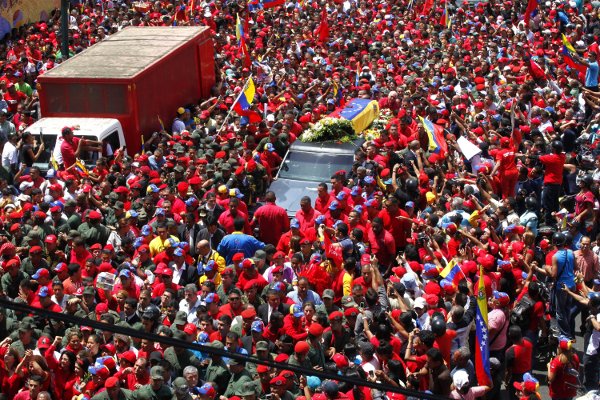
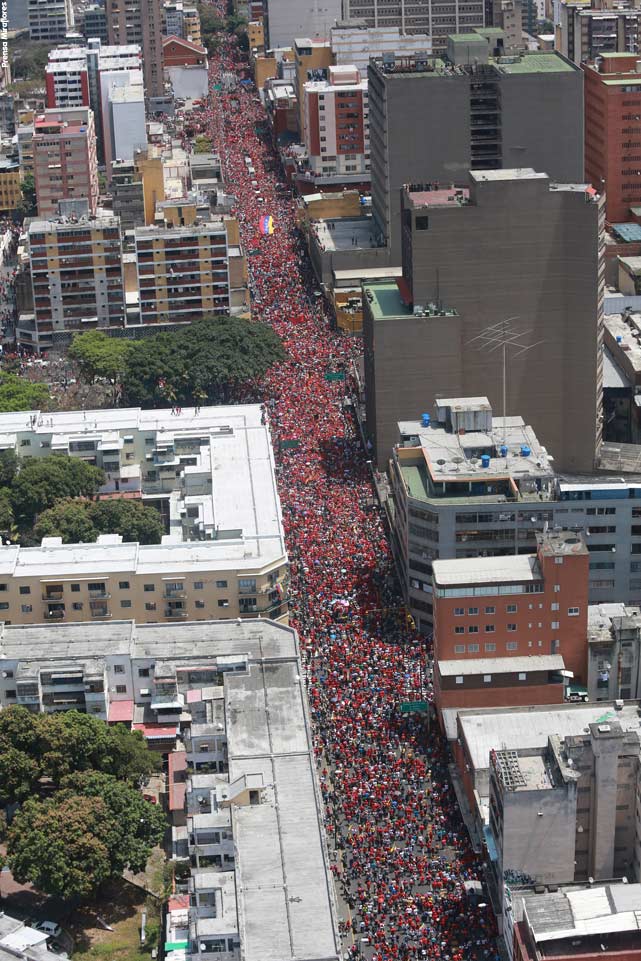
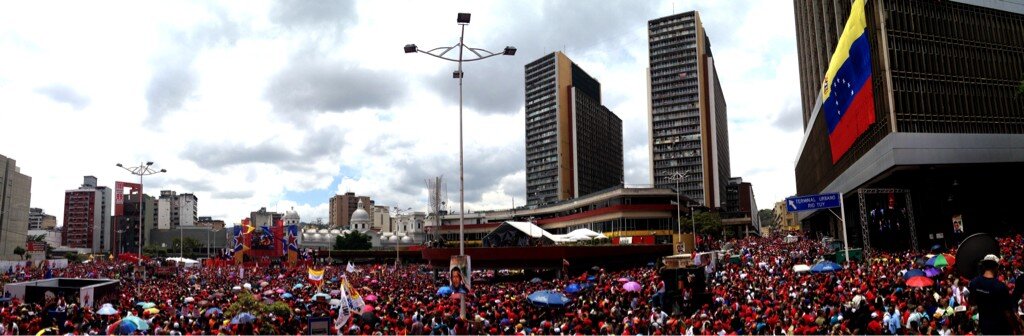
Venezuela: the April 14 presidential elections and the tasks of the revolution<http://www.marxist.com/venezuela-the-april-14-presidential-elections-and-the-tasks-of-the-revolution.htm> Written by Jorge MartínWednesday, 13 March 2013 [image: Print]<http://www.marxist.com/venezuela-the-april-14-presidential-elections-and-the-tasks-of-the-revolution/print.htm#> It is a week now since the death of Hugo Chávez and there are still kilometer long queues of people coming from all over the country to pay their last respects. Presidential elections have been called for April 14 and the mood is turning angry at the provocations of the oligarchy. [image: féretro]<http://www.marxist.com/images/stories/venezuela/f%C3%A9retro.jpg>Mass demonstration accompanying Chavez' coffinIt is very difficult to convey even a fraction of the outpouring of grief and emotion which Venezuela has witnessed in the last week. According to some accounts, as many as two million people came out to accompany the coffin, as it was being transported from the Military Hospital to the Próceres where it was to be displayed. The route is around 8 km long and it took the funeral procession over 7 hours to cover it. In the days that followed, hundreds of thousands - probably millions - queued for hours, some for days, to say their last farewell to the president. It is not just the social programs implemented by the Bolivarian government. Above all it is the sense that for the last 14 years, the overwhelming majority of the population, workers, the poor, peasants, and many who would describe themselves as middle class; have for the first time taken their future in their own hands. The deep feeling of pride and dignity, which ordinary working people have gotten from participating directly in the revolution and defending it against the repeated assaults of the oligarchy and imperialism, created a very powerful bond with the president. [image: Same protest seem from above - Click to enlarge picture]<http://www.marxist.com/images/stories/venezuela/cortejo060313_8.jpg>Same protest seem from above - Click to enlarge pictureThe mood was aptly summed up by Mario Escalona, a community council activist from Yaracuy, quoted in the excellent chronicle of the funeral by Ewan Robertson ofVenezuelanalysis<http://venezuelanalysis.com/analysis/8158> : Im here representing this new homeland that our Comandante founded. We come from a struggle; as our Comandante said to us in his final national message. We also come from community councils; were spokespersons of community councils, peoples power, and the tool that Hugo Chávez left us. To the whole people of Venezuela and the whole world we say: Chávez didnt die, hes in our hearts. Clearly, the mood was not just one of grief; there has also been a clear commitment to defending the conquests of the revolution and of carrying it forward. An indication of this was the fact that as soon as the news of Chávez's death were announced, a group of*chavista *motorcycle riders from the 23 de Enero neighbourhood went to Chacao, where a small group of opposition youth had chained themselves demanding to see proof of life for Chávez, and swiftly dispersed them and set their tents on fire. A comrade from Caracas described a conversation he had with a group of rank and file militants as they were going to the funeral. One of them was a woman who was an officer in the reserve, whose son was serving in the army in the border with Colombia. She said that talking with her mum, he had told her that if something happened, she would leave her younger child with her mother, and take up arms to defend the revolution. She added that in her view, the best way to defend the revolution in this new period was that every household should become an armed fortress of the revolution, that the people should be armed. She explained that, of course, she did not wish for an armed conflict among Venezuelans, but that the revolution should be defended, arms in hand if needed, against any aggression of the oligarchy and imperialism. Many people who, for one reason or another, had not been actively participating in the revolutionary movement in the recent period, are now becoming active again. There is a feeling that now that Chávez is no longer at the head of the revolution, it is down to the rank and file militants to ensure the continuation of the revolution. These incidents reveal the real mood amongst the masses. The ruling class is really frightened. Despite their best efforts to organise a pans and pots protest, their own supporters have until now preferred to stay home. The bourgeois media and US imperialism have insisted on the idea that the Constitution must be respected and that the transition must be fully democratic. The sly implication is that somehow the constitution was going to be violated and that democratic rules would not be respected. The Venezuelan democratic opposition went further and alleged that a coup had taken place, when Vice-president Nicolas Maduro was sworn as President-in-charge by the National Assembl. For this reason they boycotted the session where this took place. How hypocritical. These are the same people who opposed the Bolivarian constitution, burnt copies of it at their demonstrations and suspended all democratic rights and constitutional guarantees during the April 2002 coup which they organised in cooperation with Washington. They are also wrong from a legal and constitutional point of view. Chávez was not only president elect, but he had also been re-elected and had already appointed his Cabinet in November. The constitution establishes clearly that in the case of permanent absence of the president, the vice-president will take over *and new elections will be called within 30 days.* One could hardly think of a more democratic procedure, one which, incidentally, does not exist in many other countries, where there is no legal requirement to call new elections if the president dies. In the US for instance, if the president dies he or she is replaced by the vice-president and no election is called. In Spain, of course, the head of state is not elected as there is a Monarchy, with the present King Juan Carlos I having been appointed as his successor by Franco a dictator. However, this is not about constitutional legality. The Venezuelan ruling class does not really care whether Maduro (the Vice-president) or Cabello (president of the National Assembly) take over for the next five weeks until the presidential elections on April 14. What they are interested is in creating a constant climate of uncertainty and tarnishing all institutions with a suspicion of illegitimacy. This, in turn, is provoking a backlash amongst the revolutionary people, who are sick and tired of the so-called democratic opposition, who organised a coup in 2002, constantly questioning the democratic legitimacy of the revolution. Then on Friday 8 March, the main opposition leader, Capriles, went on the offensive saying that the decision for Maduro to become president-in-charge was a constitutional fraud. In an arrogant and condescending tone he said: Nicolas, nobody has elected you president, boy. This was combined with a campaign of the opposition attacking Nicolás Maduro for having been a bus driver, revealing the depth of class hatred which inspires these democrats. The oligarchy, the bankers, landowners and capitalists, who have ruled the country as their own private fiefdom for the best part of 200 years, believe that they have a god given right to rule. They could not, in the case of Chávez, stomach the idea of someone who came from the people and spoke the language of the people being the president. Now they insist that a simple bus driver cannot be a president. To add insult to injury, on Sunday, Capriles spoke at another press conference in which he alleged that the Bolivarian leadership had lied for two months about Chávez's illness. Furthermore he claimed that they had lied about the time and circumstances of his death. Who knows when he died, he said, without presenting any proof of these very serious allegations and not allowing any questions from the journalists present. The backlash against him was such that Maduro warned the opposition was provoking a tsunami of popular anger which could end up in violence. As a graphic demonstration of the balance of forces, a huge crowd accompanied Maduro when he went to register as a presidential candidate. Replying with irony to the insults of the opposition, he arrived driving a bus! The opposition candidate Capriles did not register personally. No one accompanied him. [image: maduroCNE0312]<http://www.marxist.com/images/stories/venezuela/maduroCNE0312.jpg>The demonstration accompanying Maduro At the end of the huge Bolivarian rally, thousands stayed behind for a few hours discussing and shouting slogans. Amongst them one which reflects the mood of the masses: el peo no es con Chávez, el peo es con nosotros - which can roughly be translated as: this is not about Chávez, this is about us. Capriles has accused Maduro of turning the campaign into a battle between Chávez and Capriles, rather than about himself. The people in their wisdom replied that in reality this is not even about Chávez, but about the will of the revolutionary working people. The presidential election on April 14 will also take place immediately after the commemoration of the anniversary of the April 2002 coup and the revolutionary mobilisation which smashed it. This would also serve as a reminder of what is at stake. There is no doubt that this will be yet another victory for the revolution. The revolutionary masses understand this election as a tribute to Chávez and a reaffirmation of the need to carry the revolution forward. They wholeheartedly support Maduro as he was the candidate proposed by Chávez in December, when he warned about the frail state of his health. But this does not mean that they are giving him a blank cheque. Maduro will be judged on his actions and on the yardstick of the program of the revolution. Not by the upper class *sifrino* youth of the * urbanizaciones* in the East of Caracas, nor the learnt lawyers and educated ladies and gentlemen, the people with surnames as Maduro called them. Neither will it be the oligarchy who hate the fact that he comes from a working class background. Rather, it will be the industrial workers of Guayana, fighting for workers control; the women of Gotcha, the occupied factory in Aragua; the revolutionary militants of the communal councils of the 23 de Enero, Catia, Antímano, Petare and many other poor neighbourhoods; the oil workers; the peasants being killed over agrarian reform; the Yupka indigenous people whose leader was killed the week before Chávez's death; the workers and youth who have joined the militias, etc. They will put Maduro and the new Bolivarian government to the test, demanding that they remain loyal to the socialist aims of the revolution, that there is no conciliation with the oligarchy, no watering down of the program, no concessions to those whose sole aim is to destroy the revolution and its achievements. They will resist any attempt by the bureaucracy and the reformists to continue to block the revolutionary will of the masses. Just before Chávez's death a conflict was already brewing against the bureaucracy within the Bolivarian movement over the selection of candidate for Caracas mayor. It had been announced that all Bolivarian candidates for municipal elections would be selected democratically by the rank and file. But then, there was talk that this same process would not apply for Caracas mayor. The reason was clear to everyone, one of the main representatives of the radical left wing of the movement, former Commerce Minister Eduardo Samán, had announced his intention to stand. The assassination of the traditional leader of the Yupka people Sabino Romero on March 3 also provoked a wave of anger on the part of rank and file revolutionary activists. Everyone knew that Sabino's life was under threat. His 109 year old father had been beaten to death the year before. The reason was his leading role in the struggle for the recognition of indigenous land rights in the Sierra del Perijá. This area, on the border to Colombia, is ruled by cattle ranchers, mining corporations and paramilitaries. But nothing was done to protect Romero and the struggle he represented. The landowners and mining companies are directly responsible for his death, but the bourgeois state is also an accomplice. Chávez himself had declared publicly that he was on the side of the indigenous peoples and had given orders to expropriate the land to be given to the indigenous communities. But as in many other instances, this was being blocked by bureaucrats in ministries, judges, and military officers. In November 2012, the Yupka people travelled to Caracas to press for their demands, overcoming several road blocks aimed at preventing them from leaving their communities. They wanted to talk to Chávez directly. On that occasion, Sabino Romero declared: we have been revolutionary and socialists for many years, but the Ministry is manipulating us. The problem is not Chávez, but those who are below him. The elements of workers' control in the basic industries in Guayana - which were implemented by Chávez who was responding to the demands of the workers' themselves - have been almost eradicated in a vicious campaign involving the state bureaucracy, the regional Bolivarian governor, the trade union bureaucrats of the FBT trade union federation and the multinationals. The workers at Cerámicas Caribe ceramics factory in Yaracuy have been fighting for their collective bargaining agreement for three years and have defeated an attempt of the bosses to impose a yellow union. They have now taken the step to guard the premises as they suspect the owners want to remove the machinery and declare bankruptcy in order to break the union. Throughout this process the workers have been ignored by the labour inspector and the regional representative of the Ministry of Labour. President Chávez already intervened in the conflict more than a year ago. He gave clear instructions that unless the bosses accepted the demands of the workers the factory should be expropriated. But this order has not been implemented by the authorities. All these are examples of the divisions which exist within the Bolivarian movement itself. Between the revolutionary workers and the poor on the one side and those who hypocritically pledge loyalty to Chávez and the Bolivarian revolution - but who are in fact fifth column of the oligarchy within the movement - on the other. The enemies of the revolution are the oligarchy and imperialism, but also those bureaucrats and corrupt officials who block the revolutionary initiative of the masses, water down policies proposed by Chávez himself and generally want to maintain the revolutionary process firmly within the bounds of capitalism. The ruling class still controls key levers of the economy, which it uses to sabotage the democratic will of the majority, through hoarding, speculation, flight of capital and an investment strike. The state apparatus, which remains basically a capitalist state, remains a block for the completion of the revolution. In July 2011 with the news about Chávez's health, the ruling class launched a campaign about the need for a so-called transition. He replied sharply that here there is only one transition which is posed and which needs to be speed up, the transition from the capitalist mode, which is destroying the planet, and the socialist model, which represents the salvation of humanity. It is down to the revolutionary working class activists in Venezuela to ensure that this is carried through, with the expropriation of the oligarchy and the destruction of the capitalist state, to be replaced by the democratic planning of the economy and new revolutionary institutions based on the communal councils and the socialist workers' councils. The April 14 elections will be just one step in this struggle [Non-text portions of this message have been removed] ------------------------------------ --------------------------------------------------------------------------- LAAMN: Los Angeles Alternative Media Network --------------------------------------------------------------------------- Unsubscribe: <mailto:[email protected]> --------------------------------------------------------------------------- Subscribe: <mailto:[email protected]> --------------------------------------------------------------------------- Digest: <mailto:[email protected]> --------------------------------------------------------------------------- Help: <mailto:[email protected]?subject=laamn> --------------------------------------------------------------------------- Post: <mailto:[email protected]> --------------------------------------------------------------------------- Archive1: <http://www.egroups.com/messages/laamn> --------------------------------------------------------------------------- Archive2: <http://www.mail-archive.com/[email protected]> --------------------------------------------------------------------------- Yahoo! Groups Links <*> To visit your group on the web, go to: http://groups.yahoo.com/group/laamn/ <*> Your email settings: Individual Email | Traditional <*> To change settings online go to: http://groups.yahoo.com/group/laamn/join (Yahoo! ID required) <*> To change settings via email: [email protected] [email protected] <*> To unsubscribe from this group, send an email to: [email protected] <*> Your use of Yahoo! Groups is subject to: http://docs.yahoo.com/info/terms/