http://www.marxist.com/which-way-forward-for-revolutionary-socialists-pt-1.htm
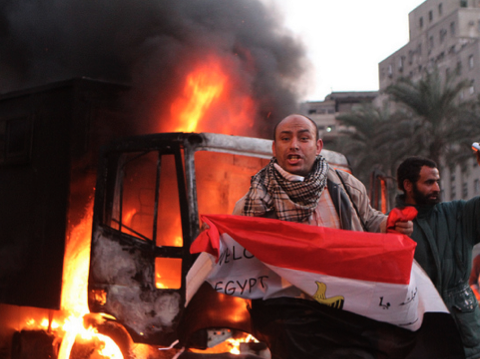
Egypt: Which way forward for revolutionary socialists? - Part one<http://www.marxist.com/which-way-forward-for-revolutionary-socialists-pt-1.htm> Written by Hamid AlizadehThursday, 28 March 2013 [image: Print]<http://www.marxist.com/which-way-forward-for-revolutionary-socialists-pt-1/print.htm>[image: E-mail]<http://www.marxist.com/component/option,com_mailto/link,ce9e6e5048de6bcb4f2cf9607dbf9a64d3aa3bdf/tmpl,component/> More than two years have passed since the first steps of the Egyptian revolution. At first the movement was in a state of euphoria going from victory to victory sweeping away every obstacle on its path. The mood was intense and to a degree even festive. Millions of people, oppressed for decades, flocked to Tahrir Square imbued with the sense of their own power. They felt that all problems could be overcome with the same ease as they swept aside Mubarak. They felt unstoppable, and they were right to feel so. But experience is teaching them things are not so easy. [image: 21-11-2011 tahrir square egypt]<http://www.marxist.com/images/stories/egypt/21-11-2011_tahrir_square_egypt.png>Soon after the fall of Mubarak the revolution realized that all was not good. Having waged the struggle and paid the ultimate price it soon dawned on the people of Egypt that power had slipped through their own hands and back into the hands of the old state in the form of the army tops. The revolution turned Egypt upside down. Everything changed, yet, it still remained the same. The most important levers of power, the state and the economy, remain in the hands of the bourgeoisie. Thus a new phase of the struggle began, a phase where the bourgeoisie, which has been severely weakened, is trying to manoeuvre to hold on to power, but is constantly forced by the crisis of its own system, to attack the revolution and its gains. On the other hand the working masses are forced to take to the streets again and again, only to find that there is no leadership which deserves the name. The lack of a revolutionary leadership is the single most important obstacle for the forward movement of the masses, who have shown again and again that they are willing and capable of responding to the attacks of the bourgeoisie. But the lack of a leadership is the reason why the movement stops, hesitates and ends up in a stalemate that is unsustainable. For the masses on the streets this is frustrating. Everything has changed, but nothing has changed they say. Every time we push away one dictator another one, albeit in different clothes, takes his place. From Mubarak, to Tantawi to Morsi there is little difference in the daily lives of the workers and the poor. But for Marxists there is no time to waste in despairing. Our task is neither to weep,nor laugh, but to understand. We must pose the questions sharply: What are the main problems of the revolution and what are our tasks as Marxists? For a class based position During the presidential elections we wrote about the counter-revolutionary nature of the Muslim Brotherhood and the mistaken position of the leaders of the Revolutionary Socialist (RS) a group linked to the British Socialist Workers' Party (SWP) who were giving support to the candidate of the Islamist group. Back then the official resolution of the RS organisation read: We are also convinced that the victory of Shafiq in the second round of the elections will be a great loss to the revolution and a powerful blow against its democratic and social gains. It would give a golden opportunity to the preparations of the counter-revolution for a more brutal and extensive revenge attack under the slogan of restore security to the street within days. (Revolutionary Socialists' statement on Egypt's presidential elections <http://www.socialistworker.co.uk/art.php?id=28595>)<http://www.socialistworker.co.uk/art.php?id=28595> To that we responded: Nobody can have any illusions as to the nature of Shafiq and the role he is playing. But is this a sufficient justification for calling for a vote for the Muslim Brotherhood? In order to justify this, the document appeals to the old argument about the lesser evil. We have heard this argument a very great evil. We have heard this argument many times before. On every occasion, what was supposed to be the lesser evil turned out to be a very great evil. (The Revolutionary Socialists and the Egyptian elections: Marxism or opportunism?<http://www.marxist.com/revolutionary-socialists-and-the-egyptian-elections.htm> ) And how true those words are today? Less than a year after his election Mohammed Morsi is today the most hated man in Egypt. After having made a deal with the same army generals who were previously backing Shafiq, Morsi turned against the revolution in a campaign aimed at taking back all that the revolution had won. By the introduction of his dictatorial decree, by pushing through the hated constitution, by attacking the workers and their organisations, by sending his thugs into the streets, by murdering hundreds of fighters and by a thousand other injustices and corrupt measures he has been waging a full blown war against the revolution since the first day of his presidency. In fact, by posing as a man of the revolution against the old regime, Morsi was merely using a golden opportunity to prepare the counter-revolution for a more brutal and extensive revenge attack under the slogan of restore security to the street. By supporting the Brotherhood an act that received the official thanks of the Morsi campaign after his election victory the leaders of the Revolutionary Socialists were nurturing the idea that the Muslim Brotherhood is a part of the revolution. In fact an RS comrade, Mostafa Bassiouny, wrote in June 2012, that the Muslim Brotherhood represents the right wing of the revolution and not the counter-revolution. (Unity against generals' attempted coup in Egypt<http://www.socialistworker.co.uk/art.php?id=28841> ) Not only is this idea wrong, which is clearly seen in the subsequent developments, but it also disarms the workers and youth especially their most advanced layers and leaves them unprepared for future events. Interestingly enough, the comrade had no problems in seeing the mistake in other left forces joining the secular camp. The the Taggammu party, for example, ended up supporting Shafiq, which is no surprise as they also supported Mubarak against the Brotherhood. However, this mistake is not rectified by making the opposite mistake and supporting Morsi. Trotsky explained a similar situation when talking about Nazi Germany: ...We Marxists regard Brüning [German bourgeois politician in the 1920s and 1930s] and Hitler, Braun included, as component parts of one and the same system. The question as to which one of them is the lesser evil has no sense, for the system we are fighting against needs all these elements. But these elements are momentarily involved in conflicts with one another and the party of the proletariat must take advantage of these conflicts in the interest of the revolution. (...) When one of my enemies sets before me small daily portions of poison and the second, on the other hand, is about to shoot straight at me, then I will first knock the revolver out of the hand of my second enemy, for this gives me an opportunity to get rid of my first enemy. But that does not at all mean that the poison is a 'lesser evil' in comparison with the revolver. The misfortune consists precisely of the fact that the leaders of the German Communist Party have placed themselves on the same ground as the Social Democracy, only with inverted prefixes: the Social Democracy votes for Brüning, recognizing in him the lesser evil. The Communists, on the other hand, who refuse to trust either Braun or Brüning in any way (and that is absolutely the right way to act), go into the streets to support Hitlers referendum, that is, the attempt of the fascists to overthrow Brüning. But by this they themselves have recognized in Hitler the lesser evil, for the victory of the referendum would not have brought the proletariat into power, but Hitler. The interests of the Bourgeois are directly opposed to the interests of the masses. This is not a matter of will or choice but a matter of material conditions. To explain this, to clarify the class divide in society and to thus raise class consciousness is the main task of any revolutionary. But by supporting a group that is essentially bourgeois in character, the RS not only did not assist in the clarification of the class divide in society, they actually served to dilute the class differences. As we shall later see, this has implications for the whole course of the revolution. Revolution or Counter-Revolution Previously, in July of 2012 when the Brotherhood was making a deal with the SCAF, comrade Sameh Naguib, one of the main leaders of the Revolutionary Socialists, stated at a conference: The victory of Morsi, the Muslim Brotherhood candidate, is a great achievement in pushing back this counter-revolution and pushing back this coup d'etat. For now, this is a real victory for the Egyptian masses and a real victory for the Egyptian revolution. This might not seem clear on the surface of things. Many people, especially in the West, and also over here, have an Islamophobic attitude that does not allow them to see the nature of the Muslim Brotherhood... And then the comrade went on to explain to us that: Whenever there is the threat of counter-revolution, the Islamists will run toward the masses, will mobilize the masses in the hundreds of thousands against the military regime. Whenever there's a threat from below, whenever the masses seem to be breaking the hold of the Muslim Brotherhood, then they side with the military regime, with the generals, in trying to hold back the masses. (From the eye of the storm in Egypt<http://socialistworker.org/2012/07/09/from-the-eye-of-the-storm-in-egypt> ) For anyone living in Egypt today this must seem like pure fiction because it has very little to do with the harsh realities that the revolution has endured over the last 6-7 months. As a revolutionary, it is the greatest mistake to mix-up revolution with counter-revolution, but this seems to be exactly what the comrades have been doing. As we have demonstrated above it was not a difficult task to see in which direction the Muslim Brotherhood would have developed. But to give the comrade the benefit of the doubt we could say that the counter-revolutionary nature of the regime hadnt fully emerged in practice before the fall of 2012 where Morsi, with the presentation of his famous presidential decree declared war on all conquests of the revolution (see our <http://www.marxist.com/new-pharao-ignites-wrath-amongst-the-masses.htm>Egypt: The New Pharaoh Ignites Wrath Amongst The Masses<http://www.marxist.com/new-pharao-ignites-wrath-amongst-the-masses.htm> and <http://www.marxist.com/egypt-morsi-humiliated-as-revolution-raises-head.htm>Egypt: Morsi Humiliated as Revolution raises its head once again<http://www.marxist.com/egypt-morsi-humiliated-as-revolution-raises-head.htm> ). Since then, and we are sure that comrade Naguib is aware of this fact, a bitter struggle has been waged almost uninterruptedly in the streets of Egypt. In fact as many activists correctly sense, there has been a threat of counter-revolution but unlike what the comrade expected, the Muslim Brotherhood has not been [mobilizing] the masses in the hundreds of thousands against the military regime. On the contrary, the Brotherhood have been directing the army and mobilizing its own forces *against *the revolution. And whenever the masses have pushed back the Brotherhood has not *merely* sided with the military regime and the generals, in trying to hold back the masses, they have tried to crush the movement by violently attacking it, working not only with the army, but with the the police, the Salafists and all other reactionary forces in Egypt. All of these real life events should have made the reactionary nature of the Muslim Brotherhood clear to comrade Naguib and the rest of the leaders of the Revolutionary Socialists and the leaders of the British SWP we should add. The disappointing answer is given in the latest edition of *Socialist Review *where comrade Naguib gives us his and the rest of the RS leaderships we assume analysis of the situation. Reading this we were shocked at seeing Sameh writing the following: The Brotherhood's problem is that it *currently *[!?!, our emphasis]* *represents the interests of big business and the apparatus of Mubarak's state. We have recently seen laughable statements from the Brotherhood attacking the liberals for working with elements of the old regime, while they themselves are in open alliance with Mubarak's army and police. The section on the army in the new constitution not only retains all the army's powers, but deepens and increases them. *(Egypt: the Muslim brotherhood under pressure<http://www.socialistreview.org.uk/article.php?articlenumber=12217> )* Despite the events of the last year where the Brotherhood has attacked the revolution again and again, and despite the admission that the MB are in open alliance with Mubaraks army and police our dear comrade still insists that this is only a temporary phenomenon (!) and that sometime in the future or in the past the Brotherhood has represented interests other that big business and the apparatus of Mubaraks state. So the Muslim Brotherhood represents the right wing of the revolution and not the counter-revolution. Of course currently, that is *temporarily*, it is representing the interests of big business and the Mubarak state. These words must seem absurd to the revolutionaries who take to the streets of Egypt today risking their lives fighting against the Brotherhood. The Brotherhood was against the revolution from the very beginning. It was not until the movement was an established fact that it finally gave its hesitant blessings. Although even then it was mainly trying to act as a break on the movement. After the revolution, at every single turn the organisation has held its hands under the rule of the generals even while they were killing protesters on the streets during the fall of 2011. After the presidential elections, as comrade Naguib admits himself, the Brotherhood struck a deal with the same army generals who had up until then been backing Shafiq. This should serve to show that from the point of the view of the army tops the Brotherhood was seen as people who could defend their positions and privileges and not people who could turn against them at a certain point. Since the fall of Mubarak the Brotherhood's policies have been decisively pro-capital. When several previously privatised companies were re-nationalised by the courts, due to pressure from the workers, the Brotherhood embarked on a campaign to stop the process. Which class were the Brotherhood resting on when doing this or when they introduced massive anti-labour legislation during Morsis short period of absolute power? There are many examples one could quote and we are sure our comrade fully understands that The Brotherhood represents the interests of big business. It is no secret that the Brotherhood plays and also played during the Mubarak era an important part in Egyptian capitalism. Its leadership consists of millionaires and businessmen such as the Kamals, the El-Shaters and it is financially fully tied to the reactionary sheiks in the Gulf. In fact the nature of the Muslim Brotherhood is self-evident. We are terribly sorry for the reader whose patience will be tested, but we have to quote at length from one of the texts of the Revolutionary Socialists of 26 January during the bloody battles that erupted during the anniversary of the revolution: Their electoral success reflected the fact that the contest was with Ahmad Shafiq and the remnants of the old regime, and their deceptive claims of supporting the revolutions goals. Less than a year later, the masks have fallen, and the true face of the Brotherhoods regime has appeared. They began their reign by honouring the killers of the Military Council, and made an alliance with the military to protect their new positions of power in return for allowing the military to retain its unaccountable economic empire. The Brotherhood regime hurried to make peace with the businessmen who looted Egypts wealth for years under Hosni Mubaraks regime. It threw itself into the arms of the IMF to implement the same programmes of privatisation and put the country up for sale. This time Khairat al-Shater has replaced Ahmed Ezz and 'Islamic bonds' are offered instead of Gamal Mubaraks bonds. There are investors from Qatar instead of Western investors, while the Brotherhoods militias take the place of the thugs of the National Democratic Party. Both governments aimed to deprive millions of poor and low-income Egyptians of the wealth of their country. The poor are being crushed by the high prices and the disappearance of their rights to healthcare, education, housing and work. Worse, they are being made to pay with their lives for the Muslim Brotherhoods failure. They meet their fate in fatal railway crashes, house collapses, capsized fishing boats and in the queues for bread, petrol and cooking gas. Mursis lies about justice for the martyrs have been exposed. He said avenging their blood was his responsibility, but this was nothing but an electoral slogan. Meanwhile the cleansing and restructuring of the Interior Ministry was ignored and it has returned to its role protecting the regime and oppressing its opponents. The military still holds sway over the country. The people living in Qursaya Island whose lands have been occupied by the army are being referred to the military courts. The government newspapers and media have become again mouthpieces for the glory of the regime and its achievements. The regime is attempting to restrict the judges in a power struggle to ensure the loyalty of the Attorney General. Meanwhile Brotherhood militias killed protesters at the Al-Ittihadiyya Presidential Palace. (The year the masks fell: Egyptians against the alliance of the Brotherhood, military and capital<http://www.socialistworker.co.uk/art.php?id=30419> )(Arabic<http://revsoc.me/statement/m-sqwt-lqn-lmsrywn-dd-thlf-lkhwn-wlskr-wrs-lml> ) We couldnt have put it more clearely. But these facts apparently mean very little to the comrades in the leadership. Instead of acknowledging the mistake they stubbornly fall back onto the old formula. Everyone can make mistakes, even revolutionaries. Marx, Engels, Lenin and Trotsky all made mistakes, but what separated them from others were that they realized their mistakes in time and took all the necessary steps to correct them. But if one does not recognize the mistake and correct it, it will become an organic tendency. What is shocking, however, is that the comrade and the whole leadership of the RS, not only do not recognize or correct their mistake, although it is plain to see in front of them, but they try to bend reality to the utmost in order to justify their mistake. And thus the comrade reaches the conclusion that the Muslim Brotherhood is only currently representing big business i.e. he is trying to instil the completely unfounded notion in us that maybe in other periods it has served the interests of the people and that it even might do so again in the future. He is trying to cover up the mistake by attempting to convince the revolution that the MB can once again come onto the side of the revolution, that it represents its right-wing, like the left-reformists. That is, he still maintains the same position as before. In the same article as above, however, Naguib making his support of the Brotherhood critical states that there is no place for frustration because those who imagined that having the Brotherhood in power would improve things are in a state of deep frustration and disappointment and are looking for alternatives. Needless to say we think the most frustrated people are those in whom comrade Naguib instilled illusions that the Muslim Brotherhood would be the lesser evil compared to Shafiq and those whom he convinced that the Brotherhood in seeing the threat of counter-revolution would mobilize the masses in the hundreds of thousands against the military regime. Reactionary base from the outset The Muslim Brotherhood has always been a conservative and counter-revolutionary force that rested on Islamic demagogy in order to gain a base amongst the poorest and most backward layers. This was the case during the monarchy and later during the rule of Nasser. It is not a coincidence that the former US secretary of state, John Foster Dulles, saw great potential in using the Brotherhood (whose leader the CIA characterized as fascist, interested in the grouping of individuals for power.) and other Islamist political organisations and their ability, through the use of religion, to gather the lowest layers of society as a counterweight to communist and leftist movements in the Arab world. Despite all their talk of anti-imperialism and defence of Palestine, the Brotherhood did not have any problems, at different times, when it saw it fit to engage in close relations with the Americans, the British or the Germans. During the Sadat era, the Brotherhood were tolerated and their religious clout used to justify the liberalisation policies and the clear rightward drift of the regime. Later on it is true that Mubarak attacked the organisation, but it was never more severe than allowing them to maintain a significant presence in the sham parliament. The main conflict of the Brotherhood leaders with the Mubarak regime was about how large a part of the cake they could have. As the Brotherhood leader Hassan Malek told Businessweek, They allowed me to reach a certain level, but there was a ceiling, (The Economic Vision of Egypt's Muslim Brotherhood Millionaires<http://www.businessweek.com/articles/2012-04-19/the-economic-vision-of-egypts-muslim-brotherhood-millionaires> ) For the Mubarak regime, the role of the organisation was that of a safety valve, a tolerated but loyal opposition to divert the frustrations of the masses into safe channels. In this sense the organisation was the final line of defence for Egyptian capitalism and the interests of US imperialism in Egypt a role we might add, that it is playing out to the fullest today. In fact today it has de facto become the most important defender of American interests in the Middle East. The Americans are clearly using the the Brotherhood to safeguard their interests, not only in Egypt, but also in Tunisia and throughout the Arab world. And as for the bitter enemy Israel, it is clear that the animosity is not stronger than for the Brotherhood to keep supporting the siege of Gaza by not opening up the borders to Palestine. The Brotherhood and the masses Yes, object these comrades, everything you say is true, but the Muslim Brotherhood, because it has a mass base, because it has much of its support in the Egyptian working class and also the Egyptian poor, has to bend to the will of the masses to a degree. (From the eye of the storm in Egypt<http://socialistworker.org/2012/07/09/from-the-eye-of-the-storm-in-egypt> ) Let us look at the first claim that comrade Naguib presents, that the Muslim Brotherhood has a mass base. Of course it is undeniable that the Brotherhood, due to its financial strength and the fact that it was tolerated by the old regime, was able to play a large role, especially amongst the poorest and most backward layers of society. First of all it was the only organisation that could have a national network and secondly its billions of dollars, some of which were channelled into charities, could be used to connect with poor Egyptians. Secondly, as the only really visible opposition the Brotherhood could attract many activists, especially those who were taking their first steps into the realm of politics. Just like the majority of bourgeois parties, it is not merely an organisation composed of a narrow circle of rich and powerful. However, as the revolution developed, this base proved very fragile. Indeed, it is a known fact that the Brotherhood split several times during the revolution and in the months prior to it. It is clear that there is a division between the top businessmen and capitalists in the leadership of the organisation, who basically see themselves as a section of the Egyptian ruling class, and the poor and the youth at the bottom. However,to say that a party has a mass following does not say anything about the character of that organisation. The Democratic Party in the United States has a mass following. Even the unions support the Democrats, but we would never dream of defining it as anything but a bourgeois party. Even the Brotherhood's great idol Recep Tayyip Erdogan and his AKP party have mass support but this does not change the fact that it is a populist conservative party. The SCAF had a mass base immediately after the revolution, and that even had historical traditions as many saw them as true revolutionaries and anti-imperialists carrying the tradition of Nasser. Even Hitler had a mass base, but we believe this is enough for the comrades to begin to understand where this is going. The real base of the Muslim Brotherhood is within the Arab bourgeoisie, the clergy and the upper middle classes. It is exactly this bourgeois base it adheres to on all important questions and that does not allow for this organisation to bend to the will of the masses at least no more than any other bourgeois party would bend (or break) during a revolution. It is exactly this characteristic that is rapidly discrediting it amongst the masses. During the parliamentary elections, the Islamist organisations, in spite of electoral fraud, bribes and having the whole state apparatus and the newly written electoral law behind behind them, only managed to gather around 10 million votes. Compared with the 15-20 million people who were on the streets during the height of the revolution, we begin to see the real balance of forces. That means that the vote for the Brotherhood is only two thirds of the active layers of the revolution, at the very best. However, the picture completely fell apart during the presidential elections only 6 months later - when the Islamist candidate's vote was more or less halved. In all major industrial areas and most major hubs of the revolution, including Cairo and Alexandria, the Islamists suffered a humiliating defeat. In fact, had there not been massive vote rigging, the victory would probably have gone to Hamdeen Sabahi who was clearly seen as the real candidate of the revolution. But still the comrade explains to us that the masses are *really *with the Brotherhood. It is just a shame that no one told the masses about this when they were on the streets in their millions over the past couple of months challenging the few thousand Brotherhood members who dared defend the rule of the Morsis, the El-Shaters, the Kamals, the generals and all the rotten old rabble. But there are more lessons to learn from the presidential elections. How did Sabahi manage to gain his base? We can agree that Sabahi represents a very confused movement, the character of which we do not have to discuss here. But what distinguished Sabahi from all other players was that he had, besides calling himself a socialist, made it clear that he would not support either Morsi or Shafiq and that he would only side with the revolution. Instead of limiting himself to the lesser evil amongst the bourgeois candidates, he chose to lean on the streets. Regardless of the shortcomings of Sabahi, it was this principled stance against the bourgeois forces that earned him the title as the candidate of the revolution. The line taken by the Revolutionary Socialists only managed to distance them from the most advanced layers of the revolution who clearly saw the Brotherhood as a counter-revolutionary force. Had the organisation taken a principled stand from the beginning, things could have been different. Had they, at every turn, exposed the class character of the Brotherhood and the need for an independent class position, they could have grown significantly on the back of the experiences of the masses. The organisation undoubtedly holds some of the most talented youth in Egypt and therefore has some authority within the revolution. With a correct approach they could have traded this authority into real growth and been able to bring the ideas of revolutionary socialism to the a much wider mass audience. But the first condition for winning any real authority is to be able to differentiate between the revolution and counter-revolution. It is clear that the Brotherhood, and also the other Islamist organisations, due to the lack of a mass revolutionary party, do have *some* support amongst *some*layers, especially the petit-bourgeois and the poor. It is also clear that at a certain point the revolution has to win over sections of this base. We would never deny this, but *how* do you win over the petit-bourgeoisie? It was never the method of Marx, Engels, Lenin or Trotsky to give any political concessions to the bourgeois leaders, regardless of how large a mass base they had. Trotsky explains this in his masterpiece *The Permanent Revolution*: Not only the agrarian, but also the national question assigns to the peasantry the overwhelming majority of the population in backward countries an exceptional place in the democratic revolution. Without an alliance of the proletariat with the peasantry the tasks of the democratic revolution cannot be solved, nor even seriously posed. But the alliance of these two classes can be realized in no other way than through an irreconcilable struggle against the influence of the national-liberal bourgeoisie. Only by drawing the class lines as sharply as possible can the proletariat break away the lower layers of the petit-bourgeoisie from the grip of the big bourgeoisie and this it can only do if it maintains absolute class independence. Comrade Naguib himself mentions the obvious the similarities between the Egyptian revolution and the Spanish revolution. But what he forgets to add is that the main struggle that the Marxists waged in Spain was precisely against the class collaboration of the Socialists, the Stalinists and the Anarchists who one after another capitulated to the Popular Front government with the bourgeois democrats. The historian Pierre Broue writing about the Spanish revolution and Trotskys position: [Trotsky wrote:] When the bourgeoisie is forced to carry out an alliance with the organisations of labour, through the intermediary of its left wing, it then has even more need of the officer corps as a counterweight. The policy of the Republican Popular Front government towards the army, allowing it to prepare openly its overthrow, was not the result of its blindness or of any mistake, but simply the policy of the Spanish bourgeoisie. In Trotskys eyes, of course, the most guilty were the labour leaders who allowed the fraud of the Popular Front to be carried out. He wrote: We can now see very much more clearly the crime that the leaders of the POUM, Maurin and Nin, committed earlier this year. Every thinking worker can ask them and will ask them: * did you not foresee anything? How could you sign the programme of the Popular Front, making us give confidence to Azana and company, instead of filling us with the greatest mistrust of the radical bourgeoisie? Now, we will have to pay for your mistakes with our blood.* He added: The rage of these workers against Nin and his friends must be of a specially pronounced kind, for they belonged to a tendency which some years ago gave an exact analysis of the policy of the Popular Front, and which repeated this analysis at every stage, concretising it and making it more precise. Nin cannot plead ignorance (a feeble excuse for a leader) for he must have read the documents which he once signed. <http://www.marxist.com/trotsky-and-spanish-revolution.htm>Trotsky and the Spanish Revolution<http://www.marxist.com/trotsky-and-spanish-revolution.htm> (Our emphasis) The same will be the fate of the leaders of the Revolutionary Socialists if they do not correct their mistakes. Obviously we must have a friendly and patient approach towards the thousands of workers and poor Brotherhood members that undoubtedly exist on the ground. that goes not just for workers and poor supporting the Muslim Brotherhood, but all workers and poor. What is impermissible is to hide the truth. On the contrary, we must criticise and expose the real class nature of the Brotherhood and all other populist bourgeois currents in all our publications and at every turn. The Russian Revolution A quick look at how the Russian Revolution unfolded will only underline the above points. Whereas the reformist Mensheviks and Social-Revolutionaries immediately after the February revolution expressed their support for the provisional, democratic government, Lenin raised the slogan of a complete break with the bourgeois liberals. One of the main slogans of the Bolsheviks became Down with the 10 capitalist ministers. That is, they demanded that the workers and peasant leaders, that is the Mensheviks and the SRs, break with the bourgeoisie. Right from the return of Lenin to Russia in April 1917 the Bolsheviks took a principled and class based position, warning the workers about any cooperation with the bourgeoisie and telling them that only a socialist revolution, where the workers would take power into their own hands, could solve the main problems of the revolution. In the beginning this stance was not popular and was met with scepticism by the workers who immediately after the first revolution were pushing for the greatest possible unity. But as it began to dawn on the masses that the there could be no unity of the proletariat with bourgeois forces, the Bolsheviks began to grow rapidly. At no time did Lenin even consider the possibility of an alliance or even critical support of the liberal bourgeois forces, even though we are sure they did have some support amongst some workers and soldiers in the days after the February revolution. The Mensheviks on the contrary maintained that the Russian revolution was a democratic revolution and therefore the workers should support the bourgeois liberals and help them finalise the revolution. The Bolsheviks on the other hand maintained that the bourgeois liberals, due to their class nature and the general impasse of capitalism, were bound to betray the revolution and that the workers had to take a completely independent stance towards them from the beginning. *[To be continued...]* [Non-text portions of this message have been removed] ------------------------------------ --------------------------------------------------------------------------- LAAMN: Los Angeles Alternative Media Network --------------------------------------------------------------------------- Unsubscribe: <mailto:[email protected]> --------------------------------------------------------------------------- Subscribe: <mailto:[email protected]> --------------------------------------------------------------------------- Digest: <mailto:[email protected]> --------------------------------------------------------------------------- Help: <mailto:[email protected]?subject=laamn> --------------------------------------------------------------------------- Post: <mailto:[email protected]> --------------------------------------------------------------------------- Archive1: <http://www.egroups.com/messages/laamn> --------------------------------------------------------------------------- Archive2: <http://www.mail-archive.com/[email protected]> --------------------------------------------------------------------------- Yahoo! Groups Links <*> To visit your group on the web, go to: http://groups.yahoo.com/group/laamn/ <*> Your email settings: Individual Email | Traditional <*> To change settings online go to: http://groups.yahoo.com/group/laamn/join (Yahoo! ID required) <*> To change settings via email: [email protected] [email protected] <*> To unsubscribe from this group, send an email to: [email protected] <*> Your use of Yahoo! Groups is subject to: http://docs.yahoo.com/info/terms/