http://www.marxist.com/a-tribute-to-hugo-chavez.htm
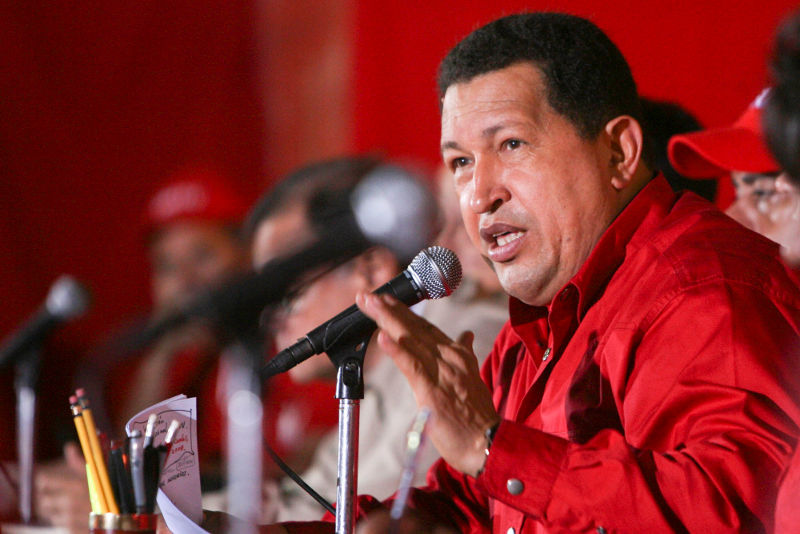
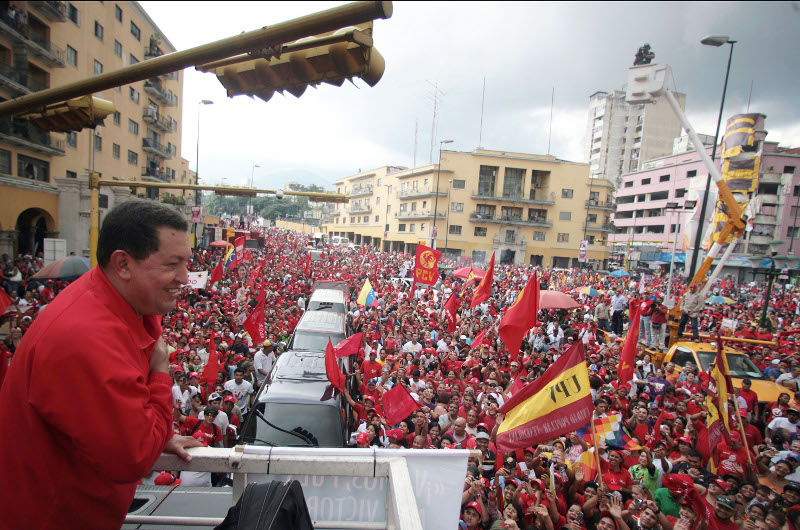
A tribute to Hugo Chávez<http://www.marxist.com/a-tribute-to-hugo-chavez.htm> Written by Alan WoodsTuesday, 16 April 2013 [image: Print] <http://www.marxist.com/a-tribute-to-hugo-chavez/print.htm>[image: E-mail]<http://www.marxist.com/component/option,com_mailto/link,57c26e21c4ac4e994722cb7f0d5d6427fcf8104e/tmpl,component/> Hugo Chávez is no more. Always a fighter, Chávez spent his last months in a life and death struggle against a cruel and implacable enemy cancer. He fought bravely to the very end, but finally his strength gave out. On Tuesday, March 5, at 4.25 pm the cause of freedom, socialism and humanity lost a great man and the author of these lines lost a great friend. [image: Hugo Chávez at the founding congress of PSUV. Photo: Bernardo Londoy]<http://www.marxist.com/images/stories/venezuela/que_comunismo-chavez_at_founding_congress_of_psuv.jpg>Chavez at founding congress of PSUV. Photo:Bernardo Londoy<http://www.flickr.com/photos/quecomunismo/>Although the government had already reported news of a deterioration of Chávezs health, with a new and severe respiratory infection, the news of his death came as a shock. I knew the President as a healthy, energetic and exuberant man, who was so full of life and the desire to live and struggle that his death seems all the more unbelievable. At the all too early age of 58, the leader of the Bolivarian Revolution has been snatched away. The grief of the workers and poor people was manifested when hundreds of thousands poured onto the streets and squares weeping. According to some estimates two million people marched in Caracas on the day of his funeral. The voice of the dispossessed No matter what one thinks about Chavez, he broke the dam and opened the floodgates. He dared to confront the power of the oligarchy and defy the might of American imperialism. Even his declared enemies and critics cannot deny that he showed colossal courage. And in giving a courageous example he conjured up tremendous forces that have lain dormant in the depths of Venezuelan society for generations. Hugo Chávez spoke for the poor, the disposed, the wretched of the earth, and he gave a voice to those millions with no voice. They never forgot it. He won another sweeping endorsement when he was triumphantly re-elected as president last October. The Revolution has carried out serious reforms in the interest of the workers and the poor in the key fields of and health. More recently it has launched an ambitious plan to build houses. 250,000 homes were built and delivered to families who needed them in the last 2 years, while in Spain, for instance, in the same period there have been 250,000 mortgage repossessions. At a time when every other government is announcing deep cuts in spending on public health and education, Venezuela has established a system of free public medicine and massively expanded access to education at all levels including free of charge university education. In Europe, but particularly in the weakest capitalist countries in the South of Europe, unemployment is reaching epidemic proportions and in Spain and Greece over 60% of the youth are unemployed. The Bolivarian revolution has significantly reduced poverty and unemployment. Yet the capitalist media talks about economic chaos in Venezuela! This stands the truth on its head. However, the most important gain of the Revolution has an intangible, one might say, moral character. It has given the masses a sense of their own dignity as human beings, it has imparted a keen sense of justice, it has given them a new sense of their own power, it has given them a new confidence. It has given them hope for the future. From the standpoint of the ruling class and imperialism, this represents a mortal peril. Hugo Chávez's Bolivarian Revolution was a direct threat to US imperialism because of the example it gives to the oppressed masses in the rest of Latin America. Ever since the Monroe Doctrine was announced, the rulers of the USA have seen Latin America as their own private backyard. A revolutionary wave was sweeping the entire Latin American continent, and Hugo Chávez acted as a powerful catalyst to the revolutionary movement throughout the continent. This made him public enemy number one for Washington. In the beginning, the Venezuelan oligarchy did not know what to make Chávez. They thought it would be like any other Venezuelan politician. That is to say, that he was for sale. As soon as they realised that they could not buy Chávez, they set in motion plans to overthrow him. On 11 April 2002, they organized a coup. Behind it there were powerful forces: the landlords, bankers, capitalists, the media, the Church, generals, police chiefs, corrupt trade union leaders and the CIA. Chávez was arrested and hijacked. The plotters installed themselves in the palace of Miraflores. But within 48 hours they were overthrown by a spontaneous uprising of the masses. Units of the army loyal to Chávez went over to the masses, and the coup collapsed ignominiously on April 13. For the first time in the history of Venezuela, the masses overthrew a coup. In reality power was in their hands, but tragically they did not know it. A great opportunity was lost. Was Chávez a dictator? The hatred the ruling class showed towards Chavez was the hatred of the rich for the poor, of the exploiter for the exploited. Behind this hatred there was fear fear for the loss of their wealth, power and privileges. It reflected the fundamental class division of society. And it was never eliminated. If anything, it grew steadily in intensity until his death, and after it. I cannot remember a campaign of such ferocity in the media as that which was unleashed against Hugo Chávez during his lifetime. Never has there been such an outpouring of hatred, malice, bile and poison. Never has the so-called free press resorted to so many distortions,, falsifications and outright lies. And the avalanche of filth keeps pouring out. The spiteful arguments of the enemies of the Revolution to the effect that Chávez is a dictator were always ironic. Whatever you think about Hugo Chávez, he was certainly no dictator. He won more elections and other electoral processes than any other political leader in the world. In fact, the Bolivarian revolution has been extraordinarily lenient with its opponents who, do not forget, organized an illegal coup against a democratically elected government in 2002. They seem to complain a lot about alleged ill treatment, but I see no basis for these complaints. For years the pro-opposition media was allowed to slander the President in the most scandalous way, to call for his overthrow and even assassination. Do you think that would be permitted in the United States? RCTV, Globovisión, Venevisión, all the privately owned TV channels played a very active role in organizing the 2002 coup. If any British television channel had done one tenth of the things they did, it would have its license withdrawn before it could say David Cameron and its owners would find themselves on trial under the Anti-Terrorist Laws. In Venezuela it took over four years for action to be taken against any of them, when RCTV was denied the renewal of its open to air licence, but allowed to continue to broadcast over cable. Even so, the opposition has complained that the Presidential election of April 14 has been called too soon. But if the government had not called elections, as it had the duty to do according to the Constitution, they would be complaining of dictatorship. Nobody has prevented the opposition from standing in elections. The problem is that they have lost. But that is democracy! The opposition, if it is to be truly democratic, must begin by respecting the will of the majority of the people and not to use its economic levers and control of the media to sabotage the democratic will of the people. The role of the individual in history Marxism does not deny the role of the individual in history. It merely asserts that individuals, no matter how capable, are never free agents. Their role is always limited and conditioned by circumstances beyond their control. But when a particular concatenation of circumstances arises, it requires men and women of a certain type to take advantage of them to move millions of people into action. Without two men, Lenin and Trotsky, the Russian Revolution of 1917 would never have succeeded. Yet these same two men for most of their lives found themselves in a tiny minority, isolated from the masses and unable to influence events in a decisive way. Without the Caracazo in February 1989, it is not impossible that Hugo Chávez might have remained an army officer pursuing a normal military career unknown to the public. But there is another side to the question. Without his actions, it is also possible that those tragic events would have passed into history as a mere footnote. Venezuelan society and politics would have returned to that monotonous routine determined by tradition and the inertia of habit. The personal role of Chávez was decisive. He acted as a catalyst, which, when all the conditions are present, produces a dramatic change. Towards the end of his life, in Fredrick Engels wrote: Men make their history themselves, but not as yet with a collective will according to a collective plan or even a definite, delimited given society. Their aspirations clash, and for that very reason all such societies are governed by necessity, the complement and form of appearance of which is accident. The necessity which here asserts itself athwart all accident is again ultimately economic necessity. This is where the so-called great men come in for treatment. That such and such a man and precisely that man arises at a particular time in a particular country is, of course, pure chance. But cut him out and there will be a demand for such a substitute, and this substitute will be found, good or bad, but in the long run he will be found. (Engels Letter to Borgius, 25 January 1894, Marx and Engels Correspondence, pp.467-68) The important words here are: good or bad. The quality of individual leaders is extremely important. If I have a good dentist and he falls ill, I have no doubt that a substitute will be found good or bad. But it is not a matter of indifference to me whether the substitute is a competent dentist or not. Matters are still more serious in the case of war. If Napoleon had not been present at the battle of Austerlitz, the French would have found a substitute, of course. But whether that substitute would have been capable of winning the battle is quite another matter. It is just the same with revolutions. If Lenin and Trotsky would not have been present in November 1917, we know who would have substituted for them: Stalin, Zinoviev and Kamenev. We also know that under their leadership the Russian Revolution would never have succeeded. Good or bad makes all the difference. An individual's personality can have an effect on the processes of history. For me, what is interesting is the dialectical relationship between subject and object, or, as Hegel would have expressed it, between the Particular and the Universal. It would be very instructive to write a book on the exact relationship between Hugo Chavez and the Venezuelan Revolution. That such a relation exists is not open to doubt. Whether it is positive or negative will depend on what class standpoint one defends. >From the standpoint of the masses, the poor and downtrodden, Hugo Chavez was the man who brought them to their feet and who inspired them, by his undoubted personal courage, to acts of unparalleled heroism. Chávez and the masses [image: Rally in Caracas]<http://www.marxist.com/images/stories/venezuela/Prensa_Miraflores-rally_in_Caracas-2.jpg>Photo: Prensa MirafloresA few years ago, when I was on a speaking tour in Italy, a left wing journalist from Il Manifesto asked me in a perplexed tone: But Alan, what has the situation in Venezuela got in common with the classical model of the proletarian revolution. In reply, I quoted the words of Lenin: Whoever wishes to see a pure revolution will never live to see it. Such a person talks about revolution and does not know what a revolution is. A revolution is, in essence, a situation where the masses begin to participate actively in politics and to take their destiny into their own hands. Leon Trotsky who, after all, knew a few things about revolutions answers in the following way: The most indubitable feature of a revolution is the direct interference of the masses in historical events. In ordinary times the state, be it monarchical or democratic, elevates itself above the nation, and history is made by specialists in that line of business - kings, ministers, bureaucrats, parliamentarians, journalists. But at those crucial moments when the old order becomes no longer endurable to the masses, they break over the barriers excluding them from the political arena, sweep aside their traditional representatives, and create by their own interference the initial groundwork for a new régime. Whether this is good or bad we leave to the judgment of moralists. We ourselves will take the facts as they are given by the objective course of development. The history of a revolution is for us first of all a history of the forcible entrance of the masses into the realm of rulership over their own destiny. (L. Trotsky, *The History of the Russian Revolution*, Preface, my emphasis) This is certainly the case in Venezuela. The awakening of the masses and their active participation in politics is the most decisive feature of the Venezuelan Revolution and the secret of its success. The relationship between Hugo Chávez and the masses was a very complex and dialectical one. I had occasion to see this for myself many times when I attended the mass rallies where he addressed the people. He aroused colossal enthusiasm and devotion. We saw the same emotions on the streets of Caracas on the days before and after his funeral. When Chávez spoke to the workers and peasants, the effect was always electric. On such occasions, one could sense a kind of chemical reaction between Chávez and the masses. There was no mistaking the intense loyalty felt by the poor and downtrodden masses to this man. Hugo Chávez for the first time gave the poor and downtrodden a voice and some hope. That is the secret of the extraordinary devotion and loyalty they have always shown him. He aroused them to life and they see themselves in him. Chavez's enemies on the right could never understand the reason for this. They could not understand it because they are organically incapable of understanding the dynamics of the revolution itself. The ruling class and its intellectual prostitutes can never accept that the masses have a mind and personality of their own, that they are a tremendously creative force that is capable not only of changing society but also of administering it. They can never admit such a thing because to do so would be to admit their own bankruptcy and confess that they are not a necessary and indispensable social agent endowed with a God-given right to rule, but a superfluous and parasitic class and a reactionary obstacle to progress. But it was not only the bourgeois who were incapable of understanding what was happening in Venezuela. Many on the Left were equally unable to understand this phenomenon. Incapable of placing themselves on the standpoint of the masses, they adopted a haughty attitude, as if the masses whose name they were always invoking were ignorant children who needed to be educated by them. Unfortunately for these Lefts, the masses showed not the slightest interest in these would-be educators or their lessons. How can we explain the peculiar chemistry that existed between Hugo Chávez and the masses? It is true that he possessed unique gifts as a communicator: a powerful personality, a penetrating intellect and a profound understanding of the psychology and aspirations of the masses. However, the real secret is to be found, not in the realm of psychology, but in the relations between the classes. The masses saw themselves reflected in Chávez. They identified themselves with him as the man who first awakened them to political life and who has given voice to their aspirations. They personify the Revolution in him. For them, Hugo Chávez and the Revolution was one and the same thing. I wrote about my impressions when I first saw this in April 2004: As he spoke, I was able to watch the reaction of the masses on the big screen behind the president. Old people and youngsters, men and women, the overwhelming majority working class, listened intently, straining on every word. They applauded, cheered, laughed and even wept as they stood there. This was the face of an aroused people, a people that has become aware of itself as an active participant in the historical process the face of a revolution. The process cut both ways. Chávez drew his strength from the support of the masses, with whom he identified fully. In his manner of speaking spontaneous and completely lacking in the stiff formality of the professional politician he connected with them. If there was sometimes a lack of clarity, even this reflected the stage in which the mass movement found itself. The identity was complete. My relations with Chávez I knew Hugo Chávez for almost a decade, and had excellent relations with him from our first meeting in April 2004. He made a very deep impression on me, and he always referred warmly to me as his friend. He read my books and was kind enough to praise them and recommend them publicly on several occasions. Our relationship was therefore of a political and ideological nature. But the attempts of the opposition to describe me as his adviser and even his political guru were entirely false. They were an ill-concealed attempt to invent some kind of malign foreign influence on the President. In fact, it was not easy to influence President Chávez, who was a very intelligent and independent man, with a very strong will. Hugo Chavez possessed boundless energy. He always seemed to be bubbling with energy and talking endlessly about all sorts of things. This did not make him an easy man to work with, as his personal secretary told me: I would do anything for him, but there is never a moment's peace. Sometimes I can't even go to the toilet. I start to walk in that direction and somebody shouts: the President wants you!' He himself was not a man who tired easily. He had immense reserves of energy, starting work every day before 8 o'clock and working until about three in the morning. I asked him if he then went to bed. He answered: No. Then I read. [image: Hugo Chávez with Alan Woods]Hugo Chávez with Alan WoodsI first met Chávez in April 2004 when I attended the Second International Gathering in Solidarity with the Venezuelan Revolution which was held on the second anniversary of the defeat of the attempted counterrevolution of April 2002. There are not many people I have met in my life who have made such a deep and lasting impression on me. Grasping my outstretched hand firmly, he looked at me with curiosity: What book did you say? Reason in Revolt. A broad smile lit up his face. That is a fantastic book! I congratulate you. Then looking around him he announced: You must all read this book! I was going to leave, to allow others to meet the President, when he stopped me. He now seemed to be oblivious of all around him and spoke with obvious enthusiasm: You know, I have got that book at my bedside and I am reading it every night. I have got as far as the chapter on The molecular process of revolution'. You know, where you write about Gibbs' energy. It appears that this section has made a considerable impact on him, because he quotes it continually in his speeches. Mr. Gibbs has probably never been so famous before. Later I was invited to meet the President in the palace of Miraflores. I was told that I would have a quarter of an hour or twenty minutes at most. In fact, we discussed for an hour and a half. As I walked into his office, he was sitting at his desk, with a huge portrait of Simon Bolivar behind him. On the desk I noticed a copy of Reason in Revolt and a letter I had sent him. The letter had been heavily underlined in blue. Chávez greeted me very warmly. Here was no protocol but only openness and frankness. He began by asking me about Wales and my family background. I explained that I was from a working class family, and he replied that he was from a family of peasants. Well, Alan, what have you got to say? he asked. Actually, I was more interested in what he had to say which was very interesting. First I presented him with two books: my history of the Bolshevik Party (Bolshevism, the Road to Revolution) and Ted Grant's Russia from Revolution to Counterrevolution. He looked extremely pleased. I love books, he told me. If they are good books, I love them even more. But even if they are bad books, I still love them." Ferment in the military Opening the Bolshevism book he read the dedication I had written, which reads: To President Hugo Chávez with my best wishes. The Road to Revolution passes through the ideas, programme and traditions of Marxism. Forward to Victory! He said That is a wonderful dedication. Thank you, Alan. He began to turn the pages and stopped. I see you write about Plekhanov. That's right. I read a book by Plekhanov a long time ago, and it made a big impression on me. It was called The Role of the Individual in History. Do you know it? Of course. The role of the individual in history, he mused. Well, I know none of us is really indispensable, he said. That is not quite correct, I replied. There are times in history when an individual can make a fundamental difference. Yes, I was pleased to see that in Reason in Revolt you say that Marxism cannot be reduced to economic factors. That is right. That is a vulgar caricature of Marxism. Do you know when I read Plekhanov's book The Role of the Individual in History? he asked. I have no idea. I read it when I was a serving officer in an anti-guerrilla unit in the mountains. You know they gave us material to read so that we could understand subversion. I read that the subversives work among the people, defend their interests and win their hearts and minds. That seemed quite a good idea! Then I began to read Plekhanov's book and it made a deep impression on me. I remember it was a beautiful starlit night in the mountains and I was in my tent reading with the light of a torch. The things I read made me think and I began to question what I was doing in the army. I became very unhappy. You know for us it was no problem. Moving about in the mountains with rifles in our hands. Also the guerrillas had no problems they were doing the same as us. But the people who suffered were the ordinary peasants. They were helpless and they had a rough time. I remember one day we went into a village and I saw some soldiers torturing two peasants. I told them to stop that immediately, that there would be none of that as long as I was in command. Well, that really got me into trouble. They even wanted to put me on trial for military insubordination. [He put special emphasis on the last two words]. After that I decided that the army was no place for me. I wanted to quit, but I was stopped by an old Communist who said to me: You are more useful to the Revolution in the army than ten trade unionists.' So I stayed. I now think that was the right thing to do. Do you know that I set up an army in those mountains? It was an army of five men. But we had a very long name. We called ourselves the Simon Bolivar people's national liberation army. He laughed heartily. When was that? I asked. In 1974. You see, I thought to myself: this is the land of Simon Bolivar. There must be something of his spirit still alive something in our genes, I suppose. So we set about trying to revive it. Chávez went on, as if thinking aloud: Two years ago, at the time of the coup, when I was arrested and being led away, I thought I was going to be shot. I asked myself: have the last 25 years of my life been wasted? Was it all for nothing? But it was not for nothing, as the uprising of the paratroop regiment showed. Chávez remembers the coup Chávez spoke to me at some length about the coup. He related how he was kept in complete isolation. The rebels wanted to pressurise him into signing a document, resigning from office. Then they would have let him go into exile in Cuba or somewhere. They wanted to do what they have done recently with Aristide in Haiti. He was not to be killed physically but morally, to be discredited in the eyes of his followers. But he refused to sign. The plotters used all kinds of tricks to get him to resign. They even used the Church (about which Chávez spoke very caustically). Yes, they even sent the Cardinal to persuade me. He told me a pack of lies: that I had no support, that everyone had abandoned me; that the army was firmly behind the coup. I had no information, and was completely cut off from the outside world. But I still refused to sign. My captors were getting very nervous. They were getting lots of phone calls from Washington demanding to know where the signed resignation letter was. When they saw the letter not forthcoming, they became desperate. The Cardinal pressed me to sign in order to avoid civil war and bloodshed. But then I noticed a sudden change in his tone. He became polite and conciliatory. I thought to myself: if he is talking like this, something must have happened. Then the phone rang. One of my captors said: It's the minister of defence. He wants to speak to you. I told him I would not speak to any golpista. Then he said: But it is your minister of defence.' I tore the phone out of his hand and then I heard a voice that sounded like the sun. I don't know if you can say that, but anyway, that is just what it sounded like to me. >From this conversation I was able to form an impression about Chávez the man. The first thing that strikes one is that he was transparently honest. His sincerity was absolutely clear, as was his dedication to the cause of the Revolution and his hatred of injustice and oppression. Of course, these qualities in and of themselves are not sufficient to guarantee the victory of the revolution, but they certainly explain his tremendous popularity with the masses. The whip of the counterrevolution After the defeat of the coup it would have been possible to carry out a socialist revolution swiftly and painlessly. Unfortunately, the opportunity was lost and the reactionaries were allowed to regroup and organize a new attempt in the so-called strike (in reality a bosses' lockout) that did serious damage to the economy. The new attempt was defeated by the workers, who seized control of the factories and oil installations and kicked out the reactionaries. Once again the possibility existed of a radical transformation without civil war. And once again the opportunity was lost. The struggle for socialism At our first meeting he asked me what I thought of the movement in Venezuela. I replied that it was very impressive, that the masses were clearly the main motive force and that all the ingredients were present to carry the revolution through to the end, but that there was something missing. He asked what that was. I replied that the weakness of the movement was the absence of a clearly defined ideology and cadres. He agreed. You know, I don't consider myself a Marxist because I have not read enough Marxist books, he said. >From this conversation I had the distinct impression that Hugo Chávez was looking for ideas, and that he was genuinely interested in the ideas of Marxism and anxious to learn. I wrote at the time: This is related to the stage that the Venezuelan Revolution has reached. Sooner than many people expect, it will be faced with a stark choice: either liquidate the economic power of the oligarchy or else go soon to defeat. Subsequent events showed that my first impressions were well founded. Hugo Chávez played a very important role in reopening the debate on socialism at a time when many had written it off. The president frequently recommended reading the works of Marx, Lenin and Trotsky. This was enormously positive. The development of Hugo Chávezs political ideas represented an evolution, in which many factors were involved. He developed and grew in stature together with the Revolution. The Revolution itself is a mighty school in which millions of men and women learn through their experience. Lenin, who was one of the greatest Marxist theoreticians, once said that for the masses an ounce of practice is worth a ton of theory. This learning curve of the Revolution is not a straight line. There are moments when the Revolution presses forward, sweeping all before it. But there are also moments of tiredness, disappointment, even despair. There can be all kinds of setbacks, confusion, retreats and mistakes. But after every setback, the masses learn from their errors, draw the conclusions and move to a higher plane. The purpose of a revolutionary party and leadership is to help to keep the number of mistakes to a minimum. It would be possible to point out a whole series of contradictions, hesitations, inconsistencies in Chávezs political evolution over the past fourteen years. But the general line was always to the left. The reason for these contradictions must be sought in the pressures that were exerted on the Bolivarian Movement by opposing class forces. The pressure from the bourgeoisie and imperialism, which was reflected by the right wing of the Bolivarian Movement and the counterrevolutionary bureaucracy, and the pressure from the workers and peasants, which was strong in the rank and file of the PSUV. These pressures sometimes pushed the Movement to the right, but this was countered by pressure from the rank and file. In January 2005 President Chavez gave a speech at the Gigantinho Stadium at the closing session of the World Social Forum in Porto Alegre, Brazil. In this speech he said: Every day I become more convinced, there is no doubt in my mind, and as many intellectuals have said, that it is necessary to transcend capitalism. But capitalism cant be transcended from within capitalism itself, but through socialism, true socialism, with equality and justice. But Im also convinced that it is possible to do it under democracy, but not in the type of democracy being imposed from Washington. [...] It is impossible, within the framework of the capitalist system to solve the grave problems of poverty of the majority of the worlds population. We must transcend capitalism. But we cannot resort to state capitalism, which would be the same perversion of the Soviet Union. I was present at a rally in Caracas when Chávez made his dramatic statement that he was a socialist for the first time. If I remember rightly it was in December 2004. He was speaking at the Teresa Carreño Theatre in Caracas which was filled with red-shirted workers and youth. After he had spoken for quite some time, he suddenly threw his papers to one side and said: Now I want to tell you something from myself. In the last few years I have been thinking a lot. I have had a lot of experience. I have read a lot. I have had many discussions. And I have come to the following conclusion: I AM A SOCIALIST! At that point the hall erupted into enthusiastic applause and cheering. These were the words the people wanted to hear. But I noticed something rather strange. I was sitting at the front of the hall with the Presidents brother Adan Chavez , surrounded by government ministers. I noticed that not all the ministers were applauding. Chavez said: I was learning in reality (...) especially after the coup in April 2002, after the imperialist onslaught that wild action with economic sabotage, terrorism, I realized that the only way for us to be free, to Venezuela is a free, independent, the only state in which the people can enjoy the benefit of equality and social justice is socialism. What role my writings played in this evolution, I cannot say with any certainty. But there was one incident that may cast some light on this question. During the World Youth Festival in 2005, I was invited to participate in a round table in Caracas, where the President spoke and gave a very radical speech, quoting from Marx, Trotsky and Rosa Luxemburg. At the end I shook his hand and congratulated him on his speech. He continued to grip my hand and said, looking me straight in the eyes: No, only a few reflections on ideas that I have learned from you. Later, in Alo Presidente (Sunday 27 July 2008) he referred to my book Reformism or Revolution: Marxism and Socialism of the XXI Century as follows: Look, Alan Woods, Reformism or Revolution'; reformism, for how long? I am reading it in great detail; I am taking notes on this book. On another occasion he said: The Revolution has allies all over the world. One of these allies is the International Marxist Tendency. Marx has returned, and with him, his ideas, which are an irreplaceable part of the ideas of this revolution The cancer of bureaucracy A successful Revolution always has many friends. Those middle class elements who are attracted to power as flies to a honey pot, who are ready to sing the praises of the Revolution as long as it remains in power, who do nothing useful to save it from its enemies, who weep a few crocodile tears when it is overthrown, and the next day pass onto the next item on Life's agenda such friends are worth two a penny. A real friend is not someone who always tells you that you are right. A real friend is someone who is not afraid to look you straight in the eye and tell you that you are mistaken. The best friends of the Venezuelan Revolution in fact its only real friends is the working class of the world and its most conscious representatives are the revolutionary Marxists. They are the people who will move heaven and earth to defend the Venezuelan Revolution against its enemies. At the same time, the true friends of the Revolution honest and loyal friends will always speak their mind without fear. Where we consider that the right road is being taken, we will praise. Where we think mistakes are being made, we will give friendly but firm criticism. What other kind of behaviour should be expected of real revolutionaries and internationalists? The Revolution faces many dangers, not only externally but internally. A few years ago, President Chávez said to me: There are too many governors and mayors who, after they are elected, surround themselves with wealthy men and beautiful women and forget about the people. He referred on more than one occasion to the counterrevolutionary bureaucracy. This exists and constitutes a kind of Fifth Column within the Revolution. The masses were learning quickly in the school of the revolution and drawing their conclusions. The main conclusion was that the revolutionary process must be pushed forward, it must confront its enemies and sweep all obstacles aside. This burning desire of the masses, however, constantly clashed with the resistance of those conservative and reformist elements who are constantly urging caution, and who, in practice, want to put the brakes on the Revolution. The destiny of the Revolution depends on the solution of this contradiction. Chávezs instinct was always to go with the workers and peasants. But he faced a hostile bureaucracy, which continually frustrated his plans, countermanded his decrees and sabotaged the Revolution. If he is to be criticised, it is for being too tolerant of these elements for too long. I believe that he did this because he feared divisions in the Movement that could undermine the Revolution. That was a mistake. What undermines the Revolution is corruption and careerism. The bureaucracy is a cancer that gnaws at the entrails of the Revolution and destroys it from within. Unfortunately, inside the PSUV and the Bolivarian movement there are people in public office, governors, mayors, etc who swear by Chávez in every other sentence, who wear red shirt but actually are opportunists, careerists, and corrupt bourgeois who have nothing to do with the revolution. These elements have been blocking the revolutionary initiative of the masses and even undermining the decrees of President Chávez. The rank and file workers and peasants should take a big broom and sweep all this rubbish out of the Movement and take control. Until this is done, we cannot speak of genuine socialism in Venezuela. Chavezs internationalism Chávez always spoke in the most unambiguous terms about his commitment to socialism, not only in Venezuela and Latin America, but on a world scale. For instance, when in 2009 he launched the idea of forming a Fifth International, which was later sabotaged by the bureaucracy and the Stalinists, he said: Lets save the world: lets defeat imperialism; lets save the world, lets defeat capitalism Lets rescue the words of Rosa Luxemburg Socialism or Barbarism He denounced the crimes of US imperialism in the most vigorous terms. In the speech at the United Nations that everybody remembers, he referred to the then US President George W Bush as the Devil. The Devil is right at home. The Devil, the Devil himself, is right in the house. And the Devil came here yesterday. Yesterday the Devil came here. Right here. [crosses himself] And it smells of sulphur still today. Yesterday, ladies and gentlemen, from this rostrum, the president of the United States, the gentleman to whom I refer as the Devil, came here, talking as if he owned the world. Truly. As the owner of the world. As a Marxist I do not believe in the Devil, but what is certainly true is that the actions of that most Christian of Presidents George W Bush and his equally pious crony Tony Blair turned Iraq and Afghanistan into a living hell for millions of people. It was about time that somebody spoke out boldly to denounce their crimes and to do it, not in the hypocritical double-speak of diplomacy, but in suitably forceful language. The hypocrites pretended to be shocked, but the rest of the world applauded. About George W. Bush, Chavez expressed himself in terms of the deepest contempt. He said to me: Personally, he is a coward. He attacked Fidel Castro at a meeting of the Organization of American States (OAS) when Fidel was not present. If he had been there he would not have dared to do it. They say he is frightened to meet me and I believe it. He tries to avoid me. But one time we were together at an OAS summit and he was sitting quite near to me. Chavez chuckled to himself. I had one of those swivel chairs and I was sitting with my back to him. Then, after a while, I spun the chair round so I was facing him. 'Hello, Mr. President!' I said. His face turned colour from red to purple to blue. You can tell the man is just a bundle of complexes. That makes him dangerous because of the power he has in his hands. There were, of course, some elements in the policies of the Bolivarian Republic with which Marxists would disagree. Its greatest weaknesses were in the field of foreign policy. In an attempt to overcome the diplomatic isolation that was being organized by US imperialism, the government looked for allies in some very unusual places. They tried to form a bloc, particularly of oil-producing countries, against US imperialism. In principle, that was not incorrect. In order to break its isolation, the young Soviet Republic built relations with countries like the Turkey of Kemal Ataturk. But this policy was complemented by the activities of the Communist International. However, cultivating relations with leaders like those of Iran was a serious mistake, which damaged the reputation of the Bolivarian Revolution in Iran and the Middle East. But Chávez was a true internationalist. When he denounced the crimes of US imperialism, he always made a careful distinction between the ruling class and the ordinary people of the United States, towards whom he harboured no feelings of hostility, but quite the contrary. At the time of his famous speech in the UN, he took the unprecedented step of visiting the South Bronx, a neighbourhood of poor and working-class residents in New York. That visit is still remembered by the people. What other world leader would do such a thing? When he spoke of socialism, he always spoke of the need for world socialism. This idea he shared with the tendency I represent. On many occasions Hugo Chavez expressed his firm support for the Hands off Venezuela campaign. Uncompleted tasks Chávez died before completing the great task he had set before himself: the carrying out of the socialist revolution in Venezuela. It is now up to the workers and peasants the real motor force of the Bolivarian Revolution to carry this task out to the end. Failure to do so would be a betrayal of his heritage. President Nicolas Maduro has promised to maintain Chávez's revolutionary, anti-imperialist and socialist legacy. The Bolivarian Movement must defend the revolutionary legacy of Chávez and carry out the Revolution to the end. Otherwise, it will face being thrown right back. But within the Bolivarian Movement there are different currents and tendencies. The left wing, reflecting the revolutionary aspirations of the masses, wishes to press forward with the Revolution, overcome the resistance of the oligarchy and arm the people. The right wing (reformists and social democrats), in practice, wishes to call a halt to the Revolution, or at least to slow it down and arrive at a compromise with the oligarchy and imperialism. In reality, the latter option does not exist. There is no compromise possible with the enemies of the Revolution, any more than oil can be mixed with water. The whole logic of the situation is moving in the direction of an open confrontation between the classes. Upon the decision of this conflict the destiny of the Revolution depends. The gains of the Revolution can only be guaranteed if it takes a bold step forward, to become truly irreversible. I am sure that this was what President Chávez was aiming to do, but was prevented from carrying out this plan by his untimely death. I accept that there are many problems, but I am certain that the main reason is that a genuine planned economy is impossible while key points of the economy remain in private hands. You can have a capitalist market economy or a socialist planned economy, but you cannot have both. You cannot plan what you do not control, and you cannot control what you do not own. In order to advance to socialism, you first have to break the economic power of the oligarchy that uses it to sabotage the revolutionary process. This means getting tough on economic sabotage, hoarding, the flight of capital and speculation. The only way to solve the economic problems is by nationalizing the land, the banks and the major industries under workers control. As soon as news of the Presidents illness became public, voices were raised in favour of a transition, by which they meant the abandonment of the socialist aims of the Revolution and compromise with the bourgeoisie and the opposition. Chávez answered this, saying that the "only transition that is posed and must be accelerated is the transition from capitalism to socialism. That is one hundred percent correct. The Revolution must move to replace the old bourgeois state by new institutions based on democratic and revolutionary socialist workers' councils, community councils etc. There are many challenges, both external and internal. The Revolution faces a constant campaign of sabotage by the oligarchy and imperialism, which refuses to recognize the democratically expressed, will of the majority that has been clearly expressed on numerous occasions. To meet these challenges serious measures will be necessary. The same forces that organized the 2002 coup, the bosses sabotage of 2002-3, the guarimbas in 2004, that introduced the Colombian paramilitaries, are the same forces that in the last two months have organized a campaign of nasty rumours, innuendo and speculation and hoarding. Nothing has changed. Carry out Chávezs legacy! In August 2009 Público reproduced an interview with Chávez, where we read the following: Q: "Is Hugo Chávez necessary for the consolidation of the Bolivarian Revolution? A: Bertolt Brecht said that those are indispensable who struggle all their lives. From that point of view, I am a lifelong fighter. And so I would be one of those who are indispensible. But I'm not. Now, looking beyond the individual, when speaking of what is indispensable we could find a word that is more applicable to politics. I prefer to speak of the necessary and sufficient conditions. Karl Marx spoke of objective and subjective conditions. I have said it. I have nothing special that you do not have. What I am is the product of historical circumstances: a set of objective and subjective conditions that have been created in Venezuela. To attribute to Hugo Chávez, the child that was born 55 years ago in the hut of a peasant, who became a soldier, all the wind of evil, as Bolivar once said, is impossible. That would give me an importance that I not deserve. I've been borne along by circumstances and I play a role, my role. The existence of Chávez is necessary but not sufficient. For there to be a revolution, it takes a conscious and united people, a project and a consciousness. In Venezuela these condition have come into existence. The President was undoubtedly too modest here in describing his own role. That he was the product of his times and the peculiar conditions that existed in his country, nobody can doubt. But there were many others who were the products of the same conditions, including those who described themselves as revolutionaries and communists, and yet were not capable of playing the role that he played. There was nobody like Chávez when he was alive, and there is no single person can replace him now he is dead. It goes without saying that we will support the election of Nicolas Maduro in April. But we must seriously question the idea that one man can lead the Revolution to victory. This was a weakness of which President Chávez was well aware, and we discussed it more than once. I admired and respected the President, who I saw as a very honest and courageous man and an outstanding leader. But a Revolution cannot depend on one man. Chávez knew that very well. On 3 July 2008 he invited me to accompany him in his car during an election campaign on the island of Margarita. He pointed to the crowds of enthusiastic people in red shirts cheering from the roadside. He turned to me and said: These are the people who must take control of this Revolution. On the day of his death, these words kept ringing in my mind. Now that Hugo Chávez is no more, the future of the Bolivarian revolution and its advance toward socialism will depend on the workers, the poor, the peasants and the revolutionary youth who have been the driving force of the revolution and have defended in all the key moments. Everything depends on this. After the death of Chavez the Venezuelan revolution stands at the crossroads. The masses have defeated reaction on many occasions. They have repeatedly shown their will to change society. But the forces of reaction have not been decisively defeated. The oligarchy continues to control key points of the economy and is constantly intriguing against the Revolution. Washington is participating in counterrevolutionary intrigues. Hugo Chavez is no more. But the story of the Venezuelan Revolution is not yet finished. Various endings are possible not all of them pleasant to contemplate. The masses are still learning, the Bolivarian Movement still developing. The tremendous polarisation between the classes will end in a showdown in which all parties, tendencies, programmes and individuals will be put to the test. I repeat what I wrote shortly after my first meeting with President Chavez: What is necessary? Clear ideas, a scientific understanding, a consistently revolutionary programme, policies and perspectives. The only guarantee of the future of the Bolivarian Revolution consists in the movement from below the mass movement which, headed by the working class, must take power into its own hands. That demands the rapid construction of the Revolutionary Marxist Current, the most consistently revolutionary section of the movement. I believe that a growing number in the Bolivarian Movement are looking for the ideas of Marxism. I am sure that this applies to many of its leaders. And Hugo Chavez? He told me that he was not a Marxist because he had not read enough Marxist books. But he is reading them now. And in a revolution people learn more in 24 hours than in 20 years of normal existence. In the end, Marxism will draw to itself all the best elements in Venezuelan society and fuse them together in one invincible fighting force. On that road lies the possibility of victory. These lines were written nine years ago. I see no reason to change a single word today. *London, 11 April 2013* [Non-text portions of this message have been removed] ------------------------------------ --------------------------------------------------------------------------- LAAMN: Los Angeles Alternative Media Network --------------------------------------------------------------------------- Unsubscribe: <mailto:[email protected]> --------------------------------------------------------------------------- Subscribe: <mailto:[email protected]> --------------------------------------------------------------------------- Digest: <mailto:[email protected]> --------------------------------------------------------------------------- Help: <mailto:[email protected]?subject=laamn> --------------------------------------------------------------------------- Post: <mailto:[email protected]> --------------------------------------------------------------------------- Archive1: <http://www.egroups.com/messages/laamn> --------------------------------------------------------------------------- Archive2: <http://www.mail-archive.com/[email protected]> --------------------------------------------------------------------------- Yahoo! Groups Links <*> To visit your group on the web, go to: http://groups.yahoo.com/group/laamn/ <*> Your email settings: Individual Email | Traditional <*> To change settings online go to: http://groups.yahoo.com/group/laamn/join (Yahoo! ID required) <*> To change settings via email: [email protected] [email protected] <*> To unsubscribe from this group, send an email to: [email protected] <*> Your use of Yahoo! Groups is subject to: http://docs.yahoo.com/info/terms/