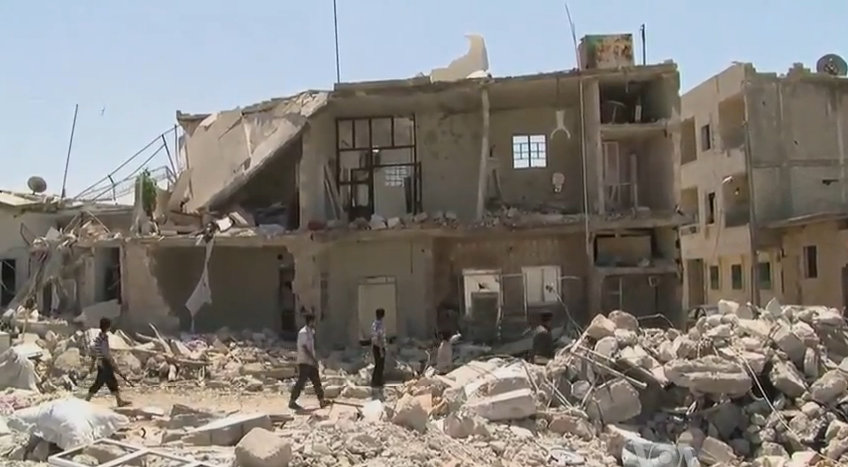
*Crisis Continues as Refugees Reach 1.5 Million*

The number of refugees <http://data.unhcr.org/syrianrefugees/regional.php> from
the conflict in Syria has reached over 1.5 million according to data
collected by the UN Refugee Agency.
The rate of
people<http://www.guardian.co.uk/world/2013/may/16/syria-crisis-refugees-million-un>
fleeing
the country has increased rapidly in recent weeks, which is dramatically
illustrated by the fact that only 10 weeks ago the number of Syrian
refugees totalled 1 million.

Some estimates suggest that if this rate is maintained then by the end of
the year 3.5 million Syrians – 15% of the country’s total population –
could be refugees.

Gerry Simpson, acting refugee programme director at Human Rights Watch,
said that Turkey and Jordan were "shouldering a huge burden" of the
problem: Turkey has accepted 347,157 refugees; Jordan, 473,587; meanwhile
Lebanon has taken 470,457, Iraq 147,464 and Egypt 66,922.

Simpson criticised Jordan for "its border push-back policy” and Turkey’s
“continued partial border closure” for exacerbating the problems facing
Syrian refugees.

Meanwhile, Chris Doyle, director of the Council for the Advancement of
Arab-British Understanding, pointed out that about 10% of Jordan's
population were Syrian refugees adding that "I think it is unconscionable
that we leave it to neighbouring states who have taken on so much. The EU
has to open its doors."


*Other Headlines:*

*Russian Foreign Minister, UN Secretary-General Support Peace Conference**
*

*3 UN Peacekeepers Abducted**
*

*Obama and Erdogan Meet in Washington, Denounce Assad (Obama constantly
reviewing and thinking about thinking)*

*CIA Chief in Israel.*

**

*According to a report in the Israeli paper Yedioth Ahronoth, the visit
stemmed from "the American fear of escalation in the region against the
backdrop of [Hezbollah leader Hassan] Nasrallah's threats to act against
Israel in the Golan Heights and the American sense that Israel is
disappointed by the ineffectuality of the Obama administration with regard
to the ongoing deterioration in Syria.*

*"It is assessed that Brennan was sent to Israel to co-ordinate a joint
policy between the two countries and prevent Israel from taking action on
its own in Syria."*

*For More go to url*

*
http://www.enduringamerica.com/home/2013/5/17/syria-today-obama-erdogan-call-for-assad-to-go-but-will-they.html
*

*---------------------*

*Israel, Assad, and the world <http://en.daam.org.il/?p=425>*
*Posted on 14/05/2013 <http://en.daam.org.il/?p=425> by Yacov Ben
Efrat<http://en.daam.org.il/?author=2>
*

*At the outbreak of the revolution in Syria two years ago, the Israeli
government announced that events there were none of its business and it
would not interfere. Forty years of quiet on the Golan Heights had led
Israel to prefer Assad over any conceivable replacement. Now, however, when
the rebels rule wide areas, when the Syrian army is falling apart, and when
the regime’s survival is in the balance, Israeli policy appears to have
shifted from passivity to active intervention.*

*Continue reading → <http://en.daam.org.il/?p=425#more-425>*

*http://en.daam.org.il/?p=425
*

*-------------------------------------------------*


http://www.jadaliyya.com/pages/index/11764/syrias-inglorious-basterd

Syria's Inglorious
Bastard<http://www.jadaliyya.com/pages/index/11764/syrias-inglorious-basterd>

May 17 2013by Audrey Ann
Lavallée-Bélanger<http://www.jadaliyya.com/pages/contributors/100716>
[image: Listen to this page using
ReadSpeaker]<http://app.readspeaker.com/cgi-bin/rsent?customerid=5919&lang=en_us&readid=rscontent&url=http%3A%2F%2Fwww.jadaliyya.com%2Fpages%2Findex%2F11764%2Fsyrias-inglorious-basterd>
 [image: [Khaled al-Hamad, left, in a photo from Omar Al-Farouk Brigade
Facebook page]][Khaled al-Hamad, left, in a photo from Omar Al-Farouk
Brigade Facebook page]

On 13 May 2013, Human Rights Watch released a
statement<http://www.hrw.org/news/2013/05/13/syria-brigade-fighting-homs-implicated-atrocities>
attesting
to the authenticity of a disturbing video that circulated first on Syrian
pro-regime websites and then on social media. In it, a Syrian man cuts open
a dead government soldier’s chest, pulls his heart and lung out, threatens
“Alawite dogs” that they will all face a similar fate, and takes a bite of
the viscera while addressing the videocamera. This latest sectarian
evocation by a member of the armed opposition, Khalid al Hamad (“Abu
Sakkar”), was simplistically depicted by many American and Gulf media
outlets as an isolated abomination perpetrated by a savage man. However,
the incident tells a more complex story about the evolution of sectarianism
in Syria, the relationship between war and social media, and the Western
media narrative on Syria more broadly.

*“Most Disgusting Atrocity”*

The editors of *Foreign Policy* opted for a sensationalist title for a
piece by Peter Bouckaert of Human Rights Watch "Is This the Most Disgusting
Atrocity Filmed in the Syria Civil
War?<http://www.foreignpolicy.com/articles/2013/05/13/most_disgusting_atrocity_syrian_civil_war_rebel_eat_heart>"
Two weeks after another massacre in al Baida village and Baniyas, where
parents discovered their children’s bodies cut into pieces, stabbed, and
burned by government soldiers, it has become redundant to note that a
voyeuristic title suggesting a hierarchy of atrocity is an insult to the
suffering that is hardly shared by an increasingly apathetic audience.

Abu Sakkar’s action in the video is undoubtedly and unquestionably
horrific. However, unfortunately, it is reminiscent of other cases in Syria
and beyond, on either side of the battleground, where violence in all its
forms is used as a weapon of war to intimidate the adversary and empower
the perpetrator (not unlike the 2009 Quentin Tarantino film Inglorious
Basterds <http://www.imdb.com/title/tt0361748/>). Singling out an act of
atrocity alone is an obfuscation of the pervasiveness, proliferation,
entrenchment, and intransigence of Syria's gruesome and grueling sectarian
problem.

The latest “cannibalistic” spectacle follows many equally damaging, albeit
less graphic, incidents in Syria over the past two years that were not
pornographic enough to make the headlines. In July 2011, exiled Sheikh
Adnan Kaour said that Alawites deserved to be put into meat
grinders<http://www.youtube.com/watch?v=Bwz8i3osHww>.
In December 2012, members of the Free Syrian Army burned down a Shi’a
mosque in Jisr al-Shoughour, perhaps in retaliation for the government
attack on the city in June of that year, which sent thousands of refugees
to Turkish refugee camps. In February 2013, some children in
Binnish<http://www.youtube.com/watch?v> disturbingly
sing of cutting throats of Alawites, under the guidance of fighters
harboring the al-Qaeda scarf. Those few examples, for which there is no
shortage of equivalents on the other side, show the steady progression of a
harmful mediated sectarian rhetoric threatening to leave an irreparable
scar on Syria. Abu Sakkar's video, like any other, is dangerous especially
as it is magnified, instrumentalized, and internalized.

*The Good Guys*

When the news depict Abu Sakkar as being somewhat of a free agent having
created his own brigade, they insinuate that he is an exception to the
rule. Many a media outlets was quick to point that the event was an
isolated case, with TIME
<http://world.time.com/2013/05/14/we-will-slaughter-all-of-them-an-interview-with-the-man-behind-the-syrian-atrocity-video/>advancing
that the Supreme Military Council, overseeing 90 percent of the fighting
groups, had joined forces to catch Abu Sakkar, “dead or alive.” However,
this reassuring statistic, for anyone familiar with the diverse armed
opposition
spectrum<http://www.feps-europe.eu/uploads/documents/20120510-syrian-opposition-aron-lund.pdf>
in
Syria, is mere wishful thinking.

Indeed, there were various instances where commanders adopted a
nonsectarian<http://www.youtube.com/watch?v=Polzea5v9zQ> discourse
and seemed to be advocating for the ideals of the Syrian revolution. This
was the case of Abu
Furat<http://darthnader.net/2012/12/15/remembering-abu-furat/>,
an FSA commander who was killed in combat last December. However, in a
context of protracted asymmetric war, where factions have different
objectives and are mostly chasing funds, drawing the lines between the
“good guys,” the “bad guys,” the “secular,” the “religious,” and the
“moderate,” is both loaded and irrelevant. Earlier this year, Ghaith Abdul
Ahad was reporting on how many "secular-minded" rebels were trying to
impress Gulf
<http://www.lrb.co.uk/v35/n04/ghaith-abdul-ahad/how-to-start-a-battalion-in-five-easy-lessons>funders
through videos to receive more resources for battle. Thus, though the
latest incident is certainly condemned by many, this should neither cast a
fog on the major public relations campaigns played by rebels, nor
overshadow the now widespread use of sectarian rhetoric in their ranks.

In the case of Abu Sakkar's video, he certainly had a predetermined
audience in mind--both of the radical sectarian comrades and enemies in the
Syrian army--considering the heavy symbolism of eating hearts and livers.
Before biting into the viscera of his victim, Abu Sakkar looked to the
camera and said:

"I swear to God, you soldiers of Bashar, you dogs, we will eat from your
hearts and livers! O heroes of Bab Amr, you slaughter the Alawites and take
out their hearts to eat them!"

It should come as no suprise that the surfacing of such a video and its
exponential proliferation serves as fodder for Islamophobia on the Syrian
war and beyond. For instance, Theodore Shoabat, a prolific anti-Muslim
writer, wastes no time to raise Abu Sakkar's video in the context of a
critique of
Islam<http://shoebat.com/2013/05/13/islamic-ritualistic-cannibalism-caught-on-film/>.
He notes the television appearance of an Egyptian scholar who revealed that
some Al-Azhar-sanctioned high school books condoned
cannibalism<http://www.youtube.com/watch?v=zNz>.
While the gorging and biting of an enemy's viscera was considered,
historically, an act of bitter humiliation in combat, it did however
contradict Islamic tradition. For instance, at the Battle of Uhud in 625,
Hind bint Utbah allegedly bit the heart of Prophet Mohammad’s uncle, Hazrat
Hamza, in a battle opposing Muslims and Meccans, an act considered a
complete abomination. It is interesting to note that while most outlets
failed to pick up on that particular instance of religious and historical
symbolism, they were nevertheless quick to draw broad generalizations about
a timeless Sunni/Shia animosity dating back to the time of Karbala.

Two days ago, Richard Spencer published an
article<http://blogs.telegraph.co.uk/news/richardspencer/100217033/cannibalism-in-syria-why-is-this-a-bigger-story-than-the-routine-slaughter-of-children/>
that
attempted to historicize cannibalism in the context of Chinese and early
Greek history, an aspect overlooked as the prevailing journalistic
narratives stressed the exceptional nature of the video, and pointed out
the "tension sometimes between journalist and moral narratives." Beyond
this journalistic urge, however, lie more structural problems. At the
outset, the narrative is reinforced by the difficulty of reporting
accurately from within Syria and the choice between being followed by
rebels or regime soldiers in an increasingly dichotomized polarized
environment. In such an journalistic climate and given the levels of
logistical chaos, there is more room for homogeneous, replicable, and
lowest common denominator reporting. The denominator in this case is both
"evil" and "random."

More abstractly, the depiction of an act as seemingly random, sporadic, and
ahistoric prioritizes sensationalistic savagery over more genuine attempts
at providing context. This lack of editorial perspicacity ultimately
legitimizes a language of international relations serving some interests
and ideologies at the expense of critical journalism. Indeed, it is this
same international language that legitimizes apologetic statements, lowers
the moral expectations and obligations for the rebels, and allows a Human
Rights Watch employee to write the following words about the
incident<http://www.hrw.org/news/2013/05/13/syria-brigade-fighting-homs-implicated-atrocities>:
“these atrocities are shocking but so is the obstruction of some Security
Council members that still do not support an ICC referral for all sides.”
It is this very language that enables journalists to, concurringly, slip in
empty statements about how the events might, finally bring
Russia<http://www.huffingtonpost.co.uk/2013/05/14/syrian-rebel-leader-abu-sakkar-cutting-eating-soldiers-heart-video_n_3271067.html?utm_hp_ref=uk>
to
get on the Western bandwagon of moral high ground.

*A Performance*

Though sadistic displays were always weapons of war, there is something to
be said about memorializing this moment on camera. It captures the sense of
impunity felt by the perpetrator, the endorsement of the act by his
cheering friends, and its sick audience of 900,000+ viewers in pursuit of
the latest adrenaline rush. Pro-regime pages used the incident as a warning
about the fate of the Alawites if the Assad government were to fall. Many
viewed and shared the video as an insight into the latest sneak peek into
the “unfortunate” and “incomprehensible” chaos unfolding in Syria.  While
many have emphasized the craziness of the individual, no one has questioned
the guilty pleasure and fetishistic excitement felt by viewers. Relatedly,
few have so far raised the question of individual and collective trauma and
mental illness that will arise from the conflict.

Peter Bouckaert encapsulates that exhibitionist/voyeuristic instance when
he describes what seems to be a performance by Abu Sakkar:

“The cameraman jokes with the commander, telling him, "God Bless you Abu
Sakkar, it looks like you are drawing a love heart [on his chest]!" The
commander, the man called Abu Sakkar, then picks up the bloody liver and
heart and speaks directly into the camera, delivering a chilling threat
[...] As men in the background shout *Allahu Akbar!* (God is Great!), Abu
Sakkar ends the video by putting the dead man's heart in his mouth and
ripping off a chunk of the bleeding organ.”

The irony is that the very tools that enable human rights violations to be
documented, archived, and perhaps prosecuted on, the social media have
opened another front where a battle of words and acts is being shepherded.

Indeed, Al Jazeera English was quick to offer a platform for the latest Syrian
National Council PR stunt, <http://www.youtube.com/watch?v=6DAaUWj1IYM> in
which spokesperson Khaled Saleh reassures his audience with a “we’re not
them” discourse, claiming that the SNC has initiated a new media
campaign<http://www.youtube.com/watch?v=owhH_z8lPQw> to
“educate” rebels about the Geneva Conventions. In his paternalistic words:
“some of [the fighters] do not understand international human rights law,
and we felt that there is a need to provide education to help them
understand the need to help them understand what’s acceptable and what’s
not acceptable.” *Read*: We would like to reassure the West that we are
doing everything in our power to keep these uncivilized farmers under
control, so long as you keep supporting us, the good guys in a post-Assad
period. Indeed, considering that the funding of rebels comes from Gulf
funders looking for videos of the rebels’ bravado, those media campaigns
are nothing but self-serving and giving more weight to elitist politics.

And while the Free Syrian Army's spokespersons the Syrian opposition
distance themselves from Abu Sakkar and rendering him a pariah before the
international media, the insatiable interest in the mind behind the video
continues unabated. Media coverage attempts to weave a psychoanalytic
profile of single man at the expense of a wider frame of the conflict. Channel
4<http://www.channel4.com/news/syria-rebel-eating-heart-soldier-abu-sakkar-mani>
revisited
a report from February 2012 featuring Abu Sakkar himself while Kim
Sengupta<http://www.belfasttelegraph.co.uk/news/world-news/i-met-the-followers-of-syrian-rebel-commander-abu-sakkar-who-was-filmed-cutting-out-government-soldiers-heart-and-eating-it-29270828.html>
 of *The Independent* wrote his reflection about the man behind the media
outrage. CNN invited James Dawes, the Director of the Human Rights program
at Macalester College and author of just-published book entitled Evil
Men<http://www.hup.harvard.edu/catalog.php?isbn=9780674072657> (2013),
to didactically explain how "war criminals" and "monsters" like Abu Sakkar
are made <http://www.cnn.com/2013/05/15/opinion/dawes-syria-video/> and how
to reverse their diabolical psychology.

*The Fatalistic Narrative *

To further entrench a fascination with the spectacle of evil and to render
it functional, when TIME sought Abu Sakkar for an interview, he said in a
Skype call
<http://world.time.com/2013/05/14/we-will-slaughter-all-of-them-an-interview-with-the-man-behind-the-syrian-atrocity-video/>that
“after what I did hopefully they will never step into the area where Abu
Sakkar is.” He is saying that if he cannot outgun his opponent at least he
can try to scare him away with his inglorious actions. Even though the
journalist is in direct contact with the Abu Sakkar, the quotes are
provided with little context and Abu Sakkar’s dual PR stunt--to instill
fear in the regime and embolden his sectarian-minded audience--is excised
from story. More context behind this desperate calculated act could lead to
a more important conversation about why and how the regime continues,
apparently, to have the upper hand.

Is Abu Sakkar’s depiction as the crazy Syrian sectarian cannibalist yet
another attempt to display the Syrian crisis as fatalistic in the absence
of a definite rebel victory? In the early months of the uprising, the
revolution was represented optimistically and romantically through a
simplistic binary: the Syrians were fighting for democracy against a brutal
regime. Over time, there was a greater emphasis on the sectarian threat
 looming <http://www.nytimes.com/2011/07/20/world/middleeast/20syria.html>,
initially as something the regime had
manufactured<http://www.nytimes.com/2012/07/25/opinion/friedman-syria-is-iraq.html?_r=0>,
then as an "a priori monster" re-emerging from past religious struggles
with the arrival of foreign
jihadists<http://www.nytimes.com/2012/07/30/world/middleeast/as-syria>.
The evolution of a
fatalistic<http://www.nytimes.com/2012/07/29/opinion/sunday/after-syrias-assad-falls-the-us-must-work-with-iran.html>
discourse
on Syria strangely coincides with a foreign policy increasingly suited to
the status quo and adverses at the idea of having to make concessions with
countries such as Iran.

In that optic, it is better to maintain Abu Sakkar’s image of the lunatic
Syrian sectarian cannibalist. It is surreal enough to send shivers down the
spine of its viewers who will feel saddened by the events, but apprehensive
and noncommittal enough compared to massacres of children such as the one
in Baniyas that would revive debates about international accountability and
dialogue.

-------------------

http://www.marxist.com/syrian-masses-pay-the-price-for-imperialist-meddling-and-sectarian-deadlock.htm

Syrian masses pay the price for imperialist meddling and sectarian
deadlock<http://www.marxist.com/syrian-masses-pay-the-price-for-imperialist-meddling-and-sectarian-deadlock.htm>
Written by Reza MohammadiThursday, 16 May 2013
[image:
Print]<http://www.marxist.com/syrian-masses-pay-the-price-for-imperialist-meddling-and-sectarian-deadlock/print.htm>[image:
E-mail]<http://www.marxist.com/component/option,com_mailto/link,6c2de490e7f70b05a1ef21e789d2bfb51b3ba081/tmpl,component/>

   -
   -
   -

As the Syrian revolution remains locked in civil war for a third year,
regional powers have begun to use the conflict as an opportunity to advance
their own imperialist agendas. Syria has become a battleground for a proxy
war between Iran, Israel, and the Arab states of the Gulf, especially Saudi
Arabia and Qatar.

[image:
syria-civil-war]<http://www.marxist.com/images/stories/syria/syria-civil-war.jpg>Last
week saw the renewed bombing of Syria by Israel, and on a scale not
witnessed since the Yom Kippur War of 1973. Unofficial Israeli sources
claimed that the strikes on Damascus targeted Fateh-110 missiles sent by
Iran en route to the Lebanese Shi’ite organisation, Hezbollah.

But this is merely the surfacing of a long-term trend as Iran and Israel
have vied for geopolitical supremacy in the region. The Iranian government
has for some time sought to build up Hezbollah – for its proximity to
Israel – as a deterrent to any Israeli airstrikes on Iranian soil. The
Assad regime has played a critical role in this process by housing Iranian
resources and weaponry ready to be sent to Lebanon. Israel, of course, has
long sought to extend its borders, notably in its conflicts with Syria over
the Golan Heights. But as with any proxy war,  this can only mean the
suffering of the people living in the battle zone, namely the Syrian people.

Added to this toxic cocktail is the ascendancy of Islamic extremism,
supported and funded by Saudi and Qatari authorities. Many jihadist
organisations have gone into Syria and have made no attempt to hide their
agenda of trying to divert the revolution to an Islamist cause. The most
prominent of these groups is the Jabhat al-Nusra, who have links to
al-Qaeda and have become entrenched within the rebel Free Syrian Army.
Indeed, al-Nusra have become the leading tendency amongst the rank-and-file
of the resistance movement, and one that the liberal, bourgeois leaders of
the Syrian National Coalition – the supposed mandated representative body
of the revolution – have tried to quash.

This Islamist element has attempted to fuel the sectarian edge of the
conflict in order to replace the main aim of the revolution from one of
political freedom to one of Sunni ascendancy over Shi’ites. Because the
Assad family are Alawite, a sect of Shi’a Islam, and have traditionally
protected and favoured Syrian Alawites in a majority Sunni country, the
pro-Assad and anti-Assad forces of the war have increasingly tended to
align approximately with the Shi’a and Sunni sections of the population,
respectively. However, these sectarian lines have been made bolder by
al-Nusra’s insistence that this is a religious war against an ‘untrue’
version of Islam, which, in turn, has rallied more Shi’ites to the cause of
Assad to seek protection.

This sectarian divide also suits the purposes of other regional powers,
especially Shi’ite Iran and Sunni Saudi Arabia and Qatar. Iran can use the
conflict to mobilise Shi’ites across the Middle East, especially in Iraq
and Lebanon, and present itself as the protector of Shi’ism in an attempt
to secure geopolitical supremacy. Already we have recently seen the Shi’ite
government of Iraq banning 10 news channels from the country, including Al
Jazeera, for ‘sectarian bias’. Hezbollah leader Hassan Nasrallah’s recent
announcement that his organisation was now actively involving itself in
Syria in order to protect Syrian Shi’ites is an extension of this
phenomenon and one that reveals the extent of Iranian interference in the
Syrian conflict. In response Saudi Arabia and Qatar have continued to fund
militant Sunni organisations like al-Nusra.*Therefore, what all these
foreign influences have in common is that their aims are hostile to those
of the Syrian revolutionaries*.

But even if such groups are gaining ascendancy in Syria, it is through
pragmatism rather than ideology. Of course, many Syrians are very devout
and it would be foolish to deny the importance of religion in their lives.
However, many Syrian rebels within the Free Syrian Army (FSA) have become
aligned with al-Nusra not out of religious inclination but because the
Islamist organisation – thanks to the logistic and military support of
their patrons – is much better organised and possesses a greater wealth of
resources with which to tackle the pro-Assad forces. The commander of a
rebel brigade in Hasaka told a *New York Times* reporter that al-Nusra “are
the strongest military force in the area… We can’t deny it.” But he added,
“Most of the youth who joined them did so to topple the regime, not because
they wanted to join Al Qaeda.” While al-Nusra continues to gain control of
government oil fields, the FSA itself it losing territory, which has been
blamed on a shortage of weapons and resources. For example, one FSA member
who joined al-Nusra told *The Guardian*, “If you join al-Nusra, there is
always a gun for you but many of the FSA brigades can't even provide
bullets for their fighters." Indeed, al-Nusra is apparently wealthy enough
to support rebels’ families financially during the conflict. In a situation
of war, can it be so difficult to see why al-Nusra is gaining support? At
the same time, who else can Syrian Shi’ites turn to other than pro-Assad
forces and Hezbollah for their survival?

Meanwhile, the West stands paralysed as to how to address the situation.
European countries like the UK and France have promoted the liberal Syrian
National Coalition as the legitimate government of Syria and have pushed
for assistance to be provided to the FSA. The USA, perhaps more fearful of
Islamist influence in the FSA, have been more reluctant but no less keen to
control the situation, shown by its move to hold talks with Russia about
what should be done concerning the conflict. What all this shows is that
the Syrian National Coalition is largely influenced by Western powers, and
would submit to their will and laws of capitalism should they come to power.

Therefore, the situation in Syria shows a clear lack of genuine
revolutionary leadership. While what seems like the most of the world
attempts to use the conflict to forward their own agenda, the Syrian people
are paying the price. At this current time, a Marxist leadership would
provide unfettered opportunities for liberation, not tied to regional or
imperialist influences. It would also be the only leadership that could cut
across sectarian lines of Sunni-Shi’a in demanding the equality of all,
which is perhaps the only foreseeable avenue for peace in Syria. In the
absence of such leadership, we can only expect the conflict to escalate,
with perhaps even more active foreign interference.


[Non-text portions of this message have been removed]


------------------------------------

---------------------------------------------------------------------------
LAAMN: Los Angeles Alternative Media Network
---------------------------------------------------------------------------
Unsubscribe: <mailto:[email protected]>
---------------------------------------------------------------------------
Subscribe: <mailto:[email protected]>
---------------------------------------------------------------------------
Digest: <mailto:[email protected]>
---------------------------------------------------------------------------
Help: <mailto:[email protected]?subject=laamn>
---------------------------------------------------------------------------
Post: <mailto:[email protected]>
---------------------------------------------------------------------------
Archive1: <http://www.egroups.com/messages/laamn>
---------------------------------------------------------------------------
Archive2: <http://www.mail-archive.com/[email protected]>
---------------------------------------------------------------------------
Yahoo! Groups Links

<*> To visit your group on the web, go to:
    http://groups.yahoo.com/group/laamn/

<*> Your email settings:
    Individual Email | Traditional

<*> To change settings online go to:
    http://groups.yahoo.com/group/laamn/join
    (Yahoo! ID required)

<*> To change settings via email:
    [email protected]
    [email protected]

<*> To unsubscribe from this group, send an email to:
    [email protected]

<*> Your use of Yahoo! Groups is subject to:
    http://docs.yahoo.com/info/terms/