Ramona Wadi
http://venceremoschile.blogspot.com/2013/05/el-doble-asesinato-de-neruda.htmlWednesday,
May 22, 2013
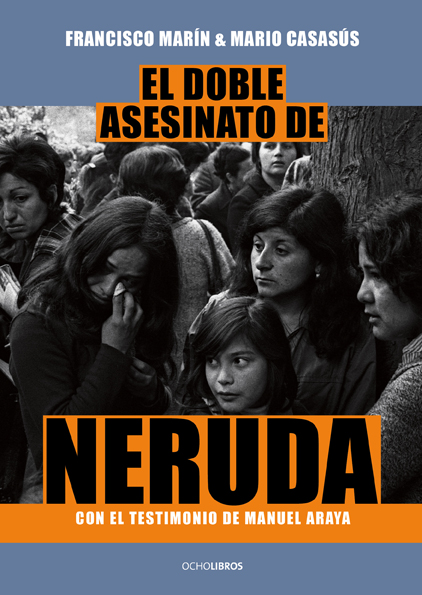
El Doble Asesinato de Neruda <http://3.bp.blogspot.com/-l7iCB_JBmFk/UZynUcgSMcI/AAAAAAAAAKI/cFdonHbgiuk/s1600/El-doble-asesinato-de-Neruda%5B1%5D.jpg>In light of the recent news regarding the investigations into Pablo Nerudas death, the much maligned testimony of Nerudas personal assistant and chauffeur Manuel Araya, is of significant importance. Denounced by the Chilean right as a leftist conspiracy, Arayas declaration in the Mexican publication *Proceso *accusing the dictatorship of having assassinated Neruda by a lethal substance injected into his stomach created a furore and Chilean courts opened investigations into Nerudas death, following a petition filed by Partido Comunista. El Doble Asesinato de Neruda (Ocho Libros, 2012) presents a compelling case based upon Arayas testimony and the Fundación Nerudas insistence upon adhering to the official version, which related the cause of death as happening from advanced and metastatic prostate cancer. The recent forensic investigations, partially completed since laboratories still have to test for toxic substances, have determined that Neruda was indeed suffering from advanced and metastatic prostate cancer, yet the authors Francisco Marín and Mario Casasús insist that medical records were void of such grim diagnosis and radiology reports did not specify the presence of metastatic cancer. The book is described as 'a reference to a biological and ideological crime' - befitting the irregularities and contradictions which evolved through the years, as well as a possible manipulation of Chilean history. Prior to Neruda's exhumation, the Foundation expressed its objection to the investigation, endorsing the dictatorship's official statement and reiterating that there was no doubt that Neruda's death had occurred due to natural causes. Despite the ambiguous statement indicating a lack of interest in constructing a vital segment of chile's recent history, Marín and Casasús discover a more sinister network of contacts which may shed light upon why Neruda's wish to bequeath La Isla Negra as a retreat for artists and intellectuals was disregarded. A betrayal of ideals ensued with the foundation became economically aligned with Cristalerías Chile - an enterprise owned by Ricardo Lagos, a torture coordinator as well as a financial supporters of Pinochet's dicatatorship. Prior to Nerudas return to Chile from France where he was serving as ambassador, Araya was summoned to Santiago by leaders of the Communist Party and asked by Victor Díaz and Luis Corvalan whether he would accept the role of personal assistant and chauffeur to Pablo Neruda a job which entailed a magnitude of commitment and responsibility. Araya describes Neruda as brimming with plans to strengthen the Communist Party in Chile, seeking ways to mobilise further support for Salvador Allende and concerned with establishing a cultural foundation for writers and intellectuals. Far from retiring to his home at La Isla Negra due to consuming illness, Neruda maintained an active political stance and frequently denounced US imperialism and interference in Chile, considering his role a poetic, political and patriotic duty to prevent a right wing insurgency in the country. Among the frequent visitors to La Isla Negra were Salvador Allende, Voloida Teitelboim and Cardinal Raul Sílva Henríquez. The latter would attract the ire of the dictatorship and Vatican officials, who instructed the clergy to maintain a perfunctory role restricted to religious duties instead of campaigning against human rights violations and clamouring for investigations into the cases of Chiles desaparecidos. <http://ts3.mm.bing.net/th?id=H.4854757173299054&pid=15.1>Pablo Neruda Considering Pinochet's fear of leftist intellectuals destabilising the dictatorship from exile, the assassination scenario fits in perfectly with the later powers allocated to DINA and the deadly targeting of militants. In the aftermath of the coup, Neruda expressed the conviction that Allende had been murdered, despite the dictatorship's proclamation of alleged suicide. The Tejas Verdes contingent paid their first visit to La Isla Negra on September 12, 1973, while Neruda fretted incessantly about the fate of his compañeros, sentiments fluctuating between the despair of abandonment and futility of defence. Knowing that the military would detain and torture Neruda for his involvement in the Allende government, discussions about the possibility of exile heightened, which would safeguard Neruda's life and also provide him with the opportunity to initiate a formidable resistance. Meanwhile La Tercera, a newspaper which was closely affiliated to the dictatorship, had started spreading rumours about Nerudas allegedly debilitating illness. In an attempt to quell opposition suspicions of assassination, Pinochet issued a statement through Radio Luxemburgo. Neruda is not dead. He is alive and free to travel wherever he likes, as befits other people of old age and struck with infirmity. We do not kill anyone and, if Neruda dies, it will be of natural causes. The book translates this ubiquitous statement as proof of constructing Nerudas imminent annihilation. Having left La Isla Negra to avoid the possibility of torture, Neruda, accompanied by his wife Matilde, and Araya, sought refuge at the Clínica Santa María. The exile offer by the Mexican government was at first repudiated, with Neruda vehemently declaring he would not assume a traitorous stance and betray his compañeros. After being briefed about the atrocities committed by the military, Neruda assumed a resilient stance, stating that he would lead the struggle against the dictatorship from exile in Mexico. On September 23, the newspaper El Mercurio contributed to the rumours by stating that Neruda had experienced a deterioration of health, coinciding with the injection administered by a doctor at the clinic at a time when the poet was alone, having sent Araya and Matilde on some errands prior to exile. Upon their return to the clinic, having been alerted of the suspicious circumstances by an employee, Araya was sent to buy medicine which, according to the doctor, was not available at the clinic. Upon his departure, Araya was ambushed and detained in Estadio Nacional. I lost all contact with Neruda forever, I never saw him again. I believe it was a plot to detain me. Arayas version of Nerudas final hours has been discredited by the Fundación Neruda, despite the fact that all official testimonies which have been endorsed by the foundation come from sources who had no access to the poet during his final days. Araya was beaten, subjected to electric shocks and asked to reveal the identities of Communist Party Leaders. He was released 45 days later following intervention by Raul Sílva Henríquez. Matildes reluctance to denounce the alleged assassination was reciprocated by the foundation in later years. A solitary figure searching for ways to open an investigation, Arayas efforts were shunned and the official version assumed the emblem of truth. The existence of the lethal injection would have been eliminated from collective memory, had it not been for Arayas determination in maintaining his testimony. The official medical and death certificates obliterated its existence, citing cardiac arrest as the cause of death. Only when El Mercurio reported Neruda having been given a tranquiliser, did the injection suddenly spring into existence. The possibility of Araya having invented his testimony in order to create a controversy fades when faced with the various contradictions and reluctance to properly investigate the cause of Nerudas death. The authors hold Matilde responsible for the ensuing silence it is reported that she had even tried to reach a compromise with Araya in return for relinquishing the quest for justice. She is also deemed responsible for the foundations betrayal of Nerudas wishes, having entrusted the administration to individuals responsible for maintaining the dictatorships atrocities. As we await the final results regarding the presence of toxic substances in Nerudas remains, it is evident that, whatever the forensic verdict decrees, Nerudas death will continue to hover within the confines of Chilean memory. The measures of impunity imposed by Pinochet to protect the network of torturers and murderers has rendered investigation a source of controversy and a means through which truth will remain eternally shrouded with a pervading negotiation of privilege over human rights violations. [Non-text portions of this message have been removed] ------------------------------------ --------------------------------------------------------------------------- LAAMN: Los Angeles Alternative Media Network --------------------------------------------------------------------------- Unsubscribe: <mailto:[email protected]> --------------------------------------------------------------------------- Subscribe: <mailto:[email protected]> --------------------------------------------------------------------------- Digest: <mailto:[email protected]> --------------------------------------------------------------------------- Help: <mailto:[email protected]?subject=laamn> --------------------------------------------------------------------------- Post: <mailto:[email protected]> --------------------------------------------------------------------------- Archive1: <http://www.egroups.com/messages/laamn> --------------------------------------------------------------------------- Archive2: <http://www.mail-archive.com/[email protected]> --------------------------------------------------------------------------- Yahoo! Groups Links <*> To visit your group on the web, go to: http://groups.yahoo.com/group/laamn/ <*> Your email settings: Individual Email | Traditional <*> To change settings online go to: http://groups.yahoo.com/group/laamn/join (Yahoo! ID required) <*> To change settings via email: [email protected] [email protected] <*> To unsubscribe from this group, send an email to: [email protected] <*> Your use of Yahoo! Groups is subject to: http://docs.yahoo.com/info/terms/