http://www.marxist.com/nepal-a-revolution-adrift.htm
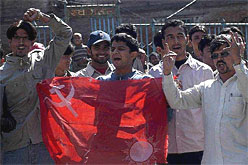
Nepal: a revolution adrift<http://www.marxist.com/nepal-a-revolution-adrift.htm> Written by Brian Conlon and Kamred Hulaki in Kathmandu Thursday, 23 May 2013 [image: Print] <http://www.marxist.com/nepal-a-revolution-adrift/print.htm>[image: E-mail]<http://www.marxist.com/component/option,com_mailto/link,020a88514ac353d5844eca26e241d3fe71d50598/tmpl,component/> - - - The situation in Nepal is rapidly deteriorating. The living forces of the revolution are witnessing the withering away of a process that abolished one of the worst symbols of feudalism in the world, the monarchy. The hopes of millions of Nepalis have been put on hold. As yet there has been no meaningful land reform, poverty is still a major problem and the countrys economy is being taken over by foreign capitalists; all this with the former insurgency leaders in the government! [image: nepal2] <http://www.marxist.com/images/stories/nepal/nepal2.jpg>The mandate of the sitting Parliament has now expired and the masses are still waiting for the long promised Constitution that was going to bring prosperity and peace. The Constituent Assembly has been a total fiasco, it did not manage to do the only thing it had to do: write a new Constitution. The elections have been postponed several times and it is by no means certain that they will take place any time soon. In all likelihood they wont at all as the dates keep being moved. If polls are not held by June, before the onset of the monsoon season, they could be delayed by several more months, which might mean an interim government until early 2014<http://www.hindustantimes.com/world-news/Nepal/Nepal-likely-to-miss-June-poll-date/Article1-1035066.aspx> . The Chairman of Nepal's interim election government, Khil Raj Regmi, has stated that he wants to hold elections before this deadline expires. In the meantime the main political force in the country has split and the Maoists look like they might not win the upcoming election. Also the refusals by nearly three dozen parties to take part in the polls are adding problems to the electoral process. Their complaints over differences over electoral lists, voter age and disruptions to voter registration are other factors delaying the announcement of poll dates. US imperialism in the form of the Carter Center has already shown its own interest in 'helping' the electoral process. How did we get here? In September 2011, Dr. Baburam Bhattarai became the 35th Prime Minister of Nepal, after Prachanda had sided with him, reinforcing the wing that wanted more involvement in the government. A year and a half later it is time to make a balance sheet, as this was the only self-proclaimed Maoist government in the world. The country has no Constitution, land reform is all but stopped, free trade agreements have been signed to the benefit of imperialist powers (namely India), the armed Maoists that had ensured the King was dismissed have relinquished their arms and the powerful Communist movement is utterly divided. As far as evaluation goes, there is not much positive. On top of this, the opinion polls are not giving good news. A recent comprehensive poll gives the view that although going for fresh elections is the preferred option of the Nepalese, a high proportion of people (57 percent) are undecided as to the political party they would vote for if new national elections were to be held. This proportion of undecided voters has gone up by 10 percentage points compared to the previous survey. Only a small proportion of those who voted for the UCPN (Maoist), NC, UML and other political parties have made up their minds to vote<http://www.nepalnews.com/contents/2011/englishweekly/spotlight/aug/aug19/opinion.php>for those very same political parties if a new national election were to be held. In fact the Nepali Congress has a core support of 10%, the Maoists have 6% after the split and the CPN-UML has almost 5%. Opinion polls have to be taken with a pinch of salt but they show the current mood of the masses. The most worrying sign of these polls is that reaction is showing again its ugly face. Some 9 percent want the revival of the Kings rule. This is still marginal but in a situation of political farce with no real improvement in living conditions, the counter-revolution could gain a real social base. Split in the movement There was little surprise to anyone when a number of radical leaders from Nepals Unified Communist Party-Maoist split from the party in June 2012. Less than a year later, around 1,000 leading cadres of the regrouped Communist Party of Nepal-Maoist (having taken the name of the party when it led the People's War) have agreed to pursue a strategy of people's revolt against the coalition government, including their former comrades. This is going back to square one, but this time with Maoists in the government in a republican set up. CPN-Maoist Chairman Mohan Baidya described the current coalition-led Nepali government as puppets (of imperialism). The document called for the scrapping of the Bilateral Investment Promotion and Protection Agreement (BIPPA) and other economic treaties with India. The CPN-Maoist argues that such agreements go against the interests of the Nepali people and relinquish the countrys political and economic sovereignty to imperialism. Another sticky issue is the disbandment of the guerrillas. In a previous article we stated: "From a Marxist point of view, seeking the support of the Madhesi bourgeois nationalist parties is a serious mistake, but the handing over of the weapons just shows how far from Marxism these so-called Marxist-Leninists are. They have no serious understanding of the role of the state apparatus, the role of the local bourgeoisie and/or of Imperialist forces in Nepal or elsewhere " - Nepal: A Maoist heads the government<http://www.marxist.com/nepal-a-maoist-heads-the-government.htm> The same mistakes are being repeated again and again by the Maoist forces in Nepal. We forewarned that: "The Constituent Assembly has not written the Constitution, land reform is going backwards (we will return to this point) and on the contrary, the armed wing of the party is abandoning its only guarantee of having any negotiating power: their weapons. On top of that, the UCPNM may split, becoming the second parliamentary force, which in turn would split all the movements that they have created: unions, student organizations, peasants organizations " This is precisely what has happened. As Trotsky explained this in his *Permanent Revolution* <http://www.marxists.org/archive/trotsky/1931/tpr/pr-index.htm>: "When the workers and peasants, through a revolutionary struggle, come to power, they cannot simply stop at tackling the tasks of the bourgeois revolution in fact the solution of the tasks of the national democratic revolution, such as land reform, and liberation from the domination of foreign powers, can only be achieved and maintained through the implementation of socialist measures. All this has come true in the months since our last article was written. Now the movement is split down the middle and the imperialists and the local bourgeoisie can breathe a sigh of relief. The split within the Maoists drew around 30 percent of the partys central committee and around a third of the Maoist members of the now dissolved Constituent Assembly. In addition, it also includes a large number of wartime cadres who feel abandoned by the parent party and has managed to attract popular support in Rolpa and other districts that were rebel strongholds during the conflict. This will bring problems during the upcoming elections. The Maoist splinters had managed to form parallel committees in many districts in almost all of the partys affiliate organisations (student unions, trade unions and ethnic fronts). A real alternative? The hardliners, as they are currently called, argued that the rebels should not be too eager to implement the commitments made in the peace agreements; rather, they should maintain a tactical approach to the entire peace process, hoping to be able to launch an armed struggle soon enough. In their view, the game of multi-party politics would gradually corrupt the Maoists as it has done with their former colleagues of the CPN-UML and rob them of their revolutionary edge. They see the same process without analysing its causes. Convention declarations of CPN-Maoist also included harsh words for UCPN Chair, Pushpa Kamal Dahal and Vice-Chair and Nepali Prime Minister, Baburam Bhattarai, describing them as stooges of foreign powers and criticizing them for betraying the revolution. CPN-Maoist leaders say a strategy of peoples revolt will be pursued on the foundations of the previous People's War. The goal, according to CPN-Maoist cadres is... a new democratic revolution! So after almost 20 years of guerrilla warfare they want to re-start without taking into account the lessons of the uprising. Immediately after the convention, Baidya publicly warned that his party would take up arms if the rights of the people are not ensured by the present government. The leaders of the UCPN quickly assured Western powers of their party's desire to improve the countrys strained political and economic conditions. One of its leaders, Mr. Dahal recently proposed an ideological shift away from the goal of a new democratic revolution and towards a Nepali revolution. For the new CPN-Maoist, Dahals recasting of the revolutions aim is a ploy to deceive the Nepali people. This is fundamentally true, but is this split really the right solution to the problem posed by the reformist wing of the party? Party struggles and tactical moves The split had been brewing for years. Bhattarai even claimed to be a Trotskyist in the light of the debate on government participation, which was used to polarise the party. Unfortunately for Bhattarai, reading the Wikipedia page on Trotsky does not make him a Trotskyist; having an understanding of the role of a revolutionary party and the international working class does. This issue, the role of the party, is what has been debated for a long time. Baidya and Bhattarai both appealed to Prachanda to uphold their respective positions as the partys official line (People's war or Government participation respectively). The chairman agreed with Bhattarai that the Maoists could not immediately launch an insurrection and capture state power, so they accommodated to the ministries and the cosy life of a bourgeois regime. The state institutions in Kathmandu remained too powerful for them to take over by force, according to their logic. The party lacked the mass support required for an urban insurrection, and major foreign powers would not accept a one-party Maoist state (conveniently forgetting the mass movement that overthrew the monarchy). Yet, Prachanda could not afford to alienate Baidya and his supporters. After all, they had been loyal to him since the days before Bhattarai had even joined the party. Moreover, during his stint as finance minister, Bhattarai had gained a reputation as a competent and reliable politician and became popular even among the bourgeois classes that were otherwise ill-disposed towards the Maoists. Bhattarai was also trying hard to establish his own faction of loyalists within the party. The chairman felt it was necessary to retain Baidyas support to ensure that Bhattarai did not gain too much power. To maintain party unity, Prachanda (in true Stalinist fashion) was forced to say, The great Lenin himself was able to lead a successful insurrection only after 25 years of peaceful struggle. Addressing PLA commanders in 2008, Prachanda said, Yesterday, war meant holding a machine gun and killing or being killed by our enemies. Today war means sitting with our enemies at the same table and chatting over cups of tea. Although the war looks different now, its essence is the same. Let's clarify a few issues. Unfortunately for Prachanda and Bhattarai, Lenin was never the Prime Minister of a bourgeois government. Furthermore whatever Prachanda might say about guerrilla warfare, fighting in the mountains and taking cups of tea with the bourgeoisie are not quite the same thing! But there is an alternative to an ultra-left policy (guerrillaism) or class collaboration (the cups of tea) and it was Lenin that actually gave the correct line to communists across the world. His *Left-Wing Communism, an Infantile Disorder*<http://www.marxists.org/archive/lenin/works/1920/lwc/>explains: The immediate objective of the class-conscious vanguard of the international working-class movement, i.e., the Communist parties, groups and trends, is to be able to lead the broad masses (who are still, for the most part, apathetic, inert, dormant and convention-ridden) to their new position, or, rather, to be able to lead, not only their own party but also these masses in their advance and transition to the new position. While the first historical objective (that of winning over the class-conscious vanguard of the proletariat to the side of Soviet power and the dictatorship of the working class) could not have been reached without a complete ideological and political victory over opportunism and social-chauvinism, the second and immediate objective, which consists in being able to lead the masses to a new position ensuring the victory of the vanguard in the revolution, cannot be reached without the liquidation of Left doctrinairism, and without a full elimination of its errors. This is exactly what the 'radical' wing should do, a critical analysis of their own past not to make the same mistakes. Lenin later on explains: ' A political partys attitude towards its own mistakes is one of the most important and surest ways of judging how earnest the party is and how it fulfills in practice its obligations towards its class and the working people. Frankly acknowledging a mistake, ascertaining the reasons for it, analysing the conditions that have led up to it, and thrashing out the means of its rectification -- that is the hallmark of a serious party; that is how it should perform its duties, and how it should educate and train its class, and then the masses. And Lenin also had some comments for Prachanda & co. (and their cups of tea). He advised to communist parties that had not yet taken power:* * In these circumstances, we must ask ourselves, not only whether we have convinced the vanguard of the revolutionary class, but also whether the historically effective forces of all classespositively of all the classes in a given society, without exceptionare arrayed in such a way that the decisive battle is at handin such a way that: (1) all the class forces hostile to us have become sufficiently entangled, are sufficiently at loggerheads with each other, have sufficiently weakened themselves in a struggle which is beyond their strength; (2) all the vacillating and unstable, intermediate elementsthe petty bourgeoisie and the petty-bourgeois democrats, as distinct from the bourgeoisie have sufficiently exposed themselves in the eyes of the people, have sufficiently disgraced themselves through their practical bankruptcy, and (3) among the proletariat, a mass sentiment favouring the most determined, bold and dedicated revolutionary action against the bourgeoisie has emerged and begun to grow vigorously. Then revolution is indeed ripe; then, indeed, if we have correctly gauged all the conditions indicated and summarised above, and if we have chosen the right moment, our victory is assured. The differences between the Churchills and the Lloyd Georges with insignificant national distinctions, these political types exist in all countrieson the one hand, and between the Hendersons and the Lloyd Georges on the other, are quite minor and unimportant from the standpoint of pure (i.e., abstract) communism, i.e., communism that has not yet matured to the stage of practical political action by the masses. However, from the standpoint of this practical action by the masses, these differences are most important. To take due account of these differences, and to determine the moment when the inevitable conflicts between these "friends", which weaken and enfeeble all the "friends" taken together, will have come to a headthat is the concern, the task, of a Communist who wants to be, not merely a class-conscious and convinced propagandist of ideas, but a practical leader of the masses in the revolution. It is necessary to link the strictest devotion to the ideas of communism with the ability to effect all the necessary practical compromises, tacks, conciliatory manoeuvres, zigzags, retreats and so on, in order to speed up the achievement and then loss of political power by the Hendersons (the heroes of the Second International, if we are not to name individual representatives of petty-bourgeois democracy who call themselves socialists); to accelerate their inevitable bankruptcy in practice, which will enlighten the masses in the spirit of our ideas, in the direction of communism; to accelerate the inevitable friction, quarrels, conflicts and complete disintegration among the Hendersons, the Lloyd Georges and the Churchills (the Mensheviks, the Socialist-Revolutionaries, the Constitutional-Democrats, the monarchists; the Scheidemanns, the bourgeoisie and the Kappists, etc.); to select the proper moment when the discord among these "pillars of sacrosanct private property" is at its height, so that, through a decisive offensive, the proletariat will defeat them all and capture political power. History as a whole, and the history of revolutions in particular, is always richer in content, more varied, more multiform, more lively and ingenious than is imagined by even the best parties, the most class-conscious vanguards of the most advanced classes. This can readily be understood, because even the finest of vanguards express the class-consciousness, will, passion and imagination of tens of thousands, whereas at moments of great upsurge and the exertion of all human capacities, revolutions are made by the class-consciousness, will, passion and imagination of tens of millions, spurred on by a most acute struggle of classes. Two very important practical conclusions follow from this: first, that in order to accomplish its task the revolutionary class must be able to master all forms or aspects of social activity without exception (completing after the capture of political power sometimes at great risk and with very great dangerwhat it did not complete before the capture of power); second, that the revolutionary class must be prepared for the most rapid and brusque replacement of one form by another. This is the best answer of Lenin to Prachanda. No, cups of tea are not the same as machine guns. The cups of tea have to be taken once the communist party has taken power, that is to say has taken political power and has started on the road to Socialism, completing the tasks of bourgeois democracy (land reform, national question) together with the socialist tasks: the nationalisation of the commanding heights of the economy, the state monopoly of foreign trade etc. What now? The hardliners have an objective mass base and they reflect discontent with the UCPN-M. In November 2011, Prachanda and Bhattarai reached an agreement with the other parliamentary parties that finally decided on the future of the Maoist combatants who had been confined to cantonments since the end of the war. According to the agreement, out of the 19,602 combatants still in cantonments, a maximum of 6,500 were to be recruited into a newly formed directorate of the Nepal Army. Compromising on their initial position, that their combatants should be recruited into the national army en bloc, the Maoists agreed that potential recruits would have to fulfill the standard norms of the army with regards to education, age and marital status. It was clear that most combatants would not meet these criteria, in particular the education requirements. As a result, only 1,451 former combatants were recruited in the end. Those who were ineligible or didnt wish to join were offered alternatives such as further education and vocational training. But almost all of them regarded this offer as an insult, and opted for the cash packages ranging from Rs500,000 to Rs800,000 before leaving the cantonments to re-enter civilian life. Many of them thought that the compensation packages they were meant to receive were insufficient. They also accused their commanders and political leaders of embezzling funds that the state had allocated for their upkeep. On the night of 10 April 2012, fights broke out between aggrieved combatants and commanders who remained loyal to Prachanda. At the Maoist chairmans behest, the government sent in the Nepal army to the cantonments to prevent further violence. For many former rebels, this was the ultimate betrayal. Their own chairman had ordered the army that had until recently been their enemy to intervene in the Maoists internal disputes. Even the leaders of the new party have recognised that, embittered as they are, the former Maoist combatants are too exhausted to plunge back into more violence. Moreover, their leaders are now well-known public figures; they cannot simply go underground and operate incognito as they had done in the mid-1990s. But the splinter Maoist party has no choice but to continue operating within the existing system. Within this political framework, however, they are an isolated and marginal force in the parliamentary arena. They are not invited to any of the negotiations between the major political parties and the media dismisses them. They have even refused to compete for positions in government. On top of that, and against their own credibility, they did try to form a tactical alliance with the Nepali Congress and UML to bring down the Baburam-Bhattarai government. But these parliamentary parties feared Baidyas eventual intention and did not trust him. The radical Maoists even appealed to former royalists on the basis of their common nationalist sentiments but the right-wing monarchists were not ready to make a deal with their arch-rivals. However, this shows the ideological bankruptcy of this new party, which with its policy is giving a breathing space to the counter-revolution! Finally it tried to ally itself, as the UCPN-M had done before, with the Madhesi and Janajati groups. Prachanda has criticised them as ideological dogmatists with a mechanical [and] narrow interpretation of objective reality; leftist liquidationists with petty bourgeois impatience. However, the party chairman is also worried that the split has weakened the partys electoral prospects. In the end, the splinter party has inherited all the vices of the former UCPN-M and few of its virtues. This is not good news for either the Nepalese workers, peasants and youth, or for the communist movement as a whole. Background of Nepal's Maoists The roots of CPN-Maoist go back to 1991, when the Communist Party of Nepal (Unity Centre) held its first convention and pledged to pursue a strategy of protracted armed struggle on the route to new democratic revolution. In practice, the party continued along the route of parliamentary struggle. Three years later a militant faction broke away and named itself the Communist Party of Nepal (Maoist). In 1996, the new Maoist party launched its guerrilla Peoples War, kicking off a decade-long armed civil conflict. This conflict escalated after a 2001 attack by the Maoist guerrillas on Nepalese Army forces. The People's Liberation Army, the CPN-Maoists armed wing, controlled a majority of Nepals rural territory by 2005. That same year the Maoists, under the leadership of Dahal, changed their strategy and opted for permanent peace accords while seeking a multi-party alliance against the monarchy. In 2006, following a general strike and waves of popular demonstrations in Kathmandu, King Gyanendra stepped down and a 240 year-old dynasty was abolished. In a bid to gain legitimacy, later in 2006 the Maoists signed the Comprehensive Peace Accords, which promised that the insurgents would lay down their arms in return for a seat in a U.N. sponsored political process. In 2009, the CPN-Maoist merged with another communist party and renamed itself the United Communist Party of Nepal. Since laying down its arms in 2006, the UCPN has achieved what bourgeois politicians would describe as worthy goals. Both its Chairman Dahal and Vice-Chairman Bhattarai have served as the countrys Prime Minister. During the 2008 Constituent Assembly election, the UCPN came out ahead of all other parties and won 229 out of 601 seats. In 2012 UCPN was removed from the U.S. State Department¹s list of terrorist organizations, a great victory according to the leaders of the party. CPN-Maoist cadres contend that these achievements do not outweigh the drawbacks that include a failure to implement revolutionary changes in Nepali society. For example, the failure of the Constituent Assembly to write a new constitution led to its dissolution in May 2012. Now that members of CPN-Maoist have accomplished a vertical split, it is unlikely that the UCPN will repeat its electoral success during the next Constituent Assembly election in 2013. In fact with the UCPN-M split it is unlikely that there will be a majority to carry though changes in a parliamentary way (if this was ever possible) so Prachanda and Bhattarai are bound to make more agreements with bourgeois parties and push to one side the pressing needs of the masses of Nepal. Maoist international relations Besides leading to a split within his own party, the Dahal-led 2005 strategic reorientation has created tensions with the neighboring Communist Party of India-Maoist (CPI-Maoist). A 2009 open letter from CPI-Maoist questioned the strategic turn taken by the UCPN, describing it as right-deviationist and Euro-communist. The CPI-Maoist letter also partly blamed the UCPN for causing the collapse of two international Maoist organizations: the Revolutionary Internationalist Movement and the Coordination Committee of Maoist Parties and Organizations in South Asia. Security analysts worry that the reconstitution of CPN-Maoist may once again lead to cross-border operations and relations between armed Maoist groups from both countries. The CPI-Maoist is the largest party in India behind the Naxalite insurgency; an ongoing civil conflict rarely reported in Western media. Maoist parties are also currently engaged in armed conflicts with state forces in Bhutan, Bangladesh, and India. One of the controversies dividing CPN-Maoist from UCPN is the relationship between Nepal's revolutionary movement and the neighboring states of India and China. While in power the UCPN has fostered close ties with the Indian state, a move that CPN-Maoist and CPI-Maoist cadres disapprove of. The UCPN, on the other hand, accuses the leadership of the CPN-Maoist of secretly meeting with Chinese state officials, a taboo within international Maoism. Maoist parties have ideologically and practically distanced themselves from the Chinese state and Communist Party since the early 1980s because, according to the historical narrative followed by most Maoists outside of the People's Republic of China, Maoist ideology was abandoned by the ruling Chinese Communist Party after the death of Mao Zedong in 1976 and a subsequent coup led by supporters of Deng Xiaoping against the Gang of Four. Although China and Nepal are neighbours, they are economically and politically cut off from each other by the mountainous terrain that lies between them. CPN-Maoist supporters contend that any meeting between the Nepali Maoists and Chinese officials would serve to create the distance from India necessary to carry forward the revolution in Nepal, arguing that since India is a key regional ally of the U.S., moves by the UCPN to further tie Nepal to India would strengthen U.S. Imperialism regionally and globally. This just shows the narrow-minded outlook that Maoism (as a local variant of Stalinism) has. None of the branches of the Maoist movement in Nepal or India have an internationalist revolutionary outlook. India has seen the biggest general strike ever and is developing a massive proletariat; the same goes for China that is seeing a rise in workers mobilisations against the appalling working conditions in this major economic power. Instead of appealing to the masses and workers of both countries, the tiny Maoists try to position themselves in favour or against a local imperialist power. The local narrow-mindedness of the Maoists (all of them) of siding with the local bourgeoisie or trying to side with the monarchists against their former comrades is just an indication of the prism they use to analyse the world. They have in practice abandoned their faith in world revolution, despite the fact that a popular revolt started two years ago in Tunisia, brought down several regimes and put the masses of an entire subcontinent on the move! The international economic crisis is starting to have an impact in India and this will have, sooner or later, its effects in Nepal. The Maoist leaders continue to play games with Indian imperialism as the declarations of the UCPNM show. A split UCPNM would have to rely more on the pro-business elements of the Assembly, pushing them even further away from the masses. This is a recipe for disaster. We have explained many times that in a semi-feudal country like Nepal, when the masses have succeeded in overthrowing the regime they cannot confine themselves to the limits of bourgeois, capitalist democracy. The workers and peasants have to take power into their own hands in order to implement even the most basic democratic reforms. If the Maoists had had a revolutionary and internationalist outlook they would have used the Nepalese uprising as a tool to spark the Indian revolution. The Tunisian analogy is there for all to see. Revolutions are unique to each country, but one of the common features of all revolutions is that they generate a wave of social mobilization; people say to each other if they can, we also can. The Maoists are at a crossroads, now more than ever. A few months ago we said, Time is ticking away and the divisions within the party will be exploited by the bourgeois and imperialists in order to form a Government and demobilise the masses as much as possible. Given the current wave of revolution sweeping across the planet, letting the opportunity go would be a criminal policy on the part of the Maoist leaders. A split would be a gift to the bourgeoisie and to the imperialists! This is exactly what has happened. The danger is that the Maoist leadership has disarmed a wing of the revolutionary forces, and this will only encourage the bourgeoisie and the imperialists to wage an even more militant campaign against any of the achievements of the peoples uprising. Prospects for Nepals Maoists Though only six months old, the reformed CPN-Maoist has managed to draw significant numbers away from the UCPN. During the week prior to its general convention alone, 3,500 former cadres of the UCPN were recruited into CPN-Maoist. This breakaway party has also absorbed well over a dozen sister organizations created during the Nepali Maoists nearly two-decade-long history. Now they will have to deal with how to implement the newly adopted peoples revolt strategy. The most likely outcome of the current debate is that the party will prepare for elections as the ultimate goal. We have warned about the dangers of parliamentarianism. The Maoists are infected with this disease; only Marxism is the cure. What is required is decisive and bold action to be taken to ensure that the old state apparatus is removed and a new power is built, firmly in the hands of the poor peasants, workers, youth and oppressed people. The conditions for this now exist. In the past the Maoists successfully organized the peasants and controlled large areas of the country. Now they have shown that the urban masses can also be mobilized. The general strike of May 2010 is proof of that. All the forces are lined up for the workers and peasants to take power. The UCPN leaders should review their position and understand the historical task that lies on their shoulders. They are the leaders; they have the authority and they should use it. Otherwise we will have paralysis and the initiative could pass into the hands of the ruling elite. By leading the masses to power and carrying through a genuine socialist revolution in Nepal, they would be lighting a beacon in Asia that the downtrodden masses would look up to in countries like Pakistan, India, China, Bangladesh and beyond. Conditions for revolution are maturing well beyond the borders of Nepal. The present world crisis of capitalism is making unbearable living conditions even worse for many of the workers in these countries. They would instinctively move in the direction of solidarity with the Nepalese masses across the South-Asian subcontinent. Parliamentary politics in Nepal has reached its limits. The power is there for the taking and the working masses under the leadership of genuine communists must take it. This is a decisive moment in the history of the class struggle of Nepal. [Non-text portions of this message have been removed] ------------------------------------ --------------------------------------------------------------------------- LAAMN: Los Angeles Alternative Media Network --------------------------------------------------------------------------- Unsubscribe: <mailto:[email protected]> --------------------------------------------------------------------------- Subscribe: <mailto:[email protected]> --------------------------------------------------------------------------- Digest: <mailto:[email protected]> --------------------------------------------------------------------------- Help: <mailto:[email protected]?subject=laamn> --------------------------------------------------------------------------- Post: <mailto:[email protected]> --------------------------------------------------------------------------- Archive1: <http://www.egroups.com/messages/laamn> --------------------------------------------------------------------------- Archive2: <http://www.mail-archive.com/[email protected]> --------------------------------------------------------------------------- Yahoo! Groups Links <*> To visit your group on the web, go to: http://groups.yahoo.com/group/laamn/ <*> Your email settings: Individual Email | Traditional <*> To change settings online go to: http://groups.yahoo.com/group/laamn/join (Yahoo! ID required) <*> To change settings via email: [email protected] [email protected] <*> To unsubscribe from this group, send an email to: [email protected] <*> Your use of Yahoo! Groups is subject to: http://docs.yahoo.com/info/terms/