http://www.marxist.com/khamenei-suffers-major-blow-as-the-masses-raise-their-heads-again.htm
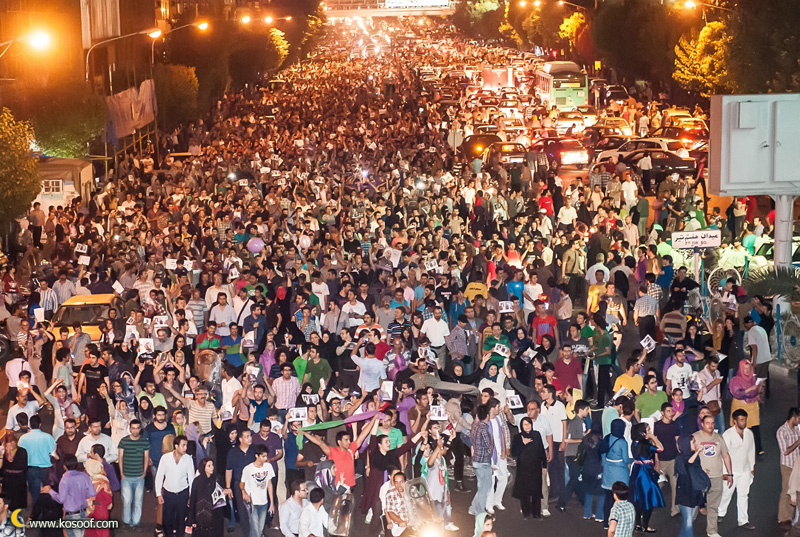
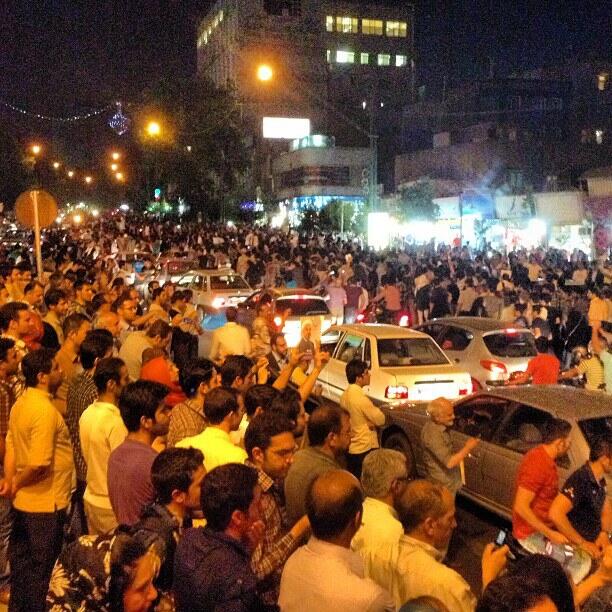
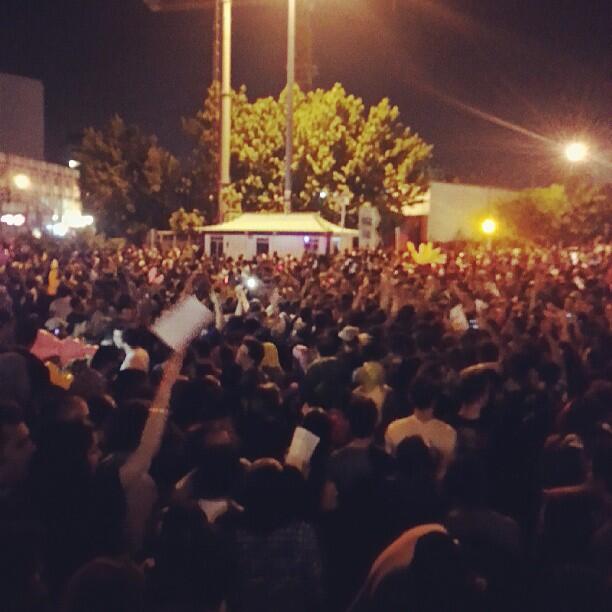
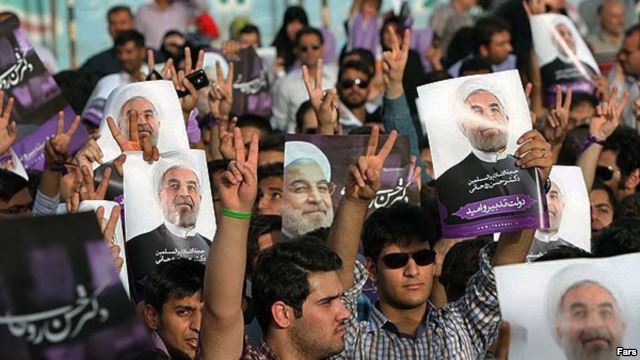
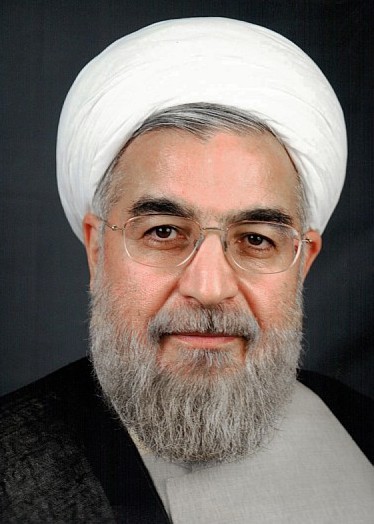
Iran: Khamenei suffers major blow as the masses raise their heads again<http://www.marxist.com/khamenei-suffers-major-blow-as-the-masses-raise-their-heads-again.htm> Written by Hamid AlizadehSunday, 16 June 2013 [image: Print]<http://www.marxist.com/khamenei-suffers-major-blow-as-the-masses-raise-their-heads-again/print.htm>[image: E-mail]<http://www.marxist.com/component/option,com_mailto/link,aa2cfc7c11f7612e23b8f7f8533603967b1ee8c9/tmpl,component/> - - - As these lines are being written hundreds of thousands of Iranians have poured onto the streets to celebrate the victory of Hassan Rouhani, in the presidential elections. Pictures of mass celebrations all over Iran are circulating the internet. This is an open defiance of Khamenei and the whole security apparatus of the regime which was dealt a humiliating defeat in the elections. [image: rouhani-victory]<http://www.marxist.com/images/stories/iran/rouhani-victory.jpg>With 50.71% of the vote, amounting to 18.6 million votes, Rouhani won outright in the first round of the elections. Tehran Mayor Mohammad Baqer Qalibaf came second with 16.56%. Saeed Jalili, Irans chief nuclear negotiator and the candidate of Supreme Leader Ali Khamenei and the military-security establishment, only managed to gain 11.35% of the total votes, barely more than Mohsen Rezaei who got 10.58%. At the bottom of the list we find Khameneis foreign affairs advisor Ali Akbar Velayati with 6.18% and the joke candidate Mohamad Gharazi who got 1.21%. [image: rouhani-victory2]<http://www.marxist.com/images/stories/iran/rouhani-victory2.jpg>After the election results had been declared people started pouring out, blocking many main streets throughout the country. The mood was electric as hundreds of thousands came out in celebration. Most places the celebrations took the form of protests and demonstrations and the chants of All political prisoners must be freed!, Ya Hossein, Mir Hossein! (Referring to the Reformist leader Mir Hossein Mousavi who is under house arrest) and "Ahmadi, bye bye!" were resounding in every major city of the country. *http://www.youtube.com/watch?feature=player_embedded&v=9cjx3MungGQ*<http://www.youtube.com/watch?feature=player_embedded&v=9cjx3MungGQ> Tehran - "Political prisoners must be set free!" *http://www.youtube.com/watch?feature=player_embedded&v=H-XrKfWV6Ug*<http://www.youtube.com/watch?feature=player_embedded&v=H-XrKfWV6Ug> City of Yazd on Saturday evening [image: rouhani-victory3]<http://www.marxist.com/images/stories/iran/rouhani-victory3.jpg>"Tehran has exploded with happiness. I have never seen so many people so happy in my life," a 29-year-old photographer told Ahram Online. Similar reports were to be seen on many facebook and twitter profiles. A source reporting to us from Mashhad the second largest city of Iran said the following: I was out until 2.30 in the morning yesterday and it was boiling. I have never seen anything like this except for after the football match between Iran and Australia. People filled up all the streets in the city. There were maybe one million people. Mashhad has three million inhabitants but wherever you went it was full of people and cars. There were also people from the poor parts of the city. There were neither any guards nor any police or Basijis. In Ahmadabad and Taghiabad which are more central and middle class there were political chants such as calls to free the political prisoners but the rest of the city was more like a carnival or people who were happy. *http://www.youtube.com/watch?feature=player_embedded&v=aUJNkjN_2nc* Anti dictatorship slogans in the proletarian hub Karaj The thing that struck me the most was how calm people were in that traffic. Normally everybody is nervous and angry, but yesterday everybody was laughing and joking. There were no fights and people got along. This people who are always snarling at each other, all got along yesterday. Four years ago the uprising that erupted in the aftermath of the presidential elections was crushed by the regime. The mood amongst the masses had become pessimistic and resigned. But today they could once again feel their own collective power. They knew that they had inflicted a severe blow on the regime that is now in a state of shock. Despite the open defiance of the people on the streets the security forces were nowhere to be seen. Tehran - ironically broadcast by the state controlled Press TV A vote for whom? [image: rohani campaign]<http://www.marxist.com/images/stories/iran/rohani_campaign.jpg>Pictures from Rouhanis campaignAs we have previously reported, the last week of the election campaign took on a sharp turn as Rouhani managed to crystallize the opposition vote around him. In all cities around Iran his meetings became a focal point for thousands of youth. The slogans chanted at his meetings became more and more radical as the crowds grew. Read also: Iran elections: Crisis of the regime deepens - The youth re-enter the scene<http://www.marxist.com/crisis-of-the-regime-deepens-the-youth-enter-the-scene.htm> Rouhani himself had stated from the beginning that he was not in opposition to the regime. He did not even claim to be a Reformist. But as one source told the Financial Times: In the rest of the world people vote for one candidate, here we all voted for one candidate not to win, This is the real reason behind Rouhanis vote. [image: hassan rouhani]<http://www.marxist.com/images/stories/iran/hassan_rouhani.jpg>Hassan RouhaniIn the absence of real national organisations, the masses will use whatever tool they find available in order to express their aims and aspirations. The massive support for Rouhani was not due to him or his political line. He merely became a focal point around which a large part of the masses gathered in order to express themselves and their opposition to the regime. More than anything the support for Rouhani must be seen as a protest against dictatorship and lack of democracy; against poverty, uncertainty and corruption; against Khamenei, the Revolutionary Guards and the whole of the ruling establishment. Khamenei exposed and isolated Khamenei had expected to purge the state from all opposition and concentrate power in his hands with these elections, but the outcome was the exact opposite. As we reported on Friday, all other factions in the regime came out in opposition to his candidates. Most importantly perhaps was the criticism he received from Ahmad Tavakoli, who is a conservative Majles deputy close to the very influential Larijani family. This means that the future government will have a very difficult time balancing between the wishes of the government, the Majles and the Supreme Leader. Read also: Iran Elections: Khamenei Blocks Mashaei and Rafsanjani - The Crisis of the Regime Continues<http://www.marxist.com/khamenei-blocks-mashaei-and-rafsanjani-crisis-of-regime-continues.htm> But Khameneis main candidate, Saeed Jalili, was not only directly attacked and humiliated by the other candidates throughout the elections. The most severe blow was dealt to him by the masses in the polls. Coming into the elections Jalili had behind him the active support of Khamenei, the intelligence and security apparatus of the state, the Revolutionary Guards and the Basij militia. Combined, these forces make up not only by far the largest economic entity in the country, but also the largest organised force for voting. Through the past 10-12 years they have developed a very advanced network, especially through the Basij, that they mobilize to vote. The fact that they only managed to gather 6-7 million (official!) votes, is an indication of their weakness. This fact was further stressed by the participation level which stood at 72.7% - far higher than any analyst had anticipated. This time as opposed to the previous elections, large parts of the workers and poor also supported Rouhani. Many sources have reported to us that Rouhani had a wide following in the poor neighbourhoods of southern Tehran, something that Mousavi did not have at the previous elections. The scope of the defeat of Khameneis candidates, and the explosive nature of the public meetings of Rouhani, was such that there could be no talk about rigging the elections. Humiliated and exposed Khamenei could only accept the outcome and his now depreciated authority. Jalili was not only Khameneis direct representative; he is also the chief nuclear negotiator and therefore one of the most important external faces of the regime. At the same time, the pre-election period revealed a deep split within Khameneis office itself. Ali Akbar Velayati, who is also the foreign affairs advisor to Khamenei, harshly criticized Jalilis (Read Khameneis) negotiation strategy during the televised debates in the run-up to the elections. It is clear that neither Jalili nor Velayati, who are both key men in Khamenei's office, can just continue as before in their positions. This also puts a big question mark over the whole foreign policy of Iran and shows that the masses are no longer as receptive to the siege mentality that the regime was cultivating in order to keep the workers and the poor from revolting. The mass movement raises its head again The entrance of the masses onto the scene completely upset the plans of the ruling class. Rouhani to be sure, although he appealed in the most populist manner to the youth, did everything he could in order not to set a mass movement in motion. The call of support from Khatami, Rafsanjani and the rest of the Reformist leaders only came when there were two days of campaigning left. Also the Reformist campaign organisations were not allowed to develop like they did in 2009. Throughout his campaign Rouhani presented himself as the candidate of moderation and in his first televised speech after the elections he called it the "Victory of wisdom, moderation, progress, awareness, commitment & religiosity over extremism & unethical behaviour" (our emphasis) But despite all of this the crowds that his meetings attracted in the last two days of campaigning could be counted in the thousands and tens of thousands per meeting. This is an indication of the enormous revolutionary energy that lies below the surface of society. This pressure is the main force behind the split in the ruling elite. While one camp stresses the need to use brute force in order to oppress a brewing revolution, another camp is calling for reforms from the top in order to avert a revolution from below. While the hard-line camp says that opening up will only invite a revolution, the Reformists and the Moderate (in Iranian context!) camp argue that it is the clampdown that will lead to a revolutionary backlash. Both camps are absolutely right! This is an expression of the impasse of the regime which is left with very little room for manoeuvre. The entrance of the youth onto the scene is an anticipation of the revolutionary upheavals of the future. The youth is merely a sensitive barometer of a process that is taking place throughout society. They have already shown their determinism and revolutionary mood. Naturally they will start from a democratic standpoint, how could it be otherwise? With the suffocating dictatorship and no revolutionary party worth the name what other options exist for the revolutionary youth? The demands for the freedom of political prisoners, freedom of press, freedom of organisation, etc., are all revolutionary demands in an Iranian context and as Marxists we fully support them. None of them, can be fully achieved without the overthrow of the regime. For now the masses have flocked around Rouhani because there is no other alternative, but this also means that they will have to go through the school of the Reformists. Rouhani is not the representative of the people. More than anything he is the representative of the Bazaar, the private capitalists and the liberal bourgeoisie. His political project is based on privatisation, liberalisation (read cuts) and the opening up of the Iranian market for investments, i.e. exploitation by western capital. Politically his closest ally is Ali Akbar Rafsanjani who, besides being one of the richest men in Iran, was one of the chief architects of the Islamic Republic and the crushing of the Iranian revolution of 1979. Rouhani is completely interwoven into the fabric of the rotten regime and his interests are directly opposed to those of the masses. But even if he wanted to he could not change the situation. It is true that the sanctions are having a big impact on the Iranian economy. If they are eased - which is not guaranteed at all! - it will undoubtedly relieve some tensions and give him some room to manoeuvre, but this will not mean a return to growth levels before the period of the sanctions and it will not change the general trajectory of the economy. The Iranian economy has always been sick and this is today magnified by the deep slump of the world economy. This has been displayed in the feeble attempts to rest on the Chinese economy to bring growth to Iran, which has proven to be futile because of the slowing growth in China itself. The crisis will continue Rouhanis government will not be able to stand outside of this process. None of the fundamental problems behind the crisis in Iranian society have been solved and therefore the crisis will continue. In the best case scenario he will probably try to ease tensions by calling for a government of national unity, softening the relationship with the west as well as opening up the atmosphere a bit by allowing limited democratic rights. Clearly this will buy him some time, but ultimately it will not solve anything. The internal struggle in the regime for the shrinking loot on Iranian soil will continue and the different factions will continue to splinter internally. As for the masses, they would benefit from a more open atmosphere, where the revolutionary movement can reorganise and consolidate itself. But sooner or later (Probably sooner) Rouhani would betray the youth and find the same force that brought him to power in opposition to him. Let us remember that the presidency of Reformist cleric Mohammad Khatami in the 1990s led to a massive youth uprising and a wave of strikes and worker protests. That, to be sure, was in a period of economic growth, falling unemployment and falling inflation. That is the exact opposite of the perspectives for Iran in the next period. The working class today is in a terrible situation. The inflation rate is around 100%, but nevertheless the minimum wage only rose 25% this year to around 4.8m Rial which is about $390 a month. But even by official criteria this is one-third of what is deemed to be a living wage in the capital. Of course for up to 40 percent this is not relevant because they do not have a job. And even if you have a job it is very normal to go on for months and even years without wages. How can Rouhani solve this question in the context of the present world economic crisis where overcapacity in all major industries means a steep fall in real investments. The same paradox confronts Rouhani when it comes to democratic rights. The question of democracy in the final analysis is a question of bread. How can Rouhani grant the workers, the youth and the poor the right to organise and agitate when he cannot feed them or provide them the prospects of a dignified future? Every democratic right will be used by the masses as a weapon against the regime itself. This means that at some point he will clamp down again. What the masses will gradually come to realize is that the dictatorship, corruption, poverty and misery are not the works of individuals or factions, but phenomena that are rooted in the system of capitalism. It is inevitable that the movement, at a certain point will become a movement against the system as a whole. The regime is severely weakened by the blow that it was dealt in these elections. The masses are conscious of this fact and feel confident. This is the single most important factor going into the next period. Against all odds and with no help they dealt a blow to Khamenei that he will not recover from easily. This is yet further proof that the masses can only trust in their own forces. They must remain vigilant, organised and ready to come out in the near future. For this purpose action committees must be built in all neighbourhoods, universities and factories, that should be connected on a local and national level in order to coordinate the next steps of the movement. The Iranian masses have long and proud revolutionary traditions that will resurface in the next period. The mass upsurge that we witnessed over the past week are only a glimpse of the revolutionary future of the country. This will send shockwaves throughout the Middle East and the whole world. It will strengthen the Turkish movement and cut through the lull in the Arab revolution where the struggle against Islamic fundamentalism will receive a powerful impetus. It is the task of the Marxists to follow these events and stand shoulder to shoulder with the workers and the youth. We must listen to the youth and patiently explain that it is only through the overthrow of the rotten system of capitalism that they can achieve the freedom that they have yearned for so long. *Freedom for all political prisoners!* *Freedom of speech, press and organisation for all!* * Prosecution of all the executioners, torturers and oppressors of the people!* *For a living wage of 15m Rial!* *Return and increase of the subsidies for all basic goods!* *Down with the dictator!* *Long live the Iranian workers and youth!* *Long live the Socialist revolution in Iran and the Middle East!* * * *London 15 June 2012* [Non-text portions of this message have been removed] ------------------------------------ --------------------------------------------------------------------------- LAAMN: Los Angeles Alternative Media Network --------------------------------------------------------------------------- Unsubscribe: <mailto:[email protected]> --------------------------------------------------------------------------- Subscribe: <mailto:[email protected]> --------------------------------------------------------------------------- Digest: <mailto:[email protected]> --------------------------------------------------------------------------- Help: <mailto:[email protected]?subject=laamn> --------------------------------------------------------------------------- Post: <mailto:[email protected]> --------------------------------------------------------------------------- Archive1: <http://www.egroups.com/messages/laamn> --------------------------------------------------------------------------- Archive2: <http://www.mail-archive.com/[email protected]> --------------------------------------------------------------------------- Yahoo! Groups Links <*> To visit your group on the web, go to: http://groups.yahoo.com/group/laamn/ <*> Your email settings: Individual Email | Traditional <*> To change settings online go to: http://groups.yahoo.com/group/laamn/join (Yahoo! ID required) <*> To change settings via email: [email protected] [email protected] <*> To unsubscribe from this group, send an email to: [email protected] <*> Your use of Yahoo! Groups is subject to: http://docs.yahoo.com/info/terms/