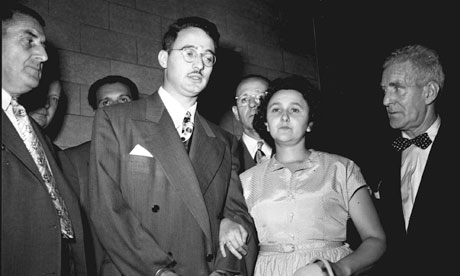
ROSENBERG CHILDREN SPEAK OF THEIR PARENTS EXECUTION 60 YEARS AGO TODAY June 19, 2013 at 06:04 (Activism<http://desertpeace.wordpress.com/category/activism/> , Espionage <http://desertpeace.wordpress.com/category/espionage/>, History<http://desertpeace.wordpress.com/category/history/> ) Sixty years ago today, Ethel and Julius Rosenberg were legally murdered by the United States government. Today, their children see that horror as a force for good *** *Today, the US government asserts that danger from the international terrorist conspiracy and their weapons of mass destruction justifies massive surveillance, indefinite detention and even torture. Authorities say we must guard national secrets even more securely to avoid destruction. Today, the issues raised by the Rosenberg case resonate from the Oval Office of the White House to Bradley Manning, who is being tried under the Espionage Act of 1917, as were Ethel and Julius.* * *Out of the horror of the Rosenbergs executions, a force for good* Our relatives trial for espionage marked a nadir of cold war paranoia. Now, 60 years on, we have our constructive revenge Robert Meeropol and Jenn Meeropol * [image: Julius-and-Ethel-Rosenber-007]<http://desertpeace.files.wordpress.com/2013/06/julius-and-ethel-rosenber-007.jpg>
Julius and Ethel Rosenberg during their trial for espionage in New York in 1951. The couple were executed in 1953 after being found guilty of spying for the Soviet Union. Photograph: AP * We are Robert and Jenn Meeropol, son and granddaughter of Ethel and Julius Rosenberg<http://www.history.com/this-day-in-history/julius-and-ethel-rosenberg-executed>. We are acutely aware of the political lessons to be drawn from the conviction and execution of the Rosenbergs at the height of the McCarthy period. The charge was conspiracy to commit espionage<http://www.guardian.co.uk/world/espionage>, but our family members were presented as traitors who gave the Soviet Union the secret of the atomic bomb. The US government used the Rosenberg case to attempt to prove to the public that the international communist conspiracy threatened the American way of life, and claimed fighting communism required that human rights and civil liberties take a back seat to national security. Today, the US government asserts that danger from the international terrorist conspiracy and their weapons of mass destruction justifies massive surveillance, indefinite detention and even torture. Authorities say we must guard national secrets even more securely to avoid destruction. Today, the issues raised by the Rosenberg case resonate from the Oval Office of the White House to Bradley Manning, who is being tried under the Espionage Act of 1917, as were Ethel and Julius. But there are other, more personal, lessons to draw as well. >From the ages of three to seven, I, Robert, lived a nightmare. After my parents arrest, relatives were too frightened to take my brother Michael and me into their homes, so we were dumped in a shelter. After the executions, we were thrown out of the New Jersey state school system when local residents found out about our parentage. In 1954, in a politically motivated attempt to separate us from Rosenberg supporters, Michael and I were seized by New York City police from the home of our prospective adoptive parents and placed in an orphanage. But Abel and Anne Meeropol won the ensuing custody battle, our last name was changed to theirs, and we dropped from public sight for almost two decades. During those growing-up years, I dreamed of revenge. I, Jenn, was two years old when my father and uncle decided to reclaim their heritage by mounting a public campaign to force the US government to release secret files relating to the Rosenbergs case. My dad worried that his actions might expose me to trauma and fear, similarly to his childhood experience. I was safe in my family but profoundly aware of what had happened to my grandparents. I grew up with sadness and anger about what was done to Ethel and Julius, as well as a fierce pride in who they were and what they stood for. As I entered college in 1990, my father started the Rosenberg Fund for Children (RFC) <http://www.rfc.org/>, a public foundation to help children<http://www.guardian.co.uk/society/children> who are experiencing similar nightmares to what he lived through as a child. The RFC is a way to transform the destruction placed on his family into a positive force to benefit a new generation of families, the way a community of support rallied to aid him and his brother after their parents were killed. As a young adult, I watched the RFC help hundreds of children who grew up with political targeting in their families. I realized that they probably endured a similar stew of emotions sorrow and anger, pride and obligation to my dads, and my own. Growing up, I also dreamed of getting retribution from the forces that killed my grandparents before I could know them. I joined the RFCs staff in 2007 as granting coordinator. Now, during this 60th anniversary year of my grandparents execution, my father will retire as executive director and I will take over the helm of the organization he founded. We both think of the RFC as our revenge our constructive revenge. When bad things happen to people, to families and communities, it is natural to want to strike back, to settle the score. The wish to avoid being a passive victim is healthy, but revenge itself is usually destructive. For us, harnessing our desire to strike back and focusing it on creating a positive response is personally satisfying, and our contribution to making a positive difference in the world. 19TH JUNE 1953 THE EXECUTION OF JULIUS AND ETHEL ROSENBERG Ethel and Julius Rosenberg Today marks the 60th anniversary of the execution of Julius and Ethel Rosenberg in the electric chair at New Yorks Sing Sing prison. Convicted of conspiring to pass atomic secrets to the Soviet Union, the Rosenbergs who maintained their innocence to the bitter end were the only US citizens to be executed under the Espionage Act, in what has been described as the most controversial death sentence in US history. The spectacular trial and unprecedented severe sentencing of Julius and Ethel Rosenberg during the height of Cold War hysteria shook America to its core, and generated worldwide condemnation. Jean-Paul Sartre denounced the executions as a legal lynching that has covered a whole nation with blood. Over half a century later, disturbing truths about the Rosenberg case and the American governments complicity in a frame-up remain unresolved. Julius and Ethel Rosenberg were a devoted couple with two young sons. Growing up in a poor Jewish neighbourhood of New Yorks Lower East Side, theyd both regularly witnessed the horrors of pre-war American social injustice: evictions of families from tenements onto the streets, soup-kitchen queues extending for blocks, malnourished children forced to eat out of garbage cans. *You had to be dead from the neck up to not feel radical,* said a friend of the couple, speaking about the era. And for such highly politicised radicals as the Rosenbergs, communism presented a viable alternative. But just how far did their admiration for the Soviet Union extend? In July 1950, the Rosenbergs were arrested on suspicion of passing information to the Soviets. On 6th March 1951, the couple and co-conspirator Morton Sobell went on trial in New York City for conspiracy to commit espionage during WW2 (when the Soviets were still Americas wartime allies). The principal prosecution witness against the Rosenbergs was Ethels younger brother, David Greenglass, who confessed to spying and agreed to testify in exchange for promises that his wife would not be charged and he would be spared the death penalty in his own trial. Greenglass had worked on the Manhattan atom bomb project as a low-level engineer without any access to or knowledge of the weapons intricacies. He was allegedly the source of information on the bombs secret, having provided an amateur and inaccurate drawing of the bomb to Julius on the back of a Jell-O packet. He would later admit hed lied on the witness stand. According to the federal prosecutor, another witness, Harry Gold, the confessed American accomplice of British spy Klaus Fuchs, was the necessary link in the chain that points indisputably to the guilt of the Rosenbergs. Gold would also later confess: I lied so often its a wonder steam didnt come out of my ears. The Rosenbergs were found guilty on 29th March 1951. One week later, Judge Irving R. Kaufman sentenced the couple to death declaring their crime to be worse than murder, and blaming them personally for 50,000 casualties of the Korean War. The appointment of a biased judge, the grooming of witnesses by the FBI, the secret and illegal meetings between the chief prosecutor and Judge Kaufman, perjured testimonies, fabricated evidence and the pervading demagogic McCarthyism all point to a trial so monumentally corrupt as to amount to a frame-up. But it was the severity of the death sentence that shocked the world. Convicted British spies Alan Nunn May and Klaus Fuchs received ten and fourteen years respectively. The Rosenbergs co-conspirators also received comparatively light sentences. Reviewing the case in 1966, law professor Alexander M. Bickel wrote, The Rosenberg case is a ghastly and shameful episode. There is first of all the death sentence, and secondly the death sentence, and thirdly the death sentence, and then again the death sentence. The imposition of the death sentence, however, was itself the tragic result of a failed prosecution strategy. At least a month before the trial began, the Justice Department discussed the usefulness of the death penalty as a device to force the Rosenbergs to confess and possibly implicate others. The Rosenbergs called their bluff. Even though a confession from one could have saved the other, they both refused to admit guilt or blow the whistle on anyone else. So, were the Rosenbergs spies? Recent declassified documents of the Soviets Venona Project certainly point a guilty finger at Julius. But the same de-coded information proves that Ethel played no role at all. Was Julius responsible for passing the atomic secret to the Soviet Union, thus perpetrating the Korean War no less? According to the Soviets, the information received through Julius was of virtually no use. Their own scientists were brilliant enough to need not rely on an amateur drawing on the back of a Jell-O packet. After all these years, what remains certain is this: the Rosenbergs were not guilty as charged. Their conviction was based upon perjured testimony and fabricated evidence; government agents and agencies orchestrated a frame-up which resulted in their execution. The sham trial and severe sentencing of Julius and Ethel Rosenberg in a country baying for commie blood has been likened to a witch hunt. Remembering the Rosenbergs on the occasion of the 50th anniversary of their execution, *the New York Times* wrote: [The case] still haunts American history, reminding us of the injustice that can be done when a nation gets caught up in hysteria. Indeed, to all those who wonder how the German people could have collectively fallen under the spell of Adolf Hitler, we need only look back at America in the grip of McCarthyism for similar evidence of national mass psychosis. http://www.onthisdeity.com/19th-june-1953-%E2%80%93%C2%A0the-execution-of-julius-and-ethel-rosenberg/ [Non-text portions of this message have been removed] ------------------------------------ --------------------------------------------------------------------------- LAAMN: Los Angeles Alternative Media Network --------------------------------------------------------------------------- Unsubscribe: <mailto:[email protected]> --------------------------------------------------------------------------- Subscribe: <mailto:[email protected]> --------------------------------------------------------------------------- Digest: <mailto:[email protected]> --------------------------------------------------------------------------- Help: <mailto:[email protected]?subject=laamn> --------------------------------------------------------------------------- Post: <mailto:[email protected]> --------------------------------------------------------------------------- Archive1: <http://www.egroups.com/messages/laamn> --------------------------------------------------------------------------- Archive2: <http://www.mail-archive.com/[email protected]> --------------------------------------------------------------------------- Yahoo! Groups Links <*> To visit your group on the web, go to: http://groups.yahoo.com/group/laamn/ <*> Your email settings: Individual Email | Traditional <*> To change settings online go to: http://groups.yahoo.com/group/laamn/join (Yahoo! ID required) <*> To change settings via email: [email protected] [email protected] <*> To unsubscribe from this group, send an email to: [email protected] <*> Your use of Yahoo! Groups is subject to: http://docs.yahoo.com/info/terms/