http://www.marxist.com/karl-marx-130-years.htm
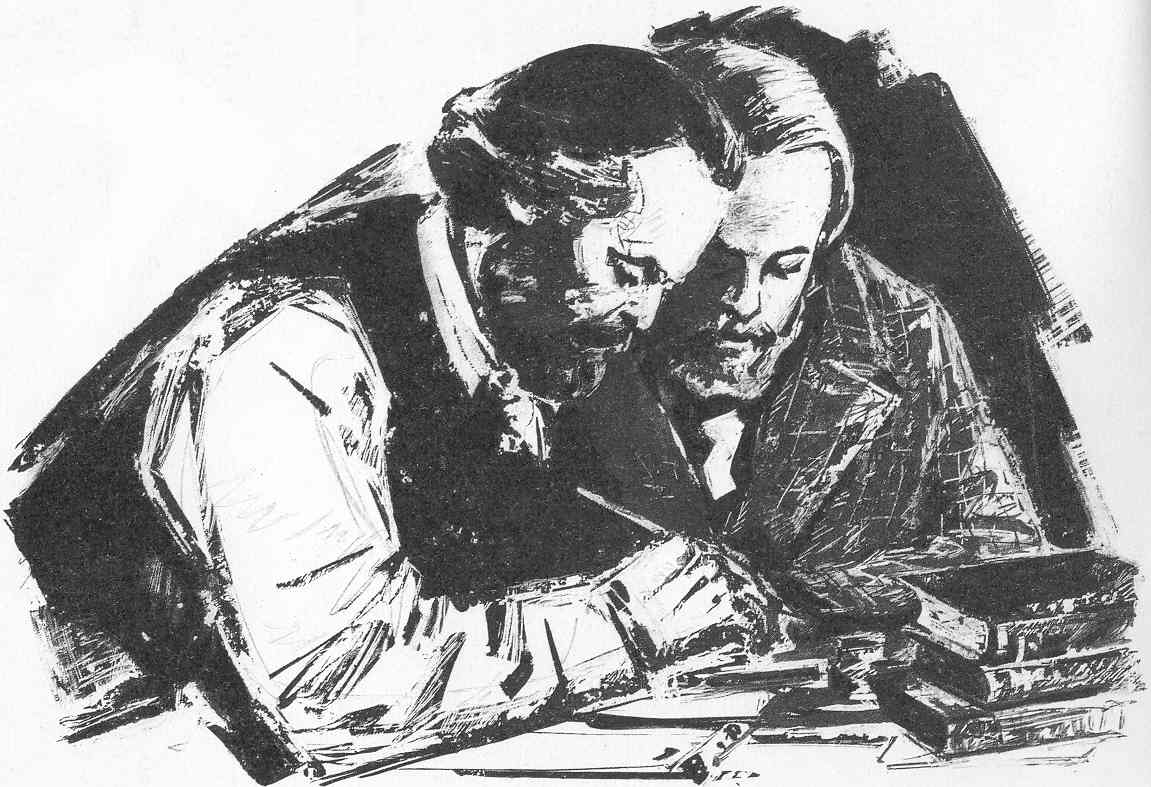
The Ideas of Karl Marx - Part one<http://www.marxist.com/karl-marx-130-years.htm> Written by Alan WoodsFriday, 21 June 2013 [image: Print] <http://www.marxist.com/karl-marx-130-years/print.htm>[image: E-mail]<http://www.marxist.com/component/option,com_mailto/link,d7e61e5b879e33db39184d8f77dfc47b2a3207ad/tmpl,component/> - - - The ideas of Marx have never been more relevant than they are today and are reflected in the thirst for Marxist theory at the present time. In this three part article, Alan Woods will deal with the main ideas of Karl Marx and their relevance to the crisis we're passing through today. [This article was written for the 4th Issue of the *In Defence of Marxism*magazine which was a special edition to mark the 130th anniversary of the death of Karl Marx in 1883. ] [image: Marx and Engels]<http://www.marxist.com/images/stories/marx-engels.jpg>It is 130 years since the death of Karl Marx. But why should we commemorate a man who died in 1883? In the early 1960s the then Labour Prime Minister Harold Wilson declared that we must not look for solutions in Highgate cemetery. And who can disagree with that? In the aforementioned cemetery one can only find old bones and dust and a rather ugly stone monument. However, when we speak of the relevance of Karl Marx today we refer not to cemeteries but to ideasideas that have withstood the test of time and have now emerged triumphant, as even some of the enemies of Marxism have been reluctantly forced to accept. The economic collapse of 2008 showed who was outdated, and it was certainly not Karl Marx. For decades the economists never tired of repeating that Marxs predictions of an economic downturn were totally outdated. They were supposed to be ideas of the 19th century, and those who defended them were dismissed as hopeless dogmatists. But it now turns out that it is the ideas of the defenders of capitalism that must be consigned to the rubbish bin of history, while Marx has been completely vindicated. Not so long ago, Gordon Brown confidently proclaimed the end of boom and bust. After the crash of 2008 he was forced to eat his words. The crisis of the euro shows that the bourgeoisie has no idea how to solve the problems of Greece, Spain and Italy which in turn threaten the future of the European common currency and even the EU itself. This can easily be the catalyst for a new collapse on a world scale, which will be even deeper than the crisis of 2008. Even some bourgeois economists are being forced to accept what is becoming increasingly evident: that capitalism contains within itself the seeds of its own destruction; that it is an anarchic and chaotic system characterised by periodic crises that throw people out of work and cause social and political instability. The thing about the present crisis was that it was not supposed to happen. Until recently most of the bourgeois economists believed that the market, if left to itself, was capable of solving all the problems, magically balancing out supply and demand (the efficient market hypothesis) so that there could never be a repetition of the crash of 1929 and the Great Depression. Marxs prediction of a crisis of overproduction had been consigned to the dustbin of history. Those who still adhered to Marxs view that the capitalist system was riven with insoluble contradictions and contained within itself the seeds of its own destruction were looked upon as mere cranks. Had the fall of the Soviet Union not finally demonstrated the failure of communism? Had history not finally ended with the triumph of capitalism as the only possible socio-economic system? But in the space of 20 years (not a long period in the annals of human society) the wheel of history has turned 180 degrees. Now the erstwhile critics of Marx and Marxism are singing a very different tune. All of a sudden, the economic theories of Karl Marx are being taken very seriously indeed. A growing number of economists are poring over the pages of Marxs writings, hoping to find an explanation for what has gone wrong. Second Thoughts In July 2009, after the start of the recession *The Economist* held a seminar in London to discuss the question: What is wrong with Economics? This revealed that for a growing number of economists mainstream theory has no relevance. Nobel Prize winner, Paul Krugman made an astonishing admission. He said the last 30 years development in macroeconomic theory has, at best, been spectacularly useless or, at worst, directly harmful. This judgement is a fitting epitaph for the theories of bourgeois economics. Now that events have knocked just a little sense into the heads of at least some bourgeois thinkers, we are seeing all kinds of articles that grudgingly recognise that Marx was right after all. Even the Vaticans official newspaper,*LOsservatore Romano*, published an article in 2009 praising Marxs diagnosis of income inequality, which is quite an endorsement for the man who declared religion to be the opium of the people. *Das Kapital* is now a best seller in Germany. In Japan it has been published in a manga version. George Magnus, a senior economic analyst at UBS bank, wrote an article with the intriguing title: Give Karl Marx a Chance to Save the World Economy. Switzerland-based UBS is a pillar of the financial establishment, with offices in more than 50 countries and over $2 trillion in assets. Yet in an essay for Bloomberg View, Magnus wrote that todays global economy bears some uncanny resemblances to what Marx foresaw. In his article he starts by describing policy makers struggling to understand the barrage of financial panics, protests and other ills afflicting the world and suggests that they would do well to study the works of a long-dead economist, Karl Marx. Consider, for example, Marxs prediction of how the inherent conflict between capital and labor would manifest itself. As he wrote in *Das Kapital *, companies pursuit of profits and productivity would naturally lead them to need fewer and fewer workers, creating an industrial reserve army of the poor and unemployed: Accumulation of wealth at one pole is, therefore, at the same time accumulation of misery. He continues: The process he [Marx] describes is visible throughout the developed world, particularly in the U.S. Companies efforts to cut costs and avoid hiring have boosted U.S. corporate profits as a share of total economic output to the highest level in more than six decades, while the unemployment rate stands at 9.1 percent and real wages are stagnant. U.S. income inequality, meanwhile, is by some measures close to its highest level since the 1920s. Before 2008, the income disparity was obscured by factors such as easy credit, which allowed poor households to enjoy a more affluent lifestyle. Now the problem is coming home to roost. *The Wall Street Journal* carried an interview with the well-known economist Dr. Nouriel Roubini, known to his fellow economists as Dr. Doom because of his prediction of the 2008 financial crisis. There is a video of this extraordinary interview, which deserves to be studied carefully because it shows the thinking of the most far-sighted strategists of Capital. Roubini argues that the chain of credit is broken, and that capitalism has entered into a vicious cycle where excess capacity (overproduction), falling consumer demand, high levels of debt all breed a lack of confidence in investors that in turn will be reflected in sharp falls on the stock exchange, falling asset prices and a collapse in the real economy. Like all the other economists, Roubini has no real solution to the present crisis, except more monetary injections from central banks to avoid another meltdown. But he frankly admitted that monetary policy alone will not be enough, and business and governments are not helping. Europe and the United States are implementing austerity programs to try to fix their debt-ridden economies, when they should be introducing more monetary stimulus, he said. His conclusions could not be more pessimistic: Karl Marx got it right, at some point capitalism can destroy itself, said Roubini. *We thought markets worked. Theyre not working.* (My emphasis, AW) The phantom of Marxism is still haunting the bourgeoisie a hundred and thirty years after Marxs mortal remains were laid to rest. But what is Marxism? To deal properly with all aspects of Marxism in the space of one article is an impossible task. We therefore confine ourselves to a general, and therefore sketchy account in the hope that it will encourage the reader to study Marxs writings themselves. After all, nobody has ever expounded Marxs ideas better than Marx himself. Broadly speaking, his ideas can be split into three distinct yet interconnected partswhat Lenin called the three sources and three component parts of Marxism. These generally go under the headings of Marxist economics, dialectical materialism and historical materialism. Each of these stands in a dialectical relation to each other and cannot be understood in isolation from one another. A good place to begin is the founding document of our movement that was written on the eve of the European Revolutions of 1848. It is one of the greatest and most influential works in history. *The Communist Manifesto* The immense majority of the books written one and a half centuries ago are today merely of historical interest. But what is most striking about the*Communist Manifesto* is the way in which it anticipates the most fundamental phenomena which occupy our attention on a world scale at the present time. It is really extraordinary to think that a book written in 1847 can present a picture of the world of the 21st century so vividly and truthfully. In point of fact, the *Manifesto* is even truer today than when it first appeared in 1848. Let us consider one example. At the time when Marx and Engels were writing, the world of the big multinational companies was still the music of a very distant future. Despite this, they explained how free enterprise and competition would inevitably lead to the concentration of capital and the monopolisation of the productive forces. It is frankly comical to read the statements made by the defenders of the market concerning Marxs alleged mistake on this question, when in reality it was precisely one of his most brilliant and accurate predictions. During the 1980s it became fashionable to claim that small is beautiful. This is not the place to enter into a discussion concerning the relative aesthetics of big, small or medium sizes, about which everyone is entitled to hold an opinion. But it is an absolutely indisputable fact that the process of concentration of capital foreseen by Marx has occurred, is occurring, and indeed has reached unprecedented levels in the course of the last ten years. In the United States, where the process may be seen in a particularly clear form, the Fortune 500 corporations accounted for 73.5 percent of total GDP output in 2010. If these 500 companies formed an independent country, it would be the worlds second largest economy, second only to the United States itself. In 2011, these 500 firms generated an all-time record of $824.5 billion in profitsa 16 percent jump from 2010. On a world scale, the 2000 biggest companies now account for $32 trillion in revenues, $2.4 trillion in profits, $138 trillion in assets and $38 trillion in market value, with profits rising an astonishing 67 percent between 2010 and 2011. When Marx and Engels wrote the *Manifesto*, there was no empirical evidence for his claims. On the contrary, the capitalism of his time was based entirely on small businesses, the free market and competition. Today, the economy of the entire capitalist world is dominated by a handful of giant transnational monopolies such as Exxon and Walmart. These behemoths possess funds that far exceed the national budgets of many states. The predictions of the*Manifesto* have been realised even more clearly and completely than Marx himself could ever have dreamed of. The defenders of capitalism cannot forgive Marx because, at a time when capitalism was in the stage of youthful vigour, he was able to foresee the causes of its senile degeneration. For decades they strenuously denied his prediction of the inevitable process of the concentration of capital and the displacement of small businesses by big monopolies. The process of the centralisation and concentration of capital has reached proportions hitherto undreamed of. The number of take-overs has acquired the character of an epidemic in all the advanced industrialised nations. In many cases, such take-overs are intimately connected with all kinds of shady practicesinsider dealing, falsification of share prices, and other types of fraud, larceny and swindling, as the scandal over the manipulation of the Libor interest rate by Barclays and other big banks has revealed.??This concentration of capital does not signify a growth in production, but quite the contrary. In every case, the intention is not to invest in new plant and machinery but to close existing factories and offices and sack large numbers of workers in order to increase profit margins without increasing production. Just take the recent fusion of two big Swiss banks, immediately followed by the loss of 13,000 jobs. Globalisation and Inequality Let us proceed to the next important prediction made by Marx. Already in 1847, Marx explained that the development of a global market renders impossible all narrowness and national individualism. Every countryeven the largest and most powerfulis now totally subordinate to the whole world economy, which decides the fate of peoples and nations. This brilliant theoretical anticipation shows, better than anything else, the immeasurable superiority of the Marxist method. Globalisation is generally regarded as a recent phenomenon. Yet the creation of a single global market under capitalism was long ago predicted in the pages of the *Manifesto*. The crushing domination of the world market is now the most decisive fact of our epoch. The enormous intensification of the international division of labour since the Second World War has demonstrated the correctness of Marxs analysis in an almost laboratory fashion. Despite this, strenuous efforts have been made to prove that Marx was wrong when he spoke of the concentration of capital and therefore the process of polarisation between the classes. These mental gymnastics corresponds to the dreams of the bourgeoisie to rediscover the lost golden age of free enterprise. Similarly, a decrepit old man longs in his senility for the lost days of his youth. Unfortunately, there is not the slightest chance of capitalism recovering its youthful vigour. It has long ago entered its final phase: that of monopoly capitalism. The day of the small business, despite the nostalgia of the bourgeoisie, has been relegated to the past. In all countries the big monopolies, closely related to banking and enmeshed with the bourgeois state, dominate the life of society. The polarisation between the classes continues uninterrupted, and tends to accelerate. Let us take the situation in the USA. The richest 400 families in the U.S. have as much wealth as the bottom 50 percent of the population. The six individual Wal-Mart heirs alone are worth more than the bottom 30 percent of Americans combined. The poorest 50 percent of Americans own just 2.5 percent of the countrys wealth. The richest one per cent of the US population increased its share of the national income from 17.6 per cent in 1978 to an astonishing 37.1 per cent in 2011. During the past 30 years the gap between the incomes of the rich and the poor has been steadily widening into a yawning abyss. In the industrialised West the average income of the richest ten per cent of the population is about nine times that of the poorest ten per cent. That is an enormous difference. And figures published by the OECD show that the disparity which began in the US and UK has spread to countries such as Denmark, Germany and Sweden, which have traditionally had low inequality. The obscene wealth of the bankers is now a public scandal. But this phenomenon is not confined to the financial sector. In many cases, directors of large companies earn 200 times more than their lowest-paid workers. This excessive difference has already provoked growing resentment, which is turning to fury that spills over onto the streets in one country after another. The growing tension is reflected in strikes, general strikes, demonstrations and riots. It is reflected in elections by protest votes against governments and all the existing parties, as we saw recently in the Italian general election. A *Time* magazine poll showed that 54% have a favourable view of the #Occupy movement, 79% think the gap between rich and poor has grown too large, 71% think CEOs of financial institutions should be prosecuted, 68% think the rich should pay more taxes, only 27% have a favourable view of the Tea Party movement (33% unfavourable). Of course, it is too early to speak of a revolution in the USA. But it is clear that the crisis of capitalism is producing a growing mood of criticism among broad layers of the population. There is a ferment and a questioning of capitalism that were not there before. The Scourge of Unemployment In the *Communist Manifesto* we read: And here it becomes evident, that the bourgeoisie is unfit any longer to be the ruling class in society, and to impose its conditions of existence upon society as an over-riding law. It is unfit to rule because it is incompetent to assure an existence to its slave within his slavery, because it cannot help letting him sink into such a state, that it has to feed him, instead of being fed by him. Society can no longer live under this bourgeoisie. The words of Marx and Engels quoted above have become literally true. There is a growing feeling among all sections of society that our lives are dominated by forces beyond our control. Society is gripped by a gnawing sense of fear and uncertainty. The mood of insecurity has become generalised to practically the whole of society. The kind of mass unemployment we are now experiencing is far worse than anything Marx foresaw. Marx wrote of the reserve army of labour: that is to say, a pool of labour that can be used to keep down wages and acts as a reserve when the economy recovers from a slump. But the kind of unemployment we now see is not the reserve army of which Marx spoke, which, from a capitalist point of view played a useful role. This is not the kind of cyclical unemployment which workers are well acquainted with from the past and which would rise in a recession only to disappear when the economy picked up again. It is permanent, structural, organic unemployment, which does not noticeably diminish even when there is a boom. It is a dead weight that acts as a colossal drag on productive activity, a symptom that the system has reached a blind alley. A decade before the crisis of 2008, according to the United Nations, world unemployment was approximately 120 millions. By 2009, the International Labour Organisation put the figure at 198 millions, and expects it to reach 202 million in 2013. However, even these figures, like all the official statistics of unemployment, represent a serious understatement of the real situation. If we include the enormous number of men and women who are compelled to work in all kinds of marginal jobs, the real figure of world unemployment and underemployment would not be less than 1,000 million. Despite all the talk of economic recovery, economic growth in Germany, the former economic powerhouse of Europe, has slowed down almost to zero, as has France. In Japan too the economy is grinding to a halt. Quite apart from the misery and suffering caused to millions of families, from an economic point of view, this represents a staggering loss of production and waste on a colossal scale. Contrary to the illusions of the labour leaders in the past, mass unemployment has returned and has spread all over the world like a cancer gnawing at the bowels of society. The crisis of capitalism has its direst effects among the youth. Unemployment among young people is soaring everywhere. This is the reason for the mass student protests and riots in Britain, for the movement of the *indignados* in Spain, the occupations of the schools in Greece and also for the uprisings in Tunisia and Egypt, where about 75% of the youth are unemployed. The number of unemployed in Europe is constantly increasing. The figure for Spain is nearly 27 per cent, while youth unemployment stands at an incredible 55 per cent, while in Greece no fewer than 62 per cent of the youthtwo in every threeare jobless. A whole generation of young people is being sacrificed on the altar of Profit. Many who looked for salvation to higher education have found that this avenue is blocked. In Britain, where higher education used to be free, now young people find that in order to acquire the skills they need, they will have to go into debt. At the other end of the age scale, workers approaching retirement find that they must work longer and pay more for lower pensions that will condemn many to poverty in old age. For young and old alike, the prospect facing most people today is a lifetime of insecurity. All the old bourgeois hypocrisy about morality and family values has been exposed as hollow. The epidemic of unemployment, homelessness, crushing debt and extreme social inequality that has turned a whole generation into pariahs has undermined the family and created a nightmare of systemic poverty, hopelessness, degradation and despair. A Crisis of Overproduction In Greek mythology there was a character called Procrustes who had a nasty habit of cutting off the legs, head and arms of his guests to make them fit into his infamous bed. Nowadays the capitalist system resembles the bed of Procrustes. The bourgeoisie is systematically destroying the means of production in order to make them fit into the narrow limits of the capitalist system. This economic vandalism resembles a policy of slash and burn on a vast scale. George Soros likens it to the kind of smashing ball used to demolish tall buildings. But it is not only buildings that are being destroyed but whole economies and states. The slogan of the hour is austerity, cuts and falling living standards. In every country the bourgeoisie raises the same war cry: We must cut public expenditure! Every government in the capitalist world, whether right or left is in reality pursuing the same policy. This is not the result of the whims of individual politicians, of ignorance or bad faith (although there is plenty of this also) but a graphic expression of the blind alley in which the capitalist system finds itself. This is an expression of the fact that the capitalist system is reaching its limits and is unable to develop the productive forces as it did in the past. Like Goethes Sorcerers Apprentice, it has conjured up forces it cannot control. But by slashing state expenditure, they are simultaneously reducing demand and cutting the whole market, just at a time when even the bourgeois economists admit that there is a serious problem of overproduction (overcapacity) on a world scale. Let us take just one example, the automobile sector. This is fundamental because it also involves many other sectors, such as steel, plastic, chemicals and electronics. The global excess capacity of the automobile industry is approximately thirty percent. This means that Ford, General Motors, Fiat, Renault, Toyota and all the others could close one third of their factories and lay off one third of their workers tomorrow, and they would still not be able to sell all the vehicles they produce at what they consider to be an acceptable rate of profit. A similar position exists in many other sectors. Unless and until this problem of excess capacity is resolved, there can be no real end to the present crisis. The dilemma of the capitalists can be easily expressed. If Europe and the USA are not consuming, China cannot produce. If China is not producing at the same pace as before, countries like Brazil. Argentina and Australia cannot continue to export their raw materials. The whole world is inseparably interlinked. The crisis of the euro will affect the US economy, which is in a very fragile state, and what happens in the USA will have a decisive effect on the entire world economy. Thus, globalisation manifests itself as a global crisis of capitalism. Alienation With incredible foresight, the authors of the *Manifesto* anticipated the conditions which are now being experienced by the working class in all countries. Owing to the extensive use of machinery and to division of labour, the work of the proletarians has lost all individual character, and, consequently, all charm for the workman. He becomes an appendage of the machine, and it is only the most simple, most monotonous, and most easily acquired knack, that is required of him. Hence, the cost of production of a workman is restricted, almost entirely, to the means of subsistence that he requires for his maintenance, and for the propagation of his race. But the price of a commodity, and therefore also of labour, is equal to the cost of production. In proportion, therefore, as the repulsiveness of the work increases, the wage decreases. Nay more, in proportion as the use of machinery and division of labour increases, in the same proportion the burden of toil also increases, whether by prolongation of the working hours, by increase of the work exacted in a given time or by increased speed of the machinery, etc. Today the USA occupies the same position that Britain held in Marxs daythat of the most developed capitalist country. Thus, the general tendencies of capitalism are expressed there in their clearest form. Over the last 30 years, CEO pay in the USA has grown by 725%, while worker pay has risen by just 5.7%. These CEOs now make an average of 244 times more than their employees. The current federal minimum wage is $7.25 per hour. According to the Center for Economic Policy Research, if the minimum wage had kept up with worker productivity, it would have reached $21.72 in 2012. If inflation is taken into account, median wages for male American workers are actually lower today than they were in 1968. In this way, the present boom has been largely at the expense of the working class. While millions are compelled to eke out a miserable existence of enforced inactivity, millions of others are forced to have two or even three jobs, and often work 60 hours or more per week with no overtime pay benefits. 85.8 percent of males and 66.5 percent of females work more than 40 hours per week. According to the International Labour Organisation, Americans work 137 more hours per year than Japanese workers, 260 more hours per year than British workers, and 499 more hours per year than French workers. Based on data from the US Bureau of Labor Statistics BLS, the average productivity per American worker has risen 400 percent since 1950. In theory, this means that in order to achieve the same standard of living a worker should only have to work just one quarter of the average working week in 1950, or 11 hours per week. Either that, or the standard of living in theory should have risen by four times. On the contrary, the standard of living has decreased dramatically for the majority, while work-related stress, injuries and disease are increasing. This is reflected in an epidemic of depression, suicides, divorce, child and spousal abuse, mass shootings and other social ills. The same situation exists in Britain, where under the Thatcher government 2.5 million jobs were destroyed in industry, and yet the same level of production has been maintained as in 1979. This has been achieved, not through the introduction of new machinery but through the over-exploitation of British workers. In 1995, Kenneth Calman, Director General of Health, warned that the lost of life time employment has unleashed an epidemic of stress related illnesses. The Class Struggle Marx and Engels explained in the *Communist Manifesto* that a constant factor in all of recorded history is that social development takes place through the class struggle. Under capitalism this has been greatly simplified with the polarisation of society into two great antagonistic classes, the bourgeoisie and the proletariat. The tremendous development of industry and technology over the last 200 years has led to the increasing the concentration of economic power in a few hands. The history of all hitherto existing society is the history of class struggles, says the *Manifesto* in one of its most celebrated phrases. For a long time it seemed to many that this idea was outmoded. In the long period of capitalist expansion that followed the Second World War, with full employment in the advanced industrial economies, rising living standards and reforms (remember the Welfare State?), the class struggle did indeed seem to be a thing of the past. Marx predicted that the development of capitalism would lead inexorably to the concentration of capital, an immense accumulation of wealth on the one hand and an equal accumulation of poverty, misery and unbearable toil at the other end of the social spectrum. For decades this idea was rubbished by the bourgeois economists and university sociologists who insisted that society was becoming ever more egalitarian, that everyone was now becoming middle class. Now all these illusions have been dispelled. The argument, so beloved of bourgeois sociologists, that the working class has ceased to exist has been stood on its head. In the last period important layers of the working population who previously considered themselves to be middle class have been proletarianised. Teachers, civil servants, bank employees and so on have been drawn into the ranks of the working class and the labour movement, where they make up some of the most militant sections. The old arguments that everybody can advance and we are all middle class have been falsified by events. In Britain, the US and many other developed countries over the past 20 or 30 years, the opposite has been happening. Middle-class people used to think life unfolded in an orderly progression of stages in which each is a step up from the last. That is no longer the case. Job security has ceased to exist, the trades and professions of the past have largely disappeared and life-long careers are barely memories. The ladder has been kicked away and for most people a middle-class existence is no longer even an aspiration. A dwindling minority can count on a pension on which they could comfortably live, and few have significant savings. More and more people live from day to day, with little idea of what the future may bring. If people have any wealth, it is in their houses, but with the contraction of the economy house prices have fallen in many countries and may be stagnant for years. The idea of a property-owning democracy has been exposed as a mirage. Far from being an asset to help fund a comfortable retirement, home ownership has become a heavy burden. Mortgages must be paid, whether you are in work or not. Many are trapped in negative equity, with huge debts that can never be paid. There is a growing generation of what can only be described as debt slaves. This is a devastating condemnation of the capitalist system. However, this process of proletarianisation means that the social reserves of reaction have been sharply reduced as a big section of white collar workers moves closer to the traditional working class. In the recent mass mobilisations, sections that in the past would never have dreamt of striking or even joining a union, such as teachers and civil servants, were in the front line of the class struggle. Idealism or Materialism? The idealist method sets out from what people think and say about themselves. But Marx explained that ideas do not fall from the sky, but reflect more or less accurately, objective situations, social pressures and contradictions beyond the control of men and women. But history does not unfold as a result of free will or conscious desires of the great man, kings, politicians or philosophers. On the contrary, the progress of society depends on the development of the productive forces, which is not the product of conscious planning, but develops behind the backs of men and women. For the first time Marx placed socialism on a firm theoretical basis. A scientific understanding of history cannot be based on the distorted images of reality floating like pale and fantastic ghosts in the minds of men and women, but on real social relations. That means beginning with a clarification of the relationship between social and political forms and the mode of production at a given stage of history. This is precisely what is called the historical materialist method of analysis. Some people will feel irritated by this theory which seems to deprive humankind of the role of protagonists in the historical process. In the same way, the Church and its philosophical apologists were deeply offended by the claims of Galileo that the Sun, not the Earth, was at the centre of the Universe. Later, the same people attacked Darwin for suggesting that humans were not the special creation of God, but the product of natural selection. Actually, Marxism does not at all deny the importance of the subjective factor in history, the conscious role of humankind in the development of society. Men and women make history, but do not do it entirely in accord with their free will and conscious intentions. In Marxs words: History does nothing, it possesses no immense wealth, it wages no battles. It is man, real, living man who does all that, who possesses and fights; history is not, as it were, a person apart, using man as a means to achieve its own aims; history is nothing but the activity of man pursuing his aims. (Marx and Engels, *The Holy Family*, Chapter VI) All that Marxism does is to explain the role of the individual as part of a given society, subject to certain objective laws and, ultimately, as the representative of the interests of a particular class. Ideas have no independent existence, nor own historical development. Life is not determined by consciousness, Marx writes in *The German Ideology*, but consciousness by life. The ideas and actions of people are conditioned by social relations, the development of which does not depend on the subjective will of men and women but takes place according to definite laws which, in the last analysis, reflect the needs of the development of the productive forces. The interrelations between these factors constitute a complex web that is often difficult to see. The study of these relations is the basis of the Marxist theory of history. Let us cite one example. At the time of the English Revolution, Oliver Cromwell fervently believed that he was fighting for the right of each individual to pray to God according to his conscience. But the further march of history proved that the Cromwellian Revolution was the decisive stage in the irresistible ascent of the English bourgeoisie to power. The concrete stage of the development of the productive forces in 17th Century England permitted no other outcome. The leaders of the Great French Revolution of 1789-93 fought under the banner of Liberty, Equality and Fraternity. They believed they were fighting for a regime based on the eternal laws of Justice and Reason. However, regardless of their intentions and ideas, the Jacobins were preparing the way for the rule of the bourgeoisie in France. Again, from a scientific standpoint, no other result was possible at that point of social development. >From the standpoint of the labour movement Marxs great contribution was that he was the first to explain that socialism is not just a good idea, but the necessary result of the development of society. Socialist thinkers before Marxthe utopian socialistsattempted to discover universal laws and formulae that would lay the basis for the triumph of human reason over the injustice of class society. All that was necessary was to discover that idea, and the problems would be solved. This is an idealist approach. Unlike the Utopians, Marx never attempted to discover the laws of society in general. He analysed the law of movement of a particular society, capitalist society, explaining how it arose, how it evolved and also how it necessarily ceases to exist at a given moment. He performed this huge task in the three volumes of Capital. Marx and Darwin Charles Darwin, who was an instinctive materialist, explained the evolution of species as a result of the effects of the natural environment. Karl Marx explained the development of humankind from the development of the artificial environment we call society. The difference lies, on the one hand, in the enormously complicated character of human society compared to the relative simplicity of nature and, secondly, in the greatly accelerated pace of change in society compared to the extraordinarily slow pace with which evolution by nation selection unfolds. On the base of the social relations of productionin other words, the relations between social classesthere arises complex legal and political forms with their manifold ideological, cultural and religious reflections. This complex edifice of forms and ideas is sometimes referred to as the social superstructure. Although it is always based on economic foundations, the superstructure rises above the economic base and interacts upon it, sometimes in a decisive manner. This dialectical relationship between base and superstructure is very complicated and not always very obvious. But in the last analysis, the economic base always turns out to be the decisive force. Property relations are simply the legal expression of the relationships between classes. At first, these relationshipstogether with their legal and political expressionassist the development of the productive forces. But the development of productive forces tends to come up against the limitations represented by existing property relations. The latter become an obstacle for the development of production. It is at this point that we enter a period of revolution. Idealists see human consciousness as the mainspring of all human action, the motor force of history. But all history proves the opposite. Human consciousness in general is not progressive or revolutionary. It is slow to react to circumstances and deeply conservative. Most people do not like change, much less revolutionary change. This innate fear of change is deeply rooted in the collective psyche. It is part of a defence mechanism that has its origins in the remote past of the human species. As a general rule, we can say that society never decides to take a step forward unless it is obliged to do so under the pressure of extreme necessity. As long as it is possible to muddle through life on the basis of the old ideas, adapting them imperceptibly to a slowly changing reality, so long will men and women continue to move along the well-worn paths. Like the force of inertia in mechanics, tradition, habit and routine constitute a very heavy burden on human consciousness, which means that ideas always tend to lag behind events. It requires the hammer blows of great events to overcome this inertia and force people to question the existing society, its ideas and values. All that revolution shows is the fact that the social contradictions engendered by the conflict between economic development and the existing structure of society have become unbearable. This central contradiction can only be resolved by the radical overthrow of the existing order, and its replacement by new social relations that bring the economic base into harmony with the superstructure. In a revolution the economic foundations of society suffer a radical transformation. Then, the legal and political superstructure undergoes a profound change. In each case, the new, higher relations of production have matured in embryo in the womb of the old society, posing an urgent need for a transition to a new social system. Historical Materialism Marxism analyses the hidden mainsprings that lie behind the development of human society, from the earliest tribal societies up to the modern day. The way in which Marxism traces this winding road is called the materialist conception of history. This scientific method enables us to understand history, not as a series of unconnected and unforeseen incidents, but rather as part of a clearly understood and interrelated process. It is a series of actions and reactions which cover politics, economics and the whole spectrum of social development. To lay bare the complex dialectical relationship between all these phenomena is the task of historical materialism. The great English historian Edward Gibbon, the author of *The Decline and Fall of the Roman Empire*, wrote that history is little more than the register of the crimes, follies and misfortunes of mankind. (Gibbon, *The Decline and Fall of the Roman Empire*, vol. 1, p. 69). In essence, the latest post-modernist interpretation of history has not advanced a single step since then. History is seen as a series of disconnected narratives with no organic connection and no inner meaning or logic. No socio-economic system can be said to be better or worse than any other, and there can therefore be no question of progress or retrogression. History appears here as an essentially meaningless and inexplicable series of random events or accidents. It is governed by no laws that we can comprehend. To try to understand it would therefore be a pointless exercise. A variation on this theme is the idea, now very popular in some academic circles, that there is no such thing as higher and lower forms of social development and culture. They claim that there is no such thing as progress, which they consider to be an old fashioned idea left over from the 19th century, when it was popularised by Victorian liberals, Fabian socialists andKarl Marx. This denial of progress in history is characteristic of the psychology of the bourgeoisie in the phase of capitalist decline. *It is a faithful reflection of the fact that, under capitalism progress has indeed reached its limits and threatens to go into reverse.* The bourgeoisie and its intellectual representatives are, quite naturally, unwilling to accept this fact. Moreover, they are organically incapable of recognising it. Lenin once observed that a man on the edge of a cliff does not reason. However, they are dimly aware of the real situation, and try to find some kind of a justification for the impasse of their system by denying the possibility of progress altogether. So far has this idea sunk into consciousness that it has even been carried into the realm of non-human evolution. Even such a brilliant thinker as Stephen Jay Gould, whose dialectical theory of *punctuated equilibrium* transformed the way that evolution is perceived, argued that it is wrong to speak of progress from lower to higher in evolution, so that microbes must be placed on the same level as human beings. In one sense it is correct that all living things are related (the human genome has conclusively proved this). Humankind is not a special creation of the Almighty, but the product of evolution. Nor is it correct to see evolution as a kind of grand design, the aim of which was to create beings like ourselves (teleologyfrom the Greek telos, meaning an end). However, in rejecting an incorrect idea, it is not necessary to go to the other extreme, leading to new errors. It is not a question of accepting some kind of preordained plan either related to divine intervention or some kind of teleology, but it is clear that the laws of evolution inherent in nature do in fact determine development from simple forms of life to more complex forms. The earliest forms of life already contain within them the embryo of all future developments. It is possible to explain the development of eyes, legs and other organs without recourse to any preordained plan. At a certain stage we get the development of a central nervous system and a brain. Finally with homo sapiens, we arrive at human consciousness. Matter becomes conscious of itself. There has been no more important revolution since the development of organic matter (life) from inorganic matter. To please our critics, we should perhaps add the phrase from our point of view. Doubtless the microbes, if they were able to have a point of view, would probably raise serious objections. But we are human beings and must necessarily see things through human eyes. And we do assert that evolution does in fact represent the development of simple life forms to more complex and versatile onesin other words progress from lower to higher forms of life. To object to such a formulation seems to be somewhat pointless, not scientific but merely scholastic. In saying this, of course, no offence is intended to the microbes, who after all have been around for a lot longer than us, and if the capitalist system is not overthrown, may yet have the last laugh. The Motor Force of History In The Critique of Political Economy Marx explains the relation between the productive forces and the superstructure as follows: In the social production which men carry on they enter into definite relations that are indispensable and independent of their will; these relations of production correspond to a definite stage of development of their material powers of production... The mode of production in ma terial life determines the general character of the social, political and spiritual processes of life. It is not the consciousness of men that determines their existence, but, on the contrary, their social existence (which) determines their consciousness. As Marx and Engels were at pains to point out, the participants in history may not always be aware of what motives drive them, seeking instead to rationalise them in one way or another, but those motives exist and have a basis in the real world. Just as Charles Darwin explains that species are not immutable, and that they possess a past, a present and a future, changing and evolving, so Marx and Engels explain that a given social system is not something eternally fixed. That is the illusion of every epoch. Every social system believes that it represents the only possible form of existence for human beings, that its institutions, its religion, its morality are the last word that can be spoken. That is what the cannibals, the Egyptian priests, Marie Antoinette and Tsar Nicolas all fervently believed. And that is what the bourgeoisie and its apologists today wish to demonstrate when they assure us, without the slightest basis, that the so-called system of free enterprise is the only possible systemjust when it is beginning to sink. Nowadays, the idea of evolution has been generally accepted at least by educated persons. The ideas of Darwin, so revolutionary in his day, are accepted almost as a truism. However, evolution is generally understood as a slow and gradual process without interruptions or violent upheavals. In politics, this kind of argument is frequently used as a justification for reformism. Unfortunately, it is based on a misunderstanding. The real mechanism of evolution even today remains a book sealed by seven seals. This is hardly surprising since Darwin himself did not understand it. Only in the last decade or so with the new discoveries in palaeontology made by Stephen J. Gould, who discovered the theory of punctuated equilibria, has it been demonstrated that evolution is not a gradual process. There are long periods in which no big changes are observed, but at a given moment, the line of evolution is broken by an explosion, a veritable biological revolution characterised by the mass extinction of some species and the rapid ascent of others. The analogy between society and nature is, of course, only approximate. But even the most superficial examination of history shows that the gradualist interpretation is baseless. Society, like nature, knows long periods of slow and gradual change, but also here the line is interrupted by explosive developmentswars and revolutions, in which the process of change is enormously accelerated. In fact, it is these events that act as the main motor force of historical development. And the root cause of revolution is the fact that a particular socio-economic system has reached its limits and is unable to develop the productive forces as before. A Dynamic View of History Those who deny the existence of any laws governing human social development invariably approach history from a subjective and moralistic standpoint. Like Gibbon (but without his extraordinary talent) they shake their heads at the unending spectacle of senseless violence, the inhumanity of man against man (and woman) and so on and so forth. In place of a scientific view of history we get a parsons view. However, what is required is not a moral sermon but a rational insight. Above and beyond the isolated facts, it is necessary to discern broad tendencies, the transitions from one social system to another, and to work out the fundamental motor forces that determine these transitions. By applying the method of dialectical materialism to history, it is immediately obvious that human history has its own laws, and that, consequently, the history of humankind is possible to understand it as a process. The rise and fall of different socio-economic formations can be explained scientifically in terms of their ability or inability to develop the means of production, and thereby to push forward the horizons of human culture, and increase the domination of humankind over nature. Most people believe that society is fixed for all time, and that its moral, religious and ideological values are immutable, along with what we call human nature. But the slightest acquaintance with history shows that this is false. History manifests itself as the rise and fall of different socio-economic systems. Like individual men and women, societies are born, develop, reach their limits, enter into decline and are then finally replaced by a new social formation. In the last analysis, the viability of a given socio-economic system is determined by its ability to develop the productive forces, since everything else depends on this. Many other factors enter into the complex equation: religion, politics, philosophy, morality, the psychology of different classes and the individual qualities of leaders. But these things do not drop from the clouds, and a careful analysis will show that they are determinedalbeit in a contradictory and dialectical wayby the real historical environment, and by tendencies and processes that are independent of the will of men and women. The outlook of a society that is in a phase of ascent, which is developing the means of production and pushing forward the horizons of culture and civilisation, is very different to the psychology of a society in a state of stagnation and decline. The general historical context determines everything. It affects the prevailing moral climate, the attitude of men and women towards the existing political and religious institutions. It even affects the quality of individual political leaders. Capitalism in its youth was capable of colossal feats. It developed the productive forces to an unparalleled degree, and was therefore able to push back the frontiers of human civilisation. People felt that society was advancing, despite all the injustices and exploitation that have always characterised this system. This feeling gave rise to a general spirit of optimism and progress that was the hall mark of the old liberalism, with its firm conviction that today was better than yesterday and tomorrow would be better than today. That is no longer the case. The old optimism and blind faith in progress have been replaced by a profound sense of discontent with the present and of pessimism with regard to the future. This ubiquitous feeling of fear and insecurity is only a psychological reflection of the fact that capitalism is no longer capable of playing any progressive role anywhere. In the 19th century, Liberalism, the main ideology of the bourgeoisie, stood (in theory) for progress and democracy. But neo-Liberalism in the modern sense is only a mask that covers the ugly reality of the most rapacious exploitation; the rape of the planet, the destruction of the environment without the slightest concern about the fate of future generations. The sole concern of the boards of the big companies who are the real rulers of the USA and the entire world is to enrich themselves through plunder: asset-stripping, corruption, the theft of public assets through privatisation, parasitism: these are the main features of the bourgeoisie in the phase of its senile decay. *To be continued...* [Non-text portions of this message have been removed] ------------------------------------ --------------------------------------------------------------------------- LAAMN: Los Angeles Alternative Media Network --------------------------------------------------------------------------- Unsubscribe: <mailto:[email protected]> --------------------------------------------------------------------------- Subscribe: <mailto:[email protected]> --------------------------------------------------------------------------- Digest: <mailto:[email protected]> --------------------------------------------------------------------------- Help: <mailto:[email protected]?subject=laamn> --------------------------------------------------------------------------- Post: <mailto:[email protected]> --------------------------------------------------------------------------- Archive1: <http://www.egroups.com/messages/laamn> --------------------------------------------------------------------------- Archive2: <http://www.mail-archive.com/[email protected]> --------------------------------------------------------------------------- Yahoo! Groups Links <*> To visit your group on the web, go to: http://groups.yahoo.com/group/laamn/ <*> Your email settings: Individual Email | Traditional <*> To change settings online go to: http://groups.yahoo.com/group/laamn/join (Yahoo! ID required) <*> To change settings via email: [email protected] [email protected] <*> To unsubscribe from this group, send an email to: [email protected] <*> Your use of Yahoo! Groups is subject to: http://docs.yahoo.com/info/terms/