Egypt lives through another revolutionary crisis - general strike
developing - Army ultimatum - masses should only trust their own forces
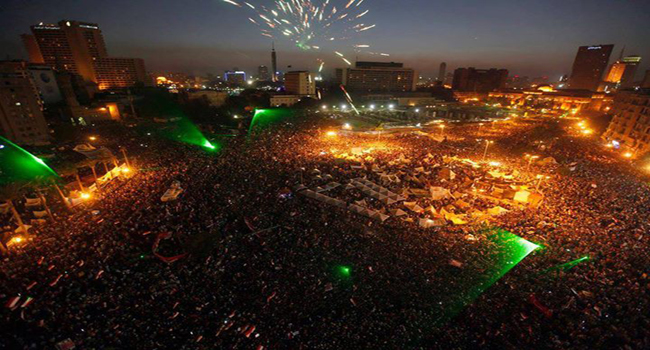
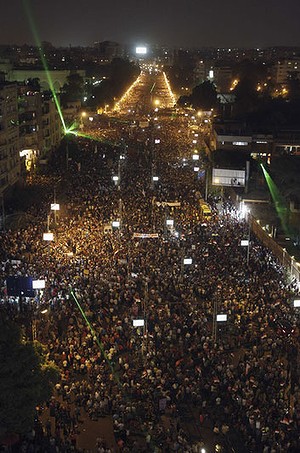
Pentagon: Nobody knows that will happen in Egypt in next 48 hours. live from Tahrir Square http://rt.com/on-air/opposition-rally-egypt-morsi/ <http://t.co/HOVJUz6QVP> http://www.marxist.com/millions-on-the-streets-marks-the-beginning-of-the-end-for-morsi.htm Egypt:Millions on the streets marks the beginning of the end for Morsi<http://www.marxist.com/millions-on-the-streets-marks-the-beginning-of-the-end-for-morsi.htm> Written by Hamid AlizadehMonday, 01 July 2013 [image: Print]<http://www.marxist.com/millions-on-the-streets-marks-the-beginning-of-the-end-for-morsi/print.htm>[image: E-mail]<http://www.marxist.com/component/option,com_mailto/link,4b36cfe8275b9d0753dd2434a4a02ca3dda65268/tmpl,component/> - - - Yet again the people of Egypt have risen against dictatorship, poverty and corruption. Yesterday, June 30, millions of people flooded the streets in all noticeable towns and cities stretching from the rural areas of Upper Egypt through the industrial heartland of the Nile Delta and all the way to the areas in the north. Mohammed Morsi and the Muslim Brotherhood, once praised by the West as saviours of Egyptian capitalism, have been completely disarmed by the revolution. His destiny is now in the hands of the movement which has every opportunity to sweep him aside. [image: tahrir-sq-june30]<http://www.marxist.com/images/stories/egypt/tahrir-sq-june30.jpg>Tahrir Square - June 30 - Click to enlarge picture In anticipations of yesterdays day of action, protests had already been breaking out in Cairo, Alexandria and several Egyptian governorates, including Daqahliya, Sharqiya and Zagazig. Several of the offices of the Muslim Brotherhood and its political wing the Freedom and Justice Party in the Nile Delta and Alexandria were firebombed and ransacked while continuing clashes between Morsi supporters and revolutionaries led to several killed and hundreds injured. >From early morning on June 30 thousands of Egyptians gathered in squares and in front of official buildings across the country. Protesters in Gharbiya chained up the doors of several city council buildings and erected banners reading "closed on the revolution's orders." But as the day went by, the movement took gigantic proportions, far beyond anything we have witnessed since the beginning of the revolution, taking everyone by surprise. In Cairo, Tahrir square and all the roads leading into it were completely packed. The same crowds could be seen in Heliopolis around the Presidential palace where what looked more like a human flood covered the extraordinarily broad boulevard as far as eyes could see. [image: Heliopolis - 30 June]<http://www.marxist.com/images/stories/egypt/heliopolis-30-june.jpg>Heliopolis - 30 June Click to enlarge pictureMarches were coming in from every corner of the city in a seemingly never ending stream. From several locations in Giza a march led by Nasserite presidential candidate Hamdeen Sabahi and the leader of the newly formed Egyptian Federation of Independent Trade Unions, Kamal Abou Eita united tens of thousands. The march merged with another one led by liberal opposition leader Mohamed ElBaradei at Al-Nahda Square at the end of the street. Passing by the Dokki police station it was saluted by low-ranking police officers standing in front of the Dokki police station holding flags in support of the protesters, some holding placards addressed at the president with one single message: 'leave! The Ultras Ahlawy, fans of Cairo-based Al-Ahly Club also participated strongly in the protest using their songs and green lasers to lift the atmosphere further. The slogans being chanted were mainly against the Muslim Brotherhood, in defence of the Revolution and for the downfall of the regime. Two of the most popular chants were, Leave! and the slogan of the January 25 uprising against Mubarak: The people demand the downfall of the regime! *Video:* *http://www.youtube.com/watch?v=z_IOrcF1nNw * There were people from all walks of life, from housewives to workers and students; and from atheists and seculars to fully veiled Muslims, men and women, young and old. Marching towards Tahrir or the presidential palace many marchers stopped to shake hands and take pictures with soldiers guarding key buildings. At least six high-ranking police officers took to the Tahrir Square podium in support of the demonstrators, a Reuters witness said.<http://news.bbcimg.co.uk/media/images/68467000/jpg/_68467781_68467780.jpg> According to the BBC, police officers joined the protesters in Alexandria, some of whom even got into the police vehicles. Clearly, two years of intense revolutionary activity by the masses have had an impact on the state apparatus. Earlier in the year there was a national strike of police officers, protesting at being used to repress the people. There are also reports of police trade unions being formed, particularly by younger elements in the force. Reporting from Alexandria, where hundreds of thousands took to the streets, Ahram Onlines Yasmine Fathi, said the protest area was packed, people cannot move. Thousands upon thousands were still flowing into the area, she reported.. A young protester, Wael Nabil, told the same source in Alexandria that he was determined to stay until Morsi leaves, even if it meant waiting for a year. Mubarak repressed us, but at least he gave us services; at least he didnt cut the electricity, water and petrol like now. Nothing has changed; my salary didnt increase. My wife is pregnant, how will I provide for my baby? added Nabil. In the industrial proletarian stronghold of Mahalla hundreds of thousands were gathered at Al-Shoun Square. Prominent labour activist Kamal El-Fayoumi told Ahram Online early in the day that: "The Muslim Brotherhood doesnt dare to organise protests in Mahalla. The people of the city voted against the constitution and President Morsi and they reject the groups presence in power. "I am expecting around 1 million people to take to the streets of Mahalla this afternoon. "Only 10 percent of workers at the state-owned Mahalla Misr Spinning and Weaving Company are working today, the others will be protesting. "President Mohamed Morsi Mubarak has failed to fulfill any of his election promises. "Mahalla contributed heavily to the removal of Mubarak from power, and we will do the same thing with Morsi." Later on he added that he will be heading back to the industrial city of Mahalla tomorrow (Monday) and By then, if the regime hasnt been toppled we will join the sit-in and the calls for civil disobedience, Amongst other slogans chanted at Al-Shoun Square in Mahalla were Abdel-Nasser has said it before, the Muslim Brotherhood are not to be trusted, a famous chant referring to former left-nationalist president Gamal Abdel-Nasser whose legacy is seeing a surge of popularity in Egypt. A similar situation was witnessed in neighbouring Mansoura, in the Sharqiya governorate and in Suez. In Damietta in the north of Egypt, Hatem El-Bayaa of the Socialist Popular Alliance reported that demonstrators in the city, estimated to be several thousand, took over the governorate headquarters and the offices of the local education authority. In coordination with employees within the governorate offices, anti-Morsi protesters were planning to occupy other government buildings to prevent recently appointed Damietta governor Tarek Fathallah Khedr from entering his office. In a similar vein, seven city council buildings have been closed by protesters in Menoufiya governorate. These examples reveal the insurrectionary mood which is building up, with the masses not limiting themselves to protests in the streets, but taking direct action against the institutions of power. According to the interior ministry there were 3 million people on the streets while anonymous army officials put the figure around 14 million. Though these figures cannot be confirmed it is clear that this was one of the largest protests in the history of Egypt. In scope it covered even more ground than the revolution in 2011 because it acquired a mass character throughout Egypt whereas in 2011 the overwhelming mass of people gathered in Tahrir square. The Balance of Forces Seeing the gathering storm the Brotherhood had attempted to mobilise their own forces over the past week. On several occasions they managed to gather crowds in the tens of thousands possibly making it into the hundreds of thousands. Islamist forces staged a sit-in at Rabaa Al-Adawiya Mosque in Cairo's Nasr City on Friday and stayed there until the mass rally on Sunday. They held a similar rally last week, which numbered in the hundreds of thousands. The protest was highly organised and was surrounded by a ring of guards wearing protective gear and carrying clubs. This was supposed to be only for defensive purposes, but this was proven to be a lie as several marchers were attacked by Islamist thugs wearing this uniform. The fact that Morsi could mobilize some forces shows that they still have a hard core of supporters. But the size of their rallies paled in comparison with the millions that came out against them yesterday. This is underlined by the fact that the Brotherhood used the whole weight of the state apparatus to ensure a large turnout. As one Guardian reader pointed out: What the Guardian reporters have failed to point out is this. There may be 20,000 or more Morsi supporters in Misr Gadidah but they represent the Brotherhood's grass root diehards who've been bussed in from all over the country and given cash and food inducements to turn up. Contrast that protest with Tahrir Square, outside the Ministry of Defense, Tanta, Alexandria, Port Suez, Manoufeya, Mahalla and elsewhere consisting of people from the respective areas who haven't been handed sweets and are not organized by any particular party or religious sect. Tahrir is full at 4pm in the afternoon when temperatures are way over 30 degrees C. Imagine the crowd later tonight when it's cooler. The plight of the masses After more than one year with the Muslim Brotherhood in power it is dawning for most Egyptians that nothing fundamental has changed in society. The undemocratic nature of the regime continues. The old state apparatus remains firmly in place and those responsible for the deaths of the dozens of martyrs of the revolution have not been brought to trial. Corruption and nepotism thrives although it is now to the advantage of more bearded part of the ruling class. Thousands of activists are still in prison. Peaceful demonstrations are suppressed every day and religious sectarian attacks are increasing. Only last week four Shia Muslims were brutally killed by a mob of Brotherhood and Salafist extremists. This followed a whole period of anti-Shia agitation by several known Salafist clerics. Although Morsi did denounce the lynching, he did not do much else about it. This also shows how Morsi is becoming increasingly dependent on the extreme Salafist tendency as he has become weaker and weaker over the course of the past year. Scores of ministers and deputy ministers have resigned from his government leaving only the more extremist elements behind. At the same time the economic situation is weighing down like a mountain on the lives of the masses. Unemployment, hunger and poverty are rising fast. Today, unemployment is over 13 percent, up from 9 percent in 2010. The most recent data shows that one-quarter of the population is living in poverty, and the figure is rising. In a recent poll <http://www.imra.org.il/story.php3?id=61307>, when asked about their satisfaction with the Morsi government the answers were damning: On the question of satisfaction with the government guaranteeing rights and freedoms: Satisfied 27 % Not satisfied 72% On the question on satisfaction with the government creating economic opportunities: Satisfied 25% Not satisfied 74% On the question on satisfaction with the government keeping people safe and maintaining order Satisfied 26% Not satisfied 74% On the question on satisfaction with the government supporting services that help provide for familys health care, education, etc.: Satisfied 26% Not satisfied 74% Disappointed with the rule of the Muslim Brotherhood and pushed to the edge by economic hardship, the mass of workers, poor, youth and even large parts of the middle classes came out on Sunday to voice their anger and indignation. One participant in Tahrir said: "My brother died in Mohamed Mahmoud Street during the 18 days, he was just 25 years old, his name was Mostafa. If I had the money I'd leave the country and travel abroad because there's no work, even though I have a degree. Egyptians are currently living in extreme poverty. There has been no justice for my brother's death. This is not what revolution demanded. I feel like Morsi is living in another world, hes taken unpopular decisions and continues to say unpopular things like praising the very police force who were responsible for my brother's death. Elsewhere in Tahrir Square Khayria, a 37 year old housewife from Sheikh Zayed City, here with her husband, a taxi driver, was carrying her three-year-old daughter on her shoulder. She told Ahram Online that she wants Morsi to leave immediately and the army to take control, because Morsi has bled the country dry. We see so many people on the streets eating garbage and so many people staying at home because they cant find work, Khayria adds, emphasising that she is going to Tahrir to fight until the last moment. Distrust in the leaders In December 2012 the first major movement against the Morsi government started but due to the lack of leadership it died down. The so-called opposition leaders have had no alternative to present and no plan of taking the movement forward. Terrified by the prospect of losing control over the movement they refused to call a general strike or present a credible battle plan. Instead they resorted to calling for meetings and more discussions with Morsi while forming the National Salvation Front together with Amr Moussa a politician with direct roots in the old regime. Ultimately this stagnation and lack of perspectives led to the movement dying down and opening a period of tiredness and withdrawal during the spring where major protests did not occur although many small isolated strikes and demonstrations took place. While the main problems of society remained, the bulk of the population could not see any alternative to rally around. In fact there was a reaction against the whole political establishment. Expressing this sentiment, on Sunday one protestor told Ahram Online that she didn't like any of the presidential candidates who ran last year such as Amr Moussa and Mohamed ElBaradei, "I don't think any of them are fit for the position, it needs to be someone outside of any existing political movement. This was also revealed in a recent poll amongst 5000 Egyptians made by the Independent Media Review and Analysis. When asked about the credibility of political figures, all of them, Morsi included, scored below 30%, while Aboul Fottou, the liberal isamist, scored 33. The only politicians to get high scores were Gamal Abdel Nasser and Anwar Al Sadat (with 73 and 93 percent respectively) none of whom are alive. The only living person to score a high credibility score was Bassem Youssef a famous political satire programme similar to the American Daily show with Jon Stewart. Amongst the left forces the situation is not better. As we explained before, the leadership of the Revolutionary Socialists, which is the largest left group with a sizeable youth base, took a criminal position during the previous presidential elections by giving support to Mohammed Morsi in the second round. At that time Sameh Naguib, a leader of the group wrote: The victory of Morsi, the Muslim Brotherhood candidate, is a great achievement in pushing back this counter-revolution and pushing back this coup d'etat. For now, this is a real victory for the Egyptian masses and a real victory for the Egyptian revolution. This might not seem clear on the surface of things. Many people, especially in the West, and also over here, have an Islamophobic attitude that does not allow them to see the nature of the Muslim Brotherhood... Today it is clear that the Muslim Brotherhood represents pure capitalist counter-revolution and nothing else. If the leaders of the Revolutionary Socialists had explained this at that time, as the Bolsheviks did in Russia between February and October, they could have grown massively in the past year and would now be able to play a decisive role. But their position only managed to isolate them from the movement because it goes directly against the reality that it is confronted with today. Tamarod None of the major political forces in Egypt showed a way forward for the revolution or presented it with a real political alternative. Symptomatic of this, the initiative for the day of action did not come from any of the established political groups but from a grass root organisation composed of normal activists from across Egypt. The organisation Tamarod (Rebel) started a campaign of signatures for the recall of President Morsi. Its original target was 15 million signatures before the 30th June protest which was the 1st anniversary of Morsis election. But in the end they collected 22 million signatures. In contrast Morsi only received 13 million votes in the second round of the elections last year, while only receiving 5 million in the first round (out of a total 50 million registered voters). This also goes to show Morsis hypocrisy when he claims that he has democratic legitimacy as he was elected by the majority of Egyptians. Certainly, Morsis support today is far lower than the five million votes he received in the first round of the presidential elections. The regime in crisis The legitimacy of his government was revoked, not on the papers of the law or in the ballot, but on the streets where the millions in support of the revolution performed a mighty show of force. While generally very arrogant to the demands on the street it was clear that Morsi was coming under pressure. Although he refused to give any serious concessions he said that "today, I present an audit of my first year, with full transparency, along with a roadmap. Some things were achieved and others not. I have made mistakes on a number of issues." At the same time a plane is reportedly at the palace ready to evacuate the president if required. Even the leader of the Salafist Nour party was more in touch with the situation as he urged Morsi to make concessions to avert bloodshed. As we have explained many times before the Islamists could never solve any of the problems of the revolution because the main problems such as poverty and unemployment are rooted in the capitalist system and are not particular to Egypt. The Muslim Brotherhood being a defender of the system would eventually, as we predicted, be confronted by the revolution. What we are witnessing is not only the beginning of the end for Mohammed Morsi, but also for political islam which is being exposed as being nothing but a reactionary bourgeois movement. The pressure from below is causing divisions at the top. Throughout the mobilizations there has been several calls for the army to step in and take power. But while the army tops, until last week refused to do this and said that they would only step in to ensure order initially a warning against the revolution the tone changed in the days leading up to 30th June. A senior military source told the Guardian on Thursday that the army did not want to intervene. But they stated that if Sunday's protests were as widespread and prolonged as those that drove Egypt's 2011 uprising, and if serious fighting broke out between Morsi's supporters and his opponents, then the army may regard the protests as a more legitimate representation of the people's will than the elections that brought Morsi to office a year ago and would step in to facilitate a transition of power to a technocratic caretaker government. As these lines are being written the army has issued a statement saying that the armed forces are giving all political forces 48 hours as a last chance to solve the ongoing problems, or else the armed forces will have to announce a new roadmap for the future, and will enforce certain measures with the help of all factions including the youth, without excluding anyone. The Egyptian army has a long tradition of involvement in politics. But this is not only as a counter-revolutionary force. The masses in Egypt and especially the lower rank soldiers and officers remember very well that it was an officers coup that lead the revolution of 1952 and overthrew the hated King Farouk. The army is not isolated from the pressure of society but reflects the same pressures. Feeling the ground shaking under their feet the army generals are hedging their bets so as not to stand back naked without an army. What the reaction of the army tops who are completely intertwined in the ruling class of Egypt really reveals is the sweeping strength of the revolution and the weakness of the bourgeoisie. In these conditions the intervention of the Army generals would be aimed at preventing the revolution from advancing further, and offering some sort of constitutional way out to the revolutionary crisis, perhaps by putting in a care-taker government, including some figures from the Liberal and bourgeois opposition while early elections are being called. The last thing the army generals want is for the revolutionary masses to overthrow Morsi on their own. This is the meaning of their statement. What they are saying to Morsi is: if you cannot control the masses, please step aside and dont make matters worse, or else we will intervene. The movement must move forward Yesterday the June 30 coordination committee passed a resolution saying: We thank the Egyptian people who have revolted in the millions for a free Egypt, free of fascism, tyranny and injustice, the statement reads, while at the same time denouncing Morsi. The presidency has released a statement belittling us and our legitimate demands and our million man marches all over Egypts squares. The committee promised to stand behind the people and their just demands and calls for further action by all democratic means to demonstrate, hold sit-ins and strikes and besiege all state institutions and we demand the trial of all those responsible for torture, killing and announcing edicts inciting against the people and calls for terrorism which was called for by the Muslim Brotherhood. We are fully in support of this resolution. In fact already in many towns and cities the people have occupied the governors offices preventing them from functioning. Just like in the 2011 revolution a general strike is decisive in order to bring down the regime. In order to coordinate this, action committees should be formed in every factory and neighborhood and connected on a regional and national level. The pressure is rising in Egyptian society and the revolution is back at full force. This should also be a lesson to all those skeptics who had declared the revolution dead and were complaining that the revolution had given way to Islamist power and black reaction. At the bottom of that argument lies lack of confidence in the ability of the working masses to draw advanced revolutionary conclusions from their own experience. In fact the protest yesterday goes to show the advanced level of the masses and the low understanding of the so-called leaders. At each step of the revolution it has not been the leaders but the rank and file which has pushed the movement forward while the leaders have acted as dead weights around the feet of the revolution. The fact that the present movement has its roots in the rank and file movement is a solid proof of this. The masses can only trust their own forces. Neither the Army tops nor the Brotherhood or any of the other bourgeois forces can solve any of the pressing needs of the workers and poor of Egypt because they represent the same capitalist system that is the cause of their plight. Only by taking power in their own hands and releasing themselves from the shackles of Capitalist society can the true potential of Egyptian society be achieved. - *Down with Morsi!* - *No trust in the Army command!* - *No trust in the felouls!* - *Only trust your own forces!* - *Set up action committees and organize a general strike to bring down the government!* - *All power to the revolutionary workers and youth!* [Non-text portions of this message have been removed] ------------------------------------ --------------------------------------------------------------------------- LAAMN: Los Angeles Alternative Media Network --------------------------------------------------------------------------- Unsubscribe: <mailto:[email protected]> --------------------------------------------------------------------------- Subscribe: <mailto:[email protected]> --------------------------------------------------------------------------- Digest: <mailto:[email protected]> --------------------------------------------------------------------------- Help: <mailto:[email protected]?subject=laamn> --------------------------------------------------------------------------- Post: <mailto:[email protected]> --------------------------------------------------------------------------- Archive1: <http://www.egroups.com/messages/laamn> --------------------------------------------------------------------------- Archive2: <http://www.mail-archive.com/[email protected]> --------------------------------------------------------------------------- Yahoo! Groups Links <*> To visit your group on the web, go to: http://groups.yahoo.com/group/laamn/ <*> Your email settings: Individual Email | Traditional <*> To change settings online go to: http://groups.yahoo.com/group/laamn/join (Yahoo! ID required) <*> To change settings via email: [email protected] [email protected] <*> To unsubscribe from this group, send an email to: [email protected] <*> Your use of Yahoo! Groups is subject to: http://docs.yahoo.com/info/terms/