TED GRANT CENTENARY This year marks the 100th anniversary of the birth of Ted Grant. As part of commemorating his achievements, In Defence of Marxism is launching an appeal to all our readers and supporters to raise 2,000. [Read the appeal]<http://www.marxist.com/ted-grant-centenary-collection.htm> 277 2,000
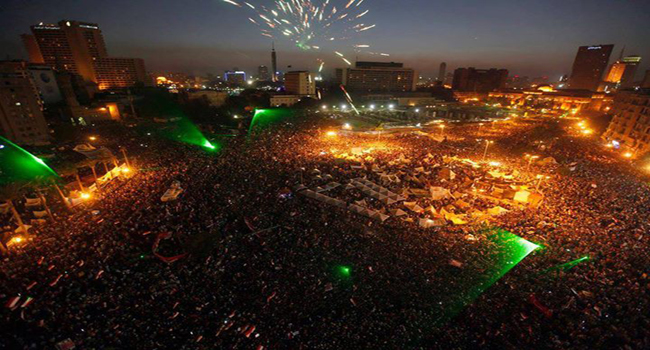
Egypt: Morsi removed by revolutionary movement - No confidence in the generals and bourgeois politicians - All power to the people<http://www.marxist.com/egypt-morsi-removed-by-revolutionary-movement-of-the-people.htm> Written by Jorge MartinThursday, 04 July 2013 [image: Print]<http://www.marxist.com/egypt-morsi-removed-by-revolutionary-movement-of-the-people/print.htm>[image: E-mail]<http://www.marxist.com/component/option,com_mailto/link,6471cde95b7522f4c9dea20fe7da8f5315b185f2/tmpl,component/> - - - After four days of mass revolutionary mobilisations by the Egyptian people and the beginning of a nationwide general strike, finally president Morsi was removed from power. What we witnessed yesterday is yet another example of the power of the masses of workers and youth, peasants and the poor when they start to move. [image: tahrir-sq-june30]<http://www.marxist.com/images/stories/egypt/tahrir-sq-june30.jpg>Despite all the talk of a military coup, the truth is that the Army generals only intervened at the last minute in order to prevent a full revolutionary overthrow which would have jeopardised not only the position of the president and the Muslim Brotherhood (a section of the capitalist class), but the capitalist state and the capitalist system as a whole. In this we can see the enormous strength of the revolutionary masses but also their main weakness, the lack of a clear leadership which could have led them to finish the job themselves. We must insist on this point: it was not the Army generals which removed Morsi, it was the revolutionary people through mass mobilisations which surpassed even those which brought down Mubarak in January 2011. The only way one can say that what happened yesterday was a coup is if you only look at the events during the few minutes in which Army chief-of-staff al-Sisi made his statement and Morsi was put under house arrest and forget everything that has happened in Egypt since January 2011 and particularly since Sunday, June 30, 2013. Lets recall. First of all, a mass revolutionary movement of the people (led by the youth and inspired by the Tunisian revolution) took to the streets and brought down Mubarak who had ruled with an iron fist for decades and had at his disposal a numerous, refined and seemingly all powerful repressive apparatus. The crucial turning points in the revolution were: 1) the beginning of the entry of the working class into the scene with a strike wave moving quickly from the Mahalla textile workers, to the Helwan military industries and the Suez Canal workers; 2) the appearance of divisions within the Army along class lines, with lower ranking officers and soldiers fraternising with the revolutionaries on the streets. It was at that point - let us remember this - that the Army generals, the Supreme Council of the Armed Forces (SCAF), intervened to remove Mubarak. This was, rightly, seen by the masses as a victory, but it was one which was only partial and incomplete, because it left the state apparatus and the power of the bourgeoisie over the economy untouched. The second act was the movement against SCAF and the attempt of the generals to continue with the old order but without Mubarak. In the period which goes from January 2011 until June 2012 there were constant mass demonstrations and clashes by the people against SCAF and defending the basic aims of the revolution. Dozens, probably hundreds of people in total, were martyred in the course of this struggle. Finally SCAF decided it could no longer continue to rule directly in the face of the enormous pressure from the revolutionary masses and made a deal with the Muslim Brotherhood. The Brotherhood at the end of the day represents a section of the Egyptian capitalist class, one which greatly enriched itself during the last period of the Mubarak regime, benefiting from his policy of privatisation and liberalisation of the economy. What the Brotherhood lacked was full access to political power. They were not really a threat to the power, wealth and privileges of the generals and the capitalists system they represent. This is why a deal was possible. The deal consisted in leaving the military basically untouched, while Morsi would use his image as a representative of the revolution to keep the masses under control, while carrying out the policies Egyptian capitalism required. Stratfor described it in this way: what the military needed was a government that could manage the political economy of the country such that the state of unrest could remain limited. The presidential elections in June 2012 in fact showed how little support the Muslim Brotherhood had, even a year ago. In the first round 5.7 million voted for Morsi (24%), 5 million (23%) for Shafiq (the SCAF candidate), but another 4.8 million (20%) voted for Hamdeen Sabbahi, the left Nasserite candidate, and 4 million (17%) for Fotouh the populist Islamist candidate. The openly bourgeois liberal candidate Amr Moussa barely got 2.5 million votes. Even at that time abstention was a massive 53% with large sections of the population thinking that none of the candidates really represented the aims of the revolution. It is noteworthy that Sabbahi, the candidate which in the eyes of the masses more clearly represented the revolution won in the major cities, such as Cairo and Alexandria (with Morsi coming in a poor third in both) and Port Said (where Sabbahi scored an impressive 40% of the vote). There were many allegations of vote rigging and fraud. In any case, as Sabbahi did not make it to the second round, only two candidates were left, Morsi and Shafiq. In those conditions, many felt that they could not allow the direct candidate of the generals to win and rallied behind Morsi. When the final result of the second round was announced (again amidst many allegations of fraud and vote rigging), Morsi was declared the winner with 13 million votes (out of a total 51 million registered voters). Many of those did not so much vote for him as against Shafiq. The stock exchange saw its largest increase in 9 years, revealing the opinion of the capitalist class. Amongst some sections of the masses there were expectations that Morsi would at least attempt to address some of the main demands of the revolution: bread, jobs and justice. He did not. He could not and he did not want to. The acute crisis of Egyptian capitalism, compounded by the world crisis meant that the economic situation of the masses went from bad to worse. There has been a 50% collapse in the value of the Egyptian pound, an increase in unemployment and poverty levels and 63% of the population now think that they are worse off than before he took power. In relation to democratic rights he used repression against those who protested against him, he allowed the acquittal of the old regime officials responsible for the death of the martyrs of the battle of the camels, he presided over the death sentences of the Port Said football fans, he gave himself sweeping powers ahead of the constitutional referendum, etc, etc. This was all part of the deal he had made with the Army, where his role was to maintain law and order. Throughout this period the Army generals supported him. There were regular outbursts of mass protests in Cairo, Alexandria, along the Suez Canal, with hundreds of thousands involved in mass movements in November/December 2012 and then in January 2013. In his last address to the nation, on Tuesday July 2, he repeated dozens of times the word legitimacy, but the truth is that he had lost any that he might have had originally, through the experience of the masses with his government. The Tamarrod movement which started in April this year, provided a channel for the accumulated anger against Morsi and the deep seated feeling that the masses had carried out a revolution but their victory had been stolen and nothing had been achieved. Ordinary workers and the poor cannot live on the basis of promises. They made a revolution to get jobs, bread and justice and what they got was higher unemployment, fuel and electricity blackouts, repression and no justice for the martyrs of the revolution. This is the real basis of the revolutionary overthrow of Morsi, not some military conspiracy. It had little to do with secular versus Islamic, and everything to do with the workers and the poor rising up for social justice. Tamarrod received 22 million signatures for its petition (surpassing the original aim of 15 million) demanding the immediate resignation of the president. This is far more than the 5.7 million Morsi won in the first round of the presidential elections and even than the 13 million he won in the second round (and many of those were not really his votes). Talk about legitimacy! The movement of the last few days was a genuine mass movement. The demonstrations on June 30 were huge, much larger and widespread than anything we saw in January 2011. Figures of the Ministry of Interior (MoI) say there were 17 million on the streets against Morsi. Of course, in this case the MoI might have a reason for exaggerating the size of the movement, but even if those figures are inflated, there would have been more people on the streets than those who voted for Morsi in 2012. As a matter of fact many who voted for him were now on the streets. The anti-Morsi demonstrations were certainly at least 10 or 20 times larger than those in his defence. The movement, however, was not limited to mass demonstrations. Revolutionary committees sprang up across the country. A general strike was launched. There were many reports, particularly on the morning of July 3, of groups of workers in the main industries and state institutions walking out of work and joining the protests and sit-ins, following the call of the revolutionary movement for mass civil disobedience. Power was in effect in the people's hands. Government buildings across the country were either occupied or blockaded and padlocked by ordinary working people, in several places with the participation of ordinary workers and officers. It is in this context that the Army generals intervened. As Morsi was not prepared to go and was clinging to power, the danger was of an all out confrontation with the revolutionary people which might have ended with a revolutionary overthrow and the masses doing away not only with the president but the whole edifice of the capitalist state. This, the generals could not allow. The way they coined their intervention revealed the real situation. They did not intervene to restore law and order, but rather to make sure that the will of the people was fulfilled! As a matter of fact Tamarrod had called on the masses on July 3 to surround the Republican Guard barracks to demand the Army to intervene and remove Morsi! On the one hand this reveals the shortcomings of the leadership of the movement, a movement which was perfectly capable of overthrowing Morsi without the need to appeal to the Army generals, but also shows how limited the room for manoeuvre is for the generals. The ultimatum of the generals makes the point very clear. What they want is a new national unity government including elements of the revolutionary youth to take over, so that the masses go back home. The last thing that the generals want is to impose military rule over an aroused revolutionary movement of millions! They would be unable to do this and would provoke the breakdown of the Army along class lines. They are riding a wild tiger, which is a very dangerous thing to do. There were, of course, scenes of wild jubilation in the streets when the removal of Morsi was announced. Many will be appreciative of the role the Army generals have played in this. But they appreciate the Army insofar as it is seen to have carried out the will of the people. Any attempt of the Army generals to clamp down on the people would be met with a similar explosion of the revolutionary movement. However, we should not exaggerate the level of support the Army has amongst the people. On July 3, reflecting the widespread feeling that everyone was negotiating a solution behind the backs of the mobilised people Tamarrod issued the following message: The regime, army and opposition should end their phone calls with the USA and listen to the nation and do what the nation wants." What the people want is bread, jobs and justice. And they have overthrown Mubarak, removed SCAF and now overthrown Morsi in order to achieve it. In the course of these tumultuous struggles they have drawn some very important lessons. They are not in a mood to trust anyone very much and they would judge whoever comes to power now against the yardstick of their own demands. They feel strong and confident. The more far-sighted analysts of the ruling class understand the dangers involved. They know that this is not a coup. Stratfor put it this way: the forcible removal of the Morsi government will make it difficult to create a new civilian government because the political environment will be even more polarized. What they see as the most dangerous element of the equation is that the military has set a precedent for giving in to mob violence. Translated into the language of the oppressed this means that the danger is that people think that through violent mob methods (read: revolutionary methods), they can achieve what they want, and that is certainly a dangerous precedent from the point of view of the ruling class. The manoeuvre at the top is clear. When announcing the removal of Morsi, head of the armed forces al-Sisi surrounded himself with the Grand Imam, the Coptic Orthodox Patriarch, bourgeois liberal ElBaradei, a representative of the Salafist Nour Party, representatives of the judiciary and the police, and yes, one representative from the Tamarrod campaign. The head of the High Constitutional Court, Adly Mansour, a judge who comes straight from the Mubarak era, has been appointed as the new president. A new broad-based council for national reconciliation will be formed and at some point there will be a new constitution and new presidential and parliamentary elections. The idea is to channel the revolutionary movement, once again, towards the safe waters of bourgeois democracy and constitutionalism. They will try to involve as much as possible figures who are close to the masses, including from Tamarrod, in order to give the whole process as much legitimacy as possible. The revolutionary masses are now jubilant. But beyond celebration they should remain vigilant, because their victory is in the process yet again of being stolen from them. The revolutionary committees which have sprung up (at a higher level than even in January 2011), should be maintained, strengthened and widened to include all sections of the oppressed people: workers, soldiers, peasants and the poor. They should take - as they have already done partially - authority into their own hands by occupying governorates and municipalities and start to rule. They should strengthen their position by calling mass assemblies in order to decide on all important matters. The structures of the committees should be formalised, with elected and recallable delegates from all workplaces, working class and poor neighbourhoods and also the election of delegates from amongst the army soldiers. Faced with the danger of radical islamists waging armed resistance, self-defence should be organised by the revolutionary committees. Above all, the revolutionary people should not wait for the new president, or interim council, to take decisions. Where were they when the masses took to the streets and risked their lives? Was Adly Mansour in Tahrir Square? Did ElBaradei fight the Mubarak thugs in the Battle of the Camels? Where was the Grand Imam when the police organised a trap for the Al-Ahly fans in Port Said? And most important of all, where were the Army generals when the masses overthrew Mubarak and then fought against Morsi? They only came in at the last minute. None of them can be trusted to carry out the will of the revolutionary people. Only the people, with the working class at its head, can do so. The revolutionary committees should take the initiative immediately. Revolutionary courts under the authority of the committees, should be established to bring justice for the martyrs of the revolution. Workers control committees should be established in all factories to guarantee workers rights and production to fulfill the needs of the people. Revolutionary provisioning committees should be set up in all working class neighbourhoods with authority to make sure enough bread is produced and distributed to the people. The crucial question of who holds power, whether it is the revolutionary people or a coalition of bourgeois politicians and army generals, is linked to the even more important question of who controls the wealth. The urgent needs of the masses cannot be solved even by the most democratic of constitutions. Voting a constituent assembly, a president and a national assembly will not give the masses bread nor jobs. That can only be done if a thoroughgoing political revolution is accompanied by a social and economic revolution. Only if the Egyptian working people expropriate the handful of wealthy individuals who control the countrys riches, a large number of them closely linked to the old regime, many linked directly to the Army high command and finally those capitalists who hide behind pious beards. The revolutionary people of Egypt have once again been the source of inspiration for the oppressed of the world. The key task is to build a revolutionary leadership which is at the level of the tasks posed. *All power to the revolutionary committees!* *No confidence in generals, bourgeois politicians and religious leaders - trust only your own forces!** Expropriate the capitalists - all wealth to those who produce it!* * http://www.marxist.com/egypt-morsi-removed-by-revolutionary-movement-of-the-people.htm * [Non-text portions of this message have been removed] ------------------------------------ --------------------------------------------------------------------------- LAAMN: Los Angeles Alternative Media Network --------------------------------------------------------------------------- Unsubscribe: <mailto:[email protected]> --------------------------------------------------------------------------- Subscribe: <mailto:[email protected]> --------------------------------------------------------------------------- Digest: <mailto:[email protected]> --------------------------------------------------------------------------- Help: <mailto:[email protected]?subject=laamn> --------------------------------------------------------------------------- Post: <mailto:[email protected]> --------------------------------------------------------------------------- Archive1: <http://www.egroups.com/messages/laamn> --------------------------------------------------------------------------- Archive2: <http://www.mail-archive.com/[email protected]> --------------------------------------------------------------------------- Yahoo! Groups Links <*> To visit your group on the web, go to: http://groups.yahoo.com/group/laamn/ <*> Your email settings: Individual Email | Traditional <*> To change settings online go to: http://groups.yahoo.com/group/laamn/join (Yahoo! ID required) <*> To change settings via email: [email protected] [email protected] <*> To unsubscribe from this group, send an email to: [email protected] <*> Your use of Yahoo! Groups is subject to: http://docs.yahoo.com/info/terms/