http://www.marxist.com/the-egyptian-revolution-a-nightmare-for-the-bourgeois.htm
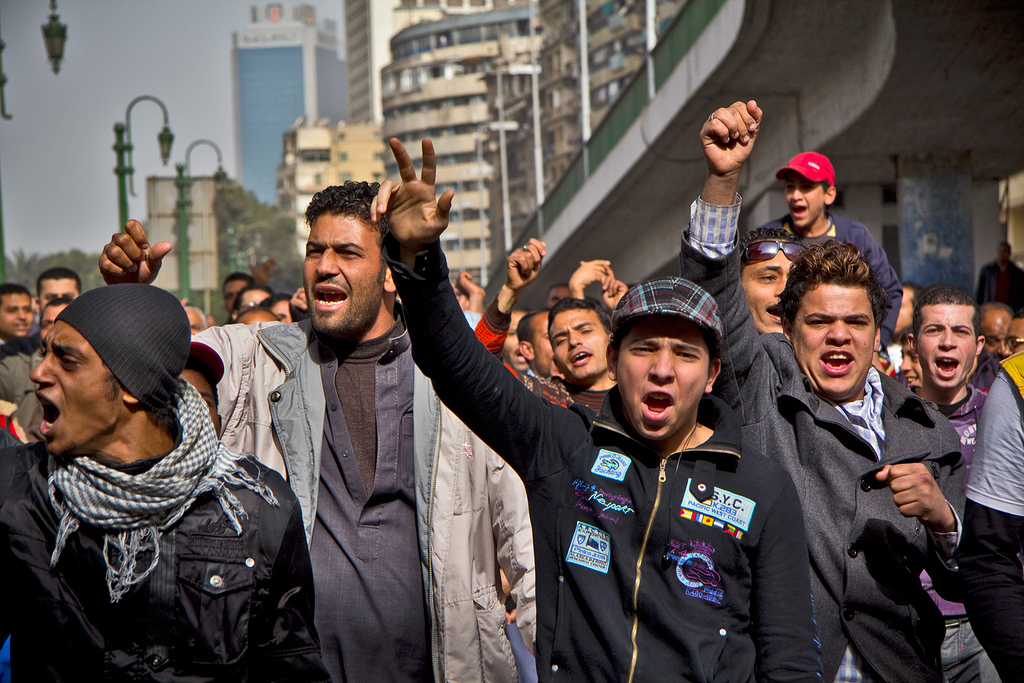
The Egyptian Revolution a nightmare for the bourgeoisie<http://www.marxist.com/the-egyptian-revolution-a-nightmare-for-the-bourgeois.htm> Written by Alan Woods and Hamid AlizadehFriday, 12 July 2013 [image: Print]<http://www.marxist.com/the-egyptian-revolution-a-nightmare-for-the-bourgeois/print.htm>[image: E-mail]<http://www.marxist.com/component/option,com_mailto/link,36328dc12986fc8978f77c8802ae41b9980c27d6/tmpl,component/> - - - <http://www.marxist.com/images/stories/egypt/31_January-darkroom_productions.jpg>The overthrow of Muhammad Morsi has opened up a new and turbulent period in the Egyptian Revolution. The Muslim Brotherhood (MB) still has a base in Egyptian society, among the petty bourgeoisie, the most backward and ignorant layers of the peasantry and the lumpenproletariat. It is determined to cling to power, but the multimillion masses that took to the streets to overthrow them are equally determined that they shall not return. The future of the Egyptian Revolution will be determined by the outcome of this struggle. [image: 31 January-darkroom productions]<http://www.marxist.com/images/stories/egypt/31_January-darkroom_productions.jpg>Picture: Darkroom ProductionsThe anger of the people was expressed in actions such as the burning and ransacking of the Brotherhoods headquarters. But this was in retaliation for the killing of unarmed demonstrators by MB thugs who poured acid and firebombs on the crowds below. The attempts by the media to present the Muslim Brotherhood as peaceful martyrs are at variance with the facts. The major news agencies and outlets are trying to paint a false picture of the situation on the ground in Egypt. The rallies of the counterrevolutionary Brotherhood are played up and shown over and over again. But the massive revolutionary counterdemonstrations are not even mentioned. On the one side the Brotherhood had been trying to provoke an armed clash since Morsi was deposed. On Friday Brotherhood thugs killed two children in Alexandria by throwing them off a roof of a building. On Sunday in Assiut three young men who participated in the protest against the Brotherhood were gunned down by Brotherhood goons. This resulted in thousands of people burning down the Brotherhood headquarters in the city. Of all this, not a single word in the media! The reality on the streets of Egypt is far from that being depicted on the news. Immediately after the deposing of Morsi, the masses, feeling the threat of reprisals by the Brotherhood, took to the streets to defend their victory. Over the weekend hundreds of thousands and maybe even millions were on the streets all over Egypt. The largest protests were on Sunday when hundreds of thousands gathered in Tahrir Square. Rallies converged on Tahrir from the working class area of Shubra, Sayeda Zeinab and Darb Al-Ahmar districts and from Mostafa Mahmoud Square in Giza. >From Shubra the chants included: Bread, freedom and social justice and Legitimacy is from the people, not Rabaa, in reference to Rabaa Al-Adawiya Square in Nasr City, where pro-Morsi supporters were demonstrating. In Alexandra, Egypt's second city, masses of people converged on the vicinity of the Sidi Gaber Train Station to protest against the Muslim Brotherhood and to defend the revolutionary overthrow of Mohammed Morsi. Tens of thousands of people in Alexandria began marching in seven different demonstrations at around 6pm, finally converging on Sidi Gaber Square, where thousands were already demonstrating. Protesters chanted against the notion that Morsi's removal constituted a military coup. There was also a strong mood against US imperialism which was seen as a key backer of Morsi and his government. The same scenes were seen all over Egypt especially in the industrial heartland of the Delta where mass protests led to clashes in Tanta Mansoura, Mahalla, Port Said and Ismailia. Even in the backward areas of Upper Egypt, which has traditionally been a stronghold of the Muslim Brotherhood thousands marched against the Brotherhood. Meanwhile the brotherhood was unable to mobilize any sizeable forces outside of Cairo and Alexandria. In Cairo their rally was one sizeable rally of some tens of thousands, but it was isolated in the middle class area of Nasr City, where professionals, doctors and small businessmen lead lives that are light years away from that of the vast majority of Egyptians. This is the real balance of forces between the Revolution and the Islamist counterrevolution. While the masses took to the streets in the thousands and hundreds of thousands across the county the Brotherhood forces were mainly isolated to the two major cities and even here they did not mobilize anything near the numbers that rallied to their opponents. Civil war? Early Monday morning the situation took a new turn. A Brotherhood sit-in in front of the Republican Guards headquarters, where Morsi is believed to be held, suddenly turned into an armed clash between the army and the Brotherhood., which left 54 dead and hundreds wounded. Although it is not clear how the clash started it is clear that it had been prepared for several days. The same day the Brotherhood was also trying to provoke a clash with the anti-Brotherhood protests in Cairo, by blocking the main roads to the Ittihadiya presidential palace where a huge rally was headed. Besides this there were countless attacks against anti-Morsi rallies leaving up to 40 dead in the previous days. What the Brotherhood was aiming at was to create a clash that could galvanize support around them. The hue and cry of the bourgeois democrats about a coup which is shamefully echoed by some so-called lefts is not a defence of democracy at all, but a disgusting slander and an attack on the revolution itself. It is a hypocritical attempt to deny the right of the people to implement change in society. That the prostitute bourgeois media should use the argument of a so-called coup to try to discredit the revolutionary movement and lower its confidence is perfectly understandable. That people who call themselves lefts should act as an echo of this miserable bourgeois campaign is merely despicable. On every occasion, these Lefts fall over themselves to pronounce the revolution dead. They did so because Morsi came to power. Now they say the same thing because Morsi has been overthrown. For such people any excuse will serve, as long as it casts the Egyptian Revolution in a negative and pessimistic light. The legend of the coup Since the overthrow of Mohamed Morsi a campaign has been led by mass media throughout the world to discredit the revolutionary human wave which was essentially behind his ouster. Most bourgeois media outlets have proclaimed the event as nothing more than a military coup against a democratically elected government. This is a contradiction in terms. A coup is by definition the seizure of power by a small, unrepresentative minority working behind the backs of the masses. But in Egypt the motor force for change was the masses themselves. Marxists stand for democracy, but not for the slavish worship of the mechanisms of formal bourgeois democracy. This fetishism of forms of democracy leaves entirely out of account its real content. Adolf Hitler could argue with some justification that he was elected to power by a majority of German voters, although in fact a majority did not vote for him or for the Nazi Party. What would we say to someone who argued that the German workers ought o have shown respect for the workings of parliamentary democracy in 1933; that it would have been wrong to advocate a general strike to overthrow him, that the only recourse for the people was to show patience and wait for the next general election (which never came)? The argument that Egypt was on its way to becoming a democracy under Morsi is a blatant lie. Those who repeat this conveniently forget to mention the hundreds of murdered and thousands of imprisoned activists. They forget to mention the deals that Morsi made with the SCAF and the security apparatus of the old regime and how he let most of the murderers and torturers of the Mubarak era go free. They also forget to mention how he sent the army against the general strike in Port Said. Nor do they mention his attempt to grant himself quasi-dictatorial powers with the November presidential decree. Morsi legislated in dictatorial fashion through a senate that was elected by only 10% of the voters. He stuffed public positions with his fellow Brothers. Foreigners promoting human rights and democracy were hounded, prosecuted and convicted on trumped up charges. Many journalists have been arrested. Morsis party blocked legislation that would have introduced more progressive taxation. They rejected the right to form independent unions through free workplace elections. Instead, they proposed to regulate strikes and support the employers. That shows clearly what class the Muslim Brothers stand for. Even against their own laws, they proceeded with the privatisation plans and the wholesale sell-off of Egyptian nationalised industry at illegally low prices. In other words, they acted as a front for a gang of voracious businessmen intent on plundering the Egyptian state and people. Then there is the little question of religion. In a genuine democracy, religion must be kept completely separate from the state. The religious beliefs of a man or woman (or lack of them) should be regarded as a purely personal matter from the standpoint of law and the state. The Muslim Brotherhood and other Islamist outfits are completely reactionary in their attitudes towards women and minorities. Under Morsi murderous pogroms were organized against Christians and Shias. The same reactionary and anti-democratic attitudes pervade the Islamist movement, which seeks to impose them on the rest of society. Morsi and his Islamist gang were determined, by hook or by crook, to Islamise every aspect of society. Egypts large Christian minority faced vicious attacks, as have the Shia Muslims. He stayed silent when bigots and thugs threatened and attacked religious minorities. When weighed against these things, the fact that Morsi won a formal majority becomes a complete irrelevance. And it becomes even more irrelevant when we consider that millions who voted for him a year ago have now turned against him. Historical analogies History teaches us that any democratic rights that we have, had to be conquered in struggle by the masses. Democracy itself is only a by-product of revolution. In England democracy was conquered in struggle and involved the cutting off of a kings head. In France, it was established through the revolutionary dictatorship of the Jacobins who cut off a few more heads, armed the people and defeated the armies of every monarchy in Europe. In America the small farmers and artisans took up arms and threw out the British by force. In all these democratic revolutions there was a lot more violence than we have so far seen in Egypt. Yet few people now ask whether those events were justified. No sensible person criticizes George Washington or Abraham Lincoln for violating the existing constitutional rules and legality. For without doing so, they could never have succeeded. The struggle for democracy in Egypt can only succeed if the masses are determined to fight to the end. Against them are ranged powerful enemies, determined to keep power in the hands of a privileged minority. The masses will have to fight hard to disarm their enemies, drive them from power, disarm them and force them to accept the will of the majority. There is no other way because they will never relinquish power voluntarily. The French Revolution in the 18th century had to fight against enemies from within and without. Powerful imperial nations interfered in Frances internal affairs and sent armies against the Revolution. The French had to fight the armies of Austria, Prussia and England at the same time. Fighting under the flag of the Revolution, they defeated all of them. But there were also many internal enemies. There were the professional politicians and moderates who tried to steal the Revolution and use it to enrich themselves. In order to succeed, the Revolution was obliged to purge itself repeatedly of traitors and corrupt elements. Among the most ferocious enemies of the Revolution were the peasants of the Vendee region in south west France. Backward and ignorant, these dark masses were manipulated by the Catholic priests to fight against the godless Revolutionaries in Paris. And behind the skirts of the fanatical priests stood the wealthy landlords and aristocrats who had been swept away by the Revolution. The Muslim Brotherhood represents the Vendee of the Egyptian Revolution. Its defeat is the prior condition for the further advance of the Revolution. The defeats suffered by the Muslim Brotherhood will have deflated the morale of its predominantly petty bourgeois activists. In Alexandria last Tuesday the pro-Morsi rally only attracted a few thousand. A source of *In Defence of Marxism *told us on Tuesday: We are still on the streets every day to defend the revolution. We are still in the millions, although not as much as 30 June. The Brotherhood is in the tens of thousands. In Tanta we are thousands on the streets everyday while the Brotherhood is only about 100. It is possible that they will manage to gather more people on large mobilizations, but the wind has been taken out of their sails. The general tendency is not ascending but descending. They may decide to go underground and resort to terrorist tactics, but this will be a sign of weakness, not strength. However, the Revolution now faces dangers from a different quarter. The Bonapartist menace In every genuine revolution it is the elemental movement of the masses that provides the motor force. However, unlike the anarchists, Marxists do not worship spontaneity, which has its strong points but also its weaknesses. We must understand the limitations of spontaneity. The masses who occupied the streets of Egypts cities on June 30th could have taken power. Nothing could have stopped them. Any attempt to use the army against the people would have caused a deep split in the armed forces. The army would have shattered in the generals hands. That is why the army chiefs decided to go with the people. They decided to swim with the tide for fear of being drowned in the revolutionary flood. However,* t*he danger to the Revolution comes not only from the Muslim Brothers but from the army itself. The open counterrevolutionaries of the Muslim Brotherhood have been driven from power but because of the limits of its purely spontaneous (i.e. unorganised) nature, the Revolution has failed to take power. The deadlock between the classes creates the conditions for the army to raise itself above society and make itself the supreme arbiter of the destinies of the Nation. On July 3rd, the chief of army staff, General Abdel Fattah al-Sisi, announced that the constitution had been suspended. On the one hand the Islamist reactionaries are organising a counterrevolutionary rebellion and threatening civil war. On the other hand the bourgeois elements, generals and imperialists are manoeuvring to rob the masses of the victory that was won with their blood. The generals on the other hand also had an interest in whipping up a sense of danger and civil war in order to divert the revolutionary movement. By deploying armed forces across the city, by flying over the rallies with Egyptian flags and by a massive nationalist campaign which they waged in coordination with the national mass media they were trying to play the nationalist card in order to cut across the class divide which was the real basis of the revolution. In this way, in fact, the generals and the Brotherhood were trying to rest on each other in order to marginalize the mass movement. This was proven in the fact that Muslim Brotherhood was offered to be a part of the interim government. However, these attempts were not successful. The Brotherhood has suffered a decisive defeat, not by the army, but by the revolutionary people of Egypt. Despite all the attempts of the Bourgeois media to build them up, their presence on the streets has fallen significantly. The ruling class is engaged in a cynical game in deciding how to split the revolutionary movement and keep the masses out of power. This has been exposed over the past few days where the demands of the revolution have been betrayed one by one. Last Monday interim President Adly Mansour presented a constitutional declaration which is to replace the disputed constitution written by the SCAF in2011 and marginally altered by the Muslim Brotherhood 2012. But the provisional constitution is only a repetition of the old hated constitution and in some ways even more reactionary. The powers of the president in the constitution are more or less limitless, giving him legislative and executive powers. This is similar to the powers Morsi granted himself in the presidential decree which was defeated by the mass movement in December 2012. At the same time the military judiciary are stated to be completely untouchable and given authority to try civilians as well, a right which was not granted in the previous constitution. Another controversial article maintains the emphasis on sharia law derived from established Sunni canons as the main source of all legislations. Freedom to form associations is not restricted to those that do not oppose the system of society, an article that would see Tamarod, the main organisers of the 30 June movement, as illegal while freedom of expression has been guaranteed, but only within the limits of the law, which again opens the way for curbing that same right. The Tamarod movement said the decree was clearing the path for a new dictatorship by giving the president the authority to take all necessary measures and actions to protect the country. This means absolute and unrestricted power. They said: This is an obvious theft of the revolution, taking us back to January 25, 2011, the day the anti-Mubarak demonstration began, said Khaled El-Kady, the Tamarod spokesman in Alexandria. At the same time a farce was played out in the corridors around the position of Prime Minister. The main candidate put forward by Tamarod, was the bourgeois liberal Mohammed El-Baradei, but his nomination was vetoed by the ultra-conservative Salafist Nour Party who saw him as too secular. Instead he was replaced by 76 year old Hazem El-Beblawi described by the *Wall Street Journal* as a champion of liberal economics. Although objecting to the provisional constitution, El Baradei pathetically accepted the post of vice president. When *The Guardian* called Hazem El-Beblawi to get his comments about his appointment he had just arrived from his holidays in Switzerland. While having no problems with taking a share of the loot, none of the above people have anything to do with the people who took to the streets and brought the regime to its knees. What they have in common is only a desire to manoeuvre in order to exclude the masses from power. Their cynicism was even more exposed when they aired the idea that the Muslim Brotherhood should be incorporated in the interim government. The vultures are already circling overhead. The new government has already received $12bn worth of loans from Saudi Arabia and the UAE to allow it a bit more room for manoeuvre. And Washington has agreed to send money to the Egyptian army as a means of maintaining its influence in Cairo. The leaders of the Tamarod movement said that the constitutional proposals were an attempt to hijack the revolution. That is correct. Some positions might be given to members of the Tamarod leadership, but this will only be in order to discredit them and share the responsibility for the coming attacks against the Revolution, beginning with the implementation of the IMF subsidy cuts programme that Morsi could not implement. Could they have taken power? Could the masses have taken power at the end of June? This question is wrongly posed. *In fact, the masses had power in their hands, but they were not aware of it. *The overthrow of Morsi came on top of the largest mass movement Egypt has ever known. The irresistible force of millions and millions of people filling every major street in Egypt paralyzed the regime and the armed forces. It was not a secular versus Islamic struggle. It was the outburst of anger by the workers and poor against poverty, unemployment and the suffocating undemocratic rule of the ruling elite. At the same time the developing general strike was about to bring the whole country to a halt. Revolutionary committees, called the 30 June Committees, sprung up in every city and neighbourhood and effectively power was in the hands of these organs of popular struggle, but the movement did not know what to do with it. Mohamed Khamis, one of the main activists of the Tamarod movement, in effect the leading centre of the mass movement of 30 June, gives a very clear account of this process: I don't call what happened that day a coup. Sisi and the army took their cue from the people. They had many previous chances to do what they did but they didn't take them. But once millions of people went out and started chanting for the army to step in, they took their orders from us. The army did not take over power. They were merely a partner in the democratic change we were seeking. Not knowing what to do with the power they had in their hands, the leaders of the revolution handed it over to their partner the army tops. But the army tops are not partners or friends of the revolution. They are the same people who backed Mubarak for decades and who until recently enjoyed a cosy relationship with Morsi. They are the same people who ordered bloody attacks on the revolution on several occasions since 2011. They are representatives of the Egyptian capitalist class which have no interests in giving any concessions to the masses. The situation is one of deadlock in which neither side can claim total victory. This is what enables the army to raise itself above society and present itself as the supreme arbiter of the Nation, although in reality the real power was in the streets. The confidence expressed by some people in the role of the army shows extreme naivety. Bonapartism represents a serious danger to the Egyptian Revolution. This naivety will be burned out of the consciousness of the masses by the harsh school of life. This situation in many ways is similar to February 1917 in Russia. Lenin pointed out that the only reason the workers did not take power then had nothing to do with objective conditions, but was due entirely to the subjective factor: Speaking about the February Revolution, Lenin posed the question thus: Why don't they take power? Steklov says: for this reason and that. This is nonsense. The fact is that *the proletariat is not organised and class conscious enough. *This must be admitted: *material strength is in the hands of the proletariat but the bourgeoisie turned out to be prepared and class conscious.*This is a monstrous fact, and it should be frankly and openly admitted and the people should be told that they did not take power because they were unorganised and not conscious enough. (Lenin, *Works*, vol. 36, page 437, our emphasis) The Egyptian workers and youth are learning fast in the school of Revolution. That is why the June uprising was far broader, deeper, faster and more conscious than the First Revolution that occurred two and a half years ago. But they still lack the necessary experience and revolutionary theory that would enable the Revolution to achieve a rapid and relatively painless victory. The Revolution was strong enough to achieve the immediate objective: the overthrow of Morsi and the Muslim Brotherhood. But it was not strong enough to prevent the fruits of its victory being stolen by the generals and the bourgeoisie. It will have to pass through another hard school in order to raise itself to the level that is necessary to change the course of history. If two years ago there had existed in Egypt the equivalent of the Bolshevik Party of Lenin and Trotsky, even with just the 8,000 members that it had in February 1917, the whole situation would be entirely different. But such a party did not exist. It will have to be built in the heat of events. The threatening catastrophe The revolutionary masses must remain alert and vigilant. Things in Egypt are just as bad, or even worse, than before Hosni Mubarak was ousted. On all sides, injustice, inequality and corruption abound. Two and a half years after the Egyptian Revolution, nothing has been solved. The most conscious elements see the army tops and the bourgeois politicians are manoeuvring behind their backs. But the masses still have some naïve illusions in the role of the military. These illusions will be shattered by events, just as the illusions in the Muslim Brotherhood have been. The underlying cause of the Egyptian Revolution is the desperate situation of the masses. Two years after the overthrow of the Mubarak dictatorship GDP growth is the weakest in two decades, official unemployment figures stand at a record 13.2 percent (up from 9 percent in 2011). And these official figures hide the real position, which is infinitely worse. A 30 percent fall of the Egyptian pound signifies that inflation has risen by an equal amount. It is especially high in foodstuffs, most of which are imported. Egypt is the biggest importer of grain in the world. Rising food prices are a critical problem today for the majority of Egyptians. Some goods have doubled in price since last autumn This is catastrophic for the quarter of families that already spend 50% of their income on food. Hunger and poverty are rife and increasing at frightening pace. A report by the United Nations in May said that poverty and food insecurity had jumped in Egypt between 2009 and 2011. In 2011, 17 percent of the population struggled to secure enough food (as against 14 percent in 2009). The malnutrition rate for children under five rose to 31 percent (23 percent in 2005). And these statistics do not take into account the steep rise of poverty since 2011. An economist, Radwian, told *The Guardian:* You are talking about nearly half of the population being in a state of poverty. Either in absolute poverty or near-poor, meaning that with any [economic] shock, like with inflation, they will fall under the poverty line. Currently, 25.2% of Egyptians are below the poverty line, with 23.7% hovering just above it, according to figures supplied by the Egyptian government. Goma, who is an architect in Cairo, explained to *The Guardian* that she cannot afford to give her children what they need to eat. Six months ago she spent half her salary on food. Now she says it is closer to four-fifths not because she is earning less, but because rising food prices show no sign of slowing down. As a result she explained that her children are doing worse in school and they have black patches below their eyes. These are the real reasons behind the uprising against Morsi. In fact they are the same reasons for the uprising against Mubarak. The only difference is that the crisis is more acute now. Two and a half years after the first revolution the only change in Egyptian society had been a thin veneer of democracy, which cannot succeed in disguising the ever growing horrors of Egyptian capitalism. The Egyptian economy is facing collapse. The Egyptian pound and foreign exchange reserves have both dwindled, inflation is rising and unemployment among those under 24 is more than 40%. Egypt is heading for an economic and social catastrophe. The IMF is withholding a big loan that would have opened the way to others. In the midst of searing summer heat, the people suffer repeated power cuts. Fuel supplies are running low and there are long queues for petrol. Farmers are often not being paid for their wheat. There is an epidemic of crime and the police are nowhere to be seen. The only way in which the Egyptian Revolution can succeed is by tackling the problems by the roots. That means overthrowing, not a particular ruler, whether a dictator or a democrat, but the dictatorship of the corrupt and degenerate Egyptian ruling class. This task cannot be handed to the professional politicians and generals, because they are part of that class of parasites and exploiters. Only the revolutionary people can solve the problems by taking power into their own hands. In order to achieve this, the Egyptian working class the only genuinely revolutionary class in society must place itself at the head of the Nation. Those who produce all the wealth of society must take control of the productive forces, the land, the banks, the industries and services, and run them in the interests of the people, not a handful of wealthy bloodsuckers. A dangerous precedent This is a very dangerous precedent, the western media continues to moan. Yes, our dear friends! It is a very dangerous precedent for all of you who were elected to office under false pretences, proffering promises of a better life for all, which turned out to be a pack of cynical lies. And once you are safely (and democratically) elected to high office, you conveniently forget everything you promised and do the exact opposite. What alternative is left to the people, once they have your well-heeled shoes resting on their necks? The only alternative, if we believe in democracy, is to take to the streets, to protest and to demonstrate. Yes, that is all very well, the democratic politicians say, but the protests must not go too far. What precisely is meant by too far? What is meant is that they must not succeed. The real function of protest in a bourgeois pseudo-democracy is only to allow the masses to blow off steam. It is a safety valve that is not meant to put an end to corrupt, unjust and unpopular governments, but on the contrary, to give them a breathing space, to divert the anger of the masses, in one word: to keep unpopular governments in power. But when the masses protest in earnest, when they come onto the streets in their millions and carry their protest to the point that they overthrow the government, then all the so-called democrats throw their hands in the air in holy horror: this is anarchy! This is chaos! They shout at the top of their voice. We say: no, it is neither anarchy nor chaos but the people moving to take their lives and destinies out of the hands of corrupt professional politicians and bureaucrats and into their own hands. And that is precisely the essence of a Revolution. In the distant past when the bourgeoisie was still a revolutionary class, it used to take democracy more seriously. To this day the Second Amendment of the American Constitution defends the right of the citizens to overthrow a tyrannical government that violates the peoples rights and dignity. That is in theory. But when the people actually attempt to put this democratic theory into practice, there are howls of protest from the bourgeoisie and its hired media. Like all other democratic rights under capitalism, it is a hypocritical falsehood. The formal democracy of the bourgeoisie is only a fig leaf designed to cover the reality of the dictatorship of the big banks and monopolies. Morsi was ousted by the masses what some people refer to as street power.*The Economist* described this as a dreadful precedent for the region. Here is what *The Economist* wrote: The precedent that Mr Morsis ouster sets for other shaky democracies is a terrible one. It will encourage the disaffected to try to eject governments not by voting them out but by disrupting their rule. It will create an incentive for oppositions all over the Arab world to pursue their agendas on the streets, not in parliaments. It thus will reduce the chance of peace and prosperity across the region. This is the voice of the frightened bourgeois. They are terrified that the example set by the Egyptian masses might spread not just to the other countries of the region, but also to Europe. The mass demonstrations and general strike that recently brought the Portuguese government to its knees is a warning of what will happen in one country after another in the coming period. The strategists of Capital are seriously alarmed by these developments.* *Leaving aside all non-essential and accidental elements, these movements were inspired and driven by the same things. What we have here is an international phenomenon: a tendency towards a world revolutionary movement. We see similar developments beginning in Europe. The democratic bourgeoisie wants to make the working class pay for the crisis by imposing a policy of savage austerity (internal devaluation) that is pushing Europe deeper and deeper into recession. As a result, unemployment increases, the economy sickens, tax returns fail, and deficits increase inexorably. But the willingness of the masses to accept further reductions in living standards has definite limits, and these are being reached. In Portugal the constant pressure on living standards has provoked rising social and political tensions. The danger of spontaneous uprisings of the masses against austerity takes on a very concrete form with the events in Egypt. That explains the horror with which the bourgeoisie of the whole world regards the Egyptian Revolution. Just over 20 years ago the Stalinist dictatorships in Eastern Europe were overthrown by mass movements on the streets. These movements exploded with an elemental force, suddenly, without warning. And in the moment of truth those seemingly all-powerful regimes came tumbling down, one after another, like a line of dominoes. At that time the bourgeoisie was jubilant. But now, only two decades later, they are haunted by the spectre of mass revolutionary movements that seem to appear out of nowhere, in one country after another. Seemingly powerful states, armies, police and secret police, find themselves suddenly powerless, hanging in mid air with no support. Can it be that the same fate that overtook the seemingly powerful Stalinist regimes and swept Mubarak and Morsi from their Presidential palaces also awaits the bourgeoisie? They complain loudly that Morsi was democratically elected just like us. And if the democratically elected Morsi can be swept away by a revolutionary torrent, can the same thing happen here? That is a question that must be causing sleepless nights, not only in Riyadh and Lisbon but in Paris, London and even Washington. London 12th July 2013 [Non-text portions of this message have been removed] ------------------------------------ --------------------------------------------------------------------------- LAAMN: Los Angeles Alternative Media Network --------------------------------------------------------------------------- Unsubscribe: <mailto:[email protected]> --------------------------------------------------------------------------- Subscribe: <mailto:[email protected]> --------------------------------------------------------------------------- Digest: <mailto:[email protected]> --------------------------------------------------------------------------- Help: <mailto:[email protected]?subject=laamn> --------------------------------------------------------------------------- Post: <mailto:[email protected]> --------------------------------------------------------------------------- Archive1: <http://www.egroups.com/messages/laamn> --------------------------------------------------------------------------- Archive2: <http://www.mail-archive.com/[email protected]> --------------------------------------------------------------------------- Yahoo! Groups Links <*> To visit your group on the web, go to: http://groups.yahoo.com/group/laamn/ <*> Your email settings: Individual Email | Traditional <*> To change settings online go to: http://groups.yahoo.com/group/laamn/join (Yahoo! ID required) <*> To change settings via email: [email protected] [email protected] <*> To unsubscribe from this group, send an email to: [email protected] <*> Your use of Yahoo! Groups is subject to: http://docs.yahoo.com/info/terms/