http://eaworldview.com/2013/08/iran-today-kurdish-pjak-leader-threatens-rouhani/
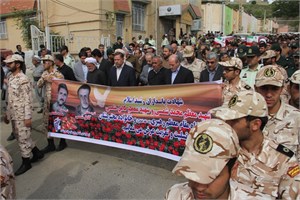
[image: Women Guerrillas of the PJAK] Published on August 19th, 2013 | *by Joanna Paraszczuk* 0 Iran Feature: Kurdish Movement PJAK Threatens President Rouhani with a Second Syria The Party for a Free Life in Kurdistan (PJAK), has warned<http://vvanwilgenburg.blogspot.co.uk/2013/08/pjak-warns-iran-could-turn-into-another.html> President Hassan Rouhani that if Tehran continues military operations against Kurdish forces in Iran, the group will turn Iran into a second Syria. PJAK, affiliated with the Turkish Kurdistan Workers Party (PKK), has carried out armed attacks in Irans Kurdistan Provinces since 2004, with the aim of establishing an autonomous Kurdish region. In October 2011, the President of Iraqi Kurdistan, Massoud Barzani, said that the Iraqi Kurdistan Regional Government and the PJAK had agreed that Iranian gorup would end its armed activities; however, clashes between PJAK and the Iranian Revolutionary Guards Corps have continued, with deaths on both sides. Last week Fars News, close to the Revolutionary Guards, reported that<http://farsnews.com/newstext.php?nn=13920521000570> an IRGC officer had been killed in border clashes with armed bandits a likely reference to the PJAK. Other Iranian media reported in May<http://sardasht-ag.ir/tabid/1032/articleType/ArticleView/articleId/27730/-2-------.aspx> that two IRGC officers had been killed in clashes with the PJAK, posting images of the martyrs: [image: ImageHandler]<http://eaworldview.com/wp-content/uploads/2013/08/ImageHandler.jpeg> Kurdish political activist Shamal Bashiri said that Tehran was passing through a sensitive stage and Hassan Rouhani is forming a new government, and he is not ready to launch a large-scale military operation. Bashiri said that the declaration of a cease-fire with Iran was in Kurdish interests, but warned that if Iran proceeded to break the cease-fire, the country will see military operations similar to the Syrian war. Analyst Wladimir van Wilgenburg adds another dimension<http://vvanwilgenburg.blogspot.co.uk/2013/08/pjak-warns-iran-could-turn-into-another.html> to the increased tensions between the PJAK and Tehran: *Iran is not happy with the PKK-Turkey talks for a political resolution, although Ankara also received the [Syrian Kurdish leaders] Salih Muslim [PYD] and Abdulhakim Bashar (KDP-S) recently. Iran wants the peace process in Turkey to fail.* ** *The PKK decided in its last meeting to uphold the ceasefire with Iran and mostly focuses on Syrias Kurds now.* PJAK has also paid more attention to Syria, amid growing violence between Kurdish militias and Islamist insurgent factions in the north of the country. Earlier this month, PJAK said that<http://www.aawsat.net/2013/08/article55312452> it was ready to send fighters to Syrian Kurdistan to fight beside their people. (Featured Images: Women PJAK insurgents at their camp in the mountains of the Iran-Iraq border Sebastian Meyer) LATEST: Rouhani Government We Are Facing Serious Budget Shortfall *Jump to Latest Update<http://eaworldview.com/2013/08/iran-today-rouhani-reaches-out-to-gulf-states/#latest> * *Press TV reports that Omani leader Sultan Qaboos bin Said, is to visit Iran<http://www.presstv.ir/detail/2013/08/18/319360/omani-king-to-visit-tehran-next-week/> next week to consolidate Tehran-Muscat ties.* It is no coincidence that the Omani ruler will be the first high-ranking official to visit Tehran since President Hassan Rouhani was formally sworn into office on August 4. Rouhani has emphasized his plans for Iran to improve relations with the Gulf States and particularly Saudi Arabia, with whom he said Tehran has very close relations culturally, historically and regionally. During Rouhanis election campaign, his deputy campaign manager Morteza Bank told pan-Arab newspaper Alsharq Alawsat<http://www.aawsat.net/2013/06/article55305491> that the Persian Gulf region enjoys a special geostrategic and strategic position in Mr. Rouhanis government and that in order to improve relations with the neighboring countries, Saudi Arabia is Rouhanis top priority. Speaking to Mehr News on Sunday about the Omani leaders visit, Deputy Foreign Minister Hossein Amir-Abdollahian referred indirectly to Rouhanis desire to improve relations with Gulf States, saying that Tehrans relations with the Persian Gulf countries are based on friendship, brotherhood and mutual trust and that Iran and regional states are determined to upgrade their cooperation in different domains ranging from the environment to security. ** Even before Rouhanis election, senior political figures set the stage for improved relations with the Gulf States including Saudi Arabia. In June, Foreign Minister Ali Akbar Salehi met the Saudi Ambassador in Tehran, saying that he hoped misunderstandings between the two countries would be cleared up in an appropriate way. In July, during the last days of the Ahmadinehad government, Salehi a fluent Arabic speaker whom Rouhani has appointed as head of the Atomic Energy Organization showed off a gift he had received from the Saudi king: Rouhani Government: We Are Facing Serious Budget Shortfall First Vice President Eshaq Jahangiri has said<http://economictimes.indiatimes.com/news/international-business/iran-faces-one-third-budget-shortfall-report/articleshow/21899823.cms> that more than one-third of the [Government] budget is unrealistic and it must be cut to about $45 billion. We face a serious budget shortfall, Jahangiri said. An aide to President Rouhani, Mohammad Baqer Nobakht, told State TV on Saturday night that a revised budget will bepresented to Parliament by mid-September. If the 2013-2014 budget law is revised, the government and the country will not face a budget shortfall and resulting inflation, Nobakht said. [image: IRAN 17-08-13 ROUHANI ZARIF] Published on August 18th, 2013 | *by Scott Lucas* 1 Iran Analysis: Interpreting a New Foreign Minister & a New Foreign Policy Ever since the election of President Rouhani and, behind him, his mentor and former President Hashemi Rafsanjani we have been anticipating a shift in Iranian foreign policy<http://eaworldview.com/2013/08/iran-analysis-what-can-we-expact-from-rouhani-government-a-4-point-guide/> to promotion of engagement with other countries, including the West and the US. Rouhani has borne out that prediction with statements since his inauguration<http://eaworldview.com/2013/08/iran-today-tehran-continues-push-for-nuclear-talks/>, including Saturdays declaration<http://eaworldview.com/2013/08/iran-today-rouhani-foreign-policy-engagement-while-standing-on-principles/> that people in the June 14 elections declared that they want a new foreign policy. In an interview with the journal Iranian Diplomacy<http://www.irdiplomacy.ir/en/page/1919990/US%E2%80%99+Turn+to+Show+Its+Political+Determination.html> run by former Deputy Foreign Minister and advisor to President Khatami, Sadegh Kharrazi the new Foreign Minister, Mohammad Javad Zarif, offers further clues: 1. MODERATION WHILE STANDING ON PRINCIPLES Moderation means realism and the creation of balance between the different needs of the country in the advancement of foreign policy and its goals in the framework of prudent and wise methods and with an appropriate dialogue. Moderation does not mean forgetting the values or leaving the principles aside. Moderation does not mean ignoring the rights of the country either. The new Foreign Ministers statement echoes Rouhanis assertion on Saturday made at the welcoming ceremony for Zarif Reconsidering foreign policy doesnt mean a change in principles because principles remain unchanged. Interpretation? Tehran will be forthcoming in seeking negotiations and dialogue with other countries, including the US, but do not expect any concessions for example, on Irans right to enrich uranium or its provision of political and military support to Syrian President Assad in advance of those talks. 2. IRANS NUCLEAR PROGRAMME We have had numerous discussions inside the government with the President with regard to how we should pursue the nuclear rights of the country and remove the oppressive sanctions imposed upon the Islamic Republic of Iran. Our basis for work is insisting on Irans rights and removing the logical concerns of the international community. As the Supreme Leader and the President himself have reiterated, this is easy provided that the objective is the resolution of the nuclear issue. Interpretation? See above on the principle of the right to enrich uranium in addition, Iran will not settle in the talks with the 5+1 Powers for anything less than the full removal of major sanctions, including restrictions on the energy and financial sectors. And Rouhani and Zarif will ensure that, while they have room for manoeuvre on Irans tactics, there is no visible distance between them and the Supreme Leader. 3. ON THE POLITICAL SITUATION IN THE US It seems that the warmongers are concerned about the reduction of problems and are trying their hardest to find an excuse to intensify the crisis. The important point is for the decision-makers in Europe and the US to comprehend the nature and goals of the warmongers well and not allow the agenda of warmongering and tension-building through oppressive pressures on the Iranian people which have no basis in international law to prevent the usage of opportunities which can be used to find a solution. Interpretation? Zarif, echoing Rouhani<http://eaworldview.com/2013/08/iran-today-tehran-presses-campaign-for-us-to-get-serious-ease-sanctions/> and other Iranian politicians, is telling President Obama, Stand up to the Congress and pursue genuine negotiations including sanctions relief, rather than imposition of more economic punishment. If Obama does this, then a deal is possible. 4. BILATERAL TALKS WITH THE US? The Supreme Leader has stated his opinion with regard to these negotiations several times. There is no issue with negotiation itself, but the question is what issues will be discussed in these talks and how much of a political determination does exist on the other side to resolve the problems. Interpretation? See above lets not talk about mechanics first, but about a change in the position of the US Administration. 5. THE MIDDLE EAST FROM SYRIA TO EGYPT Due to the mismanagement of certain players, which we have seen especially from outside the region during the past few years, conditions in the region are moving towards chaos and necessitate practical measures by everyone involved to contain the crisis. Fundamentalism, on one hand, and forgetting and ignoring the votes of the people, on the other, and, of course, the very clear intervention of foreign countries, have inflamed the region, the result of which is the killing of thousands of innocent people. Interpretation? A message to the West: pull back from support of the Syrian opposition and insurgency otherwise, you are fomenting more bloodshed and sectarian violence. And a message to the military and interim Government in Egypt: back off from confrontation and engage in political talks, including with the Muslim Brotherhood. [Non-text portions of this message have been removed] ------------------------------------ --------------------------------------------------------------------------- LAAMN: Los Angeles Alternative Media Network --------------------------------------------------------------------------- Unsubscribe: <mailto:[email protected]> --------------------------------------------------------------------------- Subscribe: <mailto:[email protected]> --------------------------------------------------------------------------- Digest: <mailto:[email protected]> --------------------------------------------------------------------------- Help: <mailto:[email protected]?subject=laamn> --------------------------------------------------------------------------- Post: <mailto:[email protected]> --------------------------------------------------------------------------- Archive1: <http://www.egroups.com/messages/laamn> --------------------------------------------------------------------------- Archive2: <http://www.mail-archive.com/[email protected]> --------------------------------------------------------------------------- Yahoo! Groups Links <*> To visit your group on the web, go to: http://groups.yahoo.com/group/laamn/ <*> Your email settings: Individual Email | Traditional <*> To change settings online go to: http://groups.yahoo.com/group/laamn/join (Yahoo! ID required) <*> To change settings via email: [email protected] [email protected] <*> To unsubscribe from this group, send an email to: [email protected] <*> Your use of Yahoo! Groups is subject to: http://docs.yahoo.com/info/terms/