Hello Jennifer and everyone

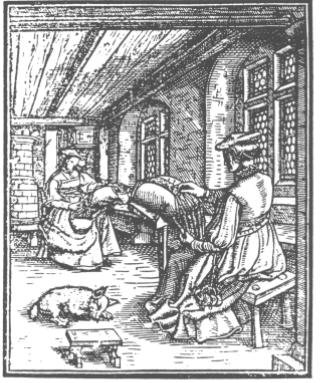
Although I haven't done research into the pillow, in looking at the jpg
(the url has an extra few letters in it, in your message)
http://ilaria.veltri.tripod.com/bobbins/nuwmodelbuch.jpg
I thought right away of the Midlands bolster as described in Alex
Stilwell's Dictionary of Lace, made from a large square of cloth, points
folded to the centre and these new sides hand-stitched, allowing room for
stuffing and stuffing, firmly stuffing, with straw. I made one once from
drill cotton, and it was a heavy immoveable object but worked well for
lace. There are several centuries between the Tudors and this Midlands
bolster, but apply the same principle to the standard width of fabric
readily accessible at the time - check into weaving history for that (plain
weave or twill?), and for the stuffing, whatever there was lots of, also
readily accessible. Possibly chaff from flax processing?

The origins for the useful object would be based on "what was around"
thinking in terms of recycling, as one would do.


On Mon, May 20, 2013 at 9:46 AM, Jennifer McNitt <[email protected]>wrote:

>
> Has anyone done much research on what early lace pillows were made out
> of?
> I'm primarily looking at the origins of the lace pillow in the sixteenth
> century or earlier.
>
> We have an image of an early pillow on the cover of Nuw
> Modelbuch (http://ilaria.veltri.tripod.com/bobbins/nuwmodelbuch.jpg).This
> pillow almost looks like the shape of a pillow that someone could sleep on.
>
>
--
Bev in Shirley BC, near Sooke on beautiful Vancouver Island, west coast of
Canada

-
To unsubscribe send email to [email protected] containing the line:
unsubscribe lace [email protected]. For help, write to
[email protected]. Photo site:
http://www.flickr.com/photos/lacemaker/sets/