I know it's a risk making trend lines, but those of us who work with clocks,
oscillators and frequency standards find it irresistible to peek ahead
sometimes and guess what's coming. This applies to my favorite clock, the earth.
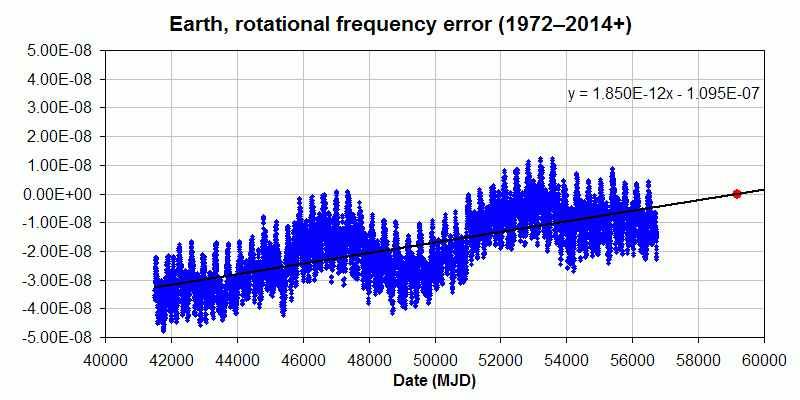
See attached inverse length of day plots (that is, frequency error rather than
excess LOD, or period error). This started with Stable32 (the standard tool we
all use for time & frequency metrology) but I reformatted them with Excel to
make them clearer.

This plot is for 1 July 1972 to the present. Those of you who follow DUT1 like
the stock market recognize the characteristic periodicity, bumps, and trends.
Note especially the stable period starting 1999, with many days of the year
longer than 86400 seconds, and consequently no leap second for 7 years (roughly
MJD 51000 to 54000).

Any betting person would say the plot shows an upward trend over the past 40
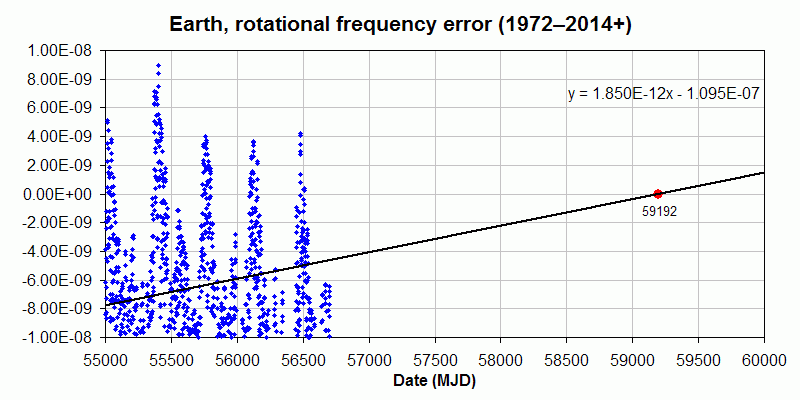
years. A simple linear fit suggests the earth will be back to an honest 86400
second day within a few years, around MJD ~59000 (year ~2020).

The URL for the plot is:
http://leapsecond.com/pages/lod/earth-lod-10.gif

See also the zoomed version, where the predicted zero-crossing is clearer:
http://leapsecond.com/pages/lod/earth-lod-11.gif

The raw DUT1 and LOD data comes from IERS. It's a work in progress; other plots
are under http://leapsecond.com/pages/lod/ as I pursue this.

I realize this is just for fun, and the serious geology, astronomy, and climate
professionals on the list will raise valid concerns. But there's no doubt that
since the 1970's the earth is generally speeding back up. If this trend
continues, within a decade, we will have another long stretch of no leap
seconds and this time it will be followed by our first negative leap second.

/tvb
<<attachment: earth-lod-10.gif>>
<<attachment: earth-lod-11.gif>>
_______________________________________________
LEAPSECS mailing list
[email protected]
http://six.pairlist.net/mailman/listinfo/leapsecs