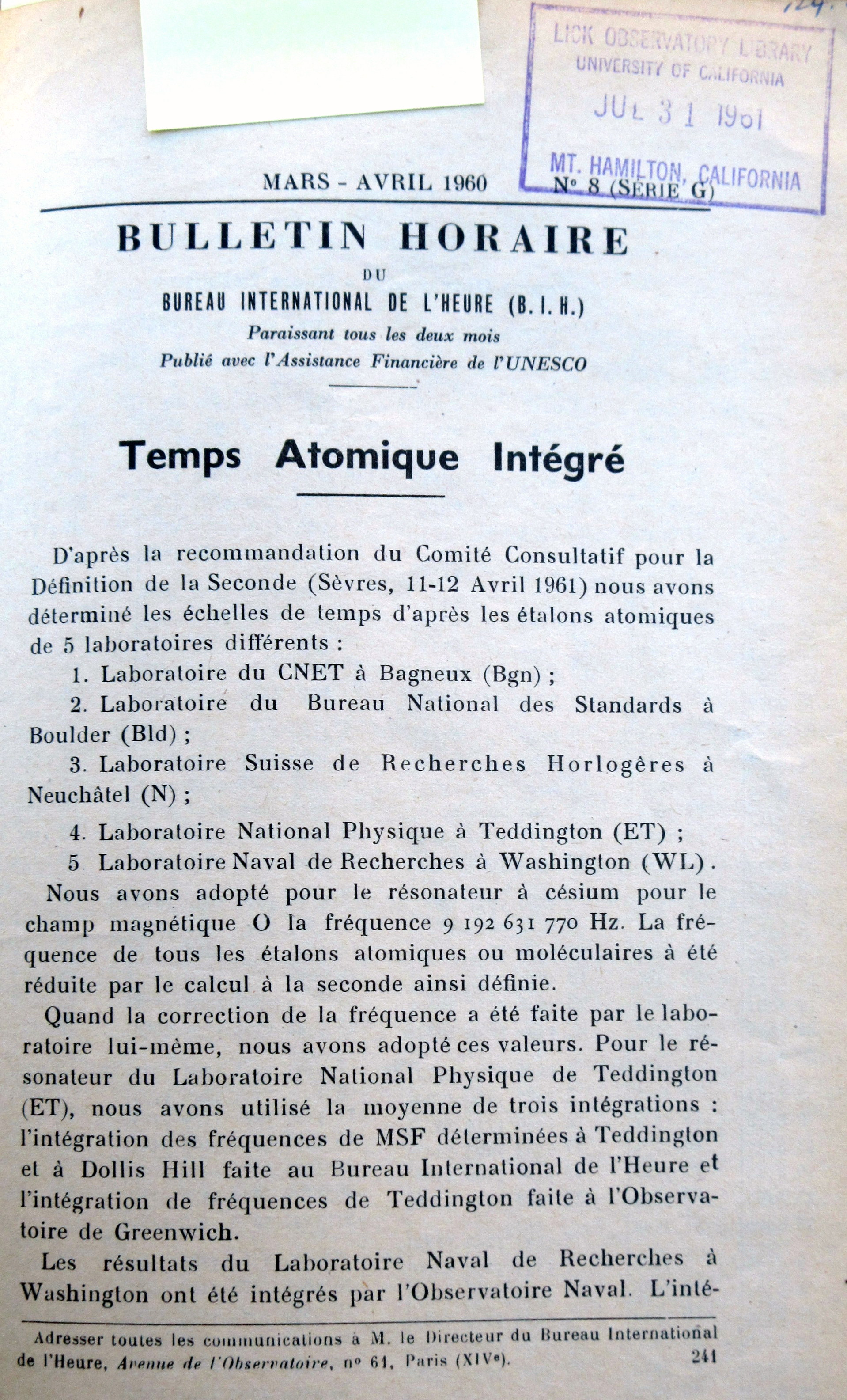
I have been diving through the library volumes with the contemporary
records of the early days of atomic chronometers.  One of the things
that stands out is in this image
https://www.ucolick.org/~sla/temporary/tai1960.jpg
Temps Atomique Intégré was first published in
Bulletin Horaire, Series G, Number 8 (1960 Mar/Apr)
Note that while this issue contained the tables of Heure Définitive
for 1960, it refers to a CCDS meeting that happened 1961 April 11/12.

At this epoch the slower issues of BH with the final values of time
were being published more than 12 months after the dates they
tabulated.  Even the faster issues of BH with the semi-final values of
time were being published about 10 months after the dates they
tabulated.  Worse, the issues which contained the predicted
corrections for transforming raw UT0 meridian observations into the
values of UT2 required for broadcast time signals were being published
after the dates those corrections were needed.  There can be little
doubt that these large delays of the perennially under-funded BIH
prompted URSI and IAU to recommend the use of coordinated frequency
offsets and time steps rather than the old way where every observatory
used its own observations to produce the reference clock for its own
radio broadcasts.

But I digress from this first publication of TAI.  I have not seen any
historical synopsis that mentions this first use of a time scale with
the initials TAI.  Has anyone seen a reference to this use?
If not, that begs the question of why not?

--
Steve Allen                    <[email protected]>              WGS-84 (GPS)
UCO/Lick Observatory--ISB 260  Natural Sciences II, Room 165  Lat  +36.99855
1156 High Street               Voice: +1 831 459 3046         Lng -122.06015
Santa Cruz, CA 95064           http://www.ucolick.org/~sla/   Hgt +250 m
_______________________________________________
LEAPSECS mailing list
[email protected]
https://pairlist6.pair.net/mailman/listinfo/leapsecs