> The epoch at which TAI was set is definitely 1961-01-01T20:00:00 UT2
>
> https://www.ucolick.org/~sla/leapsecs/taiepoch.html
I'm curious how your findings compare with this random link I ran across [1]:

https://koka-lang.github.io/koka/doc/std_time_utc.html

See especially section "1.3. UTC before 1961"

and also the link:
https://books.google.com/books?id=uJ4JhGJANb4C&lpg=PA87&vq=wwv&pg=PA87#v=onepage&q=wwv&f=false

Give it some thought. I don't have a quick answer and would appreciate your
input. If you've ever worked with raw UTC(k) data, present or historical, you
know there's no one right time. So in the late 1950's, making claims about
Paris vs. Washington / Gaithersburg / Boulder might not be as clear as you hope.

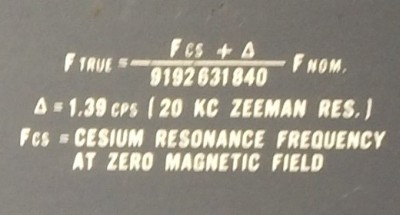
In my home museum the earliest cesium standard is 9,192,631,840 Hz not
9,192,631,770 [2]. I've learned that re-interpreting international time &
frequency history is not always simple.

/tvb

[1] I don't necessarily endorse this page; having not spent enough time with
it. As a serious hands-on atomic clock experimenter I am often repelled by
arm-chair software engineers who try to recreate time & frequency standards
history with their table lookups and pretend proleptic extrapolations.

[2] http://leapsecond.com/museum/nc2001/freq2.jpg
via http://leapsecond.com/museum/nc2001/

_______________________________________________
LEAPSECS mailing list
[email protected]
https://pairlist6.pair.net/mailman/listinfo/leapsecs