Interesting discussion on the UW and UC Berkeley lists related to
liberationtech on the FCC proposal for public WiFi.
YC


Forwarded conversation
Subject: [change] Tech, telecom giants take sides as FCC proposes large
public WiFi networks
------------------------

From: *ashish makani* <[email protected]>
Date: Tue, Feb 5, 2013 at 12:01 AM
To: TIER <[email protected]>, change <[email protected]>,
[email protected]


Hi Folks

Came across this interesting story

http://www.washingtonpost.com/business/technology/tech-telecom-giants-take-sides-as-fcc-proposes-large-public-wifi-networks/2013/02/03/eb27d3e0-698b-11e2-ada3-d86a4806d5ee_story.html

Excerpt:
"The federal government wants to create super WiFi networks across the
nation, so powerful and broad in reach that consumers could use them to
make calls or surf the Internet without paying a cellphone bill every month.

The proposal from the Federal Communications Commission has rattled the
$178 billion wireless industry, which has launched a fierce lobbying effort
to persuade policymakers to reconsider the idea, analysts say. That has
been countered by an equally intense campaign from
Google<http://washpost.bloomberg.com/marketnews/stockdetail/?symbol=GOOG>
,Microsoft<http://washpost.bloomberg.com/marketnews/stockdetail/?symbol=MSFT>
 and other tech giants who say a free-for-all WiFi service would spark an
explosion of innovations and devices that would benefit most Americans,
especially the poor."

This proposal is in the US, but would be interesting to see, if developing
countries with big user bases, could also use large scale public wi-fi n/ws
instead of/in addition to, mobile telephony n/ws.

Also, what about the relative costs of building a large scale public wifi
n/w as opposed to a mobile telephony n/w, in a world where increasingly
data dominates voice.

cheers
 ashish

_______________________________________________
change mailing list
[email protected]
http://changemm.cs.washington.edu/mailman/listinfo/change


----------
From: *Hisham Bedri* <[email protected]>
Date: Tue, Feb 5, 2013 at 4:08 AM
To: ashish makani <[email protected]>
Cc: TIER <[email protected]>, [email protected], change <
[email protected]>


Thanks for sending this out!

I heard about someone trying to implement the same thing in West Africa.
Does anyone know the specifics (pros/cons) to large-scale wifi networks vs.
cell-networks?

Thanks,
Hisham


_______________________________________________
> TIER mailing list
> Website: http://tier.cs.berkeley.edu
> [email protected]
> https://www.millennium.berkeley.edu/cgi-bin/mailman/listinfo/tier
>
>

_______________________________________________
TIER mailing list
Website: http://tier.cs.berkeley.edu
[email protected]
https://www.millennium.berkeley.edu/cgi-bin/mailman/listinfo/tier


----------
From: *Yaw Anokwa* <[email protected]>
Date: Tue, Feb 5, 2013 at 8:14 AM
To: ashish makani <[email protected]>
Cc: change <[email protected]>


Independent of the regulatory challenges, even small scale community
WiFi networks very hard to pull off. Shaddi (of TIER fame) wrote about
this a few years back. He concludes, "I'm not saying mesh networks
don't work ever...What I am saying is that unplanned wireless mesh
networks never work at scale."

Related:
http://serverfault.com/questions/72767/why-is-internet-access-and-wi-fi-always-so-terrible-at-large-tech-conferences
> _______________________________________________
> change mailing list
> [email protected]
> http://changemm.cs.washington.edu/mailman/listinfo/change
>
_______________________________________________
change mailing list
[email protected]
http://changemm.cs.washington.edu/mailman/listinfo/change

----------
From: *Kurtis Heimerl* <[email protected]>
Date: Tue, Feb 5, 2013 at 9:21 AM
To: Yaw Anokwa <[email protected]>
Cc: change <[email protected]>


I don't think anyone's talking about mesh networks, are we?

As far as wifi vs cell networks, that's a huge discussion. The biggest
issues are ones of range and quality of service; cell networks are designed
to go kilometers and provide basic guarantees for voice bandwidth. Wifi
networks are not. However, given enough spare bandwidth (rough given the
tragedy of commons) and in a dense urban situation, there's no particular
reason you couldn't do all of your communications through one of these free
networks.

I'd be happy to field any more specific questions on the differences.

_______________________________________________
change mailing list
[email protected]
http://changemm.cs.washington.edu/mailman/listinfo/change


----------
From: *Shaddi Hasan* <[email protected]>
Date: Tue, Feb 5, 2013 at 9:41 AM
To: Kurtis Heimerl <[email protected]>
Cc: "[email protected]" <[email protected]>, change <
[email protected]>


Kurtis beat me to the punch. Common architectures for mesh networks are
very inefficient, but whether community WiFi is infeasible is
an orthogonal discussion. My personal opinion is that you need someone
whose money is at stake to make any network work, but I would love to be
proven wrong.

That said, this article isn't even talking about WiFi or community
networks, and the coverage of this issue has confused the hell out of me
because I don't think anyone is proposing free WiFi. The issue here is the
FCC's desire to open up a bunch of spectrum in the 600MHz band to meet
rising mobile data demands in the US. The 600MHz band is really nice
because it has great propagation properties for going through buildings and
foliage, making it desirable for doing wireless broadband, especially in
rural areas. Think TV whitespaces, but this chunk of frequency is a
contiguous 120MHz chunk. One one side, you have the FCC and
Google/Microsoft/etc who want that band to be unlicensed (similar to the
2.4GHz and 5.8GHz bands actual WiFi uses) in order to promote competition
and increase access. On the other, you have incumbents and apparently the
Republicans who want to auction off that band since the former want to own
more spectrum for their 4G networks and the latter claim to want the
revenue from the auction (at risk of being political on a public mailing
list: I wonder if they'd still be opposed if this were cast as a tax).

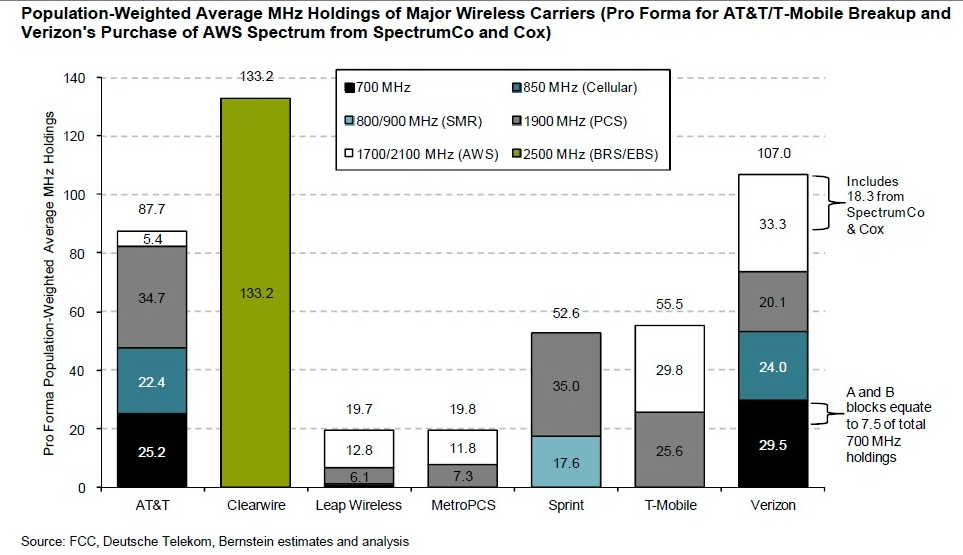
The incumbents in the US especially want more spectrum because they're
about to have new entrants into the 4G LTE market such as Clearwire (or
whoever buys them) since they own a crapload of spectrum and thus could
potentially offer high speeds:
http://static.seekingalpha.com/uploads/2012/4/29/1007049-13357261824037905-Helix-Investment-Management_origin.png

My take: it'd be a crime not to open up more unlicensed spectrum below
900MHz. It'd be a huge boost to the many Wireless ISPs in the US, and the
equipment that would be produced for that band would be excellent for rural
broadband. I expect that whatever this band gets used for, it will not be
for free service, and it will probably have an architecture pretty similar
to the cell network in urban areas and will use the standard tree-like
distribution that rural WISPs use today.

_______________________________________________
TIER mailing list
Website: http://tier.cs.berkeley.edu
[email protected]
https://www.millennium.berkeley.edu/cgi-bin/mailman/listinfo/tier


----------
From: *Pablo Paredes* <[email protected]>
Date: Tue, Feb 5, 2013 at 9:56 AM
To: Shaddi Hasan <[email protected]>
Cc: "[email protected]" <[email protected]>, change <
[email protected]>


My 2 cents...

>From my past experience with smaller projects like this in the field in
small municipalities in latin america, the biggest problem at the end is
not the technology (whether it is wifi, lte, wimax on 600MHz white spaces,
700MHz, 2.4GHz, or not), it is the actual operation.  These projects sound
very nice in paper as it is simple to throw a model that shows enough
capacity for everyone in the short term, with doable infrastructure.
 Nobody really throws numbers around actual operation and customer service.
What is more difficult, even if those numbers are there, nobody really
realizes the complexity to maintain such networks (again from a customer
use perspective).

I have seen beautiful infrastructure (fully financed) projects that die in
quite a few years due to lack of training, customer focus and lack of a
service oriented culture.

I think it is possible to overcome this problem as long as there is a
stronger emphasis on the service rather than the infrastructure. However
this is a non trivial statement in practice.  The devil is in the details
(or operation).  Potentially a PPP could help, but again, without a service
focus (and prior experience), the risk of failure is not low.


_______________________________________________
TIER mailing list
Website: http://tier.cs.berkeley.edu
[email protected]
https://www.millennium.berkeley.edu/cgi-bin/mailman/listinfo/tier


 Pablo Paredes
[email protected]


_______________________________________________
TIER mailing list
Website: http://tier.cs.berkeley.edu
[email protected]
https://www.millennium.berkeley.edu/cgi-bin/mailman/listinfo/tier


----------
From: *James Dailey* <[email protected]>
Date: Tue, Feb 5, 2013 at 10:15 AM
To: Kurtis Heimerl <[email protected]>
Cc: change <[email protected]>


Unlicensed spectrum is super important for innovation!   Really the FCC is
merely saying that a small portion of the spectrum (now owned by TV
stations) should be allocated to the public domain - unlicensed (i.e. not
sold at auction to be exclusively owned and controlled by a corporate
entity).  Mesh networks might be possible in that niche - but so could some
other interesting and innovative ideas - tethered blimp networks anyone?.
;)     Imagine what the world would be like if there was no such thing as
an opensource license, and I think you understand why having some
contextual space for different business models is important.

I applaud the FCC for taking this step.  I hope enough support lines up
behind it.

- James Dailey
Seattle


On Tue, Feb 5, 2013 at 9:21 AM, Kurtis Heimerl <[email protected]>wrote:


--
James Dailey
skype: jdailey

_______________________________________________
change mailing list
[email protected]
http://changemm.cs.washington.edu/mailman/listinfo/change


----------
From: *James Forster* <[email protected]>
Date: Tue, Feb 5, 2013 at 10:21 AM
To: Pablo Paredes <[email protected]>
Cc: "[email protected]" <[email protected]>, change <
[email protected]>


I think Pablo has focused on the right area -- operations, staffing,
responsibility, etc.  Small networks are pretty easy, but big networks are
not.

My impression about the subject of the Washington Post article referenced
below -- 'large public WiFi networks', is that many of these are being
built now; not as community networks staffed by volunteers, but designed
and built by 'professionals', funded by Google (for alternate broadband
access), the carriers (for WiFi offload), sometimes by community
development groups.

  -- Jim

_______________________________________________
TIER mailing list
Website: http://tier.cs.berkeley.edu
[email protected]
https://www.millennium.berkeley.edu/cgi-bin/mailman/listinfo/tier
--
Unsubscribe, change to digest, or change password at:
https://mailman.stanford.edu/mailman/listinfo/liberationtech