Le 06/10/2014 22:11, Francisco Ruiz a écrit :
I am in the process if adding WebRTC capabilities to my PassLok
privacy app. In its current incarnation, PassLok's public key
functions are used to generate an encrypted "chat invite" that only
the intended recipients would be able to decrypt. Once decrypted, the
invite contains the URL of a simple WebRTC webpage (based on Muaz
Khan's demos on Github)
The url of a WebRTC page???
, including a 256-bit token generated by a cryptographically secure
RNG. Users then start or join a WebRTC session, with signaling
facilitated by Firebase and XirSys
Firebase and XirSys???
, with no further involvement of PassLok other than providing an
iframe for the WebRTC to run.
an iframe!!!
But I have some doubts about the security of this scheme:
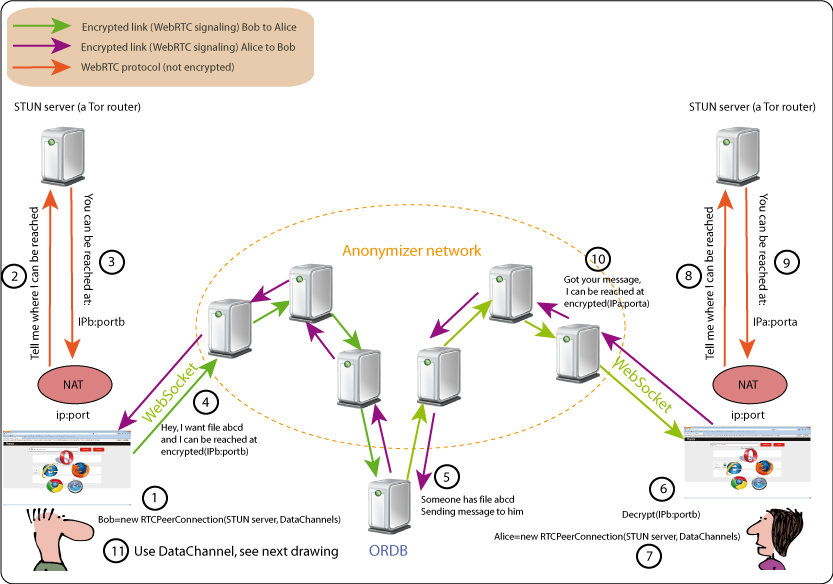
You are right to have some doubts, your scheme looks completely
insecure, you should not be using a "WebRTC page" and an iframe but host
directly the js webrtc code in your page, signaling servers are only
used to exchange the SDP information between peers, they are indeed in a
perfect position to be the MITMs, the STUN servers know about the peers
too, you can take a look at [1] where I tried to describe simply on a
drawing how it's working, or how it would work in the context of an
anonymizer network, at that time the conclusion was that WebRTC could
not be used, but it's wrong, then I wrote [2] for serverless Peersm
anonymous P2P with WebRTC.
1. In order to find each other, participants contact Firebase.io so
their external IP numbers can be relayed back to them. There is also a
connection via XirSys with pretty much the same goal. I don't
understand WebRTC (or Muaz Khan's implementation of it) to understand
precisely what is sent back and forth, but it seems that the
connection with these servers is only needed in order to get around
firewalls, and after the connection is established they are out of the
loop. Still, it bothers me that any kind of servers must be involved
to initiate each connection, since they might leak some information
about the clients that might enable malicious listeners to obtain
credentials that would enable them to establish unwanted connections.
Please look at [3], some signaling servers are necessary to bootstrap
the process (usually websockets are used with simple servers) but they
are not mandatory any longer when peers can introduce each others
(WebRTC DHT).
2. Once a connection starts, it seems that the browser (Firefox,
Chrome, Opera) deals with it very much as if a TLS connection had been
established with a server, except that it is between clients. I wonder
if this kind of connection can be trusted to be secure enough, though.
Alone it can not, WebRTC is using DTLS with self-signed certificates, so
another mechanism should be used to secure this, this is addessed in
[2], [3] and [4], see the link to the paper in [4] the idea is to use a
third party (like your Google account!!) to validate the fingerprint of
the certificates, which I don't like a lot, [2] is reusing the Tor
protocol CERT cells mechanism to do the same.
3. A third worry is about the scheme I'm using to ensure that the
chatroom is indeed private, which is to add a random token to the chat
URL itself. That URL is never displayed in my program, but I am
wondering if it needs to be relayed to the signaling server in order
to establish a WebRTC connection, in which case it might be compromised.
Any help will be appreciated.

Thanks!
[1] http://www.peersm.com/img/webrtc.png
[2]
https://github.com/Ayms/node-Tor#anonymous-serverless-p2p-inside-browsers---peersm-specs
[3]
http://librelist.com/browser//webp2p/2014/2/20/serverless-peersm-and-webrtc/#06192bfbc220d2a20c60d41c5b94f5f4
[4] http://lists.w3.org/Archives/Public/public-webcrypto/2013Nov/0057.html
--
Francisco Ruiz
Associate Professor
MMAE department
Illinois Institute of Technology

PL20ezLok=1y2z7_6qg8r_wqv3n_7886/_tj4i1_11i3w_x92wj_2p6e1_co32z_uxz0t_qLrqh_fgz++_2km/d_k6bg/_2t3q9_75xjj_w581g_bfpzx_bjxde_jnd0j=PL20ezLok
https://www.youtube.com/watch?v=YnPCfP7uPpw <https://www.youtube.com>

get the PassLok privacy app at: https://passlok.com <http://passlok.com>
--
Peersm : http://www.peersm.com
torrent-live: https://github.com/Ayms/torrent-live
node-Tor : https://www.github.com/Ayms/node-Tor
GitHub : https://www.github.com/Ayms
--
Liberationtech is public & archives are searchable on Google. Violations of
list guidelines will get you moderated:
https://mailman.stanford.edu/mailman/listinfo/liberationtech. Unsubscribe,
change to digest, or change password by emailing moderator at
[email protected].