>From Ben Schwartz:
"reading a microarray typically requires a high-resolution
digital fluorescence microscope, which is very expensive"


OLPC could be connected to USB chip for fast/cheap diagnostics.

http://www.ece.ualberta.ca/~chrisb/research/lifesciencemain.htm
January 29, 2008
Genetic testing Lab on a chip for less than $100 Canadian
<http://nextbigfuture.com/2008/01/genetic-testing-lab-on-chip-for-100.html>


Since a journal article was submitted to the Royal Society of Chemistry, the U
of Alberta researchers have already made the processor and unit smaller and
have brought the cost of building a portable unit for genetic testing down to
about $100 Cdn.
<http://www.eurekalert.org/pub_releases/2008-01/uoa-loa012808.php>  In
addition, these systems are also portable and even faster (they take only
minutes). Backhouse, Elliott and McMullin are now demonstrating prototypes of a
USB key-like system that may ultimately be as inexpensive as standard USB
memory keys that are in common use - only tens of dollars. It could help with
Pandemic disease control and detecting and controlling tainted water supplies.

This development fits in with my belief that there should be widespread
inexpensive blood, biomarker and genetic tests
<http://nextbigfuture.com/2007/11/proposal-for-widespread-monitoring-and_09.html>
  to help catch disease early and to develop an understanding of biomarker
changes to track disease and aging development. We can also create adaptive
clinical trials to shorten the development and approval process for new medical
procedures
<http://nextbigfuture.com/2007/12/biomarkers-and-adaptive-clinical-trials.html>

 <http://farm3.static.flickr.com/2223/2229764522_94fe125b9e.jpg?v=0>
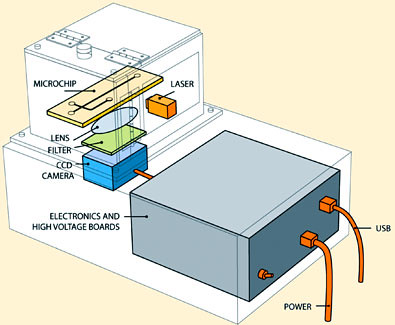
The device is now much smaller than size of a shoe-box (USB stick size) with
the optics and supporting electronics filling the space around the microchip


        Canadian scientists have succeeded in building the least expensive
portable device for rapid genetic testing ever made
<http://www.rsc.org/Publishing/ChemScience/Volume/2008/02/Genetic_testing_shoe-box.asp>
 . The cost of carrying out a single genetic test currently varies from
hundreds to thousands of pounds, and the wait for results can take weeks. Now a
group led by Christopher Backhouse <http://www.ece.ualberta.ca/~chrisb/> ,
University of Alberta, Edmonton, have developed a reusable microchip-based
system that costs just 500 (pounds) to build, is small enough to be portable,
and can be used for point-of-care medical testing.

        To keep costs down, 'instead of using the very expensive confocal
optics systems currently used in these types of devices we used a
consumer-grade digital camera', Backhouse explained.

        The device can be adapted for used in many different genetic tests. 'By
making small changes to the system you could test for a person's predisposition
to cancer, carry out pharmacogenetic tests for adverse drug reactions or even
test for pathogens in a water supply,' said Backhouse.

        The heart of the unit, the 'chip,' looks like a standard microscope
slide etched with fine silver and gold lines. That microfabricated chip applies
nano-biotechnologies within tiny volumes, sometimes working with only a few
molecules of sample. Because of this highly integrated chip (containing
microfluidics and microscale devices), the remainder of the system is
inexpensive ($1,000) and fast.

        There are many possible uses for such a portable genetic testing unit:

        Backhouse notes that adverse drug reactions are a major problem in
health care. By running a quick genetic test on a cancer patient, for example,
doctors might pinpoint the type of cancer and determine the best drug and
correct dosage for the individual.

        Or health-care professionals can easily look for the genetic signature
for a virus or E. coli - also making it useful for testing water quality.

        "From a public health point of view, it would be wonderful during an
epidemic to be able to do a quick test on a patient when they walk into an
emergency room and be able to say, 'you have SARS, you need to go into that
(isolation) room immediately.' "

        A family doctor might determine a person's genetic predisposition to an
illness during an office visit and advise the patient on preventative lifestyle
changes.


Henry Brown
[EMAIL PROTECTED]
cell 795-3680
office 505 827-2509

________________________________

From: Brown, Henry, DoIT
Sent: Mon 1/28/2008 11:26 AM
To: Benjamin M. Schwartz
Subject: RE: [OLPC library] 'OLPC-Health' takes off !!- MATLAB for OLPC?


Cheap CMOS CCD technology used in digital cameras may be able replace
microscopes in the near future.
http://www.genewave.com/documents/PS004-03_AmpliReaderW.pdf?PHPSESSID=1e778bdb95bb62afeb3343f27ff1b428

We need a prototype for clinics in the field. How soon?
There is little economic incentive to develop this technology in developing
markets.
However China and India are developing similar technology to cut health costs.
http://www.sciencedaily.com/releases/2007/03/070330092822.htm

Henry Brown
[EMAIL PROTECTED]
cell 795-3680
office 505 827-2509

________________________________

From: Benjamin M. Schwartz [mailto:[EMAIL PROTECTED]
Sent: Mon 1/28/2008 11:00 AM
To: Brown, Henry, DoIT
Cc: Arjun Sarwal; [email protected]; [EMAIL PROTECTED]; [EMAIL
PROTECTED]; [EMAIL PROTECTED]; [EMAIL PROTECTED]
Subject: Re: [OLPC library] 'OLPC-Health' takes off !!- MATLAB for OLPC?


On Mon, 2008-01-28 at 08:34 -0700, Brown, Henry, DoIT wrote:

> Could Matlab create Greene Chip DNA microarray software to run on
> OLPC?
> http://www.mailman.hs.columbia.edu/news/Lipkin_GreeneChip.html
> http://www.mathworks.com/matlabcentral/fileexchange/loadFile.do?objectId=2573
> http://laptop.org/
> http://www.sciencedaily.com/releases/2008/01/080121100909.htm
>
> If the MATLAB software could run on OLPC it could be used to monitor
> disease in the field.
> I worked with AIDS patients and child nutrition programs while in the
> Peace Corps.
> We saw kids die every week from RSV and dehydration caused by
> diarrhea.
> We did not know what antibiotic to give.
> OLPC could use MATLAB software to integrate DNA array results to
> diagnosis.
> An expert system similar to Mycin could then be used to diagnose
> disease in the field via the web.
> http://en.wikipedia.org/wiki/Mycin

Creating new software to read and analyze DNA microarrays is not hard.
MATLAB is not required.  If you can make the case for microarray
analysis, appropriate software can be created easily enough.
reading a microarray typically requires a high-resolution
digital fluorescence microscope, which is very expensive
However, .  Therefore,
any clinic that can make use of this technology is likely to be able to
afford more appropriate dedicated computing hardware than the XO.

--Ben Schwartz


______________________________________________________________________
This inbound email has been scanned by the MessageLabs Email Security System.
______________________________________________________________________


Confidentiality Notice: This e-mail, including all attachments is for the sole
use of the intended recipient(s) and may contain confidential and privileged
information. Any unauthorized review, use, disclosure or distribution is
prohibited unless specifically provided under the New Mexico Inspection of
Public Records Act. If you are not the intended recipient, please contact the
sender and destroy all copies of this message. -- This email has been scanned
by the Sybari - Antigen Email System.
_______________________________________________
Library mailing list
[email protected]
http://lists.laptop.org/listinfo/library