Thanks for your reply.

The samples from http://lsr.di.unimi.it/LSR/Item?id=954 look nice for solo
pieces, but my use case is for multiple instruments.
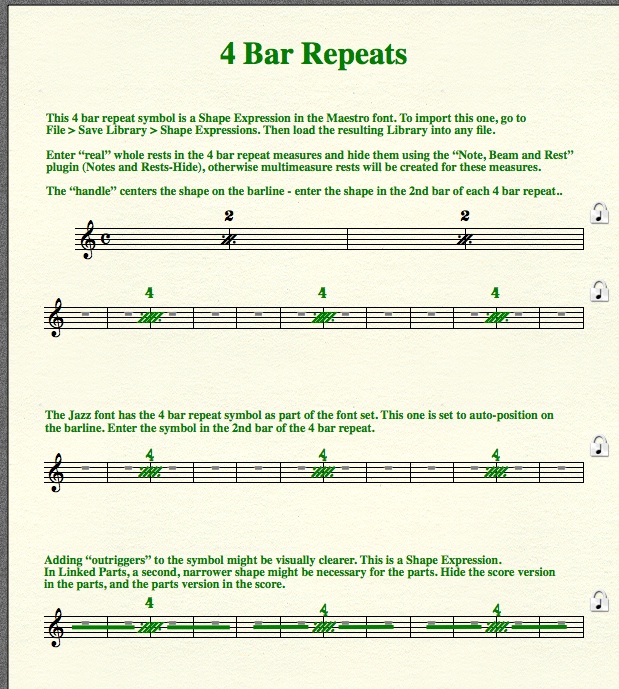
Imagine a rock band where the bass has 4 bars that will be repeated, but the
rest of the instruments don't have repetitive bars. I've have seen this usage
in rock songs for instance.
I understand the issue of having 2 empty bars and it seems like having a number
above the percent repeat helps.
Example: https://musescore.org/sites/musescore.org/files/finale%20four-bar.jpg

I've found a workaround for this here:
https://music.stackexchange.com/questions/11084/multi-measure-percent-repeats-in-lilypond

it uses a simple ./. symbol but can be changed to a .//. by changing:
'PercentEvent   to   'DoublePercentEvent

still, 4 slashes would be nice.

the default lilypond output was having the percent repeat symbol at the
beginning of the 4 bar set and the remaining bars empty.

is there a standardized approach for a 4 bar set repeat? (for a multi
instrument piece)

Best regards

On April 4, 2016 3:10:19 AM GMT+09:00, Marc Hohl <[email protected]> wrote:
>Am 03.04.2016 um 15:36 schrieb Thomas Morley:
>> 2016-04-02 19:47 GMT+02:00 Daniel E. Moctezuma
>> <[email protected]>:
>>> Hello
>>>
>>> I was wondering if it's possible to have a percent repeat with 4
>>> slashes in LilyPond. Like an \override setting or similar. My use
>>> case is when a set of 4 bars repeats n times, like: \repeat percent
>>> 4 { c1 | d | e | f | }
>>>
>>> the most I can get is a double percent symbol .//. is there a way
>>> to have .////. ?
>
>I remember vaguely that this issue has been discussed some years ago.
>
>The problem I see here is that you have two completely empty bars:
>
>|      |     .//|//.    |       |
>
>So it is not easy at first glance to understand what's going on here.
>
>I use this abbreviation for my handwritten manuscripts, but here I draw
>the slashes wide and slanted enough to cover all four bars.
>
>These comments aside, it looks as if the underlying C++ routines could
>indeed handle more than 2 slashes, but there is no way to call that
>routine directly IIUC.
>
>>>
>>> Best regards
>>
>>
>>
>> Apart from manually tweaking, I see no reasonable chance. But how
>> about: http://lsr.di.unimi.it/LSR/Item?id=954
>
>Looks promising and easy to read.
>
>Marc
>
>
>_______________________________________________
>lilypond-user mailing list
>[email protected]
>https://lists.gnu.org/mailman/listinfo/lilypond-user


_______________________________________________
lilypond-user mailing list
[email protected]
https://lists.gnu.org/mailman/listinfo/lilypond-user