2011/3/5 Tim E. Real <[email protected]>:
> On March 5, 2011 02:22:52 pm Dominique Michel wrote:
>> Le Sat, 5 Mar 2011 18:55:19 +0100,
>>
>> Giuseppe Zompatori <[email protected]> a écrit :
>> > From: Stefano D'Angelo <[email protected]>
>> > Date: 2011/2/27
>> > Subject: Re: [LAD] RDF libraries, was Re: [ANN] IR: LV2 Convolution
>> > Reverb To: Giuseppe Zompatori <[email protected]>
>> > Cc: [email protected]
>> >
>> > 2011/2/27 Stefano D'Angelo <[email protected]>:
>> > > Ciao Giuseppe,
>> >
>> > Ciao Stefano,
>> > Taking this email to a new thread.
>> >
>> > >Well... they seem to have a lot of stuff there. :-)
>> > >
>> > >However, I wonder how they do it... I think they are probably using
>> > >some black box modeling, since multiple nonlinearities+feedback in a
>> > >single system is very hard to model.
>> >
>> > They are very silent on this sadly, don't know what they are doing.
>> >
>> > >The kind of stuff I'm trying to do is accurately model a class A amp
>> > >with a single triode using white box techniques... to give you an
>> > >idea of what it sounds like see this:
>> > >http://www.youtube.com/watch?v=cdNtmaIdLdo - it is part of my MSc
>> > >thesis presentation (100.000 lire guitar, dated and slow laptop,
>> > >cheap speaker and cheap camera... only the sound card is good).
>> > >
>> > >I guess you speak Italian (at least your name suggests that), so
>> > >enjoy my weird southern accent. :-P
>> >
>> > Very interesting, I tried compiling your thesis with permafrost to try
>> > this out (obtaining the source from the pdf has been hell BTW) but it
>> > bails with an "m_pi" undeclared input/output function...
>> >
>> > Anyway, are you limited to the simulation of a half triode with white
>> > box techniques? I think you should model at least both halves of a
>> > triode if you're after accuracy, a single triode amplifier won't even
>> > work in real life (I build tube amps, I know) ;)
>> > Also class A amplifiers aren't very popular amongst guitar players
>> > (mainly because of their clipping behavior). You also want a
>> > multi-stage preamp with different filtering/biasing points between
>> > stages.
>> > You might think I am crazy but that's what you'll discover yourself by
>> > observing schematics to popular guitar amps.
>> >
>> > Here's a simple (early Fender-like) amp topology:
>> >
>> >                          Tube n. 1
>> >      -------------------------------------------------------
>> >                     Tube n. 2                           Tube n. 3 and
>> > 4
>> >
>> >
>> >
>> > 1st triode -> Tone stack -> post tone stack recovery triode -> P.I.
>> > (Phase inverter) triodes -> (at least 2) Pentodes -> O.T. (Output
>> > Transformer) -> Speakers
>> >
>> >                                     ^
>> >                                                               ^
>> >
>> >
>> >
>> >
>> >            Presence
>> > pot<--------------------------------negative-feedback--------------------
>> >-------------------------
>> >
>> >
>> > This is the easiest PP (Push Pull) class A/B amp I could come up with
>> > (sounds pretty darn good in real life). It has got a tone stack, 4
>> > tubes (2 triodes and two pentodes) and an OT/speakers, do you think
>> > this is feasible computational-wise with permafrost?
>>
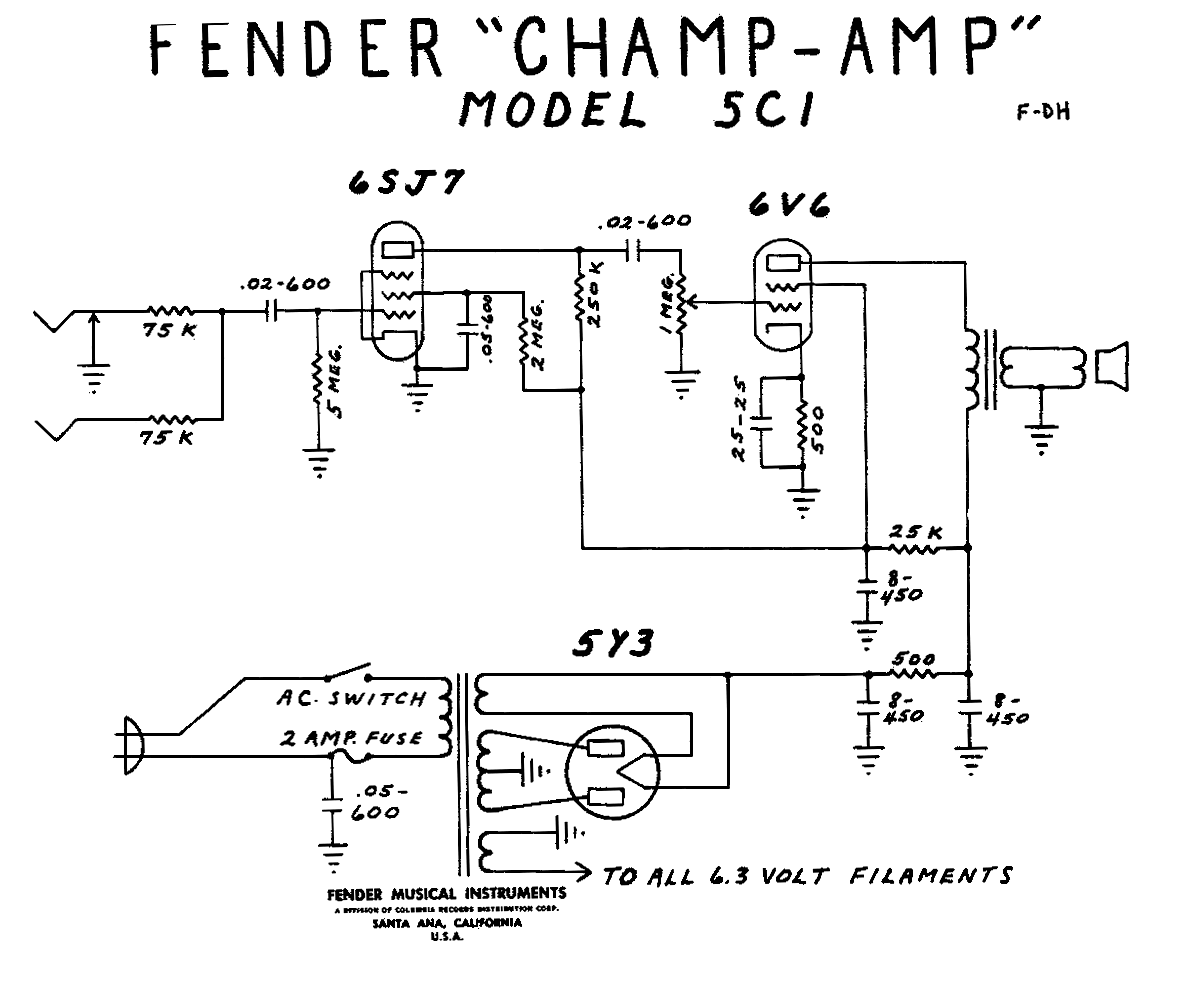
>> With triodes, the preamp will include at least 2 stages (like the 2
>> valves of an ECC81). With pentodes, you get higher gain and can make a
>> complete guitar amp with 2 tubes like in the Fender Champ :
>> http://www.drtube.com/schematics/fender/champ-5c1-schem.gif
>>
>> Also, be aware that each manufacturer make compromise between the sound
>> quality and the manufacturing costs. As example, a well-know mark is
>> using cheap power transformers, and when at full volume, the sound will
>> be very bad because half of the distortion you will ear is due to
>> saturation into the power transformer. As a consequence, those
>> amplifiers are widely used by jazz musicians but almost never by rock
>> musicians. The laters will also often blow the power transformers.
>>
>> Another well-know mark is using good but small output transformers, as
>> well than better power transformers than the precedent one. The
>> consequence is than the sound is very good at full volume, but a rock
>> or blues musician will often blow the output transformers.
>>
>> Generally speaking, a common source of non linearities, and often
>> ignored, is due to a non adequate driver stage. Tubes are by design
>> made to work best at high impedance. To get a low output impedance,
>> you need a transformer. But that's expensive hardware, especially in
>> class A. Preamp and driver stages are class A stage, when the output
>> stage is generally a class AB2 push-pull where the grid can become
>> positive in respect to the cathode.
>>
>> Common tubes for such a push-pull are 6L6. According to the datasheets,
>> such tube can take 0.35 watts and the driver output impedance must be
>> lower than 500 ohms:
>> http://www.mif.pg.gda.pl/homepages/frank/sheets/021/6/6L6.pdf
>>
>> It is no one single guitar amp I know on the market with a driver stage
>> that can provide such a power to the output stage, and this is a major
>> source of non linearities when the output stage is driven at high
>> volume.
>>
>> It would be simple to design such a driver : one tube like a
>> triode mounted EL82 in a class A stage with a high quality driver
>> transformer. But it will cost too much money, so no one single
>> manufacturer I know is using such a design. It is too bad because such
>> this sound just terrific, the sound is clean and fully saturated at the
>> same time, and its dynamic is outstanding. :)
>>
>> Be also aware than the valves models used by simulation software like
>> spice are good for consumer audio equipments or sonorisation stages, but
>> than they don't take in account the saturation that a guitar amp will
>> provide. In other words, they are completely out of business in regard
>> to correctly simulate a guitar amp at high volume, or even a simple
>> preamp stage in saturation. For that, a much better approach would be
>> to use models based on the constant current family of curves:
>> http://www.agsrhichome.bnl.gov/AP/ap_notes/ap_note_97.pdf
>>
>> My 2c
>>
>> Ciao,
>> Dominique
>
> There's also some info at simulanalog.org, on the articles page, such as
>  "A complete model of a tube amplifier stage"
> http://www.simulanalog.org/tubestage.pdf
>
> Some of the articles talk about why many tube sims are not good,
>  why they fail to take into account IM distortion etc.
>
> I really like their very good plugins, especially the JCM900.
> If someone could make a LADSPA or LV2 version of these, I would be very happy.
>
From the paper:

"We suppose the model is operating at audible fre-
quencies, so it is not necessary to consider all the sec-
ondary effects, like the Miller capacity."

But the miller capacity is important for triode models, see here why:

http://www.aikenamps.com/MillerCapacitance.html

Aiken is a respected EE/tube amps builder...

I was playing with their JCM900 sim many years ago, and never
understood why they would model it instead of a JCM800 (much better
amp)...

Anyway I had a chance to test Serafini's commecral project "TH1"
(http://www.overloud.com) and don't find the sims to sound too
realistic.

Just my 0.02€.

Cheers,

-Giuseppe

> Tim.
>
>>
>> > >Well, they say guitarix has improved, yet the last time I was all but
>> > >satisfied with it. You may want to take a look at invada plugins, if
>> > >you haven't already.
>> >
>> > Invada has a simple generic tube drive function AFAIK, I still prefer
>> > the CAPS* amp over it as it's at least based on a real amp.
>> >
>> > >Stammi bene,
>> > >
>> > >Stefano
>> >
>> > Anche tu!
>> >
>> > -Giuseppe
>
>
>
>
> _______________________________________________
> Linux-audio-dev mailing list
> [email protected]
> http://lists.linuxaudio.org/listinfo/linux-audio-dev
>
_______________________________________________
Linux-audio-dev mailing list
[email protected]
http://lists.linuxaudio.org/listinfo/linux-audio-dev