Thanks for the explaination of the interface between the session and
consumer daemon.
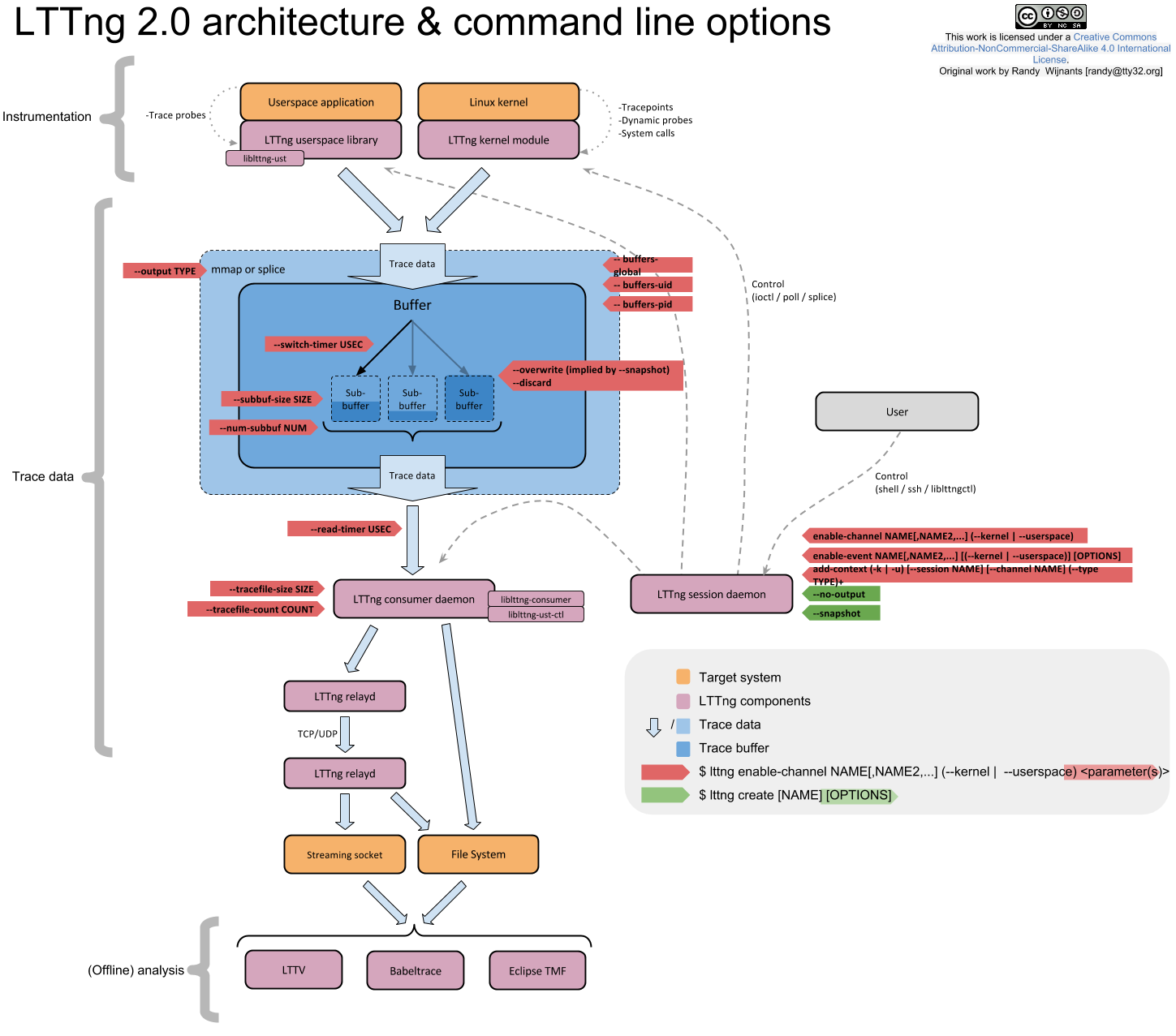
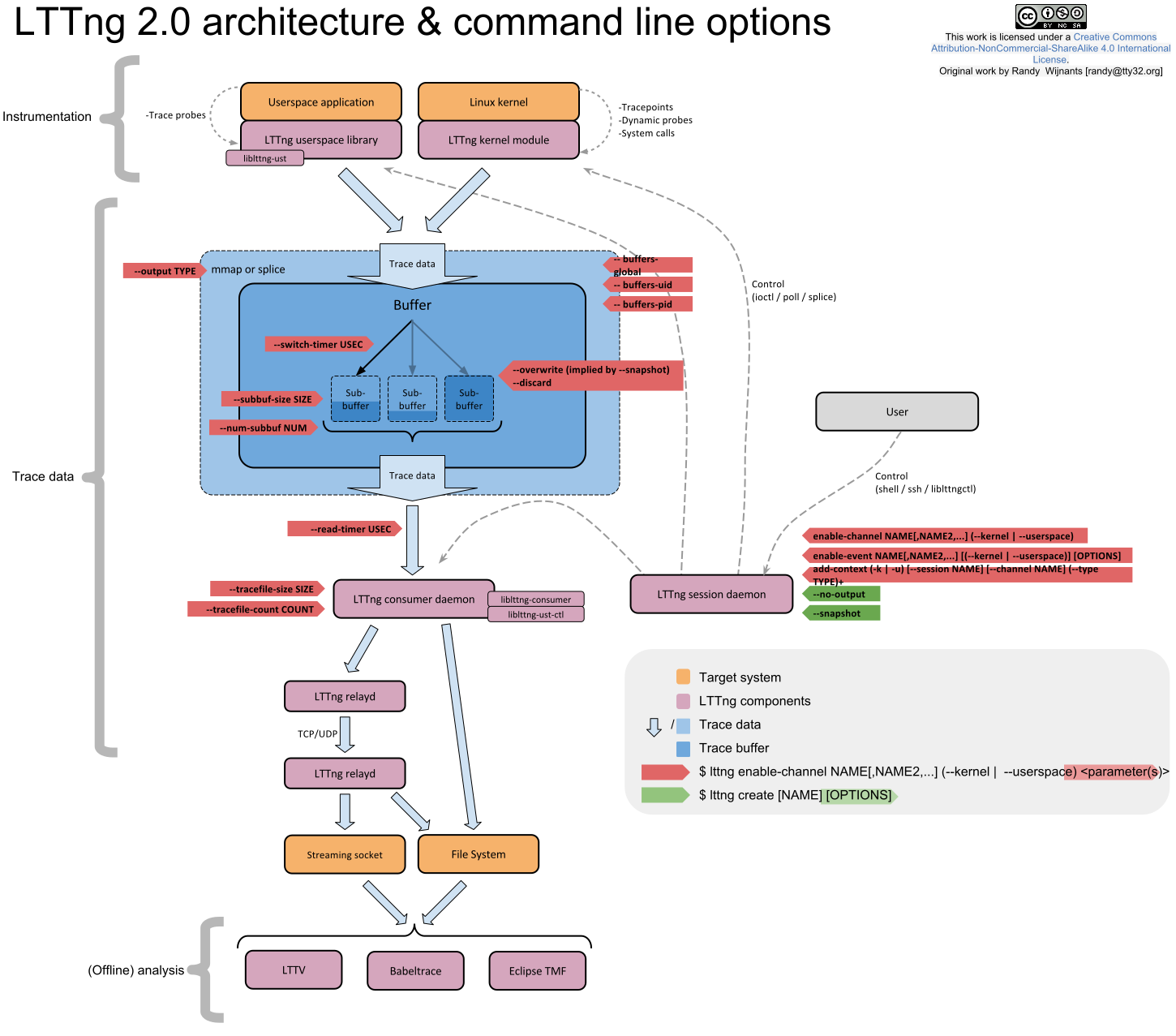
Incorporated all of your suggestions into the graphic.

Updated version:
http://tty32.org/Logging%20configuration2.png
http://tty32.org/Logging%20configuration2.svg

Should i push the SVGs to lttng git repo at this point?

Met vriendelijke groet,
Randy Wijnants.

"The good part about UDP jokes is that i don't have to worry if you get it
or not"


On 27 May 2014 15:18, Thibault, Daniel <[email protected]>wrote:

>  *De :* Randy Wijnants [mailto:[email protected]]
> *Envoyé :* 27 mai 2014 06:34
>
>   > Changed the dashed arrows into dotted arrows.
>
> >
>
> > Is the arrow running from the lttng session daemon to liblttng-ust
> valid?
>
> > Does the liblttng-ust always write to the shared memory buffer or only
> if the session daemon instructs it to (via which interface?)
>
> > And what is the interface used between the session and consumer daemon?
>
> >
>
> > New version:
>
> > http://tty32.org/Logging%20configuration2.png<http://--ESFSECEV-TY3011---------------------------->
>
> >
>
> > Randy Wijnants.
>
>
>
>    Unless I’m mistaken, when a session daemon disables a channel, for
> instance, it asks liblttng-ust to turn off the immediate value test in the
> registered applications (each tracepoint entry is guarded by an immediate
> value test which is controlled by changing a single byte).  That’s the
> principle, anyway.  I haven’t actually followed this through the tangle of
> LTTng’s code.
>
>    Rest assured that if liblttng-ust writes to a channel’s buffer, it’s
> because the event was enabled at the time.
>
>    I know the consumer daemon(s) read(s) /run/lttng/lttng-session.pid (or
> $HOME/.lttng/lttng-session.pid) to reach the session daemon.  I think the
> session daemon uses the /run/lttng/ustconsumerd64 (or
> $HOME/.lttng/ustconsumerd64; 32-bit versions may also exist) socket to send
> commands to the consumer daemon(s).
>
>    About the only things the diagram is missing now are:
>
> * the lttng-relayd daemon (which completes the “Network destination /
> streaming” box);
>
> * the add-context command (easily put beside enable-channel and
> enable-event); and
>
> * the buffers-global / buffers-pid / buffers-uid alternative (could be put
> opposite the output TYPE at the Buffer’s top right).
>
>    Change:
>
> * “LTTv” into “LTTV”
>
> * “Eclipse” into “Eclipse TMF”
>
> * “tracefilesize” into “tracefile-size”
>
> * “commandline” into “command line”
>
> Daniel U. Thibault
> Protection des systèmes et contremesures (PSC) | Systems Protection &
> Countermeasures (SPC)
> Cyber sécurité pour les missions essentielles (CME) | Mission Critical
> Cyber Security (MCCS)
> R & D pour la défense Canada - Valcartier (RDDC Valcartier) | Defence R&D
> Canada - Valcartier (DRDC Valcartier)
> 2459 route de la Bravoure
> Québec QC  G3J 1X5
> CANADA
> Vox : (418) 844-4000 x4245
> Fax : (418) 844-4538
> NAC : 918V QSDJ <http://www.travelgis.com/map.asp?addr=918V%20QSDJ>
> <*http://www.travelgis.com/map.asp?addr=918V%20QSDJ
> <http://www.travelgis.com/map.asp?addr=918V%20QSDJ>*>
> Gouvernement du Canada | Government of Canada
> <http://www.valcartier.drdc-rddc.gc.ca/>
>
_______________________________________________
lttng-dev mailing list
[email protected]
http://lists.lttng.org/cgi-bin/mailman/listinfo/lttng-dev