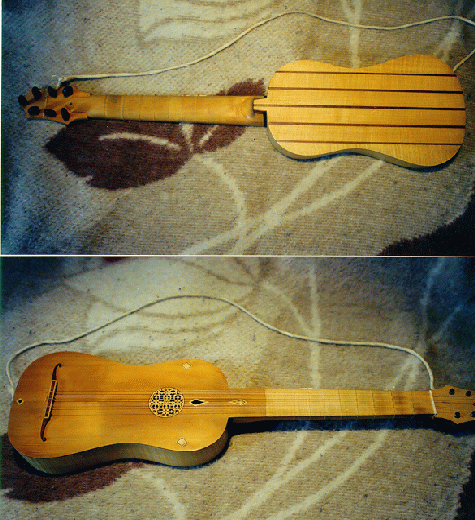
Arto,

Interesting topic, the slow growth woods for soundboards. You mention in
response to the "little ice age" point that they are currently available in
Finland and other northern countries. True, and the favored woods for US
harp builders (for soundboards) are Sitka (Alaska) Spruce and Finnish
Aircraft Grade Birch laminate. There is yet controversy in the harp
community as to the solid versus the laminated soundboard (and I can send
anyone an attachment of a "one man debate" where he takes each side and
defends it). But in both cases the choice is northern wood.
BTW, the Finnish laminate is not a normal plywood, it is 3mm thick with 6
layers of select wood. One doesn't get this at the local lumber store, that
thickness would normally be 3 plys. The 3mm is about standard for harps,
solid or laminate, as the soundboard has to take the direct pull of the
strings (in fact until it "bellies" it isn't mature).

So perhaps the suggestion of the Stradivari (and Amati) violins having the
dense wood of the little ice age may have some credibility regarding their
sound quality. As I think of it, the "chrystalline" structure of the
material (I know wood isn't chrystalline) might easily have and effect on
the sound. Drop a ball bearing on a steel plate or a lead plate, the sound
will be different. The lead will make a "clunk", the steel will ring. The
lead is heavier and therefore denser. Then try an iron plate, it has about
the same density in the sense of atomic weight as the steel, but the steel
will yet ring better. So it would seem to be the density in the sense of
atomic bonding rather than in the sense mass. Oak is a denser wood than
spruce, but I don't think it would make a good soundboard.

Pure speculation, and playing off the message about the little ice age.
Comments welcome as to other instruments and experience. My preliminary
thesis is that the dense forms of softwood, those from slow growth areas,
make the best resonating soundboards - this from the top of my head tonight.

Best, Jon

----- Original Message -----
From: "Arto Wikla" <[EMAIL PROTECTED]>
To: "Patrick H" <[EMAIL PROTECTED]>
Cc: "Lute List" <[EMAIL PROTECTED]>
Sent: Monday, December 08, 2003 5:01 PM
Subject: Re: soundboard wood from 1400-1800


>
> Dear Patrick,
>
> you wrote:
>
> >
http://www.cnn.com/2003/TECH/science/12/08/stradivarius.secret.ap/index.html
> >
> > This is an interesting story about the wood that was used by
> > Stradivari; the "Little Ice Age" that gripped Europe from the mid-1400s
> > until the mid-1800s that slowed tree growth and yielded uncommonly dense
> > Alpine spruce.
> > What does this mean for us?  Were soundboards like this used for lutes,
> > and is it possible for us to replicate this kind of wood.
>
> This is a very interesting idea! But if is is true, you still can find
> this dense spruce today from here very north, from my Finland. ;-)
> And of course also from Canada and Russia! We have lots and lots of
> dense spruce in our wast forests, just take a look to the map!
>
> By the way, my tiny chitarrino, renaissance guitar, see
>   http://www.cs.helsinki.fi/u/wikla/mus/LutePics/Chitarrino.gif
> has its soundboard made of 1500 century wood! The maker, Finnish
> lutenist Eero Palviainen, managed to buy a small part of the wall
> of a 1500 century house in Central Europe, and he used that material
> for my instrument! Perhaps that explains the very good and strong
> sound of my chitarrino?
>
> Arto
>
>
>
>