Gernot.

Actually, that's where I first saw mention of a Spelk plane.
I don't think that you'd use a spelk plane for shingles, since the width of
the wood passing through the plane was generally an inch or so.

The ribs from the 16th century had to either be sawn or split. As far as I
know, there were no super surfacers available then.

What did they use?

Garry

P.S. I'm in the process of constructing a variation of a spelk plane to test
this out. I'll report on the progress and the results


-----Original Message-----
From: Gernot Hilger [mailto:[EMAIL PROTECTED]
Sent: Sunday, November 07, 2004 3:25 PM
To: Timothy Motz
Cc: [EMAIL PROTECTED]; Craig Robert Pierpont
Subject: Re: Lute Ribs

Tim,

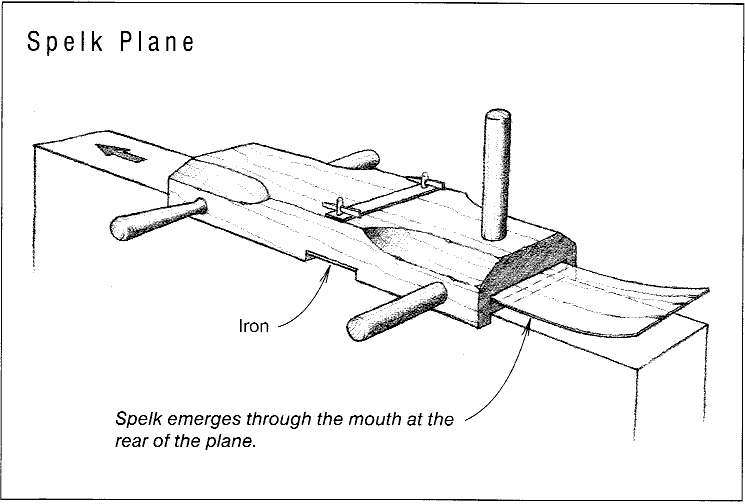
I scanned a picture from Garrett Hack's Handplane Book. Hope they
forgive me the copyright issue, it is meant as a wholehearted
recommendation for the book which can be found and ordered at
www.taunton.com

Here comes the link: http://www.jsbach.mynetcologne.de/spelkplane.gif

It is my firm belief that spelk planes do not work at all for any wood
that may be remotely used for lute ribs. Here, the used to use spelk
planes mainly for herring casks and the like, these were made from
willow. The wood needed to be wet to be soft enough to pass the plane
and there are still lots of fibres crushed by the process. You probably
don't want to have damaged fibres in your 1/16" thick lute ribs!

I also doubt that spelk planes produce durable shingles. In the black
forest, where I used to live for several years, the have many shingled
houses. I have seen e few shingle makers and they would invariably use
a froe and sharp knives for the job. They told me that split shingles
last at least 50 years, whilst sawn ones give up after 20 years.

g

On 07.11.2004, at 18:17, Timothy Motz wrote:

> Craig and Garry,
>
> I'm curious as to what such a plane looks like.  I tried looking online
> but couldn't find anything.  Does anyone know of photos or drawings
> online?
>
> I've read that for a pre-industrial society, the easiest way to get
> thin wood is by splitting with a froe.  That's how wooden shakes and
> shingles were made.  I've used a froe to split logs into sections for
> drying and it does work amazingly well.  To get thin pieces for lute
> backs I would think that you would need extremely straight-grained
> wood, however.
>
> Tim
>
> On Sunday, November 7, 2004, at 11:47 AM, Craig Robert Pierpont wrote:
>
>> Garry,
>> While not impossible, it seems unlikely as such a plane causes
>> considerable distortion and fracturing of the wood fibers.
>>
>> Garry Bryan <[EMAIL PROTECTED]> wrote:
>> Dear Lutenists,
>> Is it possible that renaissance and baroque luthiers could
>> have used the predecessor of the Spelk plane (it produces Spelk. Spelk
>> is a
>> thin strip of wood used by the Shakers to make baskets and chair
>> seats) to
>> produce the ribs for lutes? A Spelk plane would be able to cut strips
>> of
>> wood that are both wide enough and thick enough to be used. I would
>> think
>> that it would have been quicker and more cost effective to produce the
>> rough
>> ribs using this method than by cutting up a thin board into strips.
>>
>> Thoughts? Opinions?
>>
>> Garry
>>
>>
>> ---------------------------------
>> Do you Yahoo!?
>>  Check out the new Yahoo! Front Page. www.yahoo.com
>> --
>>
>> To get on or off this list see list information at
>> http://www.cs.dartmouth.edu/~wbc/lute-admin/index.html
>>
>
>