Dear Stephen
          To guide me I have Louis Pernot's
   > recording of this work, which I have often found very helpful (though
   I find
   >
   > his tone rather harsh--does anyone else?).
   Yes, Louis Pernot, himself, seems a little disappointed in the sound
   quality of the recording.
   I have not heard him play on his own lutes, which are strung with
   Charles Besnainou gut spring-string basses, but recently he came to
   play my 11c Stephen Gottlieb lute strung with Mimmo's loaded basses
   with Venice octaves. His playing struck me as very clear, and
   rhythmically well defined and articulated, certainly not warm or
   "Romantic", but not dry, as it can sound on this recording.
   It is true that he plays back near the bridge, but this is necessary
   with Charles' bass strings, as they have 25% stretch (at 3Kg they are
   more like 2Kg strings). Thus he adopts more or less the same position
   as T. Satoh does for his low tension strings (and has been doing that
   since the 70s)
   [1]http://louispernot.com/artist.html
   [2]http://www.cs.dartmouth.edu/~lsa/old/Cleveland2006/TSatohConcert.htm
   l
   Now it is possible that if a player moves back to the bridge, because
   the basses are supple, while the trebles are normal gut high tension
   strings (as Louis' are, but T. Satoh's aren't) that the trebles might
   become a little dry. However, I did not really notice that when Louis
   played on my strings and lute.
   I have heard Charles Besnainou play his lute with carbon bass spring
   strings, and the sound was very open and free, and not at all dry; so I
   don't think it can be a defect of this string type.
   [EMBED]
   [3]http://tinyurl.com/yel63kz
   [EMBED]
   [EMBED]
   although they did have that characteristic carbon sound (which of
   course would not be the case with Louis' gut version).
         As to Louis Pernot's playing, I was extremely impressed. I only
   had to hand T. Satoh's Weichenberger transcription, which he told me he
   had never seen before, and I was surprised to hear him play it straight
   off, without any hesitation, and with remarkably lucid rhythmic
   stability. That was what I noticed most, his rhythmic clarity. I had
   difficulty mastering the piece after a month, and he could play it at
   "full tilt" while sight reading; but looking at Louis' artistic
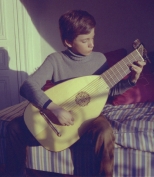
   history, I understand why: he began playing the Baroque lute before the
   age of fifteen
   [4]http://louispernot.com/images/louis2.jpg
   Regards
   Anthony
   ---- Message d'origine ----
   >De : "Stephen Arndt" <[email protected]>
   >A : "Lute List" <[email protected]>;
   > "Suzanne Angevine" <[email protected]>
   >Objet : [LUTE] Re: tempos in Francesco Fantasias
   >Date : 12/03/2010 21:16:12 CET
   >
   >I am not exactly responding to Susanne's message, but making a related
   > comment. I have been playing through and home-recording Denis
   Gaultier's "La
   >
   > rhetorique des dieux" on my 11-course. To guide me I have Louis
   Pernot's
   > recording of this work, which I have often found very helpful (though
   I find
   >
   > his tone rather harsh--does anyone else?). But, generally speaking, I
   simply
   >
   > cannot play these pieces at the same tempos (or tempi for the Italian
   > purists, or tempora for the Latin purists) as he does, which I find
   very
   > frustrating. I don't know how one works up to those speeds, unless
   one plays
   >
   > a piece over and over with a metronome, gradually increasing the
   number of
   > beats per minute, which I actually do, though before long I seem to
   reach a
   >
   > limit that I can't manage to surpass no matter how long I practice. I
   assume
   >
   > that Mr. Pernot knows very well what he is doing and is playing these
   pieces
   >
   > at the speeds at which they were intended to be played.
   >
   > In a related vein, I have been working through Elias Mertel's "Novus
   hortus
   >
   > musicalis" on my 10-course, and I generally play the pieces as fast
   as I
   > comfortably can, though I suspect that I am playing practically all
   of them
   >
   > too slowly on account of my technical limitations.
   >
   > Any suggestions for improving speed or advice on determining the
   proper
   > tempo for a piece would be much appreciated.
   >
   > Best regards to all,
   >
   > Stephen Arndt
   >
   >
   > ----- Original Message -----
   > From: "Suzanne Angevine" <[email protected]>
   > To: "Lute List" <[email protected]>
   > Sent: Friday, March 12, 2010 11:26 AM
   > Subject: [LUTE] tempos in Francesco Fantasias
   >
   >
   > > Yesterday I got out a Francesco Fantasia I hadn't played in awhile.
   Its
   > > one of the easier ones, since I'm not that advanced a player. But I
   > > thoroughly enjoyed playing it - the counterpoint, the
   expressiveness of
   > > it. Later in the day I listened to a CD of a big name player doing
   > > Francesco pieces. What struck me most was the utter contrast
   between what
   >
   > > I had enjoyed about playing the music, and what I heard. Not just
   on the
   >
   > > same Fantasia, but almost the entire CD was BRIGHT, and very PERKY
   > > sounding. In thinking about it, I felt that this effect was due
   almost
   > > entirely to the fast tempos chosen. Now this player has exceptional
   > > technique, and can play fast and cleanly. And it is to be admitted
   that
   > > the CD is rather old, and may no longer represent the player's
   point of
   > > view on Francesco exactly. But it got me thinking about tempos.
   Someone
   >
   > > on this list recently commented that folks generally try to play
   too fast.
   >
   > > Is there some actual musicological evidence somewhere that says
   what
   > > tempos should be used? Or do moderns just play fast because we live
   in a
   >
   > > fast paced world, and playing well fast shows off our skill? A
   moderate
   > > tempo on the Fantasia in question allows some time and space for
   > > expression of the music to bloom, but a fast, perky tempo just
   makes it
   > > sound like pyrotechnic display, not what would earn a player the
   name of
   > > "il divino". So, any musicological evidence for proper tempos in
   > > Francesco's music?
   > >
   > > Suzanne
   > >
   > >
   > >
   > > To get on or off this list see list information at
   > > [5]http://www.cs.dartmouth.edu/~wbc/lute-admin/index.html
   >
   >
   >

   --

References

   1. http://louispernot.com/artist.html
   2. http://www.cs.dartmouth.edu/%7Elsa/old/Cleveland2006/TSatohConcert.html
   3. http://tinyurl.com/yel63kz
   4. http://louispernot.com/images/louis2.jpg
   5. http://www.cs.dartmouth.edu/%7Ewbc/lute-admin/index.html