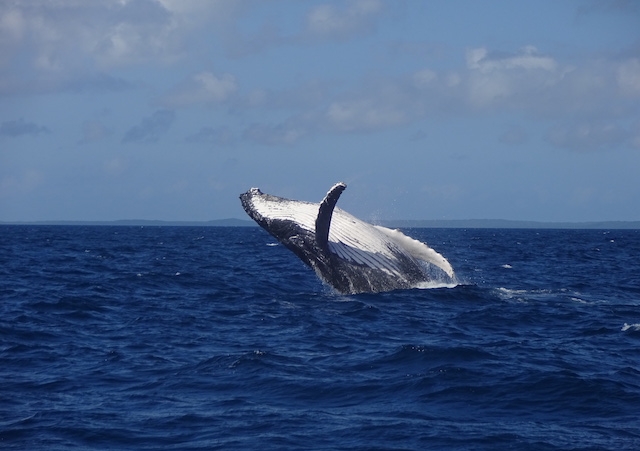
Dear colleagues,

Do the bacterial communities in the airways of whales reflect the physical
state of the whales? We found first evidence that they do.
We would like to announce the publication of our paper 'Respiratory microbiota
of humpback whales may be reduced in diversity and richness the longer they
fast' in Scientific Reports last week.

The paper is available (free access) via:
https://rdcu.be/b5TJR

The Australian Academy of Science created this short video about the paper:
https://vimeo.com/435003703/4222edc479

This is the press release of the University of New South Wales:
https://newsroom.unsw.edu.au/news/science-tech/whale-snot-reveals-likely-poor-health-during-migration
[https://newsroom.unsw.edu.au/sites/default/files/thumbnails/image/1._whale_dsc01689_copy_1.jpg]<https://newsroom.unsw.edu.au/news/science-tech/whale-snot-reveals-likely-poor-health-during-migration>
Whale 'snot' reveals likely poor health during migration | UNSW
Newsroom<https://newsroom.unsw.edu.au/news/science-tech/whale-snot-reveals-likely-poor-health-during-migration>
Whale-watching season is delighting the viewing public along the east
Australian coast but while it’s a boon for the tourism industry, for the
majestic humpback whale it’s potentially a time of less optimal health.
newsroom.unsw.edu.au

Abstract:
Humpback whales endure several months of fasting while undertaking one of the
longest annual migrations of any mammal, which depletes the whales’ energy
stores and likely compromises their physiological state. Airway microbiota are
linked to respiratory health in mammals. To illuminate the dynamics of airway
microbiota in a physiologically challenged mammal, we investigated the
bacterial communities in the blow of East Australian humpback whales at two
stages of their migration: at the beginning (n = 20) and several months into
their migration (n = 20), using barcoded tag sequencing of the bacterial 16S
rRNA gene. We show that early in the fasting the whale blow samples had a
higher diversity and richness combined with a larger number of core taxa and a
different bacterial composition than later in the fasting. This study provides
some evidence that the rich blow microbiota at the beginning of their fasting
might reflect the whales’ uncompromised physiology and that changes in the
microbiota occur during the whales’ migration.

Thank you and kind regards,
Catharina


--
Catharina Vendl | DVM | PhD |
Inter-Disciplinary Ecology and Evolution Lab |
School of Biology, Earth & Environmental Sciences |
University of New South Wales Sydney | Australia |
Phone +61 4 1655 2101
https://cvendl.wixsite.com/catharina
@ScienceCath
_______________________________________________
MARMAM mailing list
[email protected]
https://lists.uvic.ca/mailman/listinfo/marmam