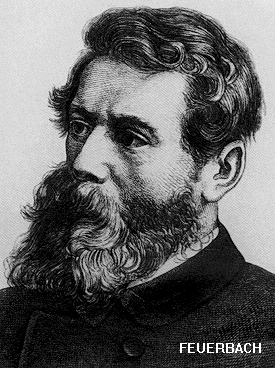
Feuerbach
________________________________
feuerbach
<http://www.marxists.org/archive/marx/works/1886/ludwig-feuerbach/ch03.gif>

The real idealism of Feuerbach becomes evident as soon as we come to his
philosophy of religion and ethics. He by no means wishes to abolish
religion; he wants to perfect it. Philosophy itself must be absorbed in
religion.

"The periods of humanity are distinguished only by religious changes. A
historical movement is fundamental only when it is rooted in the hearts of
men. The heart is not a form of religion, so that the latter should exist
also in the heart; the heart is the essence of religion." (Quoted by
Starcke, p.168.)

According to Feuerbach, religion is the relation between human beings based
on the affections, the relation based on the heart, which relation until now
has sought its truth in a fantastic mirror image of reality - in the
mediation of one or many gods, the fantastic mirror images of human
qualities - but now finds it directly and without any mediation in the love
between "I" and "Thou". Thus, finally, with Feuerbach sex love becomes one
of the highest forms, if not the highest form, of the practice of his new
religion.

Now relations between human beings, based on affection, and especially
between the two sexes, have existed as long as mankind has. Sex love in
particular has undergone a development and won a place during the last 800
years which has made it a compulsory pivotal point of all poetry during this
period. The existing positive religions have limited themselves to the
bestowal of a higher consecration upon state-regulated sex love - that is,
upon the marriage laws - and they could all disappear tomorrow without
changing in the slightest the practice of love and friendship. Thus the
Christian religion in France, as a matter of fact, so completely disappeared
in the year 1793-95 that even Napoleon could not re-introduce it without
opposition and difficulty; and this without any need for a substitute in
Feuerbach's sense, making itself in the interval.

Feuerbach's idealism consists here in this: he does not simply accept mutual
relations based on reciprocal inclination between human beings, such as sex
love, friendship, compassion, self-sacrifice, etc., as what they are in
themselves - without associating them with any particular religion which to
him, too, belongs to the past; but instead he asserts that they will attain
their full value only when consecrated by the name of religion. The chief
thing for him is not that these purely human relations exist, but that they
shall be conceived of as the new, true, religion. They are to have full
value only after they have been marked with a religious stamp. Religion is
derived from religare ["to bind"] and meant, originally, a bond. Therefore,
every bond between two people is a religion. Such etymological tricks are
the last resort of idealist philosophy. Not what the word means according to
the historical development of its actual use, but what it ought to mean
according to its derivation is what counts. And so sex love, and the
intercourse between the sexes, is apotheosized to a religion, merely in
order that the word religion, which is so dear to idealistic memories, may
not disappear from the language. The Parisian reformers of the Louis Blanc
trend used to speak in precisely the same way in the forties. They,
likewise, could conceive of a man without religion only as a monster, and
used to say to us: "Donc, l'atheisme c'est votre religion!" ["Well, then
atheism is your religion!"] If Feuerbach wishes to establish a true religion
upon the basis of an essentially materialist conception of nature, that is
the same as regarding modern chemistry as true alchemy. If religion can
exist without its god, alchemy can exist without its philosopher's stone. By
the way, there exists a very close connection between alchemy and religion.
The philosopher's stone has many godlike properties and the Egyptian-Greek
alchemists of the first two centuries of our era had a hand in the
development of Christian doctrines, as the data given by Kopp and Bertholet
have proved.

Feuerbach's assertion that "the periods of humanity are distinguished only
by religious changes" is decidedly false. Great historical turning-points
have been accompanied by religious changes only so far as the three world
religions which have existed up to the present - Buddhism, Christianity, and
Islam - are concerned. The old tribal and national religions, which arose
spontaneously, did not proselytize and lost all their power of resistance as
soon as the independence of the tribe or people was lost. For the Germans,
it was sufficient to have simple contact with the decaying Roman world
empire and with its newly adopted Christian world religion which fitted its
economic, political, and ideological conditions. Only with these world
religions, arisen more or less artificially, particularly Christianity and
Islam, do we find that the more general historical movements acquire a
religious imprint. Even in regard to Christianity, the religious stamp in
revolutions of really universal significance is restricted to the first
stages of the bourgeoisie's struggle for emancipation - from the 13th to the
17th century - and is to be accounted for, not as Feuerbach thinks by the
hearts of men and their religious needs, but by the entire previous history
of the Middle Ages, which knew no other form of ideology than religion and
theology. But when the bourgeoisie of the 18th century was strengthened
enough likewise to posses an ideology of its own, suited to its own class
standpoint, it made its great and conclusive revolution - the French -,
appealing exclusively to juristic and political ideas, and troubling itself
with religion only in so far as it stood in its way. But it never occurred
to it to put a new religion in place of the old. Everyone knows how
Robespierre failed in his attempt [to set up a religion of the "highest
being"].

The possibility of purely human sentiments in our intercourse with other
human beings has nowadays been sufficiently curtailed by the society in
which we must live, which is based upon class antagonism and class rule. We
have no reason to curtail it still more by exalting these sentiments to a
religion. And similarly the understanding of the great historical class
struggles has already been sufficiently obscured by current historiography,
particularly in Germany, so that there is also no need for us to make such
an understanding totally impossible by transforming the history of these
struggles into a mere appendix of ecclesiastical history. Already here it
becomes evident how far today we have moved beyond Feuerbach. His "finest"
passages in glorification of his new religion of love are totally unreadable
today.

The only religion which Feuerbach examines seriously is Christianity, the
world religion of the Occident, based upon monotheism. He proves that the
Christian god is only a fantastic reflection, a mirror image, of man. Now,
this god is, however, himself the product of a tedious process of
abstraction, the concentrated quintessence of the numerous earlier tribal
and national gods. And man, whose image this god is, is therefore also not a
real man, but likewise the quintessence of the numerous real men, man in the
abstract, therefore himself again a mental image. Feuerbach, who on every
page preaches sensuousness, absorption in the concrete, in actuality,
becomes thoroughly abstract as soon as he begins to talk of any other than
mere sex relations between human beings.

Of these relations, only one aspect appeals to him: morality. And here we
are again struck by Feuerbach's astonishing poverty when compared to Hegel.
The latter's ethics, or doctrine of moral conduct, is the philosophy of
right, and embraces: (1) abstract right; (2) morality; (3) social ethics
[Sittlichkeit], under which are comprised: the family, civil society, and
the state.

Here the content is as realistic as the form is idealistic. Besides
morality, the whole sphere of law, economy, politics is here included. With
Feuerbach, it is just the reverse. In the form he is realistic since he
takes his start from man; but there is absolutely no mention of the world in
which this man lives; hence, this man remains always the same abstract man
who occupied the field in the philosophy of religion. For this man is not
born of woman; he issues, as from a chrysalis, from the god of monotheistic
religions. He therefore does not live in a real world historically come into
being and historically determined. True, he has intercourse with other men;
however, each one of them is just as much an abstraction as he himself. In
his philosophy of religion we still had men and women, but in his ethics
even this last distinction disappears. Feuerbach, to be sure, at long
intervals makes such statements as: "Man thinks differently in a palace and
in a hut." "If because of hunger, of misery, you have no stuff in your body,
you likewise have no stuff for morality in your head, in your mind, or
heart." "Politics must become our religion," etc.

But Feuerbach is absolutely incapable of achieving anything with these
maxims. They remain mere phrases, and even Starcke has to admit that for
Feuerbach politics constituted an impassable frontier and the "science of
society, sociology, was terra incognita to him".

He appears just as shallow, in comparison with Hegel, in his treatment of
the antithesis of good and evil.

"One believes one is saying something great," Hegel remarks, "if one says
that 'man is naturally good'. But one forgets that one says something far
greater when one says 'man is naturally evil'."

With Hegel, evil is the form in which the motive force of historical
development presents itself. This contains the twofold meaning that, on the
one hand, each new advance necessarily appears as a sacrilege against things
hallowed, as a rebellion against condition, though old and moribund, yet
sanctified by custom; and that, on the other hand, it is precisely the
wicked passions of man - greed and lust for power - which, since the
emergence of class antagonisms, serve as levers of historical development -
a fact of which the history of feudalism and of the bourgeoisie, for
example, constitutes a single continual proof. But it does not occur to
Feuerbach to investigate the historical role of moral evil. To him, history
is altogether an uncanny domain in which he feels ill at ease. Even his
dictum: "Man as he sprang originally from nature was only a mere creature of
nature, not a man. Man is a product of man, of culture, of history" - with
him, even this dictum remains absolutely sterile.

What Feuerbach has to tell us about morals can, therefore, only be extremely
meagre. The urge towards happiness is innate in man, and must therefore form
the basis of all morality. But the urge towards happiness is subject to a
double correction. First, by the natural consequences of our actions: after
the debauch comes the "blues", and habitual excess is followed by illness.
Secondly, by its social consequences: if we do not respect the similar urge
of other people towards happiness they will defend themselves, and so
interfere with our own urge toward happiness. Consequently, in order to
satisfy our urge, we must be in a position to appreciate rightly the results
of our conduct and must likewise allow others an equal right to seek
happiness. Rational self-restraint with regard to ourselves, and love -
again and again love! - in our intercourse with others - these are the basic
laws of Feuerbach's morality; from them, all others are derived. And neither
the most spirited utterances of Feuerbach nor the strongest eulogies of
Starcke can hide the tenuity and banality of these few propositions.

Only very exceptionally, and by no means to this and other people's profit,
can an individual satisfy his urge towards happiness by preoccupation with
himself. Rather, it requires preoccupation with the outside world, with
means to satisfy his needs - that is to say, food, an individual of the
opposite sex, books, conversation, argument, activities, objects for use and
working up. Feuerbach's morality either presupposes that these means and
objects of satisfaction are given to every individual as a matter of course,
or else it offers only inapplicable good advice and is, therefore, not worth
a brass farthing to people who are without these means. And Feuerbach
himself states this in plain terms:

"Man thinks differently in a palace and in a hut. If because of hunger, of
misery, you have no stuff in your body, you likewise have no stuff for
morality in your head, in your mind, or heart."

Do matters fare any better in regard to the equal right of others to satisfy
their urge towards happiness? Feuerbach posed this claim as absolute, as
holding good for all times and circumstances. But since when has it been
valid? Was there ever in antiquity between slaves and masters, or in the
Middle Ages between serfs and barons, any talk about an equal right to the
urge towards happiness? Was not the urge towards happiness of the oppressed
class sacrificed ruthlessly and "by the right of law" to that of the ruling
class? Yes, that was indeed immoral; nowadays, however, equality of rights
is recognized. Recognized in words ever since and inasmuch as the
bourgeoisie, in its fight against feudalism and in the development of
capitalist production, was compelled to abolish all privileges of estate,
that is, personal privileges, and to introduce the equality of all
individuals before law, first in the sphere in private law, then gradually
also in the sphere of public law. But the urge towards happiness thrives
only to a trivial extent on ideal rights. To the greatest extent of all it
thrives on material means; and capitalist production takes care to ensure
that the great majority of those equal rights shall get only what is
essential for bare existence. Capitalist production has, therefore, little
more respect, if indeed any more, for the equal right to the urge towards
happiness of the majority than had slavery or serfdom. And are we better off
in regard to the mental means of happiness, the educational means? Is not
even "the schoolmaster of Sadowa" a mythical person? [A]
<http://www.marxists.org/archive/marx/works/1886/ludwig-feuerbach/ch03.htm#A
>

More. According to Feuerbach's theory of morals, the Stock Exchange is the
highest temple of moral conduct, provided only that one always speculates
right. If my urge towards happiness leads me to the Stock Exchange, and if
there I correctly gauge the consequences of my actions so that only
agreeable results and no disadvantages ensue - that is, I always win - then
I am fulfilling Feuerbach's precept. Moreover, I do not thereby interfere
with the equal right of another person to pursue his happiness; for that
other man went to the Exchange just as voluntarily as I did and in
concluding the speculative transaction with me he has followed his urge
towards happiness as I have followed mine. If he loses his money, his action
is ipso facto proved to have been unethical, because of his bad reckoning,
and since I have given him the punishment he deserves, I can even slap my
chest proudly, like a modern Rhadamanthus. Love, too, rules on the Stock
Exchange, in so far as it is not simply a sentimental figure of speech, for
each finds in others the satisfaction of his own urge towards happiness,
which is just what love ought to achieve and how it acts in practice. And if
I gamble with correct prevision of the consequences of my operations, and
therefore with success, I fulfil all the strictest injunctions of
Feuerbachian morality - and becomes a rich man into the bargain. In other
words, Feuerbach's morality is cut exactly to the pattern of modern
capitalist society, little as Feuerbach himself might desire or imagine it.

But love! - yes, with Feuerbach, love is everywhere and at all times the
wonder-working god who should help to surmount all difficulties of practical
life - and at that in a society which is split into classes with
diametrically opposite interests. At this point, the last relic of the
revolutionary character disappears from his philosophy, leaving only the old
cant: Love one another - fall into each other's arms regardless of
distinctions of sex or estate - a universal orgy of reconciliation!

In short, the Feuerbachian theory of morals fares like all its predecessors.
It is designed to suit all periods, all peoples and all conditions, and
precisely for that reason it is never and nowhere applicable. It remains, as
regards the real world, as powerless as Kant's categorical imperative. In
reality every class, even every profession, has its own morality, and even
this it violates whenever it can do so with impunity. And love, which is to
unite all, manifests itself in wars, altercations, lawsuits, domestic
broils, divorces, and every possible exploitation of one by another.

Now how was it possible that the powerful impetus given by Feuerbach turned
out to be so unfruitful for himself? For the simple reason that Feuerbach
himself never contrives to escape from the realm of abstraction - for which
he has a deadly hatred - into that of living reality. He clings fiercely to
nature and man; but nature and man remain mere words with him. He is
incapable of telling us anything definite either about real nature or real
men. But from the abstract man of Feuerbach, one arrives at real living men
only when one considers them as participants in history. And that is what
Feuerbach resisted,and therefore the year 1848, which he did not understand,
meant to him merely the final break with the real world, retirement into
solitude. The blame for this again falls chiefly on the conditions them
obtaining in Germany, which condemned him to rot away miserably.

But the step which Feuerbach did not take nevertheless had to be taken. The
cult of abstract man, which formed the kernel of Feuerbach's new religion,
had to be replaced by the science of real men and of their historical
development. This further development of Feuerbach's standpoint beyond
Feuerbach was inaugurated by Marx in 1845 in The Holy Family.


_______________________________________________
Marxism-Thaxis mailing list
[email protected]
To change your options or unsubscribe go to:
http://lists.econ.utah.edu/mailman/listinfo/marxism-thaxis