Milford Graves, Singular Drummer and Polymath, Dies at 79
His free-jazz drumming style was unlike anything heard before, but his
explorations and inventions went far beyond music.
 *
<https://www.facebook.com/dialog/feed?app_id=9869919170&link=https%3A%2F%2Fwww.nytimes.com%2F2021%2F02%2F19%2Farts%2Fmusic%2Fmilford-graves-dead.html%3Fsmid%3Dfb-share&name=Milford%20Graves%2C%20Singular%20Drummer%20and%20Polymath%2C%20Dies%20at%2079&redirect_uri=https%3A%2F%2Fwww.facebook.com%2F>
 *
<https://api.whatsapp.com/send?text=Milford%20Graves%2C%20Singular%20Drummer%20and%20Polymath%2C%20Dies%20at%2079%20https%3A%2F%2Fwww.nytimes.com%2F2021%2F02%2F19%2Farts%2Fmusic%2Fmilford-graves-dead.html%3Fsmid%3Dwa-share>
 *
<https://twitter.com/intent/tweet?url=https%3A%2F%2Fwww.nytimes.com%2F2021%2F02%2F19%2Farts%2Fmusic%2Fmilford-graves-dead.html%3Fsmid%3Dtw-share&text=Milford%20Graves%2C%20Singular%20Drummer%20and%20Polymath%2C%20Dies%20at%2079>
 *
<mailto:?subject=NYTimes.com%3A%20Milford%20Graves%2C%20Singular%20Drummer%20and%20Polymath%2C%20Dies%20at%2079&body=From%20The%20New%20York%20Times%3A%0A%0AMilford%20Graves%2C%20Singular%20Drummer%20and%20Polymath%2C%20Dies%20at%2079%0A%0AHis%20free-jazz%20drumming%20style%20was%20unlike%20anything%20heard%20before%2C%20but%20his%20explorations%20and%20inventions%20went%20far%20beyond%20music.%0A%0Ahttps%3A%2F%2Fwww.nytimes.com%2F2021%2F02%2F19%2Farts%2Fmusic%2Fmilford-graves-dead.html%3Fsmid%3Dem-share>
 *
 *
Milford Graves in 2018 at his Queens home, where his studies ranged from
music to cardiology to botany. Sought after by a wide range of students,
he was known to most simply as Professor.
Milford Graves in 2018 at his Queens home, where his studies ranged from
music to cardiology to botany. Sought after by a wide range of students,
he was known to most simply as Professor.Credit...George Etheredge for
The New York
Giovanni Russonello <https://www.nytimes.com/by/giovanni-russonello>

ByGiovanni Russonello <https://www.nytimes.com/by/giovanni-russonello>

 * Feb. 19, 2021Updated6:01 p.m. ET
By the time Milford Graves took up the jazz drum kit, in his early 20s,
he had spent years playing timbales in Afro-Latin groups. But on the kit
he was confronted with the new challenge of using foot pedals as well as
his hands. Rather than learn the standard jazz technique, he drew from
what he already knew.
In the Latin ensembles, “we’d be doing dance movements while we were
playing,” he remembered in a 2018profile in The New York Times
<https://www.nytimes.com/2018/04/26/arts/music/milford-graves-jazz-full-mantis.html>.
“So I said: ‘That’s all I’ll do. I’m going to start dancing down below.’
I started dancing on the high-hat.”
The resulting style was unlike anything heard before in jazz.
Mr. Graves mixed polyrhythms constantly, sometimes carrying a different
cadence in each limb; the rhythms would diverge, then vaporize. He
removed the bottom skins from his drums, deepening and dilating their
sound. Often he used his elbows to dampen the head of a drum as he
struck it, making its pitch malleable and introducing a new range of
possibilities.
But he wasn’t a drummer exclusively, or even first. Mr. Graves, who died
at 79 on Feb. 12**at his home in South Jamaica, Queens, was also a
botanist, acupuncturist, martial artist, impresario, college professor,
visual artist and student of the human heartbeat. And in almost every
arena, he was an inventor.
ADVERTISEMENT
Continue reading the main story
<https://www.nytimes.com/2021/02/19/arts/music/milford-graves-dead.html?fbclid=IwAR1285LWFWKbNeEy6N-RmGteBMZKS3bWeQuNtl4ju4cyM9jkiNSZaeaoGk0#after-story-ad-1>
“In the cosmos, everything — planets — they’re all in motion,” Mr.
Graves said in“Milford Graves Full Mantis,”
<https://www.nytimes.com/2018/07/12/movies/milford-graves-full-mantis-review.html>a
2018 documentary film directed by his longtime student Jake Meginsky.
“We’ve got so much cosmic energy going through us, and the drumming is
supposed to be very related to the intake of this cosmic energy,” he
added. “That’s the loop that we have with the cosmos.”
His life had taken one last poetic turn. In 2018, seemingly at the start
of a late-career renaissance, Mr. Graves learned he had amyloid
cardiomyopathy, arare heart disease
<https://www.ncbi.nlm.nih.gov/pmc/articles/PMC5584551/>known as stiff
heart syndrome. He was given six months to live. But since the 1960s he
had been studying the human heart, focusing on the power of rhythm and
sound to address its pathologies. So he became his own patient, using
remedies and insights that he had developed over decades. He lived for
over two more years.
His daughter Renita Graves said his death was attributed to congestive
heart failure brought on by amyloid cardiomyopathy.
Mr. Gravessaid of his diagnosis
<https://www.nytimes.com/2020/08/05/nyregion/milford-graves-drummer.html>:
“It’s like some higher power saying, ‘OK, buddy, you wanted to study
this, here you go.’ Now the challenge is inside of me.”
Editors’ Picks
Was ‘60 Minutes’ TV’s Most Toxic Workplace?
<https://www.nytimes.com/2021/02/16/books/review/ticking-clock-60-minutes-ira-rosen.html?action=click&algo=use&block=editors_picks_recirc&fellback=false&imp_id=219194966&impression_id=e60eddd0-731a-11eb-b863-33b70372ba9a&index=0&pgtype=Article®ion=ccolumn&req_id=418124608&surface=home-featured&variant=2_use&action=click&module=editorContent&pgtype=Article®ion=CompanionColumn&contentCollection=Trending>
How the Trump Era Broke the Sunday-Morning News Show
<https://www.nytimes.com/2021/02/11/magazine/how-the-trump-era-broke-the-sunday-morning-news-show.html?action=click&algo=use&block=editors_picks_recirc&fellback=false&imp_id=826058896&impression_id=e60eddd1-731a-11eb-b863-33b70372ba9a&index=1&pgtype=Article®ion=ccolumn&req_id=418124608&surface=home-featured&variant=2_use&action=click&module=editorContent&pgtype=Article®ion=CompanionColumn&contentCollection=Trending>
Black Grief, White Grievance: Artists Search for Racial Justice
<https://www.nytimes.com/2021/02/18/arts/design/grief-and-grievance-new-museum.html?action=click&algo=use&block=editors_picks_recirc&fellback=false&imp_id=553689513&impression_id=e60eddd2-731a-11eb-b863-33b70372ba9a&index=2&pgtype=Article®ion=ccolumn&req_id=418124608&surface=home-featured&variant=2_use&action=click&module=editorContent&pgtype=Article®ion=CompanionColumn&contentCollection=Trending>
Continue reading the main story
<https://www.nytimes.com/2021/02/19/arts/music/milford-graves-dead.html?fbclid=IwAR1285LWFWKbNeEy6N-RmGteBMZKS3bWeQuNtl4ju4cyM9jkiNSZaeaoGk0&action=click&module=editorContent&pgtype=Article®ion=CompanionColumn&contentCollection=Trending#after-pp_edpick>
ADVERTISEMENT
Continue reading the main story
<https://www.nytimes.com/2021/02/19/arts/music/milford-graves-dead.html?fbclid=IwAR1285LWFWKbNeEy6N-RmGteBMZKS3bWeQuNtl4ju4cyM9jkiNSZaeaoGk0#after-story-ad-2>
Milford Robert Graves was born on Aug. 20, 1941, in Queens and raised
there in the South Jamaica Houses, a public-housing development. His
mother, Gonive (William) Graves, was a homemaker, and his father,
Marvin, drove a limousine. (Early in Milford’s career, Marvin Graves
would drive his son to performances in the limo.)
By the time Milford could read, he was already drumming. Thefirst band
<https://www.allaboutjazz.com/a-fireside-chat-with-milford-graves-milford-graves-by-aaj-staff.php>he
put together, in junior high school, was a drum-and-dance group, and he
was soon at the fore of his own Latin music ensembles, including the
McKinley-Graves Band and the Milford Graves Latino Quintet.
By the mid-1960s he had found his way to the avant-garde, at first
throughcollaborations
<https://giuseppilogan.bandcamp.com/album/the-giuseppi-logan-quartet>with
the saxophonistGiuseppi Logan
<https://www.nytimes.com/2020/04/20/arts/music/henry-grimes-giuseppi-logan-coronavirus.html>.
He then joined the New York Art Quartet, whose1964 debut
<https://www.youtube.com/watch?v=vIA42gQKN4g>album prominently featured
Mr. Graves’s elusive drumming; it has since become part of the free-jazz
canon.
ImageMr. Graves, on drums, playing with his frequent collaborator
Giuseppi Logan in 1965 at the opening of a Manhattan bookstore.
Mr. Graves, on drums, playing with his frequent collaborator Giuseppi
Logan in 1965 at the opening of a Manhattan bookstore.Credit...Eddie
Hausner/The New York Times
Meanwhile he undertook a serious study of the Indian tabla while
continuing to push his style toward the brink. In a1965 column
<https://www.google.com/books/edition/Black_Music/cSAhAgAAQBAJ?hl=en&gbpv=1&dq=milford+graves&printsec=frontcover>for
DownBeat magazine, the poet and organizerAmiri Baraka
<https://www.nytimes.com/2014/01/19/nyregion/remembering-an-activist-with-politics-and-poetry.html>enthused
that Mr. Graves’ drumming “must be heard at once.”
“Graves has a rhythmic drive, a constant piling up of motor energies,
that makes him a distinct stylist,” Mr. Baraka wrote.
ADVERTISEMENT
Continue reading the main story
<https://www.nytimes.com/2021/02/19/arts/music/milford-graves-dead.html?fbclid=IwAR1285LWFWKbNeEy6N-RmGteBMZKS3bWeQuNtl4ju4cyM9jkiNSZaeaoGk0#after-story-ad-3>
Mr. Graves joined the band of the saxophonist Albert Ayler in 1967; its
historic performances included an appearance at John Coltrane’s funeral.
That same year Mr. Graves won the DownBeat critics’ award for the
brightest young talent.
He began to appear more often as aleader
<https://www.youtube.com/watch?v=E9oW5qojs_g>, orin duos
<https://www.youtube.com/watch?v=vi2kQ8JtPVw>, and embraced a full-body
approach to performing. Hevocalized
<https://www.youtube.com/watch?v=JwkHCLI1j1w>more from behind the drum
set, usually in a babble or a rhythmic cry. As his career went on, his
performancescame to include
<https://www.youtube.com/watch?v=jSMnFhYwwGA>philosophical, humorous
lectures in roughly equal measure to the music.
Image
Mr. Graves performing in 2013 on opening night of the Vision Festival in
Brooklyn, where he was honored.
Mr. Graves performing in 2013 on opening night of the Vision Festival in
Brooklyn, where he was honored.Credit...Ruby Washington/The New York Times
With Black Nationalism gaining steam, Mr. Graves helped lead the way for
a cadre of musicians seeking self-determination in the industry. He
started theSelf-Reliance Project
<https://www.discogs.com/label/366692-SRP-Records-3>record label to
release his own albums and became involved in actions on behalf of
student protesters and revolutionary groups.
For much of the 1960s he lived with his wife and children in the East
New York section of Brooklyn, then returned to his old neighborhood in
1970, moving into the South Jamaica house where his grandparents had lived.
They had once used the house’s basement as a neighborhood speakeasy, but
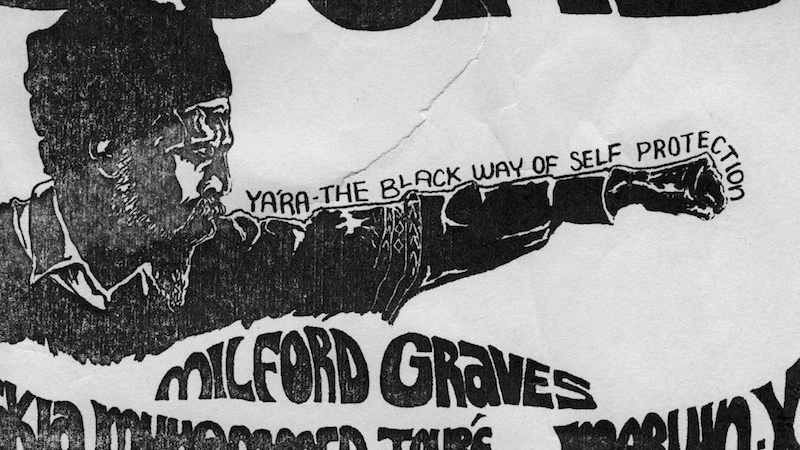
when Mr. Graves moved in he converted it into a dojo, where he practiced
and taughtYara
<https://glasstire.com/wp-content/uploads/2018/03/YARADOJO7.jpg?x31549>,
a martial art of his own creation. Its name is the Yoruba word for
agility, and its practices mixed East Asian traditions with West African
dance, as well as insights from Mr. Graves’s close study of live praying
mantises.
ADVERTISEMENT
Continue reading the main story
<https://www.nytimes.com/2021/02/19/arts/music/milford-graves-dead.html?fbclid=IwAR1285LWFWKbNeEy6N-RmGteBMZKS3bWeQuNtl4ju4cyM9jkiNSZaeaoGk0#after-story-ad-4>
The basement eventually became his laboratory, where he focused on
cardiology, acupuncture and herbalism. He alsoworked
<https://static1.squarespace.com/static/5bbae881d74562ac18fdfcc6/t/5bf246c788251b677dff9931/1542604487511/DR+Katz+doc.pdf>in
a veterinary lab during the 1970s, where he set up and ran clinical
tests to investigate new medicines.
In the house’s garden, he mixed plants from all parts of the world. “I
have a global garden,” he said in the documentary. “My garden’s not like
people. You’ve got all these people of different ethnicities, they all
hang out in their own communities. This don’t work like that. They all
hang out together.”
In addition to his daughter Renita, Mr. Graves is survived by his wife
of more than 60 years, Lois Graves; three other daughters, Kim, Monifa
and Lenne’ Graves; his son, Kevin; and grandchildren.
At the invitation of Bill Dixon, a trumpeter and organizer, Mr. Graves
joined the faculty of theBlack Music Division
<https://curriculum.bennington.edu/spring2019/2018/11/06/black-music-black-music-division-a-retrospective/>at
Bennington College, where hetaught
<https://www.bennington.edu/academics/faculty/milford-graves>for 39
years, traveling to Vermont once a week for classes.
But he also ministered to musicians who traveled from afar to seek him
out and to a devoted following of men living in the neighborhood who
respected him as a community elder. For decades he hosted martial arts
workshops, herbalism clinics and salons that doubled as drum lessons. To
all the participants, he was known simply as Professor.
ADVERTISEMENT
Continue reading the main story
<https://www.nytimes.com/2021/02/19/arts/music/milford-graves-dead.html?fbclid=IwAR1285LWFWKbNeEy6N-RmGteBMZKS3bWeQuNtl4ju4cyM9jkiNSZaeaoGk0#after-story-ad-5>
Mr. Graves often demanded that visitors submit to recording their heart
beats for research purposes. Initially he worked with analog tape
recorders, attaching speakers to people’s chests. After receiving
aGuggenheim fellowship
<https://www.gf.org/fellows/all-fellows/milford-graves/>in 2000, he
bought a full suite of computers and loaded them with the LabView
application, which he programmed to measure and document the wide range
of sonic frequencies created by the human heart.
Image
Mr. Graves in 2018 in his lab at his Queens home. He programmed
computers to measure and document the wide range of sonic frequencies
created by human heart.
Mr. Graves in 2018 in his lab at his Queens home. He programmed
computers to measure and document the wide range of sonic frequencies
created by human heart.Credit...George Etheredge for The New York Times
He then created a kind of electronic music out of the frequencies and
sought to use this music to strengthen the natural heartbeat. In recent
years he developed a partnership with Carlo Ventura, a cardiologist at
the University of Bologna,doing research
<https://static1.squarespace.com/static/5bbae881d74562ac18fdfcc6/t/5bf2471f1ae6cf7a695f6490/1542604576125/Carlo-Milford+Collaboration.pdf>that
demonstrated, they said, that his heart music could be used to stimulate
stem cell growth as well.
Late in life, Mr. Graves began creating sculptural works inspired by his
research into the heart, and he was quickly embraced by the visual art
world. In the months before he died, he was the subject of a far-ranging
and well-receivedretrospective exhibition
<https://icaphila.org/exhibitions/milford-graves-a-mind-body-deal/>at
the Institute of Contemporary Arts in Philadelphia.
In a2009 interview for All About Jazz
<https://www.allaboutjazz.com/milford-graves-time-piece-milford-graves-by-marc-medwin.php>,
Mr. Graves said he had always sought to treat every second of the waking
day as a chance for inquiry.
“Don’t tell me how many years you’ve been doing something,” he said. “I
want to know how completely you’re filling that time, how you’re
spending each nanosecond.”
-=-=-=-=-=-=-=-=-=-=-=-
Groups.io Links: You receive all messages sent to this group.
View/Reply Online (#6536): https://groups.io/g/marxmail/message/6536
Mute This Topic: https://groups.io/mt/80771299/21656
-=-=-
POSTING RULES & NOTES
#1 YOU MUST clip all extraneous text when replying to a message.
#2 This mail-list, like most, is publicly & permanently archived.
#3 Subscribe and post under an alias if #2 is a concern.
-=-=-
Group Owner: [email protected]
Unsubscribe: https://groups.io/g/marxmail/leave/8674936/1316126222/xyzzy
[[email protected]]
-=-=-=-=-=-=-=-=-=-=-=-