HAS HERMES RETURNED?
Roger W. Sinnott
Senior Editor
Sky & Telescope
October 14, 2002

Earlier this month, the Minor Planet Center's electronic
circular 2002-T14 contained this intriguing comment
by Timothy B. Spahr: "The orbital elements above for 2002 SY50
bear a striking resemblance to those of 1937 UB." With those
words, Spahr was suggesting that a newfound object might be
none other than Hermes, the famous asteroid that whizzed by
Earth just before World War II but has eluded astronomers for
65 years.

Shortly after the Hermes flyby of October 1937, the American
Museum of Natural History created a spine-tingling exhibit
for public display. Poised above a model of New York City was
Hermes, represented by a ball the size of Central Park.
Pictures of the scene appeared in many astronomy books of
the day.

For now, the new object is simply being called 2002 SY50. It
was picked up by the LINEAR survey telescope in New Mexico on
September 30th of this year. At about 17th magnitude, it was
moving slowly southwestward through the constellation Cetus
just a few degrees from the variable star Mira. The Minor
Planet Center alerted observers via the Near-Earth Object
Confirmation Page of its Web site, and within a few days more
than 100 astrometric measurements were sent in by amateur
and professional observatories around the world. The center
also identified the object with four positions of a moving
object obtained at Lowell Observatory two weeks earlier as
part of the LONEOS survey.

According to Spahr's calculations, 2002 SY50 is traveling in
an Earth-crossing orbit inclined 9 degrees to the ecliptic
plane. Its revolution period is very nearly 2 years and 3
months. When closest to the Sun, at perihelion, 2002 SY50
is roughly midway between the orbits of Venus and Mercury.
When farthest, at aphelion, it is well out in the main
asteroid belt between the orbits of Mars and Jupiter.

But is this the long-lost Hermes?  Spahr commented that
attempts by him and others had failed, so far, to establish
that 2002 SY50 and Hermes were one and the same. Further
astrometric measurements will be needed to be sure, and this
may take weeks or months. "Both the 1937 and the 2002
observations yield orbits that allow very close approaches
to the earth, Venus and Mars," he added, a situation that
greatly complicates the problem of linking the two objects.

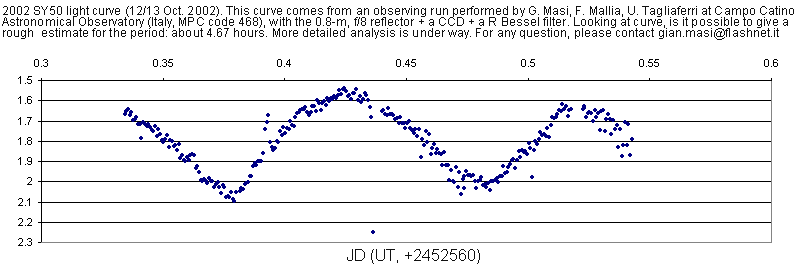
On October 14th, Gianluca Masi told members of the Minor Planet
Mailing List ( http://www.bitnik.com/mp ) that he, Franco
Mallia, and Ugo Tagliaferri have obtained a detailed light curve
of 2002 SY50 at Campo Catino Astronomical Observatory in Italy.
The fluctuations in brightness suggest that the object is
rotating once every 4.67 hours. To view the light curve, visit
http://www.bellatrixobservatory.org/2002sy50.gif .

Later this month, Jean-Luc Margot and his colleagues at Caltech
plan to make highly accurate radar measurements of the object's
range and radial velocity using the large Goldstone radio dish.

During the next two weeks 2002 SY50 is expected to become as
bright as 14th magnitude, putting it within easy reach of
CCD-equipped amateur telescopes. (See the daily ephemeris
below.) As it continues on an inbound trajectory toward the
Sun, 2002 SY50 will pass 13 million kilometers (less than
one-tenth the Sun's distance) from our planet in the first
few days of November.

------------------------------------------------------------
The following ephemeris, adapted from the Minor Planet
Ephemeris Service at http://cfa-www.harvard.edu/iau/mpc.html ,
gives the right ascension and declination of 2002 SY50 at 0h
Universal Time on successive dates. Also listed are its
distance from the Earth (Delta) and Sun (r) in astronomical
units, 1 a.u. being 149,600,000 kilometers. The last two
columns give its predicted visual magnitude and angular
motion on the sky (in arcseconds per minute). To display the
ephemeris properly, your e-mail program should be set to use
a fixed-space font such as Courier.

The Minor Planet Center notes that accurate astrometric
measurements are especially desirable between October 15th
and 27th.

                 Ephemeris of 2002 SY50

 Date     R.A. (2000) Dec.    Delta    r       V     Motion
(0h UT)    h   m      o  '     (au)   (au)           "/min
Oct 15    01 29.1   -02 37    0.227  1.221    15.3    2.74
Oct 16    01 24.8   -03 00    0.216  1.209    15.2    3.03
Oct 17    01 19.9   -03 24    0.205  1.198    15.1    3.36
Oct 18    01 14.5   -03 50    0.194  1.186    15.0    3.73
Oct 19    01 08.5   -04 19    0.184  1.174    14.9    4.15
Oct 20    01 01.8   -04 51    0.173  1.162    14.9    4.64
Oct 21    00 54.2   -05 25    0.163  1.151    14.8    5.20
Oct 22    00 45.7   -06 03    0.154  1.139    14.7    5.86
Oct 23    00 36.1   -06 45    0.144  1.127    14.6    6.62
Oct 24    00 25.2   -07 31    0.135  1.115    14.6    7.50
Oct 25    00 12.7   -08 21    0.126  1.103    14.5    8.52
Oct 26    23 58.5   -09 16    0.118  1.091    14.5    9.69
Oct 27    23 42.2   -10 16    0.111  1.078    14.4   11.02
Oct 28    23 23.5   -11 19    0.104  1.066    14.4   12.49
Oct 29    23 02.3   -12 25    0.097  1.054    14.4   14.05
Oct 30    22 38.4   -13 31    0.092  1.042    14.4   15.62
Oct 31    22 11.7   -14 33    0.088  1.030    14.5   17.05
Nov 01    21 42.7   -15 27    0.085  1.017    14.7   18.17
Nov 02    21 12.0   -16 09    0.084  1.005    14.9   18.80
Nov 03    20 40.6   -16 34    0.084  0.993    15.2   18.83
Nov 04    20 09.6   -16 41    0.085  0.980    15.5   18.25
Nov 05    19 40.0   -16 32    0.088  0.968    15.9   17.17
Nov 06    19 12.5   -16 10    0.092  0.955    16.4   15.77
-----------------------------------------------------------


______________________________________________
Meteorite-list mailing list
[EMAIL PROTECTED]
http://www.pairlist.net/mailman/listinfo/meteorite-list