Eric, List

In order to get the original data, the facts on the
ground and to get as close in time to the event,
but more scientifically sophisticated and prior
to Tunguska being adopted by whackoes and
ufo-theorists, I suggest this exhaustive
summary of the result of the 1961 Soviet
large-scale expedition to Tunguska, from
Meteoritica, XXIII (1963):
http://abob.libs.uga.edu/bobk/tungmet.html
The Lake Cheko paper by Gasperini that suggests
it is a secondary crater:
http://www-th.bo.infn.it/tunguska/GasperiniSvalbard.pdf

Gasperini works with the U. of Bologna group.
The only academic on-going research program
into Tunguska is carried on by the University
of Bologna (Italy). There is a wealth of material
at their website:
http://www-th.bo.infn.it/tunguska/
and I suggest you follow those many links on
their website to dozens and dozens of informative
websites, Gasperini's work at Lake Cheko, many
photos from past expeditions, summaries of past
research -- all you ever wanted to know about
Tunguska but were (not) afraid to ask...

There are links to a variety of material on this
website maintained by the Novosibirsk Computer
Center:
http://omzg.sscc.ru/TUNGUSKA/

particularly the excellent works of Academician Vasilyev
who does an admirable job of giving the pro's and con's
of every theory about Tunguska:
http://omzg.sscc.ru/TUNGUSKA/en/articlese/tmpt.html
and
http://omzg.sscc.ru/TUNGUSKA/en/articlese/vasiljeve.html

They also host this article by Roy Gallant:
http://omzg.sscc.ru/TUNGUSKA/en/articlese/gallantst.html

The natives, the Evenki, believed (half a century ago)
that the events of that day were the result of a duel
between two rival tribal sorcerers and, hey! it's no
crazier than some of the other theories about Tunguska.

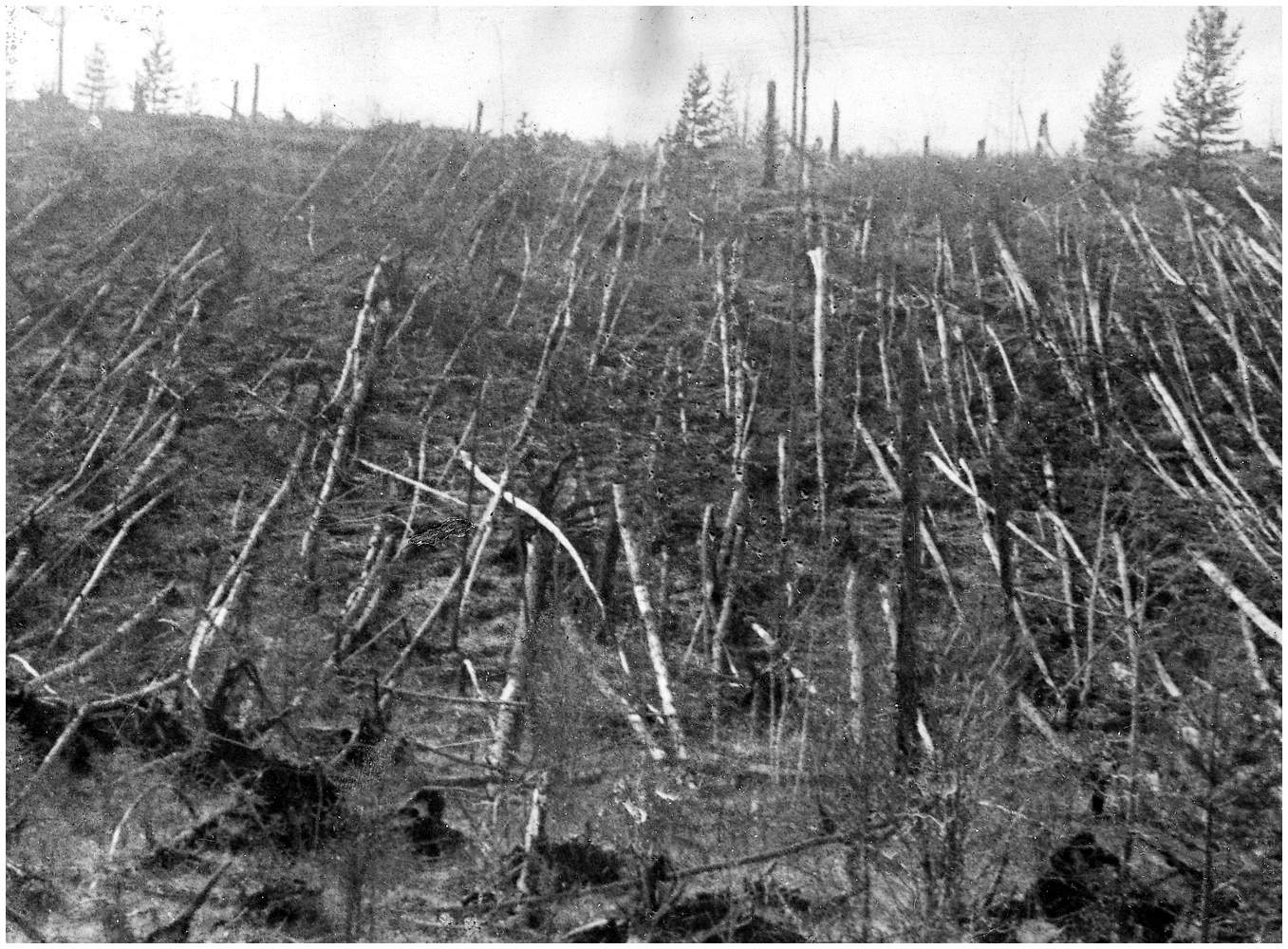
Calculating the actual force of the "impact" is guesstimation.
There's the evidence of the "toothpick forest," flattened by
the explosion, but the answer is sensitively dependent on
just how high the airburst was. The suggested height ranges
from 2400 meters to 9600 meters, producing a calculated
explosion of a minimum of 15 Megatons to a maximum of
40 megatons

Another method is from the trace of the barometric pressure
wave (which passed at least 2-1/2 times around the planet),
recorded by the brand-new invention, the chart-recording
barometer. The initial pulse is consistent with a force of
mid-20-ish megatons, right in the middle of the 15-40
megaton range.

I tried reconstructing the force from the witness accounts
of the light of the flash, in visible light flux at the distant
railway station and in the infrared flux experienced on
the porch at Varavana. A big thermal event has a "black-body"
distribution of energies across the spectrum that varies
with the temperature of the event. I got a 28 megaton event
but with error bars that run from 22 megatons to 34 megatons.

So, all these different methods seem to point to a similar
spread of possible force of the explosion. Yeomans, as a
government scientist, is of course giving the absolutely
minimum figure of 15 megatons so he can't be criticized
for exaggeration or for scaring people. Tunguska is a
magnet for kook theories and it spooks "regular" scientists
to get too close.

   In my calculation, thanks to the Stefan-Bolzmann Law
I could calculate a temperature for the event as well, and
it was a very high temperature, requiring an energetic
plasma event to achieve, which brings us to the Boslough
Theory  of the "Plasma Dragon" of Tunguska:
http://www.sandia.gov/news/resources/releases/2007/asteroid.html

I have a theory too but it's too whacky for the margins of
this email. For more information search the List Archives;
they are rife for ten years with Tunguska postings and
-- for Godsake -- Google! (1,320,000 hits)


Sterling K. Webb
-----------------------------------------------------------------------------------------
----- Original Message -----
From: "Meteorites USA" <[email protected]>
To: <[email protected]>
Sent: Friday, May 15, 2009 11:16 AM
Subject: [meteorite-list] Tunguska Questions
Hi all,

In regard to Tunguska and bioturbation.
Paul H's post on bioturbation brings up an interesting question. The
first expedition led by Leonid Kulik to Tunguska in 1927 to study the
devastation and search for meteorites happened 19 years AFTER the
event in 1908, (He had an earlier expedition in 1921 but wasn't
successful in reaching the epicenter until 1927).
19 years is a LONG time for meteorites in the forested and swampy
environment full of little critters, insects, and plants that could
bury any stones. How deep can meteorites be buried in 19 years of
snow, rain storms, mudslides, spring melt, critters, ants, termites,
and other animals?
Could bioturbation be one cause for the failed attempts to recover
meteorites at Tunguska?
You also have to take into account Leonid Kulik's mindset at the time.
He was thinking that meteorites would be directly beneath the blast at
the epicenter. Which made sense. Would he be looking for meteorites
10-40 miles away from the epicenter? He attributed the circular swampy
bogs to craters formed by the meteorite impacts, which unfortunately
turned out to be incorrect. Did he search for meteorites only under
the epicenter? How far from the epicenter did his search area expand?
Were there other expeditions to Tunguska to search in the 10-40 mile
ring from the epicenter?
Most scientists believe that the sheer force and energy of the blast
at Tunguska event vaporized every trace of the meteoroid explaining
that this is why there are no fragments to be recovered. This
obviously makes sense, but would EVERYTHING be vaporized?
Take a look at the "accepted" theory of Chixulub and the extinction of
the dinosaurs. This widely accepted theory is now being challenged.
Perhaps we should look at Tunguska again, in a new light.
I am just wondering something out loud here about the Tunguska event.
Yesterday I sent a load of links and questions and surprisingly got no
response. Come on, this is the largest meteorite related blast in
recent recorded history. So I'll will ask again.
Is it possible that there are in fact meteorites that survived the
Tunguska event by being blasted away much further from the epicenter
than previously thought?
Below is a copy of my post about some questions I had on Tunguska in
yesterday's post.
-----------------------ORIGINAL POST---------------------

Hi Listees,

Recently there's been more interest in the Tunguska event. More
scientists are trying to explain it, and some are even looking at a
lake
near the blasts epicenter believing that this is the missing crater.
http://news.bbc.co.uk/2/hi/science/nature/6239334.stm

Photo of Lake Cheko:
http://a52.g.akamaitech.net/f/52/827/1d/www.space.com/images/070626_lake_cheko_02.jpg
A witness in Vanovara (36 Miles SE of the epicenter) said in O.
Richard
Norton's "Rocks From Space"

"The crash was followed by noise like stones falling from the sky, or
guns firing."

and

"when I lay on the ground I covered my head because I was afraid that
stones might hit it."

We all know too well that witness reports aren't ideal information but
useful anyway. But, how would this person know to say that there was a
"noise like stones falling" unless that were the case? Or did the
witnesses report become tainted after countless interviews? How many
times was this witness interviewed?

I know people have searched for meteorites under and around the
epicenter area. But what if this was a stony meteoroid, and the
explosion blasted meteorite pieces 30-50 miles away. The devastation
this explosion caused is evidence that it was one hell of a blast and
was on par with a nuclear explosion.

YouTube Video: http://www.youtube.com/watch?v=EiXpp-i442s
Donald Yoemans (JPL) states in the History Channel video that this
blast
was 15 megatons of equivalent energy "roughly 1000 times that of the
Hiroshima blast."

VERY COOL ARTIST RENDERING: http://svidea.us/misha/image/tunguska2.jpg

Photos of Devastation:
http://astro.wsu.edu/worthey/astro/html/im-meteor/tunguska-photo.jpg
http://upload.wikimedia.org/wikipedia/commons/a/ad/Tunguska.png
http://www.wilsonsalmanac.com/images1/tunguska3.jpg
http://www.world-mysteries.com/sci_tu3.gif
Artist Rendering:
http://aura.gaia.com/photos/34/338910/large/tunguska-1.jpg
Area Map: http://www.world-mysteries.com/sci_tunguska1.gif
Blast Damage Area: http://www.world-mysteries.com/sci_tu2.gif
When you factor in all this information, how come people aren't
looking
30-40 miles away for debris from this blast. If it was as powerful as
they say (as evidenced by the downed trees and other devastation)
wouldn't it make perfect sense that area around the blast would be
completely void of meteorites as is the case?

Having said that, wouldn't it be prudent to look further away from the
blasts epicenter for fragments? How far will a blast such as that
throw
debris? If a Navy destroyer can launch a huge shell a hundred miles
using a few pounds of gunpowder, how far can a meteoroid blast such as
this launch stone fragments?

Bomb squad techs and investigators will be the first to tell you that
there's always something left over from a blast no matter how
powerful.
Pieces get thrown sometimes miles from the epicenter of powerful
blast.
In the case of Tunguska this blast was nuclear powerful! Yes a lot of
the mass would have been melted and disintegrated but, how likely is
it
really that the blast would make ALL trace of the meteoroid disappear?

Could there be meteorite pieces within a 30-50 mile ring around the
epicenter?

--
Regards,
Eric Wichman
Meteorites USA
http://www.meteoritesusa.com
904-236-5394
______________________________________________
http://www.meteoritecentral.com
Meteorite-list mailing list
[email protected]
http://six.pairlist.net/mailman/listinfo/meteorite-list
______________________________________________
http://www.meteoritecentral.com
Meteorite-list mailing list
[email protected]
http://six.pairlist.net/mailman/listinfo/meteorite-list