Hi Rob, Thanks...
;) Point taken... Your point about the sungrazers is a perfect example
of what I'm referring to. I was being more general in my question about
comets. Specifically the Kreutz comets couldn't be the first (maybe
first observed), nor the last to be obliterated by the Sun. The term
"smashed into" was not accurate, but artistic license. (I can say that
since I'm not a scientist) ;) Certain freedoms...
1000 years is a long time to humans, but cosmologically speaking it's
not even a blink of an eye. Could we deduce that given the number of
comets (or sungrazers) that have been discovered and observed in the
past, could we apply this number going backwards in time and figure the
number of comets that have been swallowed up by the Sun, or is there
just not enough data?
Congrats on your Kreutz comet discoveries!!! Awesome!
Oh yeah, how big are these comets, and how come we didn't see them
"before" they were gobbled up?
Regards,
Eric


------------------------------------------------------------------------------

On 4/10/2010 12:01 PM, Rob Matson wrote:
Resending from home e-mail:

Hi Eric,
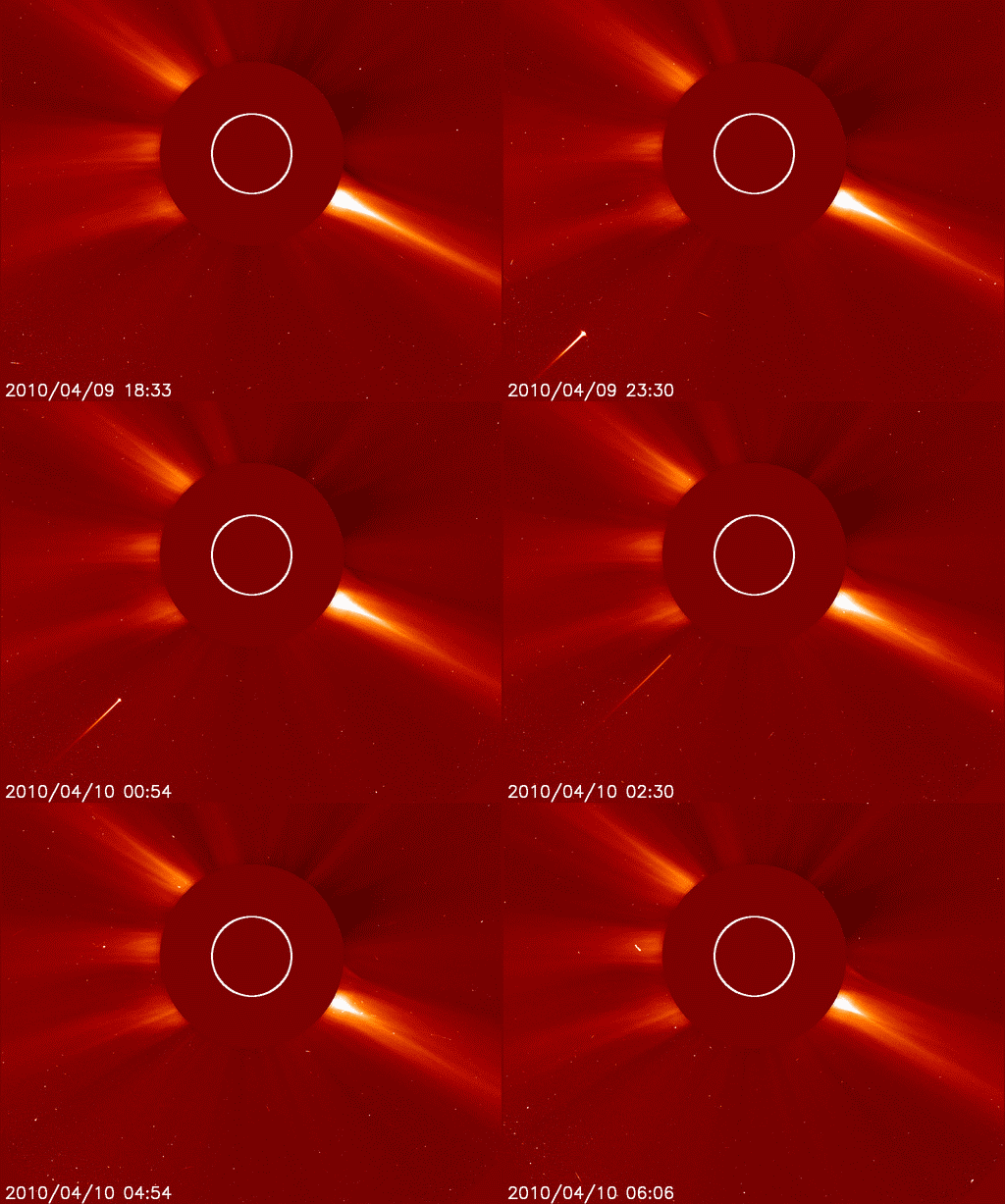
Sun Eats Another Comet
http://spaceweather.com/images2010/09apr10/comet_c2_big2.gif
Question: Is this something new? Or has this been happening since
the beginning of our solar system and we're just now "tuning in"
to the show?
Perhaps the most accurate answer to your question is "neither". ;-)
Kreutz comets are not "new" (e.g. in the sense of having just burst
on the scene in the last few years). But they haven't been around
for millennia either. The Kreutz family of sungrazers have been
putting on their show for almost a thousand years, and include the
Great Comets of 1843 and 1882, as well as Comet Ikeya-Seki in 1965.
They all trace their lineage to a single progenitor comet, which
may have been the Great Comet of 1106. You can read more about the
family here:

<http://en.wikipedia.org/wiki/Kreutz_Sungrazers>

I discovered my first Kreutz comet in 1992 -- SOHO comet #445.
My most recent Kreutz comet was SOHO #1798 (my 84th Kreutz), which
I found in January of this year. So as you can see, SOHO has
discovered over 1300 comets in the last 8 years, most of them
members of the Kreutz family).

Cheers,
Rob

P.S.  Most Kreutz comets do not actually "hit" the sun. Their
perihelion distances are typically around 0.005 a.u. (748,000 km),
which is about 7% more than the sun's radius.

______________________________________________
Visit the Archives at http://www.meteoritecentral.com/mailing-list-archives.html
Meteorite-list mailing list
[email protected]
http://six.pairlist.net/mailman/listinfo/meteorite-list
______________________________________________
Visit the Archives at http://www.meteoritecentral.com/mailing-list-archives.html
Meteorite-list mailing list
[email protected]
http://six.pairlist.net/mailman/listinfo/meteorite-list